
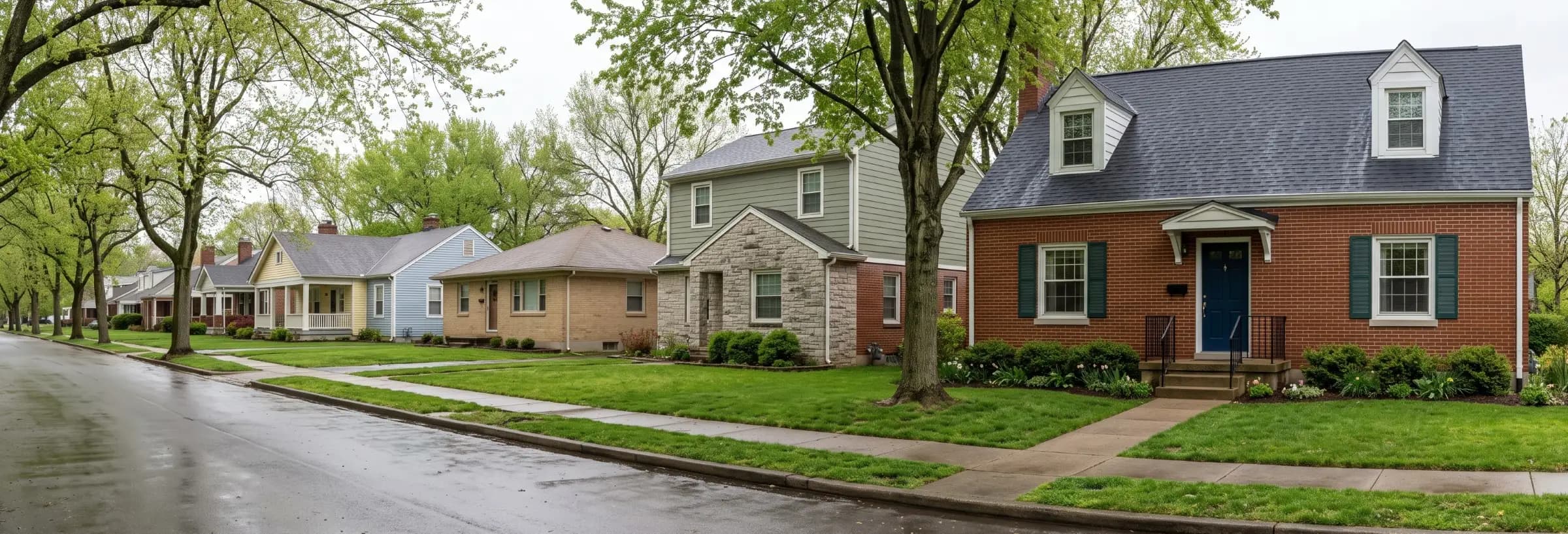

Most Louisville mold jobs follow the same path: find the water source, get a written plan, remove the contamination, and confirm the result with testing. Kentucky requires every mold remediation company to give you that written plan before you sign a contract, so the scope and price are on paper before any work begins.
In Kentucky, mold remediation means the physical removal of mold contamination and water damaged materials, along with correction of the moisture source, to return a structure to normal fungal ecology under ANSI/IICRC S520, the standard that Kentucky's mold remediation regulation, 40 KAR 2:330, is built on. Most Louisville jobs cost $1,000–$7,000, and a Category 3 sewer backup in a basement can reach $20,000 or more.
Older housing, a combined sewer system, and Ohio River and creek flooding mean water intrusion usually decides how large and how costly a Louisville job gets. Acting within 24–48 hours of a leak or backup keeps many jobs in the smaller cost brackets.
Key insights
- Kentucky requires a written plan. Under 40 KAR 2:330, a mold remediation company must give you a written assessment and remediation plan and sign a written contract with you before it starts work.
- Kentucky does not license mold contractors. The Kentucky Attorney General's Office states that no state regulation certifies mold remediation companies, so IICRC credentials, insurance, and references are yours to verify.
- Most Louisville jobs cost $1,000–$7,000. Finished basements, crawl spaces, and Category 3 sewer or river flood water push costs to $5,000–$20,000 or more.
- Sewer backup and river flooding are separate coverage events. A standard homeowners policy typically excludes flood and sewer backup unless you added a water backup endorsement or flood insurance.
- Mold can start growing in 24–48 hours. The EPA says wet materials need to be dried or removed within that window to prevent growth after a flood or backup.
- Louisville renters have statutory habitability rights. Louisville-Jefferson County has adopted the Kentucky Uniform Residential Landlord and Tenant Act, and mold complaints can be filed through Metro311 at (502) 574-5000.
Why Louisville homes get mold
Louisville homes get mold because water enters repeatedly from several directions: heavy rain that overwhelms the combined sewer system, Ohio River and creek flooding, aging foundations and crawl spaces, and humid summers that load air conditioning equipment with condensation. NOAA's 1991–2020 normals for Louisville show about 48 inches of precipitation a year across roughly 125 days of measurable rain or snow.
 Water that rises through a floor drain from a combined sewer is Category 3 under IICRC S500, so porous materials it soaks are discarded rather than dried. The tide line on the block wall marks how high the water reached, which is the level a restoration plan treats as wet.
Jefferson County sits in a low area that MSD flood protection staff describe as shaped like a bowl, and the Ohio River typically floods between January and May. MSD's account of the April 2025 flood reports more than seven inches of rain in five days, an Ohio River crest of 36.63 feet on April 9 that ranked eighth highest in recorded Louisville history, and the activation of all 16 flood pump stations, 65 flood gates, and seven floodwall closures.
| Moisture driver | How water gets in | What it does to a house |
|---|---|---|
| Combined sewer backups | Heavy rain fills sewer lines and pushes water up through basement floor drains, toilets, and laundry standpipes. In August 1992, nearly six inches fell in about three hours and overwhelmed the older combined system. | Category 3 water in basements, wet block walls, and ruined finished space |
| Ohio River flooding | River levels rise through winter and spring, and floodgates close to hold the river out of the city. | Seepage through foundations, standing water in low streets, and slow drying in damp air |
| Creek and flash flooding | Intense storms overwhelm creeks such as Floyds Fork and Beargrass Creek and overload storm drains. | Water in ground floors, crawl spaces, and garages |
| Older housing | Houses from before 1940 have crawl spaces, older plumbing, and aging roofs and foundations. | Chronic dampness under floors and around rim joists |
| Humid summers | Cooling equipment produces condensate that overflows when drains clog. | Mold around air handlers, drain pans, and ductwork |
The seasons differ by source. River flooding concentrates between January and May, while flash flooding and sewer backups follow summer and early fall thunderstorms, and the National Weather Service in Louisville issued a flash flood warning for west central Jefferson County on July 6, 2026, covering Okolona, Newburg, and Pleasure Ridge Park among other areas. Whatever the source, speed matters, because mold gets harder and costlier to remove the longer materials stay wet.
First steps after a flood or backup
In the first 24–48 hours after a Louisville flood or sewer backup, you need to cut power, report the backup to MSD, document the damage, and start removing and drying wet materials, because the EPA notes that mold can begin growing on wet materials within that window. Sewage and river water count as Category 3 contaminated water under IICRC S500, so cleanup differs from a clean water leak.
 Photograph each waterline with date and time stamps before moving or discarding anything, since your insurer sorts the claim by water source, such as sewer backup, river flood, or burst pipe. List every discarded item by name and approximate value to support the claim.
1. Turn off power and avoid standing water
Shut off electricity at the breaker panel only if you can reach it without standing in water, and call the utility or an electrician if the panel is wet. Floodwater and sewage can carry bacteria, and electrical hazards are the most immediate danger in a flooded basement.
2. Report the backup to MSD
Call MSD at (502) 540-6000, which takes calls 24 hours a day, to report a sewer backup and ask what documentation to keep. Keep children, pets, and anyone with a weakened immune system out of any sewage backup area.
3. Document the damage before moving anything
Photograph and video the waterline on each wall, the affected contents, and any visible mold, with date and time stamps. Write down what you discard, because your insurer and any later claim need a record of what was lost.
4. Treat the water as contaminated
Discard porous materials soaked by Category 3 water, including carpet, padding, drywall, insulation, and upholstered furniture, and wear a NIOSH approved respirator, gloves, and eye protection. The EPA's Flood Cleanup to Protect Indoor Air and Your Health describes the protective equipment for a sewage or flood job.
5. Remove wet materials and dry the structure
Cut out and bag wet porous materials, then run commercial dehumidifiers and air movers until moisture meter readings return to normal for each material. Household fans alone rarely dry wall cavities, wood framing, or block walls fast enough to stop growth.
6. Call a restoration company early
Call before mold is visible and ask for the written plan Kentucky requires before any mold remediation work begins. Drying equipment running in the first days costs less than remediation after growth spreads, and the written plan requirement applies once mold remediation is part of the job.
MSD advises getting a floodplain permit from MSD before rebuilding after a flood, so confirm that requirement before any reconstruction starts. Persistent mold after water damage usually means a wall cavity or subfloor stayed wet, which calls for a moisture assessment rather than a coat of paint.
Where mold hides in Louisville homes
Mold in Louisville homes most often shows up in unfinished and finished basements, crawl spaces under older frame houses, attics after storm roof damage, and around air conditioning equipment. Each location has a distinct moisture source, and that source determines whether a plumber, waterproofer, roofer, or HVAC technician has to act before remediation begins.
 Growth on the joists and subfloor shows where moisture has lingered longest, and sagging insulation holds that dampness against the wood. Find the source, whether a torn vapor barrier or a leaking pipe, and have it fixed before cleanup, or the mold will return.
Under the EPA's threshold, a patch under about 10 square feet on a cleanable surface can be a homeowner job, but past that size, when mold remediation is required depends on the material, the moisture source, and who lives in the home. Anything caused by sewage or river water, or located inside an HVAC system, goes to a professional regardless of size.
| Location | Typical cause | What to look for | DIY or pro |
|---|---|---|---|
| Unfinished basement block walls | Wall seepage and backup through floor drains | Dark or white growth near the floor line and a damp odor | DIY only for small surface patches; pro after sewage |
| Finished basement drywall and carpet | Backup or wall seepage hidden behind finishes | Staining at baseboards, bubbling paint, and a musty smell | Pro |
| Crawl space under older frame houses | Ground moisture, open vents in humid months, and plumbing leaks | Fuzzy growth on joists and subfloor, and cupped flooring above | Pro |
| Attic sheathing | Storm damaged roofing and bathroom fans venting into the attic | Dark patches on plywood and rusted nail tips | Pro above 10 square feet |
| HVAC air handler, drain pan, and ducts | Clogged condensate drain in cooling season | Musty odor at startup and water near the unit | Pro |
| Walls behind kitchen and bath plumbing | Slow leaks inside older supply and drain lines | Soft drywall, stains, and recurring odor | Pro if inside the wall cavity |
| Window sills and frames | Winter condensation | Black speckling on sills and frames | DIY |
Finished basements hide moisture because drywall, carpet, and insulation cover the floor line, where it usually starts. Louisville basements take on water from the ground and through sewer backups, so a wall that looks dry can still hold wet insulation behind it.
Mold remediation cost in Louisville
Mold remediation in Louisville typically costs $1,000–$7,000 for most residential jobs, with small single room jobs near the bottom and basements, crawl spaces, and Category 3 sewer backups reaching $5,000–$20,000 or more. Price depends on the affected area, the materials that must be removed, the containment level, and whether a plumber, roofer, or waterproofer must fix the moisture source first.
 Hauling and disposing of discarded drywall, carpet, and padding is part of the demolition scope, which is why a finished basement often costs more than the mold treatment itself. Ask whether a bid includes disposal fees, since some quotes list them separately.
National mold remediation cost averages $1,500–$6,000, and sewage and flood scopes in Louisville push the upper end higher. Contained removal work generally prices at $10–$25 per square foot, and small jobs carry a minimum charge.
| Scenario | Typical cost | What drives the price |
|---|---|---|
| Small contained patch under 10 square feet | $300–$800 | Minimum service charge, protective equipment, and moisture check |
| Single room, 10–100 square feet of drywall or trim | $1,000–$3,500 | Containment, material removal, and HEPA cleaning |
| Unfinished basement with block walls and joists | $2,500–$7,000 | Wall and joist cleaning, air scrubbers, and drying equipment |
| Finished basement with drywall removal | $4,000–$12,000 | Demolition of drywall, insulation, and carpet, plus disposal |
| Crawl space under an older frame house | $1,500–$6,000 | Low access labor, insulation removal, and vapor barrier work priced separately |
| Attic after a roof leak | $1,500–$6,000 | Sheathing treatment, insulation removal, and roof repair coordination |
| HVAC system and ductwork | $1,500–$5,000 | Component cleaning, duct replacement, and clearance testing |
| Category 3 sewer backup or river flood, full basement | $5,000–$20,000+ | Discarded porous materials, antimicrobial treatment, and extended drying |
Demolition scope and containment are the largest cost drivers. Removing and replacing finished basement drywall, insulation, and carpet adds more than the mold treatment itself. Category 3 water raises the scope further because contaminated porous materials are discarded, and drying is billed separately from remediation.
Inspection adds $300–$1,000 and independent clearance testing adds $250–$1,000, depending on home size and the number of samples. Rebuilding after remediation, such as drywall, flooring, and trim, is priced separately and often exceeds the remediation itself in a finished basement.
Mold remediation timeline in Louisville
Active work on a Louisville mold job usually takes 1–7 days, and the full calendar time runs longer because drying and clearance testing come afterward. Demolition scope, water category, and a leak or drain that still needs fixing decide where a job lands.
 Structural drying typically runs three to five days, with moisture readings taken daily until materials reach their dry standard. Mold cleanup should not begin until the structure is dry, since remediating a wet building lets growth return.
Kentucky's rules add steps before the work starts, including the written plan, signed forms, and a written contract, so the timeline begins with the assessment rather than with demolition. Independent verification comes after cleanup and adds the 24–72 hours that labs commonly take to return results.
| Job type | Active work | Drying and testing | Typical total |
|---|---|---|---|
| One room with limited containment | 1–2 days | 1–3 days for lab results | 2–5 days |
| Crawl space under an older frame house | 2–4 days | 1–3 days for lab results | 3–7 days |
| Attic after a roof leak | 2–4 days | 1–3 days for lab results | 3–7 days |
| Finished basement after clean water | 3–5 days | 2–5 days of drying plus lab results | 1–2 weeks |
| Basement after a sewer backup or river flood | 4–7 days | 3–7 days of drying plus lab results | 1–3 weeks |
Rebuilding is priced and scheduled separately. Replacing drywall, flooring, and finishes after clearance can add days to weeks, and a flood job may also need a floodplain permit from MSD before reconstruction begins.
What Kentucky requires of contractors
Kentucky requires every mold remediation company to give you a written plan and a written contract before work starts. The Kentucky Department of Law adopted these standards under KRS 367.83801 through 367.83807 and 40 KAR 2:330, in effect since December 2012 and based on the five principles of ANSI/IICRC S520: safety and health, project documentation, contaminant control, contaminant removal, and contamination prevention.
 Under 40 KAR 2:330, a mold remediation contractor must provide a written remediation plan and contract, and any change in scope has to go into a written change order. Keep copies of every document, since the contractor must retain its own records for three years.
The requirements apply to the company doing the work, not to the homeowner, so you can check each one against the paperwork you receive. A company that cannot produce the documents before you sign is out of compliance with the regulation. Because no state regulation certifies mold remediation companies, the written plan and your own credential checks are the main safeguards.
Health information and vacate notice
Before contracting, the company must give you the EPA's A Brief Guide to Mold, Moisture, and Your Home and tell you in writing which areas to vacate and the estimated duration of the work. It must also tell you to keep tenants and occupants out of containment and work areas.
Forms MRC-1 and MRC-2
The company must give you the forms titled "Read This About Mold Before You Sign A Contract" and "Read This About Indoor Environmental Professionals Before You Sign A Contract," and it must keep copies bearing your dated signature before any contract for assessment or remediation.
Written assessment and remediation plan
Before the contract, the company must provide a plan stating the scope of work with areas, tasks, and a price estimate, an assessment of the moisture source, the extent of the mold, the containment and removal techniques, and how the post remediation evaluation will be done. That plan becomes part of the contract.
Containment and protection decisions
The company must tell you in writing whether it plans full or limited containment and negative pressure, or explain in writing why it will use no containment. Workers must wear a NIOSH approved respirator, gloves, and goggles when mold is disturbed.
Form MRC-3 notice of moisture problem
If the moisture source is unidentified, cannot be determined, or you choose to proceed without fixing it, the company cannot start until you sign and date the notice. A signed notice means mold can return, so fix the source first whenever you can.
Written contract and change orders
Work cannot begin without a written contract that incorporates the plan. Additional paid work or a material departure from the plan requires a written, signed change order before the company performs it.
Independent verification
If verification sampling is part of the job, an independent indoor environmental professional paid directly by you must perform it and report directly to you, which keeps the company that did the cleanup from grading its own work. Clearance results are judged against normal fungal ecology as defined in ANSI/IICRC S520.
Post remediation report and records
At the end, the company must give you a written report stating whether visible mold, damaged materials, and debris were removed, whether odors are gone, whether surfaces are free of dust, what unexpected conditions arose, and whether salvaged materials were dried. The company must keep these documents for at least three years.
How to hire a mold remediation company
To choose a mold remediation company in Louisville, verify its credentials, collect the written plan from at least two companies, and compare scope line by line rather than by total price. Because Kentucky issues no state mold license, the credentials you check are IICRC certification, insurance, and any local or state trade licenses that apply to the work.
 A reliable bid comes after an on-site inspection, so be wary of any company that quotes a firm price over the phone without seeing the damage. Get at least three written estimates and compare the scope of work line by line, not just the total.
Kentucky does not issue a statewide general contractor license, and Louisville Metro handles contractor registration locally through the Department of Codes and Regulations. The Kentucky Department of Housing, Buildings and Construction licenses HVAC, plumbing, and electrical work statewide, which matters when mold work involves ductwork, drain lines, or wiring.
| Credential | What it shows | How to verify |
|---|---|---|
| IICRC Certified Firm | The company follows IICRC standards and maintains certified technicians | IICRC Global Locator |
| IICRC AMRT | A technician trained in applied microbial remediation | Ask for the certificate and confirm with IICRC |
| ACAC CIEC or CMI | An independent assessor qualified to inspect and write sampling plans | ACAC certificant directory |
| General liability and pollution liability insurance | Coverage for property damage and contamination caused by the work | Certificate sent directly by the insurer |
| Louisville Metro contractor registration | Local registration for rebuild and construction work | Department of Codes and Regulations |
| State HVAC, plumbing, or electrical license | Authorization to perform that trade work in Kentucky | Kentucky Department of Housing, Buildings and Construction |
| Written plan under 40 KAR 2:330 | Compliance with Kentucky's minimum remediation standards | The signed plan and Forms MRC-1 and MRC-2 in your hands |
Technician and assessor credentials differ in what they prove, and the available mold remediation certifications include IICRC's AMRT for remediators and ACAC's CIEC and CMI for independent assessors. A company that offers only a training certificate with no IICRC firm status or insurance certificate has not shown the qualifications that matter.
Compare bids on the same containment level, disposal, drying equipment, and clearance testing terms, since a low total often omits demolition or verification. Ask each company who will correct the moisture source, because the written plan must address it.
Red flags when hiring a mold company
The main red flags when hiring a Louisville mold company are no signed forms or written plan, a company grading its own clearance testing, a claimed state mold license, large deposits with pressure to sign, and promises that mold will never return. Kentucky's rules give you a checklist, and a company that skips it is unlikely to follow the plan either.
 Breaking apart moldy drywall without gloves, a respirator, or plastic containment releases spores that settle through the rest of the home. Ask any company how it will seal off the work area and what respiratory protection the crew wears before you sign.
After a flood, homeowners want the problem gone fast, and that is when pressure tactics work best. Check the company against each red flag even when the house is a mess.
No signed forms or written plan
A company that cannot hand you Forms MRC-1 and MRC-2 and a written plan before you sign is out of step with 40 KAR 2:330. Verbal promises and one line estimates do not meet that standard.
The same company testing and clearing
If the company that cleans the mold also grades its own work, nobody independent has checked the result. Kentucky requires verification sampling to be done by an independent professional who is paid by you.
Claims of a state mold license
Kentucky does not license or certify mold remediation companies, according to the Kentucky Attorney General. A company advertising a state mold license is either confused or misleading you, so ask what credential it means and verify it with the issuer.
Large deposits and pressure to sign
A request for most of the price up front, or a deadline to sign today, is a warning sign. The written contract and plan should be in your hands first, and any added work needs a signed change order.
Unrequested visits after a flood or storm
Contractors who knock on doors after a flood may be unfamiliar with Kentucky's requirements. Check the company's address, reviews, and references before letting anyone into the house.
Promises that mold will never return
No company can guarantee that, because recurrence depends on the moisture source. Ask for the written warranty terms and what voids them, since a warranty usually excludes new water intrusion.
If a company does not follow the regulation, keep your forms, plan, change orders, and photographs and file a complaint with the Attorney General's Office of Consumer Protection. For emergency mold removal within a day, ask whether the company can start containment and drying immediately and whether it will still provide the written plan, because speed does not waive those requirements.
Mold inspection and clearance testing
A mold inspection in Louisville documents visible growth, maps moisture with a meter and thermal camera, and may include air or surface sampling, and it should be performed by someone other than the company that will do the cleanup. Clearance testing after remediation confirms the area has returned to normal fungal ecology, and under Kentucky's regulation it must be done by an independent indoor environmental professional paid by you if verification sampling is part of the job.
 Clearance sampling should come from an independent tester rather than the company that did the cleanup, so the result is not self-graded. Kentucky's rules call for independent verification paid for by the customer, which is why the testing fee is separate from the remediation bid.
An inspection before remediation sets the scope that bids are priced against, so a company bidding without seeing the moisture source is guessing at the price. Inspectors who also sell remediation have a conflict of interest, since their findings determine their own revenue.
| Service | Typical cost | What it includes |
|---|---|---|
| Visual inspection with moisture survey | $300–$600 | Walkthrough, moisture meter and thermal camera readings, and a written summary |
| Full inspection with sampling and report | $400–$1,000 | The survey plus air or surface samples, lab fees, and a written report |
| Air sample | $75–$150 each | One sample, usually paired with an outdoor control sample for comparison |
| Surface or tape sample | $50–$100 each | Identifies what the growth is on a specific surface |
| Clearance testing after remediation | $250–$1,000 | Independent sampling to confirm the area meets the plan, priced by the size of the work area |
Louisville mold inspection cost rises with home size, the number of samples, and rush lab turnaround, and a large finished basement costs more to assess than a single room. Ask whether the lab fee is included before you compare quotes, since some inspectors list it separately.
Clearance sampling compares post work samples against outdoor and unaffected indoor conditions, and lab results typically return in 24–72 hours. If the area fails clearance, the contract should say who pays to clean it again, so confirm that term before you sign.
Common mold types in Louisville homes
The mold in a Louisville home depends on how the material got wet and how long it stayed that way. Light, repeated moisture such as condensation favors Cladosporium and Alternaria, while materials soaked for days by a backup or river water favor Penicillium, Aspergillus, and eventually Stachybotrys.
 Cladosporium is one of the most common indoor molds and often colonizes window sills, frames, and other surfaces kept damp by condensation. Color alone cannot identify a species, so only a lab test can confirm which mold is growing.
The EPA says you cannot tell a mold's type or health effects by its color, and it recommends removing any indoor growth. Naming the species through mold testing rarely changes the cleanup plan, so the water event behind the growth is the more useful clue.
| Mold group | Where it shows up | What it points to |
|---|---|---|
| Cladosporium | Attic sheathing after storm roof damage, air handlers in cooling season, and window sills | Humidity or condensation, and it is common outdoors as well |
| Alternaria | Around showers, sinks, and window sills in older homes | Surfaces that stay damp for long stretches |
| Penicillium | Drywall, carpet, and insulation after a pipe leak or basement seepage | A recent or repeated water event |
| Aspergillus | Basement block walls, dust, and air handlers | A broad group, so a lab result is needed to name the species |
| Stachybotrys | Drywall paper and wood left wet for weeks after a sewer backup or river flood | An unresolved flood or backup, which calls for a professional assessment |
After a sewer backup or river flood, symptoms can come from bacteria and other contaminants in the water as well as from mold, so a doctor is the right person to sort out the cause. Sensitive household members, including infants, older adults, and people with asthma, are the ones to move out of the area first.
Does insurance cover mold in Louisville?
Homeowners insurance covers mold in Louisville only when the mold results from a covered sudden event such as a burst pipe or a storm damaged roof, and it typically excludes flood, sewer backup without an endorsement, and chronic moisture. Many policies also cap mold payouts with a sublimit, so a policy's mold limit can fall below the cost of a large basement job.
 Ring marks from repeated wetting point to a long-term leak, and most homeowners policies exclude damage from seepage that continues over weeks or months. Mold that follows a sudden covered event, such as a burst pipe, is far more likely to be covered.
Louisville's main water risks fall into separate coverage categories: sewer backup needs a water backup endorsement, Ohio River and creek flooding needs flood insurance, and roof or plumbing failures fall under the standard policy. Whether homeowners insurance covers mold in a given loss depends on which category the water came from, so document the source in the first hours.
| Water source | Standard policy | What usually applies |
|---|---|---|
| Sudden pipe burst or appliance failure | Often covered | Mold treatment may fall under a sublimit |
| Sewer or drain backup | Excluded unless endorsed | A water backup endorsement added to the policy |
| Ohio River or creek flooding | Excluded | National Flood Insurance Program or private flood coverage |
| Storm damage that opens the roof | Often covered | Sudden damage counts, while gradual leaks do not |
| Chronic humidity, seepage, or deferred maintenance | Usually excluded | Out of pocket, which makes early repair cheaper |
National Flood Insurance Program policies typically take effect 30 days after purchase, so coverage bought after a flood forecast will not pay for that event. The National Association of Insurance Commissioners publishes a consumer explanation of homeowners coverage, exclusions, and endorsements that helps you read a policy's water backup and mold terms.
Mold in Louisville rental homes
Louisville renters have a statutory right to a habitable home because Louisville-Jefferson County has adopted the Kentucky Uniform Residential Landlord and Tenant Act, and mold caused by leaks or poor ventilation falls within the landlord's duty to keep the unit fit under KRS 383.595. The remedy starts with written notice to the landlord, which creates the record that every later step depends on.
 Document mold in a rental with dated photos and report it to the landlord in writing, since written notice is what formally starts the repair clock under Kentucky's tenant law. Persistent bathroom moisture often points to poor ventilation or a leak, and both are typically the landlord's responsibility to fix.
Report mold conditions to Louisville Metro Codes and Regulations through Metro311 at 311 or (502) 574-5000. The department's Property Maintenance Code Enforcement program lists interior surfaces damaged or contaminated by mold or mildew among the most common violations its officers find.
Inspection results and violation notices strengthen a written complaint, though enforcement can take time. The Kentucky Attorney General's Office cannot force a landlord to remediate mold, and tenants outside URLTA jurisdictions have fewer statutory remedies.
A tenant with documented mold and a filed complaint can send a written demand for repair backed by the inspection record, using the mold rights for renters that URLTA provides. KRS 383.705 bars retaliation against a tenant who exercises these rights.
Buying or selling a home with mold
Kentucky sellers must disclose mold on the Seller's Disclosure of Property Condition when a licensed real estate agent is involved and paid, because the form required under KRS 324.360 asks about the existence of mold or other fungi. The Kentucky Real Estate Commission's Seller's Disclosure of Property Condition is Form 402, and buyers in Louisville should read its answers against the home's flood and backup history, since the form reports only what the seller knows.
Sellers who know of past basement backups, river flooding, or earlier remediation should list them and keep the remediation paperwork, which shows that the work followed Kentucky's written plan requirement. A clearance report attached to the disclosure is the strongest evidence that the problem was fixed.
A seller who knows about mold and stays silent risks a fraud or misrepresentation claim after closing. The duty to disclose mold when selling a house turns on what the seller actually knew.
Neighborhood mold risk in Louisville
Mold risk in Louisville varies by neighborhood because housing age and water exposure differ: older shotgun and masonry districts near the river carry crawl space and backup risk, while mid century neighborhoods in the south and southwest face flash flooding and sewer backups. Based on American Community Survey estimates, about 14% of Louisville's housing was built before 1940 and another 35% between 1940 and 1969.
 Mold risk varies block by block with elevation, drainage, and the age of the housing, and older homes in low-lying areas near combined sewer lines see the most repeat water exposure. A property's flood and sewer backup history tells you more than its neighborhood name does.
Louisville has the largest collection of shotgun houses of any American city, most built between 1890 and 1915 and concentrated in Portland, Germantown, Schnitzelburg, the Highlands, Russell, California, and Butchertown. These houses are 12–15 feet wide and three rooms deep with no hallways, and many sit over shallow crawl spaces, so a damp crawl space mold problem can reach every room.
| Area | Housing | Main moisture driver | Homeowner note |
|---|---|---|---|
| Butchertown, Clifton, and the Mellwood corridor | Shotgun cottages and older brick | Beargrass Creek and Ohio River flooding, including homes on Mellwood Avenue partly submerged in April 2025 | Check flood zone status before buying |
| Germantown, Schnitzelburg, and the Highlands | Shotgun and camelback houses from 1890–1915 | Older plumbing, crawl spaces, and sewer backups | Inspect the crawl space and main sewer line |
| Portland, Russell, and California | Frame shotgun cottages near the river | Ohio River floodwall zone and low ground | Ask about prior flood and backup history |
| Old Louisville | Large masonry houses and older apartment buildings | Roof, plumbing, and rain intrusion in older envelopes | Fix leaks promptly in multi story buildings |
| South Louisville, Okolona, and Pleasure Ridge Park | Mid century ranches and brick homes | Flash flooding and sewer backups | Install a backwater valve and test the sump pump |
| Fern Creek and the Floyds Fork corridor | Later suburban homes | Creek overflow, as at Broad Run Park in April 2025 | Review the floodplain map before rebuilding |
Neighborhood patterns show where to look first, but each home's drainage, roof, plumbing, and maintenance decide its actual risk. A home in a lower risk area with a failed condensate drain or an unflashed roof can have a larger problem than a flood corridor home with a working backwater valve.
How to prevent mold in Louisville
Louisville's two main failures are sewer backups through basement drains and damp foundations during river and storm season, so the highest value mold prevention work targets those first. Beyond water control, hold indoor relative humidity between 30% and 50%, the range the EPA gives as the target for mold control, and never above 60%.
 Extend downspouts at least four to six feet from the foundation and keep the soil sloping away from the wall. Water that pools against a foundation is one of the main ways moisture reaches basements and crawl spaces.
MSD's Plumbing Modification Program, which paid licensed plumbers to install backflow prevention devices for more than 17,000 customers, has been described by MSD staff as ended, so call MSD at (502) 540-6000 to ask what help exists now. Connecting a basement sump pump to the sewer system is illegal, and MSD's Private Property Illicit Discharge Program has offered to pay a limited amount toward disconnecting them.
| Action | Frequency | Why it works |
|---|---|---|
| Install a backwater valve on the main sewer line using a licensed plumber | Install once and inspect yearly | Closes the line when sewer water surges, which stops backups through basement floor drains |
| Test the sump pump and battery backup | Quarterly and before spring river season | A pump that fails during a storm leaves the basement without protection |
| Discharge sump pumps and downspouts outdoors, away from the foundation | Check each season | Moves rain water away from walls and keeps clear water out of the sewer |
| Run a dehumidifier in the basement with a hygrometer | April through October | Holds humidity below the level that supports mold growth |
| Clear and flush the HVAC condensate drain | Every spring | Prevents overflow into the air handler and surrounding framing |
| Check the crawl space vapor barrier and look for standing water | Twice a year | Limits ground moisture rising into joists and subfloor |
| Inspect the roof and attic after severe storms | After each storm | Finds openings before water reaches insulation and sheathing |
A hygrometer in the basement, checked weekly through summer, gives early warning, and a reading above 50% is the cue to run a dehumidifier before growth starts. Musty odors, new stains, and bubbling paint are early signs of mold that often appear before growth is visible, so look for them whenever you read the hygrometer. Keep a record of the readings, since a log shows a contractor or insurer how the basement behaved before a loss.
Frequently asked questions
Who handles complaints about a mold remediation company in Louisville?
The Kentucky Attorney General's Office of Consumer Protection handles them. KRS 367.83805 directs customer complaints about mold remediation companies to the Attorney General, and the office takes complaints through its consumer complaint process. Keep your signed forms, the written plan, change orders, and the post remediation report, since those documents show whether the company followed 40 KAR 2:330.
How long does mold remediation take in Louisville?
Most jobs take 1–7 days of active work, plus 24–72 hours for lab results on clearance testing. Small single room jobs finish at the short end, while basements with demolition, Category 3 water, or HVAC work run longer, and drying time and any rebuilding extend the calendar further.
Can you stay home during mold remediation in Louisville?
Sometimes. Under 40 KAR 2:330 the company must tell you in writing which areas to vacate and how long the work will take, and a small job in one contained room may allow you to stay elsewhere in the home. Sewage jobs, HVAC work, and households with infants, older adults, or people with asthma or weakened immune systems are better handled by leaving.
Can I remove mold myself in Louisville?
Yes, for a small area. The EPA threshold is about 10 square feet on a cleanable, nonporous surface, and sewage, flood water, HVAC systems, and porous materials such as soaked drywall need a professional. Small patches on tile, glass, or sealed surfaces are the realistic DIY mold removal jobs, and they need detergent, a respirator, gloves, and drying until the surface stays dry.
Do I need a permit to rebuild after a flood in Louisville?
Possibly. MSD advises getting a floodplain permit from MSD before rebuilding after a flood, and structural, electrical, or HVAC work may need permits through Louisville Metro Codes and Regulations. Ask your contractor to list every required permit in the written plan or contract.
Can mold come back after remediation in Louisville?
Yes, if the moisture source stays active. Kentucky's written plan must assess the moisture source, and a company that proceeds without a fix must first get a signed Form MRC-3 notice from you. Repair the leak, drain, or grading problem before cleanup and keep basement humidity below 50% afterward.
Is black mold in a Louisville basement more dangerous than other mold?
Not by color alone. The EPA says you cannot tell a mold's type or health effects by its color, and any mold growth should be removed regardless of species. Dark growth on basement walls after repeated flooding or sewage exposure still deserves a professional assessment because it signals sustained moisture.
How much does a mold inspection cost in Louisville?
Most Louisville mold inspections cost about $300–$1,000, depending on home size and how many samples are taken. A visual inspection with a moisture survey sits at the low end, air or surface samples add roughly $50–$150 each, and clearance testing after remediation is billed separately.
What is the difference between mold removal and mold remediation in Louisville?
Mold removal usually means taking out visible growth, while mold remediation also means fixing the moisture source and confirming the result. In Kentucky, remediation is the removal of mold contamination and water damaged materials plus correction of the moisture source, to return a structure to normal fungal ecology under ANSI/IICRC S520.
How much does mold remediation cost in Louisville?
Most Louisville mold remediation jobs cost $1,000–$7,000, with small contained patches starting near $300. Category 3 sewer or river flood jobs in full basements can reach $5,000–$20,000 or more, because demolition scope and water category drive the price more than the mold itself.
Do mold contractors need a license in Kentucky?
No. The Kentucky Attorney General's Office states that no state regulation certifies mold remediation companies, but 40 KAR 2:330 sets minimum standards that every company must follow, including a written plan and a written contract. Verify IICRC credentials, insurance, and references yourself.
- IICRC S520: Standard for Professional Mold Remediation
- EPA: Flood Cleanup to Protect Indoor Air and Your Health
- Kentucky Administrative Regulations: 40 KAR 2:330, Mold Remediation
- Kentucky Attorney General: Mold Remediation
- Louisville MSD: Historic Flooding in April Recap
- National Weather Service Louisville: 1991–2020 Climate Normals
- Louisville Metro: Property Maintenance Code Enforcement
- Kentucky Real Estate Commission: Seller's Disclosure of Property Condition
- NAIC: A Consumer's Guide to Home Insurance
Sam Hickerson is the founder of RestoreAdvisor and writes consumer guides on mold remediation, water damage restoration, inspection, testing, and home recovery. His work focuses on helping homeowners understand costs, risks, and when to call a professional. He draws on guidance from the EPA, CDC, IICRC, and other authoritative sources to make complex home issues easier to navigate.