
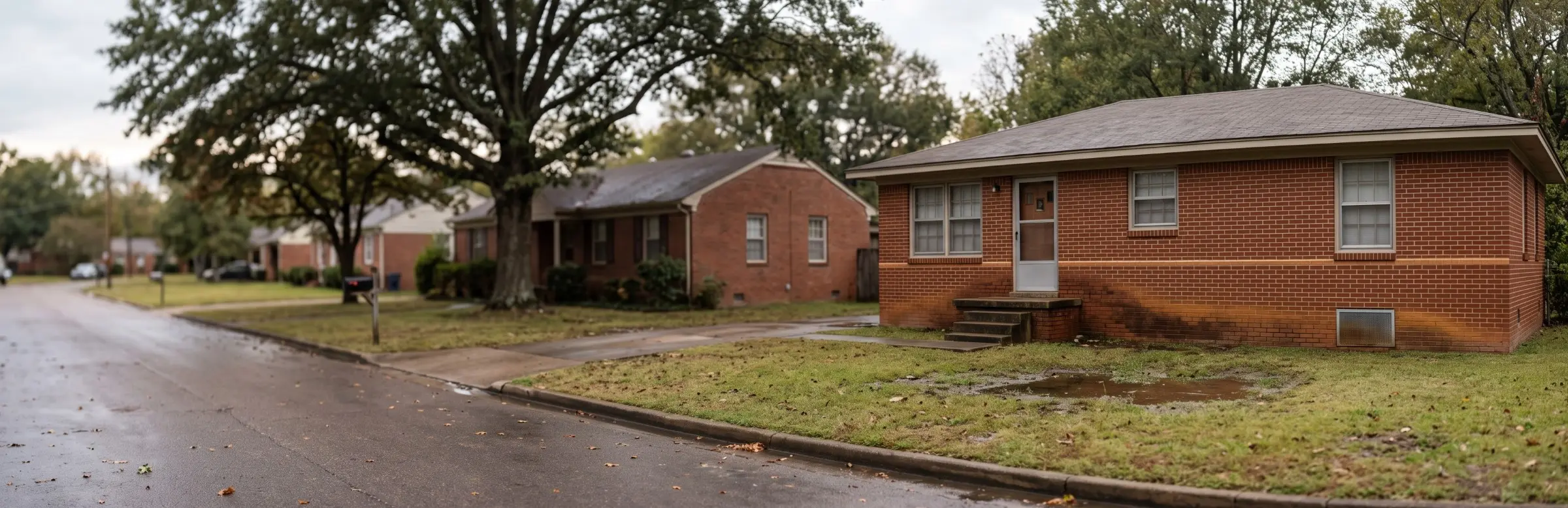

If you have found mold in a Memphis home, you probably want two answers first: what the work will cost and who is qualified to do it. Local contractors quote $1,500–$5,000 for most residential jobs, with crawl space, flood, and sewage cases running higher, and Tennessee licenses contractors by project dollar value rather than by mold work alone, which changes how you verify who you hire.
In Memphis, mold remediation is the containment, removal, and drying work that returns a home to normal fungal conditions, performed under the ANSI/IICRC S520 Standard for Professional Mold Remediation, with the EPA threshold of 10 square feet as the usual line between homeowner cleanup and professional work. Three local conditions shape most Memphis jobs: about 55 inches of rain a year, Mississippi River tributaries that flood in a heavy storm, and crawl space foundations that are common in older neighborhoods.
Key insights
- Typical cost. Most Memphis residential mold remediation jobs cost $1,500–$5,000, while crawl space, flood, and sewage cases can reach $15,000–$25,000 or more.
- Licensing. Tennessee has no standalone mold license, a TDCI contractor license is required at $25,000 or more, and a Home Improvement license is required in Shelby County for residential projects of $3,000–$24,999.
- Flood timeline. EPA says mold can grow on wood, drywall, carpet, and furniture that stay wet for more than 24 hours, and the Wolf River, Nonconnah Creek, and Mississippi River backwater have all flooded Memphis homes.
- Sewer backups. Memphis homeowners own the sewer line between the house and the street connection, so a plumber's camera inspection should come before any assumption that the city is responsible.
- Renters. Tennessee's Uniform Residential Landlord and Tenant Act applies in Shelby County, and about 55% of Memphis households rent.
- Verification. Independent clearance testing under IICRC S520 is the proof that a remediation worked, and Tennessee does not require the inspector and remediator to be separate companies.
Why Memphis homes grow mold
Memphis homes grow mold because about 55 inches of annual rain, hot humid summers, and older foundations keep building materials damp for long stretches. Three moisture sources account for most local jobs: crawl space dampness, air conditioner condensation, and water entering after storms or flooding.
 Wood framing with a moisture reading above 19% is the IICRC S520 warning level for mold growth, so a meter reading on crawl space joists in July shows whether the space needs a vapor barrier or dehumidifier before mold starts.
Many older homes in Midtown, East Memphis, and Germantown sit on vented crawl spaces, which pull humid outdoor air against cooler floor framing in summer. When that moisture condenses on joists and subfloor sheathing, crawl space mold can develop for months before anyone sees it, and a musty odor often reaches the living area first.
National Weather Service normals for Memphis show 5–6 inches of rain in each month from March through May and a July average high near 92°F. The wettest months run right into the start of the cooling season, and air conditioners that run for months can overflow clogged condensate drains or sweat on poorly insulated ducts.
Winter adds a less common fourth source. During the January 25–31, 2026 winter storm, Action News 5 reported that MLGW responded to about 50 water main breaks and called bursting pipes its main concern. A split pipe inside a wall can wet insulation and drywall for days before anyone notices, which is why mold from a burst pipe shows up after freezes as well as in summer.
How Memphis floods lead to mold
Memphis floods in two ways that both lead to mold: flash flooding on creeks such as Nonconnah Creek and the Wolf River after heavy rain, and backwater flooding when a high Mississippi River pushes water up its tributaries. Either one can leave drywall, flooring, and wall insulation wet for days, which is long enough for mold to take hold.
 Drywall that absorbed Category 3 floodwater is usually cut out, and moisture wicks above the visible stain, so a moisture meter should map the wall before anyone decides where to cut.
The spring 2011 flood shows how backwater works: the Mississippi crested at 48.03 feet at Memphis on May 10, 2011, the second highest crest on record, and National Weather Service Memphis reported that the backwater pushed the Wolf River above flood stage and flooded numerous homes in North Memphis and Raleigh. Tributaries can also flood on their own after heavy local rain, with no high river behind them.
On June 29, 2014, Nonconnah Creek at Winchester Road rose from 8 feet to 25.13 feet against a flood stage of 23 feet, and the Shelby County Office of Emergency Preparedness reported that about half of the 300 homes in a Whitehaven mobile home park flooded. On June 22, 2026, WREG reported 3–5 inches of rain in spots across Shelby County, with the Walnut Grove and Germantown Parkway underpasses closed.
Floodwater from creeks and rivers is Category 3 water under IICRC S500, which means porous materials it touched are usually removed rather than dried, and mold after flooding can appear within 24–48 hours on any material left wet. Sewage contamination adds a health hazard that ordinary drying and cleaning do not address.
Flood and mold risk by Memphis area
Mold risk in Memphis follows water and foundation type: older Midtown homes sit on vented crawl spaces, and flood exposure comes from three directions. Frayser, Raleigh, and North Memphis face Wolf River and Loosahatchie River backwater, Whitehaven and South Memphis face Nonconnah Creek overflow, and Downtown and Mud Island face Mississippi River flooding.
 A home beside a creek corridor can sit in a mapped floodplain even when its street has never flooded, so check the FEMA flood map for the exact address and ask about past water entry before buying or renting.
Flood history is specific to an address, so a home in a flood-prone area may never have flooded while a nearby street did. Ask sellers and landlords directly about past water entry, and check the foundation before the walls.
| Area | Documented events | Moisture driver | What to check |
|---|---|---|---|
| Frayser, Raleigh, and North Memphis | 2011 backwater flooding of homes along the Wolf River; the Wolf River at Raleigh reached 14.55 feet in June 2014 against a 7 foot flood stage | Wolf River and Loosahatchie River backwater and flash flooding | Flood history, wall cavities, crawl space |
| Whitehaven and South Memphis | June 2014 flooding in a Whitehaven mobile home park; creek flooding near homes in 2011 | Nonconnah Creek overflow | Flood zone status, subfloor, insulation |
| Midtown and Cooper-Young | Street flooding at Union and East Parkway and on Highland Street in earlier storms | Older homes on vented crawl spaces | Vapor barrier, joists, floor vents |
| Berclair and the Highland corridor | North Perkins Road flooding on June 22, 2026 | Storm runoff and older housing stock | Water entry points, ceilings, crawl space |
| Germantown, Collierville, and Cordova | Wolf River flooding at Germantown Parkway in June 2014 | Wolf River corridor, air conditioner condensation | Drainage, condensate drains, attic |
| Downtown and Mud Island | 2011 river flooding of Beale Street, Riverside Drive, and Mud Island | Mississippi River flooding and building envelope leaks | Shared walls, plumbing risers, HVAC |
First 24 to 48 hours after a flood
In the first 24 to 48 hours after a flood or sewer backup, make the building safe, document the damage, remove standing water and wet porous materials, and start mechanical drying before mold can establish. EPA says mold can grow on wood, drywall, carpet, and furniture that remain wet for more than 24 hours, so the first day decides how large the job becomes.
 Padding soaked by Category 3 floodwater cannot be cleaned, so it is discarded the same day, and the tack strip and subfloor underneath still need to be dried and disinfected.
The cleanup depends on where the water came from. In Memphis, the homeowner owns the sewer line from the house to its connection at the street, according to Shelby County government, while the city or county maintains the lines under the street, so a plumber should camera the lateral before anyone assumes a backup is the city's responsibility. The city's own system has been under a 2012 EPA settlement requiring about $250 million in sewer rehabilitation, which applies to the public system rather than your lateral. Memphis residents can report a sewage backup from the public main through 311 or at (901) 636-6500, and unincorporated Shelby County takes reports at (901) 222-7705.
1. Make power and structure safe
Turn off electricity at the main panel if water reached outlets or the panel itself. Keep any generator outside, at least 20 feet from the building, because carbon monoxide is a greater immediate danger than mold.
2. Document everything before cleanup
Photograph and video every room, record waterline heights on walls, and keep receipts for emergency work. If a sewer line failed, keep the plumber's camera report, since it separates a blockage in your lateral from a failure in the public main.
3. Identify the water source
Creek floodwater, river backwater, and sewage are Category 3 water, while a clean supply line leak is not. The category decides which materials can be dried and saved and which must be removed.
4. Remove standing water and wet porous materials
Extract standing water, then discard wet carpet, padding, insulation, and drywall that cannot be cleaned and dried, as EPA advises. Hard surfaces can usually be cleaned and disinfected, but porous materials that soaked up water usually have to go.
5. Dry the structure mechanically
Gently clean visible mold first, then run fans and dehumidifiers until a moisture meter reads 15% or less on walls and flooring. Do not run an HVAC system that floodwater reached.
6. Call a qualified remediation contractor
Call an IICRC certified firm when more than 10 square feet is affected, when floodwater or sewage was involved, or when the HVAC system got wet. A contractor offering emergency mold removal should still provide a written scope and show a license before any demolition begins.
Signs of mold in Memphis homes
The most reliable signs of mold in a Memphis home are a musty odor that returns after cleaning, discoloration or staining on drywall and ceilings, cupped hardwood floors, and symptoms that ease when you leave the house. Visible color does not identify a species, so any of these signs near a known leak, flood line, or crawl space calls for a moisture check before any cleaning.
 Cupping means the underside of the boards is wetter than the top, which points to moisture from the crawl space or subfloor and not a spill on the surface.
Early signs of mold in Memphis often appear at floor level or at the lowest points of the house, because crawl space moisture and floodwater both begin low. Cupped hardwood, soft baseboards, and an odor strongest near floor vents point toward the crawl space or a wall cavity rather than a roof leak. A moisture meter reading above 19% in wood framing is the IICRC S520 warning level, and 28% or more means the wood is wet enough to decay.
| Location | What to look for | Memphis cause | Next step |
|---|---|---|---|
| Crawl space and floor framing | Dark spots or white fuzz on joists, wet insulation, sagging vapor barrier | Vented crawl space in humid summer air, standing water after spring rain | Professional assessment |
| Hardwood floors over a crawl space | Cupping, buckling, musty smell at floor vents | Moisture rising from the crawl space | Moisture meter check, then professional |
| Ceilings and attic sheathing | Brown rings, dark patches, damp insulation | Storm damaged roof or flashing | Fix the roof first, then assess |
| Around HVAC registers and the air handler closet | Dark growth on register frames, damp odor at startup | Clogged condensate drain or sweating ducts | Drain service, professional if growth is inside ducts |
| Bathrooms and sink cabinets | Black spots on grout, caulk, and cabinet floors | Weak ventilation, slow plumbing leaks | DIY if under 10 sq ft on nonporous surfaces |
| Walls and baseboards after a flood or backup | Staining above the waterline, swollen baseboards, odor | Wicking of floodwater or sewage into drywall | Professional, with Category 3 protocol |
After a storm and a creek rise, treat any signs of mold as flood damage until proven otherwise. Mark the edge of any stain and photograph it, because growth that spreads past the mark within days means the source is still active.
Mold in air conditioning and ducts
Mold in a Memphis air conditioning system usually starts at a clogged condensate drain, a wet drain pan, or ducts that sweat in an attic or crawl space, and it spreads spores to every room the system serves. A cooling season that lasts from April into October gives these parts months of damp conditions, so the air handler closet and the registers deserve a check whenever a musty odor appears at startup.
Sheet metal ducts can often be cleaned, while fiberglass duct board and lined or insulated ducts with growth usually have to be replaced because the porous material cannot be cleaned reliably. If floodwater reached the system, do not run it until a professional has inspected it. Any remediation should also fix the drain, insulation, or leak that wet the system, or the growth will return.
Mold inspection and testing in Memphis
A Memphis mold inspection typically costs $300–$700 and includes a visual survey, moisture readings, and several lab samples. The inspector's job is to find the moisture source and write the scope of work, which is why the inspector should not be the company that removes the mold. An inspection that includes a crawl space and attic costs toward the top of that range because of access time.
 A thermal camera shows temperature differences, not mold, so a cool patch only marks where moisture may be hiding and still needs a moisture meter reading to confirm it.
When you pick an inspector, look for an ACAC Certified Mold Inspector (CMI) or Council-certified Indoor Environmental Consultant (CIEC), and ask for a sample report before you book. A sound inspection includes an outdoor air sample taken at the same time as the indoor samples, since mold spores are always present outdoors and indoor results only mean something in comparison.
| Method | What it shows | Best use in Memphis |
|---|---|---|
| Visual survey with moisture meter | Where wet materials are and how far moisture traveled | Every inspection, starting with the crawl space |
| Thermal imaging camera | Cool, wet areas behind finished surfaces | Wall cavities after a flood or roof leak |
| Air spore sample with outdoor control | Whether indoor spore levels differ from outdoors | Hidden mold suspected, odor with no visible growth |
| Surface tape or swab sample | Whether a stain is mold and which type | A discolored patch before a cleanup decision |
| Bulk sample of material | Growth inside drywall, insulation, or wood | Crawl space framing and wet insulation |
Sampling results show what is present but do not set the cleanup method, which depends on the material and the extent of growth. A lab report compares indoor spore counts with the outdoor control, and indoor counts close to the outdoor ones usually mean normal air.
Mold species common in Memphis homes
Cladosporium is the species most often found on surfaces, Aspergillus and Penicillium turn up on materials that stayed damp after a leak, and Stachybotrys chartarum or Chaetomium grow on paper and wood that stayed saturated for days. Which species appears depends on how long the material was wet, so the water event that wet the home is more reliable than the color of the growth.
 Only laboratory analysis of a sample identifies a species, and a bulk sample like this drywall piece can show growth inside the material that a surface swab would miss.
Confirmed black mold removal follows tighter containment protocols than ordinary surface mold, and Stachybotrys findings after a flood or long leak should go to a professional regardless of the affected area. Only laboratory analysis of a sample confirms a species. The species result matters most for households with asthma or weakened immune systems and for clearance decisions, while the removal method depends mainly on the material and the amount of growth.
| Water event | Species to expect | Where it appears | Cleanup |
|---|---|---|---|
| Summer condensation in a vented crawl space | Cladosporium, Penicillium | Joists, subfloor, duct wrap | Fix humidity first, then clean or remove framing surfaces |
| Overflowing air conditioner condensate drain | Aspergillus, Penicillium | Drywall near the air handler, ceiling insulation | Remove wet porous material, service the drain |
| Roof leak after a storm | Aspergillus, Cladosporium | Attic sheathing, ceiling drywall | Repair the roof, then assess the attic |
| Creek or river flood wet for days | Stachybotrys, Chaetomium | Drywall paper, baseboards, wall cavities | Professional removal under Category 3 protocol |
| Sewer backup | Mixed growth with bacterial contamination | Flooring, lower drywall, cabinets | Remove porous materials, disinfect, verify |
Health effects of mold exposure
Mold exposure can cause nasal stuffiness, throat irritation, coughing, wheezing, and eye or skin irritation, and people with asthma, allergies, or weakened immune systems react most strongly. EPA states that there is no practical way to tell how dangerous a mold is by its color, so visible growth in a living space should always lead to a search for the moisture source.
Memphis summers keep windows closed and air conditioners running for months, so symptoms that ease when you leave home are worth mentioning to a doctor. Bring the dates of any leak or flood, since timing helps connect symptoms to a home.
Mold remediation cost in Memphis, TN
Mold remediation in Memphis typically costs $1,500–$5,000 for most residential jobs, with small surface patches starting near $500 and flood, sewage, or whole house cases reaching $15,000–$25,000 or more. Local contractors price by affected area, access, and the amount of material removed.
 Containment and HEPA air scrubbing are usually priced by the day, so a quote should state how many equipment days it includes and how a longer drying period would change the total.
Memphis quotes sit inside the national mold remediation cost range of $1,500–$6,000. Three conditions move them most: how much material must come out, whether the source was clean water, floodwater, or sewage, and how hard the space is to reach, as in a low crawl space.
| Scope | Cost | What drives the price |
|---|---|---|
| Small surface patch under 10 sq ft on a nonporous surface | $500–$1,500 | Minimum project charges, containment setup |
| Single room with drywall removal and HEPA cleaning | $1,500–$3,500 | Amount of drywall removed, contained work area |
| Crawl space mold removal without moisture repair | $2,000–$6,000 | Access height, insulation removal, abrasion or soda blasting |
| Two or more rooms, or an attic | $3,500–$8,000 | Structural wood treatment, insulation, air scrubbing days |
| HVAC ductwork contamination | $1,500–$5,000 | Duct material, liner replacement, coil and drain pan cleaning |
| Flood or Category 3 sewage, several rooms | $8,000–$25,000 | Demolition above the waterline, disposal, extended drying |
| Whole house remediation | $10,000–$30,000 or more | Total square footage, number of containment zones |
Contractors often convert a scope into a rate, and the cost per square foot runs $10–$25 for the remediation work itself, with minimum project charges lifting the effective rate on small jobs. Crawl space jobs usually price by total area and access rather than by visible growth.
Reconstruction after demolition, such as new drywall, insulation, flooring, and paint, is priced separately and is not part of the remediation number. Ask for it as a separate line item so a low remediation price does not hide a high rebuild cost.
How long remediation takes in Memphis
Most Memphis mold remediation jobs take 1–5 days of active work, followed by drying and a lab clearance result that takes 24–72 hours. Flood and sewage jobs run longer because demolition, extraction, and structural drying come before any mold work begins. Rebuilding is a separate phase that starts after a passing clearance test, and drywall, insulation, and flooring replacement can add days or weeks. A contractor who quotes only the remediation window leaves you without a real move-in date.
| Job type | Active work | Drying | Typical total |
|---|---|---|---|
| Small surface patch | 1 day | 1–3 days | 2–4 days |
| Single room with drywall removal | 1–3 days | 2–4 days | 3–7 days |
| Crawl space | 2–5 days | 2–4 days | 4–9 days |
| Two or more rooms, or an attic | 3–5 days | 3–5 days | 6–10 days |
| Flood or Category 3 sewage | 5–10 days | 4–7 days | 2–3 weeks |
Drying time depends on the moisture reading rather than the calendar, and a humid Memphis summer slows it. Every mold remediation process ends with drying to a target moisture reading and a clearance test, so ask for both in the contract.
DIY or professional mold removal
Memphis homeowners can clean mold themselves only when it covers less than 10 square feet, sits on a hard nonporous surface, and has a fixed moisture source, which is the EPA threshold that IICRC S520 also uses to separate small jobs from professional work. Three Memphis situations override that rule: mold in a crawl space, mold after floodwater or a sewer backup, and mold near the HVAC system all belong with a professional whatever the size.
 A small stain on a hard, sealed surface under 10 square feet is a reasonable DIY job only after the moisture source is fixed, because growth on a surface that keeps getting wet comes back.
For a small patch on tile, glass, or sealed fiberglass, DIY mold removal with detergent, water, and an N95 respirator is enough. Porous materials such as drywall and unfinished wood are cut out rather than treated.
| Memphis situation | DIY or pro | Deciding factor |
|---|---|---|
| Spots on bathroom grout or caulk, under 10 sq ft, leak already fixed | DIY | Detergent and water remove surface growth from nonporous material |
| Dark growth or wet insulation under the house | Pro | Confined crawl space with structural framing exposure |
| Wall staining after Wolf River, Loosahatchie River, or Nonconnah Creek flooding | Pro | Category 3 water and hidden growth inside wall cavities |
| Mold after sewage came up a floor drain or tub | Pro | Contamination needs protective equipment and regulated disposal |
| Growth on registers, the air handler closet, or inside ducts | Pro | Spores travel through every room the system serves |
| Ceiling stain larger than 10 sq ft under storm damaged roofing | Pro | Porous material removal and attic assessment |
| Growth returns in the same spot after cleaning | Pro | An unfound moisture source is feeding it |
EPA advises that people with asthma or weakened immune systems stay out of cleanup entirely, and that is one of the conditions that makes professional mold remediation required regardless of square footage. Children and pregnant people should also stay out of flood cleanup work.
Lead and asbestos in older homes
Homes built before 1978 may contain lead paint, and homes built before the 1980s may contain asbestos in materials such as textured ceilings, vinyl floor tile, plaster, and pipe insulation. Mold remediation often means cutting out drywall, plaster, and flooring, which is the kind of demolition that can release both.
Test suspect materials at an accredited laboratory before demolition begins, and ask the contractor in writing how lead and asbestos will be handled. Under EPA's Lead Renovation, Repair and Painting Program, anyone paid to disturb painted surfaces in a home built before 1978 must be certified. Older Midtown and Cooper-Young homes are the most likely to be affected.
Tennessee mold contractor licensing
Tennessee has no standalone mold remediation license. Contractors are licensed by the Board for Licensing Contractors at the Tennessee Department of Commerce and Insurance (TDCI) according to project dollar value. A contractor license, with the S-Mold designation for mold work, is required at $25,000 or more, and Shelby County is one of nine counties where a Home Improvement license is also required for residential projects from $3,000 to $24,999.
 A state license and an IICRC certification are separate credentials, so verify the license number with TDCI and the firm's certification with IICRC before any deposit changes hands.
TDCI's Home Improvement licensing requirements list Shelby among the nine adopting counties, and the license is required for residential remodeling projects from $3,000 to $24,999. A contractor who already holds a residential or commercial contractor license does not need a separate Home Improvement license. A mold job that crosses $25,000 once reconstruction is included moves into the contractor license category.
| Credential | What it shows | Where to verify | When it applies |
|---|---|---|---|
| TDCI contractor license | State license for projects of $25,000 or more | TDCI license verification | Large flood and whole house jobs |
| TDCI Home Improvement license | State license for residential work of $3,000–$24,999 in Shelby County | TDCI license verification | Most Memphis residential remediation and rebuild work |
| IICRC Certified Firm | Company meets IICRC business and training standards | IICRC Global Locator | Any remediation contractor |
| IICRC AMRT | Technician trained in applied microbial remediation | Contractor's certificate and IICRC lookup | Crew leader on the job |
| ACAC CMI or CIEC | Independent inspector credential | ACAC directory | Pre and post remediation assessments |
| General and pollution liability insurance | Coverage if cross contamination or damage occurs | Certificate of insurance from the carrier | Before any work starts |
A contractor who cannot show a license number or an insurance certificate before signing should not start work, and the Tennessee mold licensing threshold of $25,000 for a contractor license applies statewide, not only in Shelby County. Ask for the license number in writing so you can verify it with TDCI before any deposit changes hands.
What a Memphis contract should include
A Memphis mold remediation contract should include a written scope naming every affected area and the moisture source, the containment and air filtration methods, the clearance criteria, pricing that separates remediation from reconstruction, and the contractor's license and insurance details. Anything promised verbally should appear in writing before work starts.
 A bid that costs far less than the others often leaves out containment, air scrubbing, or independent clearance testing, so compare the line items and not only the total.
The way to choose a mold remediation company is to collect at least three written bids built on the same scope, since price differences usually come from scope differences. Ask each bidder to list the materials it will remove and the clearance criteria it will accept.
Written scope and square footage
List each room, material, and square foot to be removed, cleaned, or treated. A scope that says only "mold removal" cannot be enforced afterward.
License and insurance details
Require the TDCI license number, the IICRC Certified Firm status, and certificates for general liability and pollution liability insurance. Verify each one directly rather than from the contractor's brochure.
Containment and clearance
The contract should name containment barriers, negative air pressure, and HEPA air scrubbers, and it should name an independent sampler and the pass criteria, because post-remediation verification is the evidence that the work met the standard. A contractor who also grades its own clearance has a conflict of interest.
Moisture correction and payment
The scope should identify the water source and who fixes it, and the final installment should depend on a passing clearance result. Keep deposits modest and be wary of any demand for most of the price upfront.
Walk away from a contractor who gives a quote with no written scope, demands most of the payment before work starts, refuses to show a license or insurance certificate, or promises to "kill" mold with fogging or a coating. Fogging and coatings only treat the surface, so they do not replace removing damaged material.
Homeowners insurance and mold in Memphis
A standard homeowners policy usually covers mold only when it results from a sudden, accidental covered loss such as a burst pipe, and policies typically cap mold payments at a sublimit of $5,000–$10,000. Flood and surface water are excluded, so mold after a Wolf River or Nonconnah Creek flood is a matter for separate flood insurance, which under the National Flood Insurance Program generally takes effect after a 30 day waiting period.
Sewage backing up through drains is also excluded unless a water backup endorsement was added, which matters in Memphis because homeowners own the lateral line from the house to the street. Coverage turns on the cause of the water, so keep dated photographs, plumber reports, and mitigation invoices that show whether homeowners insurance covers mold in your case.
Home repair help for Memphis homeowners
Memphis and Shelby County home repair programs do not list mold remediation itself as a covered repair, but several fund the roofs, plumbing, and structural problems that feed mold for income-qualified homeowners. Funding is limited, and many programs accept applications only during set windows.
 A ceiling stain with a darker outer ring means the area has been wet more than once, so repairing the roof or plumbing leak above it comes before any cleaning or repainting.
Dollar amounts and income limits change by funding year, according to MLK50, so confirm current eligibility by phone before applying. The City of Memphis program works as a forgivable loan with a lien during an affordability period.
| Program | Who qualifies | What it covers | Contact |
|---|---|---|---|
| City of Memphis RRRAP | Memphis homeowners, and renters with landlord permission, with priority at or below 80% of area median income | Structural, health, and safety repairs | 901-636-6500, interest form expected to reopen in fall 2026 |
| Shelby County Housing Rehabilitation | Homeowners in Arlington, Bartlett, Collierville, Germantown, Millington, or unincorporated Shelby County at or below 80% of area median income | Safety hazards and code violations, up to $36,000 per home | 901-222-7600 |
| Habitat for Humanity Aging in Place | Memphis homeowners age 62 and older at or below 50% of area median income | Plumbing, roofing, and structural repairs | 901-322-3500, call-in periods only |
| Alliance for Housing Progress Emergency Repair Fund | Memphis homeowners of any age | Air conditioning and unexpected damage | 901-283-7496 |
Ask each program whether the repair that stops the water, such as a roof or plumbing fix, qualifies, and whether remediation can be scoped as a separate job. Demand for repairs far exceeds the funding available, so waitlists are common and an application does not mean immediate work.
Tenant rights for mold in Memphis
A Memphis landlord must keep a rental fit and habitable under Tennessee Code § 66-28-304, because the Uniform Residential Landlord and Tenant Act applies in Shelby County, a county with more than 75,000 residents. About 55% of Memphis households rent, according to U.S. Census Bureau estimates, so mold in a rental is a common situation, and the tenant mold rights that apply depend on written notice.
Send the landlord written notice that describes the mold, its location, and the date you found it, and keep photographs and a copy of the notice. Under the Act, a tenant can give written notice that the lease will end if the landlord does not fix the problem within 14 days.
The City of Memphis Department of Housing Code Enforcement takes unsafe housing complaints at (901) 636-7464, and the Mayor's Citizen Service Center takes them at (901) 636-6500 or through 311. According to City of Memphis Code Enforcement, inspectors apply the International Property Maintenance Code as adopted by the city, so a documented mold complaint is enforced against that standard.
Buying or selling a home with mold
Tennessee sellers of residential property with one to four units must give buyers a residential property disclosure statement, a disclaimer the buyer agrees to accept, or an exemption notice under the Tennessee Residential Property Disclosure Act (Tenn. Code Ann. § 66-5-201 and following). The standard form asks about known existing or past mold, so a seller who knows about mold must report it, but the form is not a warranty.
Memphis buyers should ask whether a home sits near the Wolf River, Loosahatchie River, or Nonconnah Creek, since a flood history the seller did not witness may never appear on the form. A seller who fixes mold should keep the remediation contract and the clearance report, because the duty to disclose mold when selling a house attaches to what the seller actually knows, including past remediation.
Seasonal mold prevention in Memphis
Most preventable mold in Memphis starts with one of four moisture sources: crawl space dampness, air conditioner condensate, drainage around the foundation, or the sewer lateral. The routine is a check for crawl space mold after spring rain and in midsummer, a condensate drain flush each April, and a camera inspection of the sewer lateral after any slow drain.
 Look at the grade outside the access door as well as the space inside it, because water pooling against the foundation shows up as crawl space moisture within weeks.
EPA recommends keeping indoor relative humidity below 60%, ideally 30%–50%. A hygrometer costs $15–$40, and one in the main living area and one in the crawl space shows when a repair or dehumidifier is needed.
| Action | Frequency | Why it works in Memphis |
|---|---|---|
| Check the crawl space for standing water, torn vapor barrier, and wet insulation | After spring rain and again in midsummer | Vented crawl spaces pull humid air against cooler framing, and standing water appears after heavy March to May rain |
| Flush the air conditioner condensate drain | Each April and again in midsummer | A long cooling season means a clogged drain sends water into the air handler closet or ceiling |
| Extend downspouts and check grading | Twice a year and after major storms | Water directed away from the foundation reduces crawl space moisture |
| Camera inspect the sewer lateral | When drains slow or after any backup | A slow drain is the early warning of a lateral problem before sewage reaches the house |
Frequently asked questions
How long does mold remediation take in Memphis?
Most residential jobs take 1–5 days of active work. Clearance lab results add 24–72 hours, and rebuilding drywall, insulation, and flooring is a separate phase that can add days or weeks.
How much does a mold inspection cost in Memphis?
A residential mold inspection in Memphis typically costs $300–$700, including several lab samples. Larger homes, crawl space access, and extra air samples raise the price.
Should the mold inspector and the remediator be different companies?
Yes, they should be. Tennessee does not require separation, but an independent inspector writes the scope and confirms the result without a financial stake in the removal work.
Can I stay in my Memphis home during mold remediation?
Often yes for a small, fully contained job. Leave during demolition, when the HVAC system is involved, when mold spans several rooms, or when anyone in the home has asthma or a weakened immune system.
How much does mold clearance testing cost in Memphis?
Clearance mold testing typically costs $200–$1,200, depending on the number of rooms and samples. The sampler should be independent of the remediation company.
Is Memphis humidity enough to cause mold by itself?
Not usually. Mold needs indoor relative humidity held above about 60% for extended periods or a source of liquid water, such as a crawl space leak, condensate overflow, or flood water.
Will mold come back after remediation in Memphis?
Yes, if the moisture source is not fixed. Crawl space dampness, clogged condensate drains, and roof leaks are the usual causes of recurrence.
Does Tennessee require a license for mold remediation?
Tennessee has no standalone mold license. A TDCI contractor license is required at $25,000 or more, and a Home Improvement license is required in Shelby County for residential projects of $3,000–$24,999.
Does homeowners insurance cover mold in Memphis?
Only when the mold results from a sudden, accidental covered loss such as a burst pipe, and usually up to a mold sublimit of $5,000–$10,000. Flood mold requires separate flood insurance and sewer backup requires an endorsement.
Where do I report mold in a Memphis rental?
Report it to the landlord in writing first. If repairs are not made, file a complaint with City of Memphis Code Enforcement at (901) 636-7464 or through 311.
- EPA: Flood Cleanup to Protect Indoor Air and Your Health
- EPA: Lead Renovation, Repair and Painting Program
- ANSI/IICRC S520 Standard for Professional Mold Remediation
- National Weather Service Memphis: Spring 2011 River Flooding
- Shelby County Office of Preparedness: July 2014 eNews
- WREG: Heavy rain through Monday afternoon
- Shelby County: Sanitary Sewers
- TDCI: Home Improvement licensing requirements
- City of Memphis: Code Enforcement
- EPA: City of Memphis, Tennessee Sanitary Sewer Overflow Settlement
- Action News 5: MLGW responds to 50 water main breaks during winter storm
- MLK50: Does your Memphis home need repairs? You may qualify for these assistance programs
- U.S. Census Bureau: QuickFacts Memphis city, Tennessee
Sam Hickerson is the founder of RestoreAdvisor and writes consumer guides on mold remediation, water damage restoration, inspection, testing, and home recovery. His work focuses on helping homeowners understand costs, risks, and when to call a professional. He draws on guidance from the EPA, CDC, IICRC, and other authoritative sources to make complex home issues easier to navigate.