
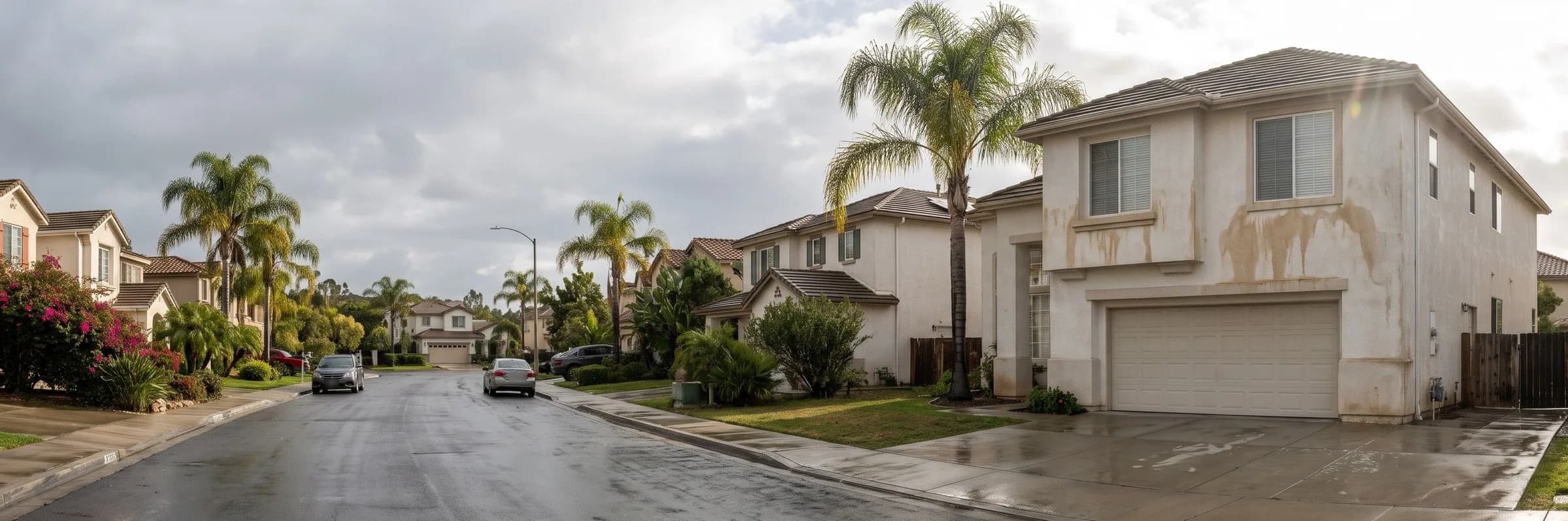

Booking a drying crew in San Diego is the easy call, since companies answer through the night. The repair quote that comes afterward is where homeowners meet two rules: the City of San Diego exempts only small repairs from a building permit, and California lets an unlicensed person take only work under $1,000 that needs no permit. A drywall patch, a water heater swap or a corroded pipe repair can cross either line, and the answer decides who may legally quote the job.
San Diego's version of water damage restoration is the work of extracting water, drying the structure to the ANSI/IICRC S500 standard and repairing what stayed wet, and the Contractors State License Board (CSLB) and the City's Development Services Department decide who may do the repairs and which ones need a permit. The water itself arrives from a roof in a winter storm, a pipe or heater that fails indoors, or, rarely, a flood like the one in January 2024.
Key insights
- Cost. Most San Diego water damage jobs cost $1,700–$8,100, and the average is about $4,400.
- Permit line. The City exempts a repair from a building permit only when it replaces parts with similar materials, totals $1,000 or less and affects no plumbing, electrical or mechanical work (Information Bulletin 203).
- Plumbing permits. Water heater replacement (except tankless), water or sewer piping repair and drain repair need a plumbing permit, which the City issues as a Simple No-Plan permit for non-historic properties.
- License line. California exempts only work under $1,000 that needs no permit and uses no employees, so a repair that needs a permit requires a CSLB licensed contractor (CSLB bulletin 24-07).
- Older homes. A building 45 years or older needs historic review before a no-plan permit issues, which typically takes ten business days unless the scope is exempt.
- Rain. The National Weather Service puts seasonal rainfall in the city at about 10 inches, yet January 22, 2024 brought 2.72 inches in one day and hundreds of rescues from flooded homes.
How water reaches San Diego houses
San Diego water damage comes from four sources: roofs and walls that leak during winter storms, pipes and water heaters that fail indoors, drains and sewer lines that back up, and stormwater that overwhelms the street in a rare downpour. The National Weather Service puts seasonal rainfall in the city at about 10 inches, with most of it falling in winter, so storm leaks cluster in the cool months while plumbing failures can start in any month.
 Storm leaks usually start at cracked tiles, flashing and roof seams, so have a roofer check them before the next winter storm.
Supply lines, hoses and water heaters fail without regard to season, and a failure inside a wall or under a floor can run for days before a stain shows. A roof leak follows the rain, so it shows up in winter storms at flashing, cracked tiles and worn roof seams, while the other sources keep their own schedules.
| Source | Category | Effect on the job |
|---|---|---|
| Failed supply line or water heater | 1 | Dries in place when a crew starts within a day, and only the materials that stay wet are cut out |
| Washer or dishwasher discharge | 2 | Carpet pad and other porous finishes usually come out, and hard surfaces are cleaned and dried |
| Rain through a roof or window | 1, can rise to 2 | The crew sets the category after inspecting, and soaked insulation and ceiling drywall come out once the water has picked up dust and debris |
| Drain or sewer backup | 3 | Porous materials the water touched are removed and the area is disinfected |
| Creek or river overflow, and contaminated runoff | 3 | Rising stream and river water is a listed Category 3 example, so flooring, drywall and padding that touched it are removed |
The IICRC S500 standard sorts water into Categories 1, 2 and 3 by how contaminated the source is, and the category sets how much material can stay in the house. The restorer sets it after inspecting the site, and the S500 consensus body has stated that rain entering through a roof is not automatically Category 3. Water that sits or soaks into building materials can be reclassified, which is why the first day matters and why the EPA tells owners to throw away porous materials that cannot be cleaned and dried.
January 22, 2024 was the heaviest recent test of those sources. The day was the fourth wettest on record, with 2.72 inches of rain at the airport, according to the City of San Diego flood report, which also records hundreds of people rescued from their homes in Mountain View and Southcrest, and swift water rescues along the San Diego River, in low-lying areas near the coast and in the Tijuana River Valley. Its Stormwater Department said the flooding is what happens when heavy rain overwhelms an aging stormwater system with limited capacity, and many pump stations reached capacity during the storm.
The first 48 hours in a San Diego home
In the first 48 hours of an emergency water damage loss, stop the source, make wet areas electrically safe, record the loss, protect what is wet and book a drying crew on the same day. The EPA says mold can grow on wood, drywall, carpet and furniture that stay wet for more than 24 hours, so a crew that starts the same day has the best chance of saving drywall and flooring.
 Test the main shutoff before a leak happens, because a valve that sticks or does not fully close needs a plumber to replace it.
1. Close the main and drain the lines
Turn the main shutoff clockwise until it stops, then open the lowest faucet to drain the pipes. When water is coming through a ceiling or wall in a storm, move belongings out from under it, set out containers and call a roofer to cover the opening.
2. Cut power to wet rooms
Switch off the breakers for wet rooms while standing on dry footing, and call an electrician if the panel sits in or near water. Keep fans and extension cords off wet floors and away from wet outlets.
3. Record the loss before moving anything
Film a slow walk through each wet room, then photograph the source, the edges of each stain and every damaged item. Write down the date and time the water was found, since a timestamped video supports the point that the loss was sudden.
4. Move small items and leave the rest
Lift rugs, books and small items onto dry surfaces, and leave wet drywall, flooring and baseboards in place until a crew has taken moisture readings. Readings taken before demolition show what was wet, and the insurer can see what was removed and why.
5. Book drying and tell the insurer
Call a drying crew and the insurer on the same day, because the equipment does not need to wait for an adjuster. Protect the house with temporary fixes, keep every receipt, and hold off on permanent repairs until the insurer has seen the damage, since some repairs need a City permit.
Water that comes in from outside, such as runoff across a threshold or a backed up drain, is contaminated from the first minute. The EPA flood cleanup advice calls for an N-95 respirator, goggles, gloves, long sleeves and boots, and it warns that older buildings may contain asbestos or lead, so a job of that kind is work for a trained crew in a house built decades ago.
What a San Diego job costs
Most San Diego water damage jobs cost $1,700–$8,100, and the average is about $4,400. The low end covers water removal and drying of one area, the high end adds repairs after the drying, and a leak caught the same day can cost as little as $400, while a flood or storm that wets several rooms can reach $11,500–$29,000 or more.
 How much drywall and insulation a crew cuts out and replaces is a big part of the gap between a $1,700 job and an $8,100 job.
San Diego construction and extraction workers earned about 116 percent of the U.S. average in the Bureau of Labor Statistics' May 2025 wage data. The final water damage restoration cost depends on how many drying days the moisture logs support, whether the repair side needs a permit and a CSLB licensed contractor, the 25–50 percent premium some companies add after hours, and the extra ten business days a historic review can add in a house 45 years or older.
| Scenario | Estimates | Drivers |
|---|---|---|
| Minor spot mitigation | $400–$1,700 | A small wet patch caught within hours and dried in place without demolition |
| Supply line burst | $1,200–$3,500 | A line that ran for hours before the shutoff, often inside a wall or beneath a slab |
| Standard mitigation | $1,700–$4,600 | One or two rooms of extraction, then air movers and dehumidifiers running for several days |
| Appliance overflow | $2,300–$5,800 | Water that reached flooring and cabinet bases, and in a multistory building the ceiling of the unit below |
| Roof leak in a storm | $2,900–$8,100 | Wet attic insulation and ceiling drywall, and a roofer's repair priced apart from the drying |
| Mitigation plus basic repairs | $4,600–$8,100 | Drywall, paint and trim work that pushes the repair past the $1,000 permit and license lines |
| Sewage backup | $8,100–$16,000+ | Category 3 water, so containment, removal of porous materials and disinfection |
| Storm flooding, several rooms | $11,500–$29,000+ | Flood water in several rooms, flooring and drywall cut out, and weeks of rebuilding |
Water mitigation, meaning extraction and drying, is billed at $3.50–$8.75 per square foot of wet floor, with clean Category 1 water at the low end and Category 3 water, such as a sewage backup, near the top, while rebuilding runs $23–$43 per square foot. Only the wet area counts toward the rate: with 300 wet square feet in a 2,000 square foot house, the mitigation rate applies to those 300 square feet, and the rebuild rate applies only to materials that have to be replaced.
| Room | Estimates | Drivers |
|---|---|---|
| Bathroom | $600–$5,200 | Water held in tile, grout and vanity bases, and a ceiling stain below when the bath is upstairs |
| Laundry room | $1,200–$5,800 | A failed supply hose or drain line, and in stacked units a leak that reaches the unit beneath |
| Kitchen | $1,700–$9,300 | Sink, dishwasher and refrigerator lines, cabinet toe kicks, and flooring that continues into the next room |
| Living or family room | $3,800–$21,500 | A wide expanse of flooring under one finish, plus furniture that has to be moved and stored |
Check whether moisture mapping and equipment days are listed as separate lines or folded into the mitigation total. Two bids with the same total can contain different work, and a line reading only "dry structure" gives you nothing to verify, whereas a scope that names air mover and dehumidifier counts and the days they run can be compared with the daily log and the final invoice.
San Diego permit rules for repairs
In the City of San Diego, a water damage repair needs no building permit only when it replaces parts with similar materials, totals $1,000 or less in aggregate and affects no electrical, plumbing or mechanical work. Most other repairs need a permit, and the City often issues no-plan permits the same day. The City's Information Bulletin 203 sets out these exemptions and lists the repairs eligible for a no-plan building permit.
 Replacing a water heater needs a plumbing permit even when the bid is under $1,000, so ask the contractor for the permit number before work starts.
The permit line and the license line meet at the same repair, which is why a low price can mislead. A handyman who offers to replace a water heater, or to patch drywall as part of a pipe repair, is working outside California's minor work exemption, because both jobs need a permit and a permit requires a license even when the price is under $1,000.
| Repair | Permit | Condition |
|---|---|---|
| Replace damaged parts in kind | None | Similar materials, $1,000 or less in aggregate, and no plumbing, electrical or mechanical work affected |
| Drywall after a plumbing repair | None for the drywall | No more than 100 square feet in total, and the plumbing work still needs its own plumbing permit |
| Drywall repair above those lines | No-Plan Building Permit | Existing drywall must be intact enough for the inspector to verify fire rating and attachment, with hourly fees |
| Damage repair in kind | No-Plan Building Permit | Structural framing and life safety elements must be intact, and trusses or glulam beams need plans |
| Water heater replacement | Simple No-Plan plumbing permit | Tankless units are excluded, and the no-plan route is for non-historic properties |
| Water or sewer piping and drain repair | Simple No-Plan plumbing permit | Non-historic properties only, with plans required for anything that does not qualify |
| Roof replacement | Not eligible for no-plan | The City handles roof coverings under a separate bulletin |
| House 45 years or older | Historic review | Typically ten business days, unless the scope is exempt under the municipal code |
Consider how the lines combine on one repair. A supply line fails and wets 60 square feet of kitchen drywall: the drywall replacement needs no building permit because it is under 100 square feet and tied to a plumbing repair, but the pipe repair itself needs a plumbing permit, so a contractor doing it should hold a license. If the same line had wet 150 square feet, the drywall above the 100 square foot line would need a no-plan building permit too.
A building that is 45 years or older must go through historic review before a no-plan permit issues, so the age of the house is the first thing to check before a repair is scheduled. The review typically takes ten business days, and it can add a wait to a repair that would otherwise start within the week.
Applications go through the City's online DSD portal, and owners with project questions can call Development Services at 619-446-5000. Simple no-plan permits can issue the same day they are applied for and paid, and inspections can be scheduled online or through the automated line at 858-581-7111, which takes requests around the clock.
The City's storm permitting FAQ says no City permit is needed to remove mold, though replacing the drywall afterward may need one. Inspections must be scheduled before work is covered or concealed, a permit is valid for up to two years, and when a permit is required the City also requires smoke and carbon monoxide alarms in the existing dwelling unit. Repairs that skip a required permit can surface later, and the City says unpermitted work has to be brought up to code at the owner's expense. Nationally, permits for water damage repairs turn on electrical, plumbing and structural changes, and San Diego adds larger drywall repairs and the age of the house to that list.
Hiring a licensed San Diego crew
A San Diego water damage company is worth hiring when it can show an IICRC Certified Firm listing, a CSLB license for any repair work, certificates of insurance, a written scope with equipment counts and a daily moisture log. Each of those can be checked before a deposit changes hands, and the CSLB and IICRC lookups take a few minutes.
 Look up the CSLB license and the IICRC Certified Firm listing under the company's exact name before the crew unloads, since both checks take only a few minutes.
Which jobs need a CSLB license?
California's minor work exemption now ends at $1,000, but the CSLB bulletin adds two conditions: the work cannot require a permit, and the unlicensed person cannot employ anyone for the project. If the job is subject to a permit of any kind, or one worker is hired to help, a license is required even when the price is under $1,000.
An unlicensed person who bids above $1,000, does work that needs a permit or employs workers is subject to legal action, and the exemption does not cover anyone who advertises as licensed or qualified to act as a contractor. Because most San Diego repairs beyond a small patch need a permit or a crew, treat a CSLB license as the default for the repair side and ask for the number before accepting a bid.
How do you verify the license and the firm?
Enter the company name or license number in the CSLB's online license check, confirm the license is active and matches the exact name on the contract, and ask for certificates of insurance before the crew starts. A contractor license says nothing about drying skill, so look up the IICRC Certified Firm listing separately and ask which technicians on the job hold the Water Damage Restoration Technician certificate.
Warranty terms and red flags matter in any city when choosing a restoration company, and San Diego adds a local test. Ask each firm who pulls the permit, who schedules the City inspection and who keeps the final sign-off, because the answer shows whether the company has done permitted work in San Diego before.
What should the written scope say?
A scope names each room, the materials to be removed, the number of air movers and dehumidifiers, the planned days of equipment and whether moisture mapping and daily monitoring are separate lines. It also says whether the price covers mitigation only or includes repairs, because the repair side is where the permit and license rules apply and where a second bid is most useful.
Ask whether the company bills the insurer directly and what you owe if the insurer pays less than the invoice. Compare two or three scopes line by line, since the lowest total often leaves out equipment days or the permit fee that a licensed contractor builds into the repair price.
How will the crew prove the structure is dry?
A crew should log moisture readings every day, each entry showing the date, the room, the material and the reading, and it should stop the equipment only when materials reach a dry standard taken from unaffected materials in the same house. Without a log, nobody can show the insurer why equipment ran for five days, or show the next contractor that framing was dry before drywall closed it back in.
What a homeowner can safely handle
A homeowner can safely handle a small, fresh leak of clean water: mopping, running a wet vacuum, moving belongings and setting out fans in the first hours. Sewage or flood water, electrical hazards, wet drywall in an older house and any repair that needs a permit belong to a trained crew or a licensed contractor.
 Mop up clean supply water yourself only after photographing the puddle and the cabinet, and call a crew if the cabinet floor or the wall behind it stays wet.
Three facts set that limit. Fans alone rarely finish wet drywall or carpet padding, and a rented fan cannot show whether framing has reached its dry standard. The EPA warns that older buildings may contain asbestos or lead, which matters when cutting into the walls and floors of a house that is 45 years or older. The permit and license lines then decide whether the repair can be done by a handyman at all.
| Task | DIY? | Reason |
|---|---|---|
| Wet vacuum a fresh clean water puddle | Yes | Supply water is the least hazardous category, and speed is what saves the flooring |
| Run rented fans and a dehumidifier | Partly | They move air, but only moisture readings show whether framing has dried |
| Cut out wet drywall or baseboards | Rarely | Older houses can hide asbestos or lead, and the repair may need a City permit |
| Clean anything touched by sewage or flood water | No | Category 3 work needs an N-95 respirator, goggles, gloves and disinfection |
| Handle wet outlets or the panel | No | An electrician checks the circuits before power returns |
An owner who does permitted work personally signs the City's owner-builder verification form, which records that the owner takes responsibility for the work in place of a contractor. The form is also required when an owner hires different contractors for different trades, and it leaves the inspection requirement in place, so the owner schedules the same inspections a contractor would.
Moisture logs and how long it takes
Drying a San Diego house takes three to seven days of equipment time, and repairs add one to three weeks after the readings pass the dry standard. Drywall dries in about three to five days, while hardwood, concrete and Category 3 losses take longer, and the crew's daily readings, not the calendar, decide when the machines leave.
 Repairs begin only after the readings pass the dry standard, so ask for the final moisture reading in writing before anyone closes a wall.
The ANSI/IICRC S500 standard sets the drying goal by comparing wet materials with unaffected ones in the same building, so each house gets its own target. A log that lists the dry reference, the starting readings and each day's numbers is the record a crew hands to the insurer, and the same log shows how long air movers, dehumidifiers and heat ran to reach that target.
Ask the company to put three dates in writing: the day the equipment will be set, the day the first moisture check against the dry standard is due, and the day the permit application will be filed. Readings that miss the dry standard on schedule are the signal to extend the drying or open the wall, and a written plan makes that decision visible to the insurer.
Sorting belongings after a leak
Sort belongings by whether the water can be cleaned off them: the EPA says materials that do not soak up water can usually be cleaned and dried, while materials that soak up a lot of water and cannot be cleaned should be thrown away. The category of the water also counts, because anything that sat in Category 3 water, such as creek overflow or a sewage backup, needs disinfecting before it is kept.
Items that soak up water, such as carpet padding, mattresses and upholstered furniture, are the ones to ask the crew about first, since they are the hardest to clean and dry once soaked. Hard items such as glass, metal and hard plastic are easier to wash and dry, and when a room has to be emptied a crew can pack out, clean and store valuables while the house dries.
Photograph and list each item before it leaves the house, with its age and approximate value, because the insurer's contents review works from that list and a discarded item cannot be inspected later. Keep the receipts for any cleaning, storage or replacement purchases, and wear an N-95 respirator, goggles and gloves when handling anything that touched flood water.
Insurance clocks and coverage gaps
California requires an insurer to acknowledge a claim within 15 calendar days, accept or deny it within 40 calendar days after receiving proof of claim, and pay accepted amounts within 30 calendar days. These time limits come from 10 CCR 2695.5 and 2695.7, and an insurer that needs more time must write to the claimant every 30 calendar days until it decides.
 Write down the date the claim was reported and the date proof of claim was sent, since the 15 and 40 day limits count from those dates.
The clocks run on the insurer's schedule, and the part an owner controls is the paperwork. A restoration invoice from a licensed contractor that lists the permit number, the final inspection and the daily moisture logs gives the adjuster a record that matches the scope, and a claim with that record is harder to shrink than one with a photo and a verbal estimate.
When the offer comes in short, ask the adjuster for the estimate line by line and compare it with the crew's scope, the daily moisture logs and the permit invoice. Differences in equipment days, in the amount of drywall or flooring removed and in repairs that need a permit are the ones worth raising in writing, and the letter should go out before the 40 day decision period ends.
Flood is handled under a separate policy. Water that arrives as street runoff or creek overflow, as it did on January 22, 2024, is treated as flood, and most homeowners policies do not pay for it. An owner whose policy lacks flood coverage should still file the claim for any sudden interior leak and keep the flood damage documented separately, because the insurer will ask which water caused which damage.
How a slow dry out turns into mold
A water job turns into a mold job when materials stay wet for more than 24 hours, according to the EPA, so the daily moisture log is the best evidence that the structure dried in time. Drywall, carpet padding and insulation that stay damp behind a finished wall are the usual starting points, because nobody sees them until a smell or a stain appears.
Three signs mean the job has crossed over: readings that stay above the dry reference after several days of equipment, a musty smell in a room that was treated, and visible growth beyond a small patch. At that point the work moves from drying to containment and removal, and the repair schedule waits until mold after water damage has been removed and the area checked.
The City of San Diego requires no permit to remove mold, but replacing the drywall afterward may need one, so the permit question returns at the end of a mold job. The removal side is a separate trade from drying, so the same license, certification and written scope checks apply to a San Diego mold remediation contractor.
San Diego neighborhoods and water risk
San Diego's flood risk concentrates along creeks, the San Diego River and the Tijuana River Valley, while plumbing and roof leaks can strike any street. The City's January 2024 response shows which areas needed rescues, which pump stations reached capacity and which buildings flooded, and rising creek and river water is a listed Category 3 source.
 Homes that back onto a creek or drainage channel are worth checking against the FEMA flood map, since overflow counts as flood water that most homeowners policies exclude.
Owners can confirm whether an address sits in a flood zone through the FEMA Flood Map Service that the City's permit staff point to. A flood zone address matters when a loss happens, because flood water is Category 3 work and flood cleanup after flood water damage needs a trained crew before any repair estimate is written.
| Area | Risk factor | Homeowner note |
|---|---|---|
| Southcrest and Mountain View | Street and creek flooding | The City reported hundreds of people rescued from their homes on January 22, 2024, and creek and street flood water is usually handled as Category 3 |
| Midway District near the Sports Arena | Pump station capacity | The City said a power outage hit the pump station serving this district during the storm |
| San Diego River corridor | River overflow | The swift water rescue team responded along the river, and low floors take water first |
| Tijuana River Valley | Low-lying valley floor | City crews made swift water rescues here, and outbuildings and ground floors are exposed |
| Downtown | Garage flooding | The Central Library's underground garage flooded, and multi-unit buildings follow separate building and plumbing permits |
| Low-lying coastal blocks | Storm water near the coast | The City responded to flooding in low-lying areas near the coast during the January 2024 storm |
| Chula Vista and other nearby cities | Separate permit offices | Repairs outside the City of San Diego go through the local building department, so City permit rules do not apply |
Rentals, condos and shared walls
A San Diego tenant whose landlord will not fix a leak can use California's repair and deduct remedy, and a condo owner usually looks to the HOA for leaks in common areas. Both depend on who owns the pipe or roof the water came through and on notice given in writing.
 Take dated photos before sending written notice to the landlord or HOA, since a record of when the leak began backs up the notice.
When the landlord owns the leak
California Civil Code 1941.1 treats a dwelling as untenantable when it lacks effective waterproofing and weather protection of the roof and exterior walls, or plumbing maintained in good working order. Civil Code 1942 then lets a tenant repair the problem after notice and a reasonable wait, and deduct up to one month's rent for the cost. A tenant should send the notice in writing and keep a copy, since tenant rights for water damage depend on proof that the landlord knew about the problem.
When the HOA owns the pipe
Under Civil Code 4775, an association is responsible for repairing, replacing and maintaining the common area unless the declaration says otherwise. A leak from a shared riser or a roof therefore starts as an association claim, while the damage inside the unit is a claim under the owner's own policy, a split that decides who pays in condo water damage cases.
Selling or buying after a leak
A San Diego seller who knows about past water problems should disclose them on the real estate transfer disclosure statement that California Civil Code 1102.6 requires for sales of one to four residential units, a form that asks directly about flooding, drainage or grading problems and about major damage from floods. An unpermitted repair adds a second problem, because the City warns that work done without a permit has to be brought up to code later, at the owner's expense.
Keep the permit number and final inspection, the contractor's license number, the daily drying log and the photographs from the day of the loss. A buyer can ask for those papers and for the insurance claim history before closing. An older drywall or plumbing repair with no permit on record is the gap to look for, and the buyer can ask the seller to document who did the work and when, and can ask for an inspection before the sale closes.
Prevention for San Diego houses
In San Diego, water damage prevention means closing the paths that winter rain and aging plumbing use before the wet season starts, since most of the city's rain falls in winter. Five habits cover most of those paths, and each takes an afternoon or less, so the work fits in the dry months before the first storm.
 Clear the grate and check that soil falls away from the wall before the first storm, because the City said its stormwater system reached capacity in January 2024.
1. Service the water heater and its drain pan
Check the tank and the pan beneath it for rust or moisture, and have a plumber replace a failing unit before it leaks. A non-tankless replacement qualifies for the City's Simple No-Plan plumbing permit, so the permit should not delay the swap.
2. Clear roof valleys and gutters before winter
Remove leaves and debris from valleys and gutters before the first heavy rain, and look for lifted flashing or cracked tiles. Storm water enters at those weak points, and repairing them before the first storm keeps it out of the attic and ceiling.
3. Replace worn supply hoses
Swap bulging, kinked or rusted braided hoses on washers, dishwashers and toilets, and fit shutoff valves where they are missing. A failed hose can pour water for hours while a household is out.
4. Read the meter with every tap off
Note the water meter reading, run no water for an hour and check whether the dial has moved. A moving dial points to a hidden leak, which is how many slow leaks behind walls and under slabs are first found.
5. Keep yard drains and grading clear
Clear yard drains, and keep soil sloping away from the foundation. The City said its stormwater system reached capacity in January 2024, so a yard has to move its own water off the property during a heavy storm.
Frequently asked questions
How much does water damage restoration cost in San Diego?
Around $4,400 on average, with most jobs landing at $1,700–$8,100. Extraction and drying run $3.50–$8.75 per square foot of wet floor, and repairs after drying are priced apart at $23–$43 per square foot.
Do I need a permit to repair water damage in San Diego?
Sometimes, because the City exempts repairs that replace parts with similar materials, total $1,000 or less and touch no plumbing, electrical or mechanical work, but larger drywall repairs, water heater replacement and water or sewer piping repair need a permit, and a house 45 years or older adds historic review.
Does a San Diego water damage company need a California license?
Usually yes for the repair side. California exempts only work under $1,000 that needs no permit and uses no employees, so a crew bidding repairs should hold a license you can confirm in the CSLB license check.
How long does water damage restoration take in San Diego?
Drying takes three to seven days and repairs add one to three weeks. A no-plan permit can issue the same day it is paid for, while historic review for a house 45 years or older adds about ten business days.
Is a water damage estimate free in San Diego?
Often yes for the visit itself, so ask before booking. Whatever the visit costs, get a written scope listing the rooms, the air mover and dehumidifier counts and the planned days, and ask what an after hours call or a moisture map adds.
How do I find the best water damage company in San Diego?
Pick the company that can prove its credentials in writing. Ask for the CSLB license number, the IICRC Certified Firm listing and certificates of insurance, then compare two or three scopes line by line and put the questions to ask a restoration company to each of them.
Does homeowners insurance cover storm flooding in San Diego?
Usually not, because runoff, creek overflow and rising street water count as flood, which needs its own policy through the NFIP or a private insurer, while homeowners insurance pays for sudden leaks from plumbing, appliances and storm openings in the roof.
What happens if my California insurer denies a water damage claim?
The insurer must deny in writing. California regulations require the letter to list every reason for the denial and to give the address and phone number of the Department of Insurance unit that reviews claims practices, so keep the letter with the photos and moisture logs that support your water damage insurance claim.
Who should I call first when water floods my San Diego house?
Start with the shutoff, then call a drying crew and your insurer the same day. If the water came from outside or from a sewer backup, wear an N-95 respirator, goggles, gloves and boots and leave the cleanup to a trained crew.
Is it safe to stay in a flooded San Diego home?
Not during a flood or sewage loss. The EPA says flood water can contain bacteria, chemicals and other hazards and can make the air in a home unhealthy, and standing water near outlets or the panel is an electrical hazard, while a small clean water leak with dry circuits usually lets a household stay in the unaffected rooms while the equipment runs.
Is residential water damage restoration different from commercial in San Diego?
Yes, mostly in who pays and who approves the work. A house is billed to the homeowner or the homeowner's insurer under the City's single dwelling permit rules, while apartment and commercial buildings need separate building and mechanical, electrical and plumbing permits and usually involve a property manager and a commercial policy.
- IICRC S500
- EPA: Flood Cleanup to Protect Indoor Air and Your Health
- NWS San Diego: Climate
- City of San Diego: Record Amount of Rain Causes Widespread Flooding
- CSLB: License Requirement for Minor Work Increases to $1,000
- City of San Diego: No-Plan Building Permit (Information Bulletin 203)
- City of San Diego: Plumbing/Gas Permit
- City of San Diego: Storm-Related Permitting FAQ
- 10 CCR 2695.7: Standards for Prompt, Fair and Equitable Settlements
- BLS: Occupational Employment and Wages in San Diego-Chula Vista-Carlsbad, May 2025
Sam Hickerson is the founder of RestoreAdvisor and writes consumer guides on mold remediation, water damage restoration, inspection, testing, and home recovery. His work focuses on helping homeowners understand costs, risks, and when to call a professional. He draws on guidance from the EPA, CDC, IICRC, and other authoritative sources to make complex home issues easier to navigate.