
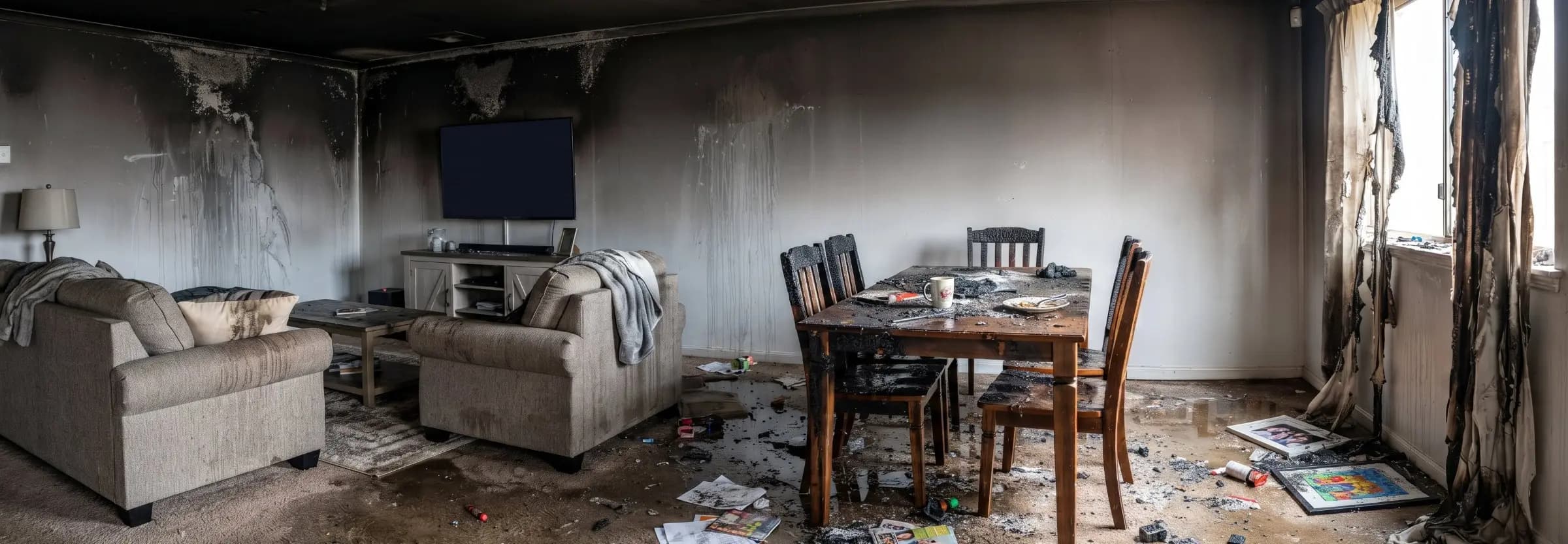

The fire is out, but the house is still soaked. Carpets are saturated, ceilings sag, and water keeps running through the walls of rooms the flames never reached, and that water starts doing its own damage within hours. It is the part of a fire loss that can be stopped with a fast response from a crew trained in water damage restoration, and it typically adds $7,000 to $45,000 to a multi-room fire loss once repairs are included, before smoke and soot work is counted.
Water damage after a house fire is the saturation of floors, walls, ceilings and belongings by hose streams, sprinkler discharge and heat-ruptured pipes during firefighting, and it is classified and dried under the ANSI/IICRC S500 standard for professional water damage restoration. Soot, ash and burned debris change how that water is treated, which is why a fire loss needs different handling from a plumbing leak.
Key insights
- Wait for the all-clear. The American Red Cross says to stay out of a fire-damaged home until local fire authorities say it is safe to re-enter.
- A single handline moves 1,000 to 1,800 gallons in 10 minutes. Fire service sources put a 1¾ inch handline at roughly 100 to 180 gallons per minute, and much of that water ends up inside walls, ceilings and floors.
- Fire water is rarely clean. Water that runs through soot, ash and debris is typically treated as Category 2 or 3 under ANSI/IICRC S500, which limits what can be dried in place.
- Mold can start after 24 hours. The EPA says mold can grow on wood, drywall, carpet and furniture that stay wet for more than 24 hours, and a boarded-up house with no power dries slowly.
- Water damage after a multi-room fire typically costs $7,000 to $45,000. Extraction and drying alone run $4,000 to $7,500 or more per 1,000 square feet, and fire, smoke and rebuild work are priced on top.
- Most policies treat the water as part of the fire claim. Loss of use coverage typically pays some housing costs while the home is repaired, at about 20% of the dwelling limit according to the NAIC.
Is it safe to go back inside?
A fire-damaged home is safe to enter only after local fire authorities say so. The American Red Cross advises staying out until they give that approval and not crossing fire tape or entering a home with an inspection placard until you know what the placard means, because a house that looks intact from the street can still have a weakened roof, floor or stairway.
 The American Red Cross advises staying out until local fire authorities say the home is safe, and not entering a home with an inspection placard until you know what it means.
Fire crews usually shut off damaged utilities before they leave, and those shutoffs should stay in place. Wet drywall, burned framing and saturated ceilings can fail without warning, and electrical systems that were exposed to water and heat can shock or start a second fire. Once you have clearance, the Red Cross lists the first things to check on entry:
- Structure. Look for sagging ceilings and floors, cracks in the foundation, and missing support beams, and use a flashlight instead of candles or open flame.
- Electricity. If you see sparks or frayed wires, or smell hot insulation, shut off the main breaker if it is safe to reach and call an electrician. Do not restore electrical service yourself.
- Gas. If you smell natural or propane gas or hear hissing, leave right away and call the fire department from a safe distance.
- Water lines. If pipes are damaged, shut off the main valve and call a plumber before anyone uses a sink or toilet.
Food, drinks and medicine that were exposed to heat, smoke or soot should be thrown away, as the Red Cross advises. Children and pets should stay out of the house until the debris and contaminated water are cleared, and the EPA advises opening doors and windows, if possible, to increase ventilation while anyone is cleaning.
Anyone who goes in after clearance should dress for wet, dirty work. The EPA recommends an N-95 respirator, goggles without vent holes, gloves, long pants, a long-sleeved shirt and boots or work shoes for wet cleanup, and people with asthma or weakened immune systems should stay out of the cleanup altogether.
What to do in the first 48 hours
Get the all-clear, call your insurer, document the damage, secure the building and start water extraction within the first day or two, in that order. Hose and sprinkler water keeps spreading into porous materials, so the first day or two decide how much can be dried in place instead of torn out. Any flood or leak starts with the same emergency water damage priorities of safety, shutoff and extraction, and a fire loss adds clearance, board-up and claim steps on top of them.
 Photos taken before anything is moved or thrown away show the adjuster the original condition of each surface and item. That record supports the room-by-room scope of the claim.
1. Get the all-clear before you enter
Wait for the fire department to say the house is safe to enter, and stay out of any home marked with an inspection placard until you know what it means. Entering early risks collapse, electrical shock and a rekindled fire.
2. Call your insurer from outside
Report the loss as soon as you are safe, ask what documents the claim needs, and write down the date, time and name of everyone you speak with. The NAIC advises contacting your agent or company as soon as possible and keeping notes of every conversation with the agent or adjuster.
3. Photograph and video before anything moves
Record every room, the wet streaks and stained areas on walls, and each soaked item before it is carried out or thrown away. Wide shots of each room, close-ups of ceilings and baseboards, and a running list of damaged belongings make up the kind of insurance documentation for water damage an adjuster expects.
4. Board up openings and tarp the roof
Cover broken windows, forced doors and roof ventilation holes so rain and weather do not add to the loss, and keep every receipt. Homeowners policies expect you to protect the home from further damage, and the NAIC gives boarding up as an example.
5. Shut off the water and the main breaker
Close the main water valve if pipes are damaged and cut electricity at the main breaker if it can be reached safely, without stepping through standing water. Fire crews often do this before they leave, so check what has already been shut off and leave it that way.
6. Haul out soaked soft goods
Move wet carpet, padding, mattresses and upholstered furniture out of the house after they have been photographed, since these hold the most water and dry the slowest. Leave heavy items that the adjuster may want to see where they are until the photos are done.
7. Book extraction and drying the same day
Hire a restoration company that follows ANSI/IICRC S500 to pump out standing water and set drying equipment, because waiting a day lets mold take hold. Ask for a moisture map of the affected rooms so the starting readings are on record.
How firefighting floods a home
Firefighting floods a home through three routes: hose streams aimed at the fire, sprinkler heads that open in the heat, and plumbing that the fire itself ruptures. Each route sends water to a different part of the structure, which is why the wettest rooms are often not the ones that burned.
 Rooms below the fire need moisture readings too, since water travels through gaps around pipes and fixtures before any stain appears.
Hose water arrives first and in the greatest volume. Fire service training sources put a 1¾ inch handline at roughly 100 to 180 gallons per minute, so every 10 minutes of flow sends 1,000 to 1,800 gallons into the building. Crews also open walls and pull down ceilings to find fire hiding in the cavities, and that opens a path for water to run into insulation, framing and the rooms underneath.
Heat damages plumbing as well. Plastic supply lines can soften and split in a hot room, and metal lines can weaken at the joints, so a burst pipe can keep flowing for hours after the fire crew leaves if nobody closes the main valve. Water that pools on an upper floor drains through light fixtures, vents and gaps around pipes into the rooms below, which can leave a finished basement or a first-floor ceiling soaked even when the fire stayed upstairs.
Water category after a fire
Water used to fight a fire is usually treated as Category 2 or 3 once it has run through the burned area. The ANSI/IICRC S500 standard classifies water by its source and by how contaminated it is when it is found, and it recognizes that a category can worsen as water picks up contaminants and sits in materials.
 Ask the restoration crew to record the water category in writing, since it decides which materials are removed and sets the per square foot price.
Hose water leaves a municipal supply as Category 1 clean water, but it then washes over char, soot, ash and burned debris, runs through insulation and carpet, and sits in warm wall cavities. Each of the three water damage categories carries different rules for protective equipment and for which materials have to be removed instead of dried.
Category 1 water in a room the fire never touched, such as a bedroom that only received overspray, can often be extracted and dried in place if it is caught early. Category 2 or 3 water in the fire zone means porous materials like carpet, padding, ceiling insulation and wet drywall are removed, hard surfaces are cleaned and treated with antimicrobial products, and workers wear gloves, eye protection and respirators. A sprinkler that opens in a small fire often leaves cleaner water than hose runoff, since it falls from a closed pipe network and stays near the ceiling that triggered it, and fire sprinkler water damage without any fire is usually Category 1.
What can be saved and what cannot
Hard, nonporous surfaces can usually be cleaned and saved, while drywall, insulation, carpet padding and mattresses usually cannot. The EPA advises cleaning and drying materials that do not soak up water, and throwing away materials that soak up a lot of water and cannot be cleaned and dried.
 Photograph and list each item before it reaches the curb, because personal property is reimbursed by value and the adjuster needs the inventory to calculate it.
Fire adds soot, smoke odor and heat damage to the water problem, so items that would survive a clean water leak may still be lost. Final salvage decisions come from a restoration crew with a moisture meter once the water category is set, so a keep or replace verdict for any item is only a starting point.
| Material | Usual call | Why |
|---|---|---|
| Ceiling and wall drywall | Replace | Soaked paper facing sags and holds contaminated water, and soot stains bleed through paint |
| Insulation | Replace | It holds water and soot and does not dry in place |
| Carpet and padding | Replace | Padding absorbs the most water and cannot be cleaned of soot |
| Hardwood and laminate | Depends | Solid wood can sometimes be dried if it is caught early, while laminate swells and delaminates |
| Upholstered furniture | Depends | Frames may be saved and cleaned, but cushions with smoke and water are usually lost |
| Mattresses | Replace | Foam and springs retain moisture and smoke odor |
| Electronics and appliances | Depends | Wet circuits fail from corrosion even when they power on, so a technician has to test them |
| Hard surfaces and tile | Save | Nonporous surfaces can be cleaned and disinfected after soot is removed |
| Documents and photos | Depends | Freezing and professional document drying can recover paper that is still wet |
Wet belongings that are salvageable should be separated from the rest early, because mold and odor set in within days. Televisions, computers and other water damaged electronics and appliances should stay unplugged until a technician has checked them, and the same caution applies to smoke-exposed devices that look fine. The EPA adds that some fabrics and textiles can be saved by laundering, though smoke odor often needs a separate deodorizing step.
How restoration works after a fire
A fire loss is restored in a set order: stabilize the building, extract standing water, remove materials that cannot be dried, dry the structure, then clean soot and smoke and finally rebuild. Water work goes first because wet materials start to deteriorate within hours, while soot residue changes more slowly.
 Extraction clears standing water, and the drying that follows is finished only when daily moisture readings return to the dry reference.
Crews begin with board-up and temporary power or a generator, since air movers and dehumidifiers need electricity. The EPA says generators should only be used outdoors and at least 20 feet from buildings, because carbon monoxide builds up quickly in a closed house. Extraction follows, using truck-mounted or portable pumps to clear standing water from floors and basements, and then technicians cut out soaked ceiling drywall, insulation and carpet padding.
The structural drying process then uses air movers, dehumidifiers and moisture meters to pull water out of framing and subfloors until readings return to a dry reference, and technicians log those readings each day before they remove any equipment. Soot and smoke cleaning on dried surfaces comes next, and it is a separate scope with its own crew, tools and price, followed by deodorizing and repairs.
Hiring a crew for fire and water
Hire a restoration company that holds IICRC certification in water damage restoration and in fire and smoke restoration, and get the water and fire scopes written as separate line items. One company often handles both, which keeps the schedule simple, and separate line items let each part be matched to the claim and checked against its own moisture readings.
Ask how the crew documents moisture readings each day, since those readings show when drying is finished and support the insurer's payment. A written scope should list each room, the materials to be removed, the equipment to be set, and the expected number of drying days. Request a copy of the starting and final readings for each room, since they show the insurer that drying reached its target.
Be careful with crews that arrive unrequested after a fire, since fire losses draw contractors who solicit door to door. Check that the company is licensed where your state requires it and carries insurance, and avoid signing a work authorization that assigns your claim payments to the company before you have read it. Get every agreement in writing and keep a copy with your claim records.
Mold after a fire
Mold can start to grow within a day or two on anything that stays wet after a fire. The EPA says mold can grow on wood, drywall, carpet and furniture that remain wet for more than 24 hours, and fire-damaged houses are often at higher risk because they are boarded up, have no power, and trap humid air.
 Mold can start on wet insulation and wood within a day or two, so fast removal of soaked materials is what keeps a water loss from becoming a remediation job.
A closed house with no running HVAC or dehumidifier holds moisture in wall cavities, attic insulation and subfloors. Wet insulation and soaked ceiling drywall are the most common hidden sources, since the water that ran into them from above is not visible from the room. A musty smell that appears in the days after the fire usually means water is still trapped somewhere, and that smell needs a moisture reading before anyone starts cleaning. Damp walls, peeling paint and stained ceilings are the signs to check first, and a moisture meter or thermal camera finds water behind surfaces that look dry.
Fast extraction and drying are the best prevention, and professional crews check readings in wall cavities and under flooring before they close up any wall. If mold has already appeared, the work moves from water mitigation to remediation, which has its own process and licensing rules. Visible growth that follows a wet loss is the point where mold after water damage becomes a separate job, and the EPA advises gently cleaning visible mold before fans or dehumidifiers are started so the spores are not spread.
What water cleanup after a fire costs
Water damage after a house fire typically costs $7,000 to $45,000 when drywall, insulation and flooring are replaced across several rooms, and $4,000 to $7,500 or more for extraction and drying alone across a 1,000 square foot area. An ordinary leak without a fire runs $1,500 to $7,000 according to the water damage restoration cost figures, because fewer rooms are wet and the water is usually cleaner.
 Ask for the wet square footage in writing for each room, since both drying and repair prices are quoted per square foot of wet area.
Price per square foot rises with the water category. Category 2 water typically costs $4 to $6.50 per square foot to extract and dry, Category 3 water typically costs $7 to $7.50 or more, and mitigation plus basic repairs costs roughly $23 to $44.50 per square foot of wet area. A 300 square foot loss, a 1,000 square foot loss and a whole-house loss of 2,000 square feet price out differently, because the rates apply to the square footage that got wet.
| Scope | Estimates | What's included |
|---|---|---|
| 300 sq ft, drying only | $1,200–$2,250 | One or two rooms with extraction, structural drying and antimicrobial treatment |
| 300 sq ft, with repairs | $6,900–$13,350 | Drying plus drywall, insulation and flooring replacement in those rooms |
| 1,000 sq ft, drying only | $4,000–$7,500+ | A floor or most of the main level, with Category 2 or 3 water |
| 1,000 sq ft, with repairs | $23,000–$44,500 | Drying plus ceiling, wall and flooring replacement across the floor |
| 2,000 sq ft, drying only | $8,000–$15,000+ | Whole-house extraction and drying |
| 2,000 sq ft, with repairs | $46,000–$89,000 | Whole-house material replacement and framing repair where needed |
Estimates for the water side exclude smoke and soot cleaning, odor treatment, structural fire repair and contents cleaning, which come on top. The water category, the square footage that got wet, whether ceilings came down and the number of drying days set the price, and a fire that reached the attic or roof structure moves a job toward the top of its range because of the ceiling, insulation and framing involved. Light overspray in one or two rooms the fire never reached stays near the $1,500 to $4,000 that standard mitigation costs, so ask for an itemized estimate that separates water mitigation from fire restoration and lists each room.
Does insurance cover firefighting water?
Most homeowners policies treat water damage from putting out a covered fire as part of the fire loss, so the policy wording decides the details. The NAIC lists fire as a covered peril, and the dwelling coverage pays for damage to the house, including plumbing and electrical systems, while personal property coverage reimburses the value of damaged belongings.
 Keep receipts for hotel stays and extra meals, because loss of use coverage pays some additional living expenses up to the policy limit.
The NAIC also describes loss of use coverage, which pays some additional living expenses while the home is repaired. Loss of use is typically limited to 20% of the dwelling limit, and personal property is typically limited to 50%, though the percentages vary by policy. The settlement basis matters too: replacement cost pays to repair or replace with similar materials, while actual cash value accounts for age and wear.
Policy wording and the cause of the fire decide whether a specific loss is covered, and limits and exclusions differ between policies, so compare the dwelling, personal property and loss of use limits in your policy declarations before the adjuster visits. Ask your adjuster to confirm in writing that hose, sprinkler and burst-pipe water are included in the fire claim, and keep the written answer with your other claim records.
Other damage from firefighting
Firefighters cause some damage on purpose to stop the fire, and that damage is part of the fire loss. They break windows to ventilate, force doors, cut holes in the roof, pull ceilings and strip wall coverings to find hidden fire, and every one of those openings lets in weather or leaves wet material exposed.
Photograph each opening and board it up, because the openings add to the water problem if rain gets in before the roof is covered. Utility shutoffs, damaged locks and pulled ceilings go in the same claim as the burned areas, and adjusters expect the same room-by-room records they would for any other water damage insurance claim.
Keep receipts for board-up, tarps, temporary power and storage, and submit them with the claim. Note which doors, windows and ceilings were opened by crews and which were damaged by the fire, so the estimate lists each one correctly and the adjuster can match every opening to a cause. Crews also leave debris and wet materials behind that a restoration company can haul out.
Renters and condo owners
Renters and condo owners should notify the landlord or association right away and file their own claim for belongings and living expenses, because the building owner or association insures the structure. Firefighting water damage can reach a unit even when the fire started somewhere else in the building, and a claim for belongings is still worth filing when the landlord handles the structure.
The landlord or property manager controls access to the building and the structural repairs, so ask for the name of the restoration company they hire and for the expected repair timeline in writing, since additional living expenses are tied to the period the unit cannot be lived in. A tenant's renters insurance typically covers personal belongings and some additional living expenses, while the landlord's property policy insures the building itself.
Condo owners typically rely on the association's master policy for shared structure and their own unit policy for interior finishes and belongings, so ask the association for its adjuster's contact and coordinate the two claims. Ask the association which contractor it has hired, and keep your own estimate for the interior finishes your policy covers.
Prevention
Label the main water valve and main breaker, keep a photo or video inventory stored off site, and review your policy limits each year. Knowing where the shutoffs are lets you or a firefighter stop the water quickly, and an inventory shortens the claim by showing exactly what was in each room.
 Anything stored in the house can be lost in the same fire, so keep the inventory and a copy of the policy at another location.
The NAIC recommends a household inventory with photos or video of every room and valuable item, stored somewhere outside the house such as a workplace or safe deposit box, and updated every year. Keep receipts for major purchases and repairs with it, because they support the value of what was lost.
Keep a copy of your policy and agent contact details somewhere you can reach after a loss, such as a phone note or a folder kept outside the house. Tell anyone who has a key to the house where the main water valve and main breaker are, so a crew that arrives while you are away can find them.
Frequently asked questions
Does the fire department clean up the water it uses?
No. Fire crews typically secure the scene, but water extraction, drying and cleanup fall to you and a restoration company.
Should I turn the water back on after a house fire?
Not until a plumber checks the lines. The American Red Cross advises shutting off the main valve when pipes are damaged and calling a plumber, because a line weakened by heat can fail as soon as pressure returns.
How long does drying take after a house fire?
Several days to weeks, according to the EPA, depending on how much water soaked in and how humid the house is. The EPA says materials should read 15% or less moisture content before they are refinished.
Do water and fire damage need separate insurance claims?
No. Water damage from putting out a fire normally belongs to the same fire claim, and the NAIC notes that a deductible is paid on each claim, so one claim means one deductible. Confirm the wording with your adjuster, because homeowners insurance coverage for water damage varies by policy.
Can I clean up the water myself after a fire?
Only light work is safe for a homeowner. After the all-clear, you can carry out soaked soft goods and photograph damage, but extraction, structural drying and anything involving soot or damaged wiring belong to a restoration crew and an electrician.
Can a neighbor's fire cause water damage in my home?
Yes. Water from a fire in an adjoining unit or a shared wall can run through ceilings, floors and wall cavities into your space. Report it to your own insurer and your landlord or association.
Should I hire a public adjuster for a house fire claim?
Yes, on large losses where you and the insurer disagree about the scope. A public adjuster is a licensed freelance adjuster who charges a fee, and the NAIC notes that not every state allows them. The NAIC also points to the policy's appraisal clause and to hiring an attorney as other options when the disagreement is over the value of the claim.
Sam Hickerson is the founder of RestoreAdvisor and writes consumer guides on mold remediation, water damage restoration, inspection, testing, and home recovery. His work focuses on helping homeowners understand costs, risks, and when to call a professional. He draws on guidance from the EPA, CDC, IICRC, and other authoritative sources to make complex home issues easier to navigate.