

Mold in a Baltimore home usually follows a predictable path, and most jobs finish in one to two weeks. Typical remediation costs $1,500–$6,000, Maryland does not license mold contractors, and the city pays for cleanup after some sewage backups, so the order of your first few calls matters.
In Baltimore, mold remediation means locating and correcting the moisture source, containing the work area, removing or cleaning contaminated materials, and confirming the result with testing, following the ANSI/IICRC S520 standard and EPA mold cleanup recommendations. Local jobs differ from the national average because the median Baltimore home was built in 1949, rowhouses share walls, and the city's sewers and streets flood during heavy rain.
Key insights
- Maryland has no mold remediation license. A 2008 law that would have created one never took effect and its licensing subtitle terminated on July 1, 2019, so mold credentials come from IICRC or ACAC, and any firm that rebuilds drywall, framing, or floors needs a Maryland Home Improvement Commission license.
- Baltimore DPW pays for some sewage backup cleanup. A backup caused by a wet weather capacity problem qualifies for free Sewage Onsite Support cleanup or reimbursement of up to $5,000 per dwelling for documented disinfection and cleaning costs, and reimbursement applications are due within 90 days.
- Baltimore homes are old. The median home was built in 1949, and about 52% of units were built before 1950, which means brick and stone foundations, shared party walls, and plaster that complicate moisture control.
- Most Baltimore mold jobs cost $1,500–$6,000. Small patches run $300–$800, while a finished basement or sewage backup with mold can reach $5,000–$20,000 once demolition is included.
- Landlords must assess reported mold within 15 days. Maryland's Tenant Mold Protection Act sets remediation at 45 days after the assessment, with extensions allowed when delays are unavoidable.
- Sellers must disclose known latent defects even in an as is sale. Maryland Real Property § 10-702 requires a disclosure or disclaimer statement before the buyer signs a contract.
Why Baltimore homes are prone to mold
Baltimore homes are prone to mold because four conditions overlap: older masonry construction, basement walls pressed against wet soil, sewers and streets that flood in heavy rain, and hot summers that load air conditioning with condensation. Any one of them can supply the 24–48 hours of wetness mold needs to start growing, and many Baltimore homes face two or three at once.
 Older Baltimore foundations were built without vapor barriers or modern drainage, so water enters through the wall, the floor slab, and the joint between them. Wood framing above 19% moisture content is a warning level under IICRC S520.
Weather adds to the load. BWI recorded 71.8 inches of precipitation in 2018, roughly 30 inches above a normal year, and July normals reach a high of 91°F with a low of 73°F, which keeps the ground saturated in wet years and cooling equipment running all summer.
Rowhouse construction and shared walls
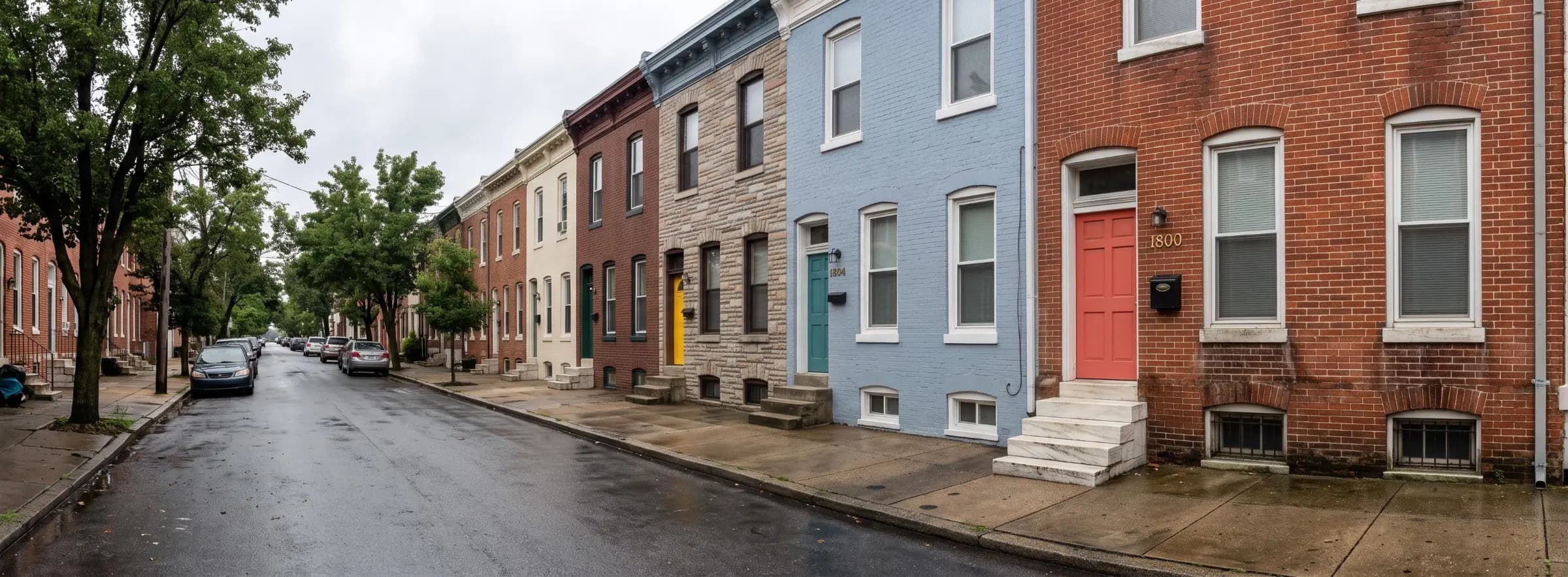
U.S. Census Bureau data put the median year built for Baltimore homes at 1949, and about 52% of units were built before 1950. Many are brick rowhouses with stone or brick foundations, lath and plaster walls, and party walls shared with neighbors, none of which were built with modern vapor barriers or drainage. Water from a roof or plumbing leak next door can enter a shared wall, so a stain on your side may start at a different address. Nearly 13,000 vacant homes across the city add to the problem, because a vacant rowhouse with a failed roof can feed moisture into the occupied home beside it.
Basement moisture and groundwater
Water enters Baltimore basements through foundation walls, cracks in the floor slab, and the joint where the wall meets the slab, then settles into wood joists, paneling, and stored cardboard. Finished basements make basement mold harder to catch, since drywall and carpet trap moisture against masonry and hide growth until a musty odor appears.
Summer humidity and air conditioning
Central air conditioning removes moisture, but a clogged condensate drain, wet duct insulation, or a duct run through an unconditioned attic lets condensation collect and feed growth in the air handler and ducts. Rowhouse systems tucked into tight basements and attics are checked rarely, and their long drain lines clog easily. Mold in HVAC components spreads spores through every room the system serves, so a musty smell that starts when the air conditioning starts points to this source.
Sewer backups and urban flooding
Heavy rain overloads Baltimore's sanitary sewers, which have sent overflows into the Jones Falls during storms, and low lying neighborhoods flood when drains cannot keep up. On July 28, 2026, thunderstorms flooded streets in Canton, Fells Point, and East Baltimore, and floodwater that reaches a basement or ground floor counts as Category 3 water under IICRC S500 because it can carry contaminants. Porous materials that stay wet past 24–48 hours often start growing mold, so homes hit by this summer's storms can still show growth in October.
Mold risk by Baltimore neighborhood
Mold risk in Baltimore is highest in Canton and Fells Point near the harbor, in Remington and Hampden along the Jones Falls, and on repeatedly flooded streets in Southwest and East Baltimore. Blocks where vacant rowhouses share walls with occupied homes carry higher risk too, and individual blocks vary by elevation, roof condition, and sewer line age, so risk in any one house still depends on its own moisture history.
 Floodwater that reaches a ground floor counts as Category 3 water under IICRC S500 because it can carry contaminants. Porous materials that stay wet past 24 to 48 hours usually have to be removed.
Even a street with no flood history can see mold after water damage when a single storm sends water into a basement, so check basement walls and floors after any heavy rain, wherever you live in the city. Low blocks near the harbor and along the Jones Falls take the water first, so those basements deserve a closer look after every major storm.
| Area | Housing type | Main moisture driver | What to check first |
|---|---|---|---|
| Canton and Fells Point | Brick rowhouses near the harbor | Low streets flooded on July 28, 2026 | Ground floor and basement walls, baseboards |
| Remington, Hampden, and Mount Washington | Rowhouses and converted mills near the Jones Falls | Jones Falls flooding and stormwater overload | Basement walls, floor drains, sump pump |
| Beechfield and Southwest Baltimore | Rowhouses and detached homes | Repeated flooding along Frederick Avenue | Basement and crawl areas after each major storm |
| West Arlington and Northwest Baltimore | Mid century detached and semi detached homes | Reported basement flooding in heavy storms | Sump pump with battery backup, window wells |
| East Baltimore, including Orville Avenue | Rowhouses | Street flooding on July 28, 2026 | Basement floors and stairwell walls |
| Cherry Hill and South Baltimore | Low lying rowhouses and apartments | Floodwater reaching homes in heavy rain | Ground floor flooring and wall cavities |
| Carrollton Ridge and West Baltimore | Rowhouse blocks with roughly 800 vacant homes as of 2022 | Shared party walls with vacant neighbors | Stains and odor along shared walls, roof condition |
Residents who suspect a vacant neighbor is feeding moisture into a shared wall can report the property to 311, which starts a Housing Department process. Dated photos of stains and odors give the inspector a record of the pattern.
How to spot mold in a rowhouse
Mold in a Baltimore rowhouse looks like fuzzy, speckled, or slimy growth in white, green, gray, or black, and it comes with a musty odor that returns after cleaning. Staining that reappears after repainting, peeling paint, and warped trim also point to moisture that has been present for days or weeks.
 IICRC S520 treats framing lumber above 19% moisture content as a warning level, and decay can begin near 28%. Take a second reading on a dry wall elsewhere in the home so you have a baseline to compare against.
Moisture readings confirm what the eye suspects: IICRC S520 treats framing lumber above 19% moisture content as a warning level and readings near 28% as the point where wood decay can begin. Location helps too, because the most common signs of mold in older Baltimore homes cluster in basements, top floors, and bathrooms, and each spot points to a different moisture source.
| Where it appears | What you notice | Likely cause |
|---|---|---|
| Basement walls and joists | Gray or white fuzz on wood, damp insulation, musty odor | Water through foundation walls, failed or missing sump pump |
| Brick, stone, or block foundation | White crystalline powder that dissolves in water | Efflorescence from water moving through masonry, sometimes with mold on dust and debris |
| Top floor ceiling and attic | Brown rings and dark patches near the roofline | Flat or low slope roof leaks, failed flashing, poor attic ventilation |
| Interior bathroom | Black spots on the ceiling and grout | No window and a missing or undersized exhaust fan |
| Baseboards along a shared wall | Stains or odor along one wall | Moisture from a neighbor's leak or a vacant home |
| Supply registers and air handler | Musty odor when the air conditioning starts, dark dust at vents | Clogged condensate drain, wet duct insulation |
Hidden growth is common behind plaster, paneling, and baseboards on shared walls. A musty odor with no visible source, or symptoms that ease when you leave the house, justify a professional mold inspection with a moisture meter and a thermal imaging camera.
Mold species common in Baltimore homes
Baltimore mold species follow the moisture history: Cladosporium on damp surfaces, Aspergillus and Penicillium after leaks and backups, and Stachybotrys chartarum and Chaetomium after a week or more of saturation. Species cannot be confirmed by eye, so only a lab report from an inspector settles the question.
 Air samples are compared against an outdoor sample taken the same day, and only the lab report names the species. Because the removal plan rarely changes with the species, sample to answer a specific question such as a dispute or a clearance check.
The CDC does not recommend routine sampling to identify species, because the response to visible indoor mold is the same. Dark growth is often called black mold, but only lab results confirm Stachybotrys, and confirmed black mold removal calls for stricter containment than a typical job.
| Mold | Where it appears | What it tells you |
|---|---|---|
| Cladosporium | Cool damp surfaces such as bathroom walls, window frames, and ductwork | Humid conditions; allergic reactions are the main concern |
| Aspergillus and Penicillium | Water damaged drywall, insulation, and basement materials; often reported together as Asp/Pen in air tests | A recent or ongoing water event |
| Stachybotrys chartarum | Drywall paper and wood that stay saturated for a week or longer, including after sewage backups | A long unfixed leak or flood |
| Chaetomium | Water damaged drywall paper and wood after flooding | Heavy water exposure; removing wet material is the main fix |
The first 24 to 48 hours after a flood
After a basement flood or sewage backup, the first 24–48 hours decide whether the job stays a cleanup or becomes a mold remediation. Mold can begin growing on wet porous materials within that window, so removing water and soaked materials quickly matters more than any product you spray.
 Wet drywall wicks moisture above the visible water line, so a cut that stops short of the stain leaves wet board behind. Meter the remaining drywall and the framing before anything is closed up.
Sewage and floodwater can carry bacteria, so wear rubber boots, waterproof gloves, and an N95 respirator, keep children and pets out, and leave the HVAC off if water reached the furnace, air handler, or ducts. Wash your hands and any exposed skin with soap and clean water after handling wet materials.
1. Shut off power to wet areas
Turn off the breaker for any wet circuit only if you can reach the panel without standing in water. If water is near the panel or outlets, call BGE and an electrician before you enter the area.
2. Report a sewage backup to 311
Call 311 or use the 311 portal as soon as you discover the backup and before you hire a cleaner. A DPW inspector confirms the cause, and that finding decides whether you qualify for city cleanup or reimbursement.
3. Document the damage
Photograph and video the water line, the damaged items, and the room before you move anything. Keep every receipt for equipment, cleaning, and labor, since insurers and DPW reimbursement both require documentation.
4. Remove water and wet porous materials
Extract standing water first, then remove carpet, padding, insulation, and drywall that contacted sewage or floodwater, because EPA flood cleanup recommendations call for discarding porous items that cannot dry within 24–48 hours. Bag contaminated debris and keep it out of living areas.
5. Dry the structure mechanically
Run commercial dehumidifiers and air movers until framing lumber reads 16% moisture content or lower. Household fans and open windows do not dry masonry and joists fast enough in a humid Baltimore summer.
6. Call your insurer and a certified remediator
Notify your insurer the same day, and call an IICRC certified firm when sewage or floodwater is involved or when more than 10 square feet of material is wet. A crew that provides emergency mold removal can set up containment and start drying before growth takes hold.
What the city pays after a sewage backup
Baltimore's Department of Public Works pays for cleanup after some sewage backups through two programs. Sewage Onsite Support (SOS) cleanup sends a crew at no cost, and the Expedited Reimbursement Program repays up to $5,000 per dwelling per occurrence for documented disinfection and cleaning costs. Both apply only when DPW determines the backup came from a capacity related wet weather event, and a resident can use one program, not both.
 City reimbursement covers documented disinfection and cleaning only, so photograph the drain, the water line and the treated floor and keep every receipt. Flooring, drywall and belongings are excluded from both programs.
You must be a City residential customer, which includes tenants and owners, and you should report the backup to 311 as soon as you discover it so an inspector can confirm the cause. Reimbursement applications must reach DPW within 90 days, and the Expedited Reimbursement Program excludes property damage such as flooring, drywall, and belongings.
Backups caused by roots, wipes, grease, or pipe maintenance problems fall outside both programs, and DPW directs those claims to the Baltimore City Law Department, which evaluates each on its merits. Property damage claims go through the same Law Department process, and a claim and a reimbursement application can be filed at the same time as long as the same cleanup cost is not recovered twice.
Neither program pays for mold remediation, rebuilding, or lost belongings, so mold that develops after a covered cleanup falls to you or your insurer. Keep the SOS or reimbursement paperwork with your remediation records because it documents when the water entered and what was disinfected.
Insurance for mold and sewer backup
Standard homeowners policies in Maryland generally do not cover sewer backup or flooding, but state law requires insurers to offer water and sewer backup coverage in writing at application and renewal. Mold coverage depends on the cause: mold that results directly from a covered sudden event, such as a burst pipe, is more likely to be paid than mold from chronic seepage or flood.
A water backup endorsement pays for damage when sewage or sump pump overflow enters through pipes and drains designed to carry it away, according to the Maryland Insurance Administration. It does not cover surface water entering through doors, windows, or foundation walls, which requires a separate flood policy.
Ask your agent in writing whether the policy carries a water backup endorsement and what the separate mold limit is, since a capped mold limit can fall well short of a finished basement job. Whether homeowners insurance covers mold depends on the cause of the water, the endorsements you hold, and how quickly you reported the loss, so file the claim promptly.
DIY or professional mold removal
Clean mold yourself only when it covers less than 10 square feet, sits on a nonporous or lightly affected surface, and comes from a moisture source you have already fixed. Supplies for a qualifying job cost $200–$400, and anything outside those limits belongs with a certified professional.
 Detergent and water work on tile and grout, and the area should be dried completely afterward. Caulk that stays stained after cleaning is better replaced, and a stain that returns within days means the moisture source is not fixed.
The EPA 10 square foot threshold marks when mold remediation is required in most homes, but Baltimore properties add conditions that override size. Homes built before 1978 may have lead paint beneath the mold, older plaster and pipe insulation may contain asbestos, and sewage or floodwater contamination makes any size job a professional one. Test before you cut or sand, since disturbing lead or asbestos creates a larger hazard than the mold.
| Situation | DIY or pro | Why |
|---|---|---|
| Under 10 sq ft on tile, glass, or sealed surfaces, with the source fixed | DIY | Detergent and water remove surface growth |
| Under 10 sq ft on drywall, plaster, or wood | Pro assessment | Growth usually extends below the surface |
| Any size after a sewage backup or floodwater | Pro | Category 3 water requires containment and removal of porous materials |
| Mold in a home built before 1978 where plaster or paint will be disturbed | Pro | Lead and asbestos testing come before demolition |
| Mold on a shared wall with a vacant or neighboring home | Pro plus a 311 report | The moisture source is outside your control |
A qualifying patch calls for an N95 respirator, gloves, goggles, and detergent and water, which keeps DIY supplies near $200–$400. Bleach does not reach growth inside porous materials, so drywall and wood are cut out and replaced instead.
Mold remediation cost in Baltimore
Mold remediation in Baltimore typically costs $1,500–$6,000 for a standard job, with small patches near $300–$800 and finished basements or sewage backups reaching $5,000–$20,000. Contractors price most jobs from the national range of $10–$25 per square foot and then adjust for access, materials, and demolition.
 Ask the contractor to measure the affected area with you and write the square footage on the estimate. Two or three written quotes built on the same measurement are the only fair way to compare price.
Baltimore jobs follow the usual mold remediation cost structure, but narrow basements, single entrances, and plaster walls push crews toward the higher end of each range. Plaster removal is slower than drywall removal, which adds labor in older rowhouses.
| Scope | Cost | What drives it |
|---|---|---|
| Surface patch under 10 sq ft | $300–$800 | Minimum service charge; DIY supplies run $200–$400 |
| Single room or wall section, 10–100 sq ft | $1,000–$3,500 | Drywall or plaster cutouts, containment, HEPA cleaning |
| Unfinished basement, 100–300 sq ft | $1,500–$6,500 | Masonry cleaning, joist treatment, source repair coordination |
| Finished basement with demolition | $5,000–$15,000 | Drywall, carpet, and framing removal and disposal |
| Top floor or attic after a roof leak | $1,500–$8,000 | Roof repair must come first; plaster removal is slower than drywall |
| Whole level with HVAC involvement | $6,000–$20,000 | Duct cleaning or replacement, coil cleaning, containment across rooms |
| Sewage backup with mold | $5,000–$20,000+ | Category 3 protocol, removal of all porous materials, disinfection |
Where the mold sits changes the price as much as how far it has spread. The same patch costs far more behind plaster or inside a party wall cavity than on an open masonry wall, because crews have to open the surface, contain the dust, and haul out debris before cleaning starts. Hidden growth is also common, and a moisture meter reading at the quote stage often shows the affected area is larger than the visible stain.
| Location | Cost | Baltimore factor |
|---|---|---|
| Unfinished basement walls and joists | $1,500–$6,500 | Stone and brick foundations, low headroom, drain and sump repairs |
| Finished basement | $5,000–$15,000 | Drywall, carpet, and framing removal; rebuilding billed separately |
| Top floor ceiling after a roof leak | $1,000–$5,000 | Source repair first; plaster adds labor and disposal weight |
| Interior bathroom without a window | $500–$2,500 | Ceiling and grout growth; exhaust fan upgrade is extra |
| Party wall cavity | $1,500–$6,000 | Access through plaster, and coordination with a neighbor if the source is next door |
| HVAC system | $600–$10,000+ | Coil and duct cleaning or replacement, condensate repair |
A quote that lists only a lump sum is hard to check, so ask the contractor to state the affected square footage and the rate applied, which matches the cost per square foot method most firms use to price mold work. Remediation quotes usually cover removal and cleaning only. Replacing drywall, plaster, flooring, and trim is billed separately and can double the total. After major storms such as July 28, 2026, crews book out and some firms add rush charges, so collect two or three written quotes before accepting.
Mold inspection and testing costs
A mold inspection in Baltimore typically costs $300–$700, and independent clearance testing after remediation adds $200–$1,200 depending on the number of samples. Hire the inspector separately from the remediator, because a company that both tests and removes mold has a financial reason to find more of it.
 A thermal camera shows temperature differences that can point to moisture behind a wall, but only a moisture meter reading confirms it. Ask that the report record both for every area flagged.
A typical mold inspection cost covers moisture meter readings, thermal imaging, and air or surface samples compared against an outdoor control sample. The written report should list sample locations, lab results, and moisture readings so you can hold the remediator to a measurable target.
| Service | Cost | What it includes |
|---|---|---|
| Visual inspection with moisture meter and thermal camera | $300–$700 | Moisture mapping, photos, written findings |
| Air or surface samples with lab analysis | $75–$250 per sample | Outdoor control sample and lab spore counts |
| Clearance testing after remediation | $200–$1,200 | Visual check, moisture readings, and air samples confirming the work area is clean |
Whether the samples come from mold testing before the work or clearance testing after it, a written lab report gives you a document for insurers, lenders, and future buyers. A failed clearance result sends the contractor back to correct the work before reconstruction begins.
Help paying for mold remediation
Baltimore homeowners can get up to $10,000 toward mold remediation through Maryland's WholeHome Critical Home Repairs Grant if they own and live in the home and earn at or below 150% of the county area median income. Baltimore City repair loans and Green & Healthy Homes Initiative assessments can also help eligible owners, and many people never check before paying out of pocket.
 Assistance programs usually ask for proof of ownership, household income, and a written scope of work, so gather them before you apply. Photograph the damage before any work starts, since the photos support both an application and an insurance claim.
The WholeHome grant opened for applications on January 22, 2026 and awards money first come, first served until the funds run out, so confirm with the Maryland Department of Housing and Community Development that money remains before you plan around it. Apply before you sign a remediation contract so you know what the program will and will not pay for.
| Program | Who qualifies | What it covers | How to apply |
|---|---|---|---|
| WholeHome Critical Home Repairs Grant | Owner occupants at or below 150% of area median income | Up to $10,000 for roof, heating or cooling, electrical, plumbing, and mold or mildew remediation | Apply through the Maryland Department of Housing and Community Development |
| Baltimore City housing rehabilitation loans | Owner occupants with household income up to $74,800 for one person and $141,000 for eight | Roof, heating, plumbing, and electrical repairs, plus grants for lead and accessibility work | Initial application with the LIGHT Intake and Assessment Unit at (410) 396-3023 |
| Green & Healthy Homes Initiative | Low income Baltimore City families | Healthy homes assessments for allergens and moisture, weatherization, and lead hazard reduction | Application help for the city's LIGHT program |
Baltimore's housing rehabilitation program serves only owner occupied properties, and some of its loans may be forgiven or deferred. Mold remediation is not named in its covered work, so use it to fix the roof, pipe, or drain that caused the mold and use the state grant for the cleanup. Renters do not qualify for either program, because both require owner occupancy, and a tenant's route is written notice to the landlord and a 311 report.
Maryland licensing and hiring
Maryland does not issue a mold remediation license, so the credentials that matter are IICRC certification and, for any rebuilding, a Maryland Home Improvement Commission license. The 2008 Maryland Mold Remediation Services Act would have created a state license, but its start was postponed for budget reasons and the subtitle terminated on July 1, 2019. Any company advertising a state mold license deserves a follow up question about what the license actually covers.
 Verify the MHIC license number in the Maryland Department of Labor search and confirm any IICRC credentials with the issuing body before you sign. Hiring a licensed contractor also keeps you eligible for the MHIC Guaranty Fund if the work goes wrong.
The Maryland Home Improvement Commission licenses contractors who renovate homes and apartment buildings of three or fewer units, which covers tearing out and replacing drywall, plaster, framing, and flooring after the mold is gone. Ask for the MHIC license number even when the quote covers removal only, and verify it through the Maryland Department of Labor license search before signing. IICRC credentials show training in the S520 process: the Applied Microbial Remediation Technician (AMRT) certification for technicians and Certified Firm status for the company. Inspectors should hold an ACAC credential such as Council certified Microbial Investigator (CMI) or Indoor Environmental Consultant (CIEC), and each credential should be verified through the issuing body.
Written bids should state the affected area in square feet, the containment method, the disposal plan, and whether independent clearance testing is included, and a bid that skips any of those is a reason to choose a different mold remediation company. Decline contractors who demand full payment upfront or pressure you to sign the same day.
Lead paint rules for pre-1978 rowhouses
Most Baltimore rowhouses predate 1978, so tearing out moldy plaster or trim can disturb lead paint. EPA's Lead Renovation, Repair and Painting rule requires a firm to hold EPA certification before it performs covered work in a home built before 1978, and demolition of painted surfaces is always covered no matter how small the area. Ask for the firm's certification number and how it will contain dust. Maryland also requires owners of rental homes built before 1978 to register with the Maryland Department of the Environment and provide lead inspection certificates at each tenant turnover, so a landlord should confirm the certificate is current before and after mold work.
How long mold remediation takes
Most Baltimore mold remediation jobs take 1–7 days of active work and 3–21 days from first visit to final clearance, depending on size, drying, and lab turnaround. A separate roof, plumbing, or waterproofing repair adds time before remediation can start.
 A HEPA negative air machine keeps the work area at lower pressure so air flows into the containment, not out of it. The barriers stay up until the area passes clearance testing.
Crews follow the ANSI/IICRC S520 sequence of containment, removal, cleaning, drying framing to 16% moisture content or lower, and post remediation testing. Clearance lab results usually return within 24–72 hours, and reconstruction begins only after the work area passes.
| Job type | Active work | Total with drying and clearance |
|---|---|---|
| Small room or single wall section | 1–2 days | 3–5 days |
| Unfinished basement | 2–4 days | 5–10 days |
| Finished basement with demolition | 4–7 days | 8–14 days |
| Top floor after a roof leak | 2–4 days | 5–10 days, plus roof repair first |
| Sewage backup with mold | 4–7 days | 10–21 days |
| HVAC system | 2–4 days | 5–9 days |
Two things stretch the mold remediation process more than the mold itself: waiting for a roofer, plumber, or waterproofer to fix the source, and waiting for an insurance adjuster to approve the scope. Scheduling the repair trade and the remediator in the same week keeps the work area from sitting open and wet.
Staying in the house during remediation
Most homeowners can stay on unaffected floors while a contained basement or single room is treated, because containment and negative air keep spores in the work zone. Leave during the job when sewage was involved, when the HVAC system is being cleaned, or when someone in the home has asthma or a weakened immune system. In a rowhouse the work zone often shares a stairwell with living space, so ask the contractor how it will seal the stairs and where hoses and cords will run. Contents are handled item by item: hard nonporous items are cleaned, while porous items that touched mold, such as mattresses, upholstery, and stored paper, are often discarded. If a covered loss made the home unlivable, check whether your policy includes additional living expenses.
Baltimore tenant mold rights
Baltimore tenants who find mold should send the landlord written notice and report the moisture source to 311, which starts a Department of Housing inspection. Maryland's Tenant Mold Protection Act, in effect since July 1, 2025, requires landlords to assess reported mold within 15 days of written notice and complete remediation within 45 days of the assessment, with extensions allowed when delays are unavoidable.
 Take dated photos of the stain and any leak source before you report it, and keep a copy of every written notice. Those records support a 311 complaint, an escrow filing, or a legal aid case.
The Tenant Mold Protection Act also requires landlords to give tenants a mold information pamphlet at lease signing and on request. It directs state agencies to develop uniform standards for mold assessment and remediation in rentals, which gives tenants an objective measure when a landlord disputes whether mold is present.
Fewer than half of Baltimore homes are owner occupied (47.5%, according to Census Bureau QuickFacts), so rental mold is a common situation. Landlords must register and license their rental properties with the city, and licensed rentals are subject to inspection, so a documented 311 complaint creates an official record that can affect the landlord's rental license.
If a landlord misses the 15 day or 45 day deadline, tenants can file a Housing Department complaint, ask the District Court to hold rent in escrow, or contact legal aid. Tenants should not withhold rent on their own, because skipping the escrow process can expose them to an eviction filing.
Reporting mold in Baltimore County
Tenants outside the city limits use Baltimore County's process instead of the city's 311 inspection route. Baltimore County Code Enforcement takes housing complaints by phone at 311 or 410-887-3351, through the BaltCoGo app, or with an online form, and it covers rental conditions such as unsanitary conditions and unsafe structures. Include your name, contact details, and the exact address of the violation, then track the case online. The county does not name mold in its list of examples, so describe the moisture source and the visible growth in the complaint.
Buying or selling a home with mold
Maryland sellers must give buyers either a Residential Property Disclosure Statement or a Disclaimer Statement before the buyer signs a contract, and even a disclaimer does not excuse a seller from disclosing latent defects the seller actually knows about. A buyer who does not receive either form before contract can rescind within five days after receiving it.
 Fresh paint can hide past water damage, and old stains often bleed back through. A stain on a kitchen or bathroom ceiling usually points to a leak from the floor above, so ask when it was repaired and request the invoices.
Section 10-702 of the Maryland Real Property Article defines a latent defect as one a buyer could not reasonably find by visual inspection and that poses a direct threat to health or safety. Active mold behind a finished basement wall that the seller has seen or smelled fits that definition.
Baltimore sellers should state known water intrusion, past basement flooding, sewage backups, and prior remediation, and keep invoices, clearance reports, and DPW records as proof. A seller who remediated mold before listing should still disclose it, since the rules for disclosing mold when selling a house turn on what the seller knows, and a freshly painted basement ceiling or new flooring does not erase that duty.
The disclosure form states it is not a substitute for a home inspection, so buyers should schedule a mold inspection with moisture readings and a thermal scan during the contingency period. Ask whether a neighboring rowhouse is vacant, request sump pump and backwater valve records, and look for staining on basement walls near the floor.
Preventing mold in a Baltimore home
Preventing mold in an older Baltimore home means controlling three moisture sources: water entering through the foundation and roof, sewer or drain backups, and indoor humidity. Keeping relative humidity between 30% and 50% and fixing leaks within 24–48 hours stops most growth before it starts.
 Check shared walls and the top floor ceiling each season, and photograph anything new. A stain that grows on a shared wall may come from the house next door, so keep dated photos and tell the city if the source is a neighbor's property.
In a Baltimore rowhouse, two of the biggest preventable risks start outside your own walls: sewage backing up through floor drains, and a vacant neighbor's failed roof or plumbing sending moisture through a shared wall. A backwater valve and a seasonal walk along shared walls, stairwells, and the top floor ceiling do more than humidity control alone.
| Action | When | Why it works |
|---|---|---|
| Test the sump pump and battery backup | Monthly and before forecast storms | A pump that fails during a power outage lets groundwater into the basement |
| Clean gutters and extend downspouts away from the foundation | Spring and fall | Roof water dumped near the foundation soaks basement walls |
| Run a dehumidifier in the basement | May through October | Holds relative humidity at 30%–50%, below the level mold needs |
| Flush the HVAC condensate drain | Each spring | Prevents overflow into the air handler and ducts |
| Inspect the roof, flashing, and top floor ceiling | After major storms | Catches leaks before they reach plaster and attic framing |
| Ask a licensed plumber about a backwater valve | Once | Blocks sewage from flowing back through floor drains |
| Check shared party walls and stairwells for stains or odor | Each season | A vacant or neglected neighbor's leak often shows up on your side first |
| Photograph basement walls and joists | Each season | Dated photos show new staining and support insurance claims |
Frequently asked questions
Can mold from this summer's Baltimore flooding still appear?
Yes, mold after flooding from the July 28, 2026 storms can still appear months later, especially behind baseboards, under flooring, and inside wall cavities that never fully dried. Look for a musty odor that grows stronger in damp weather, staining that returns after painting, or flooring that cups or lifts. A moisture meter reading above 19% in framing lumber means the area is still wet enough for growth and should be assessed by a professional.
Can mold in a vacant rowhouse next door spread to my home?
Yes, mold can move into an occupied home through a shared party wall when water from a failed roof or plumbing line saturates the wall. Spores travel through gaps around pipes and wiring, and persistent moisture lets them grow on your side. Report the vacant property to 311 so Housing inspectors can act, and have a professional inspector check the shared wall in your home.
Is white powder on a basement wall mold?
Not always, because white powder on brick, stone, or block is often efflorescence, a mineral salt left behind when water moves through masonry. Efflorescence is crystalline and dissolves when sprayed with water, while mold looks fuzzy or spotted and smears or spreads. Either way the powder signals moisture entering the wall, so fix the water source before you try DIY mold removal on any fuzzy growth, and have growth that returns assessed.
Does Maryland license mold inspectors?
No, Maryland does not issue a state license specific to mold inspectors or mold remediators as of 2026. Look for an ACAC credential such as CMI or CIEC and ask for the certificate number, then confirm the inspector has no financial tie to the remediation company.
Do Baltimore City's sewage cleanup programs cover Baltimore County homes?
No, Sewage Onsite Support cleanup and Expedited Reimbursement are limited to Baltimore City residential customers. Baltimore County residents report backups to the county's Bureau of Utilities, and homeowners in other counties contact their local utility. Maryland's contractor licensing and seller disclosure rules apply statewide, so those protections follow you across county lines.
Will a sump pump stop mold in a Baltimore basement?
A sump pump helps only when the moisture source is groundwater, and it does not stop sewage backups or humid summer air. A pump with a battery backup keeps working during storm power outages, and a dehumidifier is still needed to hold relative humidity at 50% or lower. If the basement already has mold, remove it first because a pump does not dry walls and joists that stayed wet.
Can I clean up before the insurance adjuster arrives?
Yes, after you photograph and video the damage, because most policies require you to prevent further loss. Remove standing water, run dehumidifiers, and keep photos or samples of soaked materials along with receipts for equipment and labor. Wait for adjuster approval before demolishing finished surfaces you plan to claim, unless sewage or active mold growth makes delay unsafe.
Is there financial help for mold remediation in Baltimore?
Yes, for some owner occupants. Maryland's WholeHome Critical Home Repairs Grant pays up to $10,000 per homeowner for repairs that include mold or mildew remediation, with eligibility at or below 150% of the county area median income. Funding is first come, first served and may run out, so confirm availability with the Maryland Department of Housing and Community Development. Baltimore City also offers repair loans and Green & Healthy Homes Initiative assessments for eligible homeowners, but renters do not qualify for these programs.
- IICRC S520: Standard for Professional Mold Remediation
- EPA: Flood Cleanup to Protect Indoor Air and Your Health
- Maryland Home Improvement Commission: Licensing FAQs
- Baltimore DPW: Basement Backup Reimbursement Program
- Maryland DHCD: WholeHome Critical Home Repairs Grant
- Baltimore DHCD: Housing Rehabilitation and Repairs
- Maryland Insurance Administration: Flood Damage vs. Water Damage
- Maryland Code, Real Property § 10-702
- Maryland General Assembly: SB 856, Tenant Mold Protection Act
- U.S. Census Bureau: QuickFacts, Baltimore City
Sam Hickerson is the founder of RestoreAdvisor and writes consumer guides on mold remediation, water damage restoration, inspection, testing, and home recovery. His work focuses on helping homeowners understand costs, risks, and when to call a professional. He draws on guidance from the EPA, CDC, IICRC, and other authoritative sources to make complex home issues easier to navigate.