
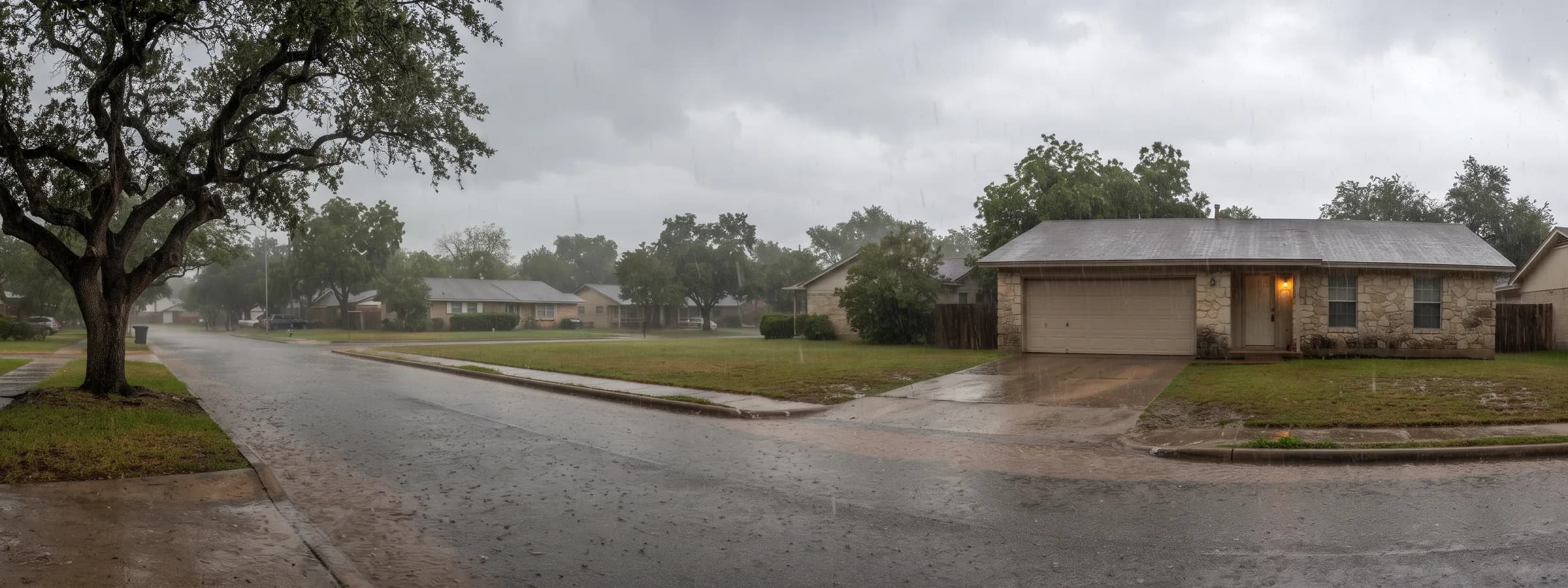

In Austin, a house does not have to sit in a floodplain to take on water. About 10 percent of Austin land lies in a floodplain, according to the City, yet the City also warns that flooding can occur before stormwater reaches a creek and that storm drains in many older or annexed neighborhoods are inadequate or in poor condition. The National Weather Service places Austin in Flash Flood Alley and notes that rainfall has exceeded 5 inches in several hours, so an overloaded street drain can send water across a lawn and under a garage door within a single storm.
In Austin, water damage restoration is the extraction, drying, cleaning, and repair of a water damaged home to the ANSI/IICRC S500 standard, and because the Texas Department of Licensing and Regulation (TDLR) licenses mold assessors and remediators but no state license is written for extracting and drying water, the choice of crew rests on IICRC firm certification, current insurance, and a written scope. Water from a creek, a street, or a yard is Category 3 from the first minute, while water from a supply line starts clean and degrades the longer it sits.
Key insights
- Typical cost. Water damage restoration in Austin costs $1,300–$6,100 for a typical job, with an average of about $3,300.
- Floodplain share. About 10 percent of Austin land lies in a floodplain, and the City says more than 10,000 buildings and 300 bridges in Austin are subject to flooding.
- Drains before creeks. The City says flooding can occur before stormwater reaches a creek, and that storm drains in many older or annexed neighborhoods are inadequate or in poor condition.
- Flood water is Category 3. Creek, street, and yard water that enters an Austin home is Category 3 under ANSI/IICRC S500, so wet carpet, padding, and lower drywall are removed instead of dried.
- Insurer clocks. The Texas Department of Insurance says an insurer has 15 business days to decide a claim after it receives what it asked for, and 5 business days to pay once it agrees.
- Your valve. Austin Water maintains the mains, and the owner maintains the service line past the meter and the customer cut-off valve that shuts off the whole property.
Price ranges for Austin water jobs
Austin water damage jobs usually land between $1,300 and $6,100, with an average of about $3,300. That range describes a typical job, meaning a single affected area that gets dried and, at the top end, repaired, and a loss that spreads across several rooms costs a multiple of it. A small leak caught the same day can start near $300, while flood or storm water through several rooms reaches $8,800–$22,000 or more.
 Wet attic insulation holds water against the ceiling drywall, which is why a storm roof leak bills as drying and drywall replacement on top of the roofer's repair.
According to the Bureau of Labor Statistics, the average hourly wage for construction and extraction work in the Austin metro was about 88 percent of the U.S. average in May 2025. The final water damage restoration cost of an Austin job depends on how much Category 3 street or yard water reached the floors, whether the wet room sits under a second story, and how many crews a spring thunderstorm line has already booked.
| Scenario | Estimates | Austin drivers |
|---|---|---|
| Minor spot mitigation | $300–$1,300 | A small clean water spill dried within a day, often without drying equipment |
| Supply line burst | $900–$2,600 | One room of clean water, costing more when the line fed an attic or an upstairs wall |
| Washer or dishwasher overflow | $1,800–$4,400 | Category 2 water that takes wet padding and lower drywall with it |
| Roof leak during a storm | $2,200–$6,100 | Wet attic insulation and ceilings after hail or wind rain, with the roof repair billed by a roofer |
| Mitigation plus basic repairs | $3,500–$6,100 | Extraction and drying, then replacing drywall, flooring, and paint |
| Sewage backup | $6,100–$12,500+ | Category 3 water, disinfection, and removal of porous materials |
| Flood or storm across several rooms | $8,800–$22,000+ | Category 3 water at ground level, with flood cuts, flooring, and contents |
Extraction and drying are billed as one scope and drywall, flooring, and paint as another, so ask each bidder to price them on separate lines. The mitigation line moves with the number of air movers and dehumidifiers and the days they run, and a bid that leaves out the equipment count or the planned days cannot be compared with one that includes them.
Rates apply to the affected floor area, so a 300 square foot loss is priced on those 300 square feet only. Category 3 drying costs about twice as much per square foot as Category 1 because of disinfection and disposal, and repair and rebuild work costs several times more per square foot than drying.
| Work | Estimates per sq ft | Applies to |
|---|---|---|
| Category 1 mitigation | $2.75–$3.50 | Affected floor area, clean water drying |
| All mitigation | $2.75–$6.50 | Affected floor area, across all categories |
| Category 2 mitigation | $3.50–$5.75 | Affected floor area, appliance and aged water |
| Category 3 mitigation | $6.25–$6.50+ | Affected floor area, flood and sewage water |
| Repair and rebuild | $18–$32 | Affected floor area, drywall, flooring, and paint |
Room costs follow how much flooring, drywall, and cabinetry the water reaches. A living area runs highest because of its carpet or hardwood and the furniture that has to move, while a bathroom runs lowest because the affected surface is small, and a kitchen sits between them because cabinet bases and appliance lines add tear out.
| Room | Estimates | Austin drivers |
|---|---|---|
| Bathroom | $400–$3,900 | Tile, vanity, and subfloor after a supply line or toilet failure |
| Laundry room | $900–$4,400 | Overflow and supply hoses that wet flooring and the wall behind the machine |
| Kitchen | $1,300–$7,000 | Cabinet bases, flooring, and appliance leaks that run under the cabinets |
| Living or family room | $2,900–$16,500 | Large carpet or hardwood areas and contents that have to be moved |
Where the water came from
Category 3 water adds disinfection and removal of porous materials under ANSI/IICRC S500, and that tear out accounts for most of the gap between a pipe leak and a flood that came in at the garage door.
How long it sat wet
Moisture travels into drywall, padding, and framing with every hour, so a crew that starts drying the same day removes less material than one that arrives on day three, and the invoice shows the difference.
After hours calls
Crews that answer at night, on weekends, or on holidays often add an after hours premium of 25–50 percent to their labor, which makes a Friday evening leak pricier to stop than the same leak found Monday morning. When an emergency water damage response can wait until business hours without the water spreading, waiting avoids the premium.
Crew supply in storm weeks
When a spring storm line floods many homes at once, restoration crews, dehumidifiers, and drywall all go to the same neighborhoods, so a loss can start later and cost more than the same loss in a quiet week.
The first 48 hours in an Austin house
Close the customer cut-off valve, cut power to wet rooms from dry footing, record the loss on video, move what is wet, and call the insurer and a restoration crew in the same hour. The first day decides whether clean water stays Category 1 and whether drywall and padding can be dried in place or have to be torn out.
 Narrated video fixes the date and the room in the claim record, and it is the baseline an adjuster compares against the crew's moisture readings later.
Austin Water maintains the water mains, and the owner is responsible for the service line past the meter and for the plumbing inside the house. A customer cut-off valve sits just past the property line on the private side of the meter, and Austin Water says it shuts off flow to the entire property in an emergency or for repairs. The owner maintains that valve, so a valve that sticks is the owner's repair.
1. Find the customer cut-off valve
Close the customer cut-off valve on the private side of the meter. If the water keeps flowing or the leak is in the street, call Austin Water Customer Service at 512-972-1000, which the City lists as available at all hours.
2. Kill power only from dry footing
Switch off the breakers for wet rooms only when the panel is dry and you can reach it without standing in water, and call an electrician or the utility when you cannot.
3. Shoot video before you carry anything out
Walk each room with your phone, narrate what you see, and photograph the source, the water line on the walls, and each damaged item before anything is moved or thrown away.
4. Raise or remove what is wet
Move electronics, papers, and photographs to a dry room, lift furniture off wet carpet, and set the pieces you cannot move on foil or wood blocks.
5. Phone the insurer, then a crew
Report the loss to your insurer the same day and book a restoration crew in the same hour, because drying cannot wait for an adjuster's visit, and keep receipts for every temporary repair.
Water from outside changes the order of work because the EPA says flood water can carry bacteria, chemicals, and sewage, so keep everyone out of the room until the power is confirmed off, wear waterproof boots and gloves, and follow the EPA flood cleanup steps for what to discard. Run generators outdoors and away from doors and windows, because carbon monoxide is a danger during storm outages.
What a homeowner can dry alone
A homeowner can handle a small clean water spill on a hard surface that is caught within a day, and anything larger or dirtier belongs to a crew. The Texas Department of Insurance says mold can start growing within a day after a leak, so a spill that sits for a weekend is no longer a mop job.
| Situation | Owner can dry? | Reason |
|---|---|---|
| Clean spill on tile or sealed floor, under a day old | Yes | Mop, towels, and a fan are enough when no material absorbed the water |
| Wet carpet over padding from a clean source | Sometimes | Extraction speed matters, and padding that stays wet usually has to be removed |
| Wet drywall or insulation | No | Moisture sits inside the wall, where a surface meter cannot read it |
| Appliance discharge, creek, street, or sewage water | No | Category 2 or 3 water needs disinfection and removal of porous materials |
| Water near outlets, panels, or ceiling fixtures | No | Power must be isolated by someone qualified before anyone enters |
How flash floods reach an Austin house
Austin homes take on water from street and yard runoff, overloaded storm drains, hail and wind rain through the roof, air conditioner condensate, supply lines, and, rarely, freezes. Under the ANSI/IICRC S500 standard, Category 1 is clean supply water, Category 2 is used water from an appliance or a drain, and Category 3 is flood water, sewage, or anything that has crossed soil, so water that enters from outside is Category 3 and the source decides how much material is removed and how much is dried.
 The City asks residents to report flooding of a home, yard, or road, so a photo of a blocked inlet like this one belongs in that report.
Clean water left standing for about 48 hours can slip to Category 2, so the first two days set what is dried in place and what goes to the dumpster. Roof and condensate leaks sit inside that window more often than they should, because they can run unseen for days before a stain shows.
| Water source | Category | Effect on the job |
|---|---|---|
| Supply line, water heater, or sink overflow | 1 | Often dried in place when caught within a day or two |
| Air conditioner condensate overflow | 1, degrading if it sits | Wet ceiling drywall and attic insulation are the usual losses |
| Roof leak after hail or wind rain | 1, degrading if it sits | Insulation that stays wet for days is replaced, and the roof is repaired separately |
| Washing machine or dishwasher discharge | 2 | Wet padding and drywall are usually removed instead of dried |
| Creek, street, yard, or storm drain water | 3 | Carpet, padding, and drywall it reaches are cut out and thrown away |
| Sewer lateral backup | 3 | The crew disinfects and removes porous materials while a plumber repairs the line |
The National Weather Service's Austin climate summary says Austin sits in Flash Flood Alley, that thunderstorms can be very efficient rainmakers, and that rainfall amounts have exceeded 5 inches in several hours. May, October, and June are the wettest months, and the late summer and fall rain that tropical systems bring is the other flood season, with Hurricane Harvey in August 2017 leaving 7.94 inches at Camp Mabry and 10.07 inches at Austin Bergstrom.
The City's flood safety information adds a second route that a floodplain map does not show. Austin has more than 1,100 miles of storm drain pipes and small ditches, and in many older or annexed neighborhoods the City says those drains are inadequate or in poor condition, so water can pool on a street and enter a house that is nowhere near a creek. The City also says it can be challenging and expensive to upgrade those systems without affecting homes in nearby floodplains.
The severe weather season runs March through May, and the National Weather Service says the majority of it comes as large hail and strong winds. A roof leak after hail shows up in the attic first, and the insulation holds the water against the ceiling drywall below it, so a stain that appears days after a storm usually means the insulation is already saturated. The Texas Department of Insurance advises policyholders to tarp a roof or cover a broken window but to wait on permanent repairs until the insurer has seen the damage.
Normal highs in Austin stay above 90 degrees from May 26 to September 23, according to the National Weather Service, so air conditioners run through roughly four months, and a clogged condensate line drips into an attic or closet for weeks before anyone sees a ceiling stain. Freezes are the rarest route. Camp Mabry averages about 12 days a year at or below 32 degrees and Austin Bergstrom about 33, and Austin Water says Winter Storm Uri in February 2021 showed that severe and prolonged freezing weather is possible.
Texas rules for restoration crews
Texas does not license water damage restoration as a trade, so no state license number exists to check for extracting and drying water. TDLR licenses mold assessors and remediators, and plumbing and electrical work fall to licensed trades, which leaves IICRC firm certification, insurance, and a written scope as the checks that apply to a water crew.
 A drying plan is measured against ANSI/IICRC S500, so ask the technician which moisture readings will mark the job as finished before any equipment is set.
Under TDLR rules, remediating 25 contiguous square feet or more of visible mold must be done by a licensed mold remediator in most cases, and areas under 25 contiguous square feet can generally be cleaned by someone who is not licensed. The TDLR mold assessors and remediators FAQ adds that certain exemptions apply to buildings with fewer than 10 rental units, including houses, so a water job that turns into a mold job can change who is allowed to do the work.
A restoration crew that also repairs the house works under the City's trade rules. The City's list of residential permits shows stand-alone electrical repair and plumbing repair permits that require contractor registration, so a company that proposes to move a pipe or rewire a wall should name the registered contractor who will pull that permit. Names matter here because choosing a restoration company comes down to who is accountable for each trade on the job, and a crew that cannot name that contractor is a weak candidate.
Vetting an Austin restoration crew
Vet a crew by verifying its IICRC firm certification, insurance, equipment counts, written scope, and billing terms before it sets a fan. Austin homeowners facing flood water are often calling several companies in one afternoon, so a short list of questions to ask a restoration company that each can answer in minutes sorts the crews quickly.
 Ask for the written scope and the equipment count before anything comes off the van, since a price quoted verbally has no scope to check the final invoice against.
1. Look up the IICRC firm by company name
Search the IICRC Certified Firm listing for the exact company name on the contract, because a technician's certificate does not make the company certified, and write down the answer in your claim notes.
2. Ask for current insurance certificates
Request liability and workers' compensation certificates in writing from the insurer's agent, and read the dates, since a card with an expired date proves nothing about today's job.
3. Get the equipment count and the planned days
Ask how many air movers and dehumidifiers will run, in which rooms, and for how many days, and ask that the answer appear on the scope so the invoice can be checked against it.
4. Sign a scope before any demolition
Ask for a written scope that lists what will be cut out, what will be dried in place, and who rebuilds, and approve additions in writing so a flood cut found on day two does not appear as a surprise on the bill.
5. Read the deductible notice
A Texas contract of $1,000 or more that is expected to be paid from insurance must carry a boldfaced notice that the policyholder pays the deductible. A company that offers to waive or absorb it is breaking Texas law, and that offer is a reason to stop.
6. Settle who gets the check
The Texas Department of Insurance says the payment on a home claim usually goes to your mortgage company when you have a loan, and that the mortgage company must contact you within 10 days of receiving it. Ask the crew whether it expects payment from you, from the insurer, or from the mortgage release.
7. Agree to daily moisture logs
Ask for readings on every wet material each visit, taken in the same spots, and for the unaffected reference reading, because the logs are what show that drying is finished.
Read recent reviews on more than one platform, look for specific comments about arrival time, drying logs, and the final invoice, and discount a company whose reviews all arrived in the same week. Before signing, ask what the warranty covers and how the crew handles damage it finds behind walls, since both answers decide who pays when a second problem turns up after the drywall closes.
Proof that the structure is dry
A structure is dry when moisture readings on every wet material match readings from an unaffected reference area of the same material, as ANSI/IICRC S500 describes. A crew that removes the equipment on a set day, whatever the readings say, is leaving moisture inside the walls and floor.
Each visit the technician records temperature and humidity inside and outside, readings from the same marked points on drywall, framing, and flooring, and the equipment running in each room. A log that shows readings falling at every point and ending at the reference value is the document to keep for the insurer and for a later buyer, and a log with gaps is a reason to ask for another visit before the fans leave.
A surface meter only reads the first fraction of an inch of drywall, so ask the technician to confirm wall cavities and lower framing with probes or a thermal camera before the walls are closed. Readings that count as dry differ by material, and dense materials such as hardwood, plaster, and framing hold water longest.
Timeline from extraction to rebuild
A typical Austin job runs 3–7 days of drying and then 1–3 weeks of repairs, with extraction and equipment setup in the first one to two days. Dense materials and Category 3 losses stretch both phases, and storm water damage that hits many homes at once can add waiting time before a crew arrives.
 New flooring and drywall go in only after moisture readings match the unaffected reference, so any added drying day pushes the repair dates back by the same amount.
Hardwood floors can take 7–10 days to dry, while carpet and padding often dry in 2–3 days but are usually replaced instead. A quoted drying time starts counting when the crew begins extraction, so every hour between the leak and the first technician adds to the total, and a crew that cannot arrive until the next day pushes the finish date back by that day.
| Stage | Timing | Work |
|---|---|---|
| Extraction | Days 1–2 | Pumps and extractors remove standing water, and the crew maps the wet area |
| Tear out | Days 1–2 | Padding, wet insulation, and drywall that cannot dry are cut out and bagged |
| Drying | 3–7 days | Air movers and dehumidifiers run while the technician logs readings each visit |
| Cleaning | Days 3–7 | Surfaces are cleaned and disinfected, with Category 2 and 3 losses treated first |
| Repairs | 1–3 weeks | Drywall, flooring, cabinets, and paint are replaced once readings match the reference |
A longer job than quoted usually means that damage found behind a wall added scope or that the readings did not reach the reference. Ask the crew to explain any extension in writing, because the finish date depends on the material, the water category, and whether damage turned up behind a wall.
Insurer deadlines and coverage gaps
A Texas insurer has 15 business days to confirm it received a claim, 15 business days after receiving what it asked for to accept or reject it, and 5 business days to pay once it agrees. The Texas Department of Insurance says the insurer can extend its decision by 45 days if it explains why it needs more time.
 Point out every damaged cabinet, wall, and floor to the adjuster during the visit, because the 15 business day decision clock runs from the date the insurer receives the items it asked for.
Deadlines start with the information you supply, so a clear record moves a claim faster. The Texas Department of Insurance says the insurer subtracts your deductible from the payment, that a home claim with replacement cost coverage can pay twice, first for repairs minus depreciation and then after the work is done, and that a policyholder who disagrees with the amount should send documentation to back up the position.
| Insurer step | Deadline | Detail |
|---|---|---|
| Confirm it received the claim | 15 business days | The company starts its review and asks for information |
| Accept or reject | 15 business days | Counted from receiving what it requested, with a written reason for a rejection |
| Extended review | 45 more days | Allowed only when the insurer explains why it needs more time |
| Pay the claim | 5 business days | Counted from the day it agrees to pay all or part |
| Weather catastrophe | 15 more days | The Texas Department of Insurance can extend deadlines after a weather related catastrophe |
Most Texas home policies cover sudden and accidental water damage such as a burst pipe, a toilet overflow, or a broken washer hose, and usually do not cover gradual leaks or seepage. The Texas Department of Insurance also says damage that was hidden from view usually must be reported within days after you first see it, mold cleanup is usually an add on, and a flood needs a separate flood policy. The date of the first stain therefore matters, so write it down and keep it with the photographs and receipts that go into filing a water damage claim.
Fighting a late or low claim offer
A Texas homeowner can dispute a late or low claim offer through appraisal, a complaint to the Texas Department of Insurance, or a licensed public adjuster. Appraisal settles only the amount of loss, TDI takes complaints online and by phone, and a public adjuster can charge up to 10 percent of the total the company will pay.
Texas Insurance Code Chapter 1813 requires residential property policies delivered, issued, or renewed in the state to contain an appraisal provision, and it applies from January 1, 2026, according to the Senate analysis of S.B. 458, with appraisal deciding only the amount of loss when the policyholder and the insurer disagree and leaving the policy terms alone. The amount an appraisal sets is binding except for fraud, accident, or material mistake. The chapter does not cover Texas Windstorm Insurance Association or commercial policies, so a policy renewed before that date may still use older wording.
The Texas Department of Insurance licenses public adjusters and lets them charge up to 10 percent of the total amount the company will pay on the claim, including amounts that are not in dispute. TDI suggests asking for the fee as a dollar amount in the contract, allows 72 hours after signing to cancel, and says a public adjuster cannot act as your contractor, nor can a contractor advertise that it will handle your insurance claim.
Before filing anything, send the insurer your documentation next to its estimate, because TDI tells a policyholder who disagrees with a payment to provide documentation that backs up their position. TDI accepts insurance complaints online and at 800-252-3439, and its site shows whether a company has complaints against it, which is worth checking before a policy renews.
Austin permits and floodplain repairs
Austin does not require a permit for every water repair, but structural work, moved plumbing fixtures, and electrical or plumbing work outside the exempt list do need one. The City publishes a list of work exempt from building permits, and Development Services answers permit questions at 512-978-4000 during business hours, which makes a call the fastest check before a crew closes a wall.
 Ask the electrician which permit applies to this repair and who pulls it, because the City lists electrical repair permits that require a registered contractor.
The City's exempt work list covers repairs to leaks in pipes, valves, or fixtures when the work does not require replacing or rearranging them, and a residential gypsum board repair of up to 128 square feet that is not part of a fire rated assembly, a shear wall, or a tub and shower surround. A new shower, tub, or combination replacement is not exempt, and the City's permit types name an interior remodel permit for structural changes or relocated plumbing fixtures.
The City's list of permit types also names drywall repair among the minor repairs that need a permit, which differs from the exempt list's 128 square foot allowance, so call Development Services before closing walls. The City lists emergency repair permits for damage to water lines, the main electrical service, or a building structure, and a contractor should say which permit applies before work begins. Cosmetic work moves faster than structural, electrical, and plumbing work, and a permit delay can hold up the rebuild after the structure is dry.
Floodplain rules apply when you build, redevelop, or remodel in a floodplain, and the City says that if you are simply living in your home you do not need to make any changes. Any repair or remodel in the floodplain must provide a cost estimate of all work proposed on the buildings in the floodplain, and for a residential project the City completes the floodplain review during plan review. The Floodplain Office answers questions at 512-974-2843, and the City's FloodPro tool shows floodplain maps by address.
When water turns into mold
Mold can start growing within a day after a leak, according to the Texas Department of Insurance, so wet drywall, padding, and framing that stay damp past the first two days become a mold job as well as a water job. That is why drying equipment runs until readings match the unaffected reference, and why wet padding and drywall that cannot reach it are removed.
A water job tips into remediation when visible mold appears, when a musty odor persists after the materials dry, or when readings stay above the reference after several days of drying. The mold cleanup itself is usually an add on that most home policies do not include, and the cost and process of mold after water damage differ from drying, because mold work needs containment and, past the TDLR line, a licensed assessor's protocol.
Keep the drying logs and the final reading sheet, because a clean final reading is what separates a water claim from a mold claim later, and an insurer or a buyer can ask for it years afterward. When the water was not removed in time, Austin mold remediation adds species testing, containment, and the licensing that comes with it.
Austin areas and what raises risk
Flood risk in Austin concentrates in creek watersheds, in older neighborhoods with weak storm drains, and at addresses inside a mapped floodplain. The City publishes floodplain maps by address, so the first check on any house is its map status, and the second is whether the street it faces drains well, since flood water damage arrives as Category 3 water either way.
 Check the floodplain map for creek risk and the street in front of the house for drain risk, since each route needs its own check.
Over a 30 year mortgage there is a 26 percent chance of a 100-year storm, according to the City, so a house with no flood history still carries that risk. The City's flood safety information also tells owners to call an insurance agent for a flood quote, which it calls the number one way to protect finances, and to check the address against the floodplain maps before the next storm line.
| Area | Risk factor | What to check |
|---|---|---|
| Onion Creek and Dry Creek East watersheds | The City says the floods of October 30, 2015 and May 26, 2016 produced more than 13 inches of rain in eight hours in portions of these watersheds | Ground floor and garage readings after heavy rain |
| Bull Creek watershed, northwest Austin | Tropical Storm Hermine in September 2010 produced rainfall approaching a 100-year storm over portions of the watershed | Flood zone status and drainage along the lot |
| Southeast Austin near Bergstrom | A low area in the Onion Creek drainage basin where clear winter nights can run 10 degrees colder than Camp Mabry | Wrapped exterior lines and the cut-off valve |
| Older and annexed neighborhoods | The City says storm drain systems in many of these neighborhoods are inadequate or in poor condition | Street inlets, curb flow, and lot grading |
| Any address in a mapped floodplain | The 100-year floodplain is where a storm has a 1 percent chance of occurring in any year, and the City's FloodPro tool shows it by address | FloodPro map and flood insurance quote |
| Northwest Austin and the Hill Country edge | Elevations rise from about 400 feet in the east and southeast to just above 1,000 feet in the northwest, and weather can differ between sectors | Roof condition after spring hail |
Renters, condo owners, and sellers
A renter, a condo owner, and a seller each deal with a different owner of the problem, and Texas law decides some of those lines. A tenant can repair and deduct in a flooding emergency, a condo owner follows the association's declaration, and a seller must deliver a disclosure notice that asks about flooding and water penetration.
Your landlord owns the pipe
Texas Property Code 92.056 presumes seven days is a reasonable repair time after notice, and Section 92.0561 lets a tenant who is current on rent repair flooding from broken pipes immediately after notice of intent, with the deduction capped at one month's rent or $500, whichever is greater. A tenant should keep every notice in writing, because tenant rights after a leak depend on the lease and on the cause of the water.
The association owns the shell
For water damage in a condo, the declaration and the master policy decide whether the association or the owner repairs the wall, the pipe, and the finishes, and a leak between units can involve three insurers. Ask the association for the declaration and the master policy before the crew starts, and photograph the unit before anyone enters it.
The seller must disclose what they know
Texas Property Code 5.008 requires most residential sellers to deliver a seller's disclosure notice, and the form asks about previous flooding and previous water penetration. Buyers should ask for repair records, permits, and any insurance claim history, and a seller who knows of a past leak should treat disclosure as a legal duty.
Prevention before the spring rains
Four habits close most of the paths water uses in Austin, and each costs less than one night of emergency extraction. May, October, and June are the wettest months at Camp Mabry, according to the National Weather Service, so the first two habits belong on the calendar before spring and the last two before summer.
 Water standing in the safety pan means the primary drain line is not keeping up, so clear it before the next cooling cycle.
Exercise the customer cut-off valve
Find the valve on the private side of the meter, turn it off and on once a year, and mark its location, because a valve that has not moved in years can seize when the crew needs it. Austin Water says the owner maintains the valve, so a stuck valve is the owner's repair.
Keep street inlets and gutters clear
Clear leaves and debris from the gutters and from the storm drain inlet in front of the house before spring storms. The City says many older neighborhoods have drains that are inadequate or in poor condition, so a clear inlet matters more there.
Flush the AC condensate line before summer
Clear the condensate drain line and check the safety pan under the air handler before the cooling season starts in May. Normal highs stay above 90 degrees from May 26 to September 23, and an HVAC condensation leak that runs for weeks is a Category 1 loss that gets worse with time.
Get a flood quote before the wet months
Ask an insurance agent for a flood quote before May, because a flood needs a separate policy and the City calls flood insurance the number one way to protect your finances. Ask about the waiting period for a new policy before a storm is in the forecast.
Frequently asked questions
How much does water damage restoration cost in Austin?
About $3,300 for a typical job, within a usual range of $1,300–$6,100. The mitigation visit covers extraction and drying, and rebuilding drywall, flooring, and paint is quoted as its own scope, so a job that needs both adds the two together.
How long does water damage restoration take in Austin?
Drying usually takes 3–7 days, and repairs add another 1–3 weeks. Hardwood, plaster, and framing dry slowest, and a spring storm that floods many homes at once can stretch both phases when crews and materials are in demand.
Is Austin in Flash Flood Alley?
Yes. The National Weather Service describes Austin as located in a region known as Flash Flood Alley, with a history of devastating flash floods, and its climate summary says rainfall has exceeded 5 inches in several hours.
Do I need a permit for water damage repairs in Austin?
Some repairs need one and some do not, since the City exempts repairs to leaking pipes, valves, and fixtures that do not replace or rearrange them, and drywall repair up to 128 square feet outside fire rated and shear wall assemblies, while structural changes and moved plumbing fixtures need permits.
Does Texas require a license for water damage restoration?
No license is written for extracting and drying water. Texas licenses mold assessors and remediators through TDLR, so check IICRC Certified Firm status, current insurance certificates, and a written scope before work starts.
Does homeowners insurance cover flood damage in Austin?
No. The Texas Department of Insurance says home policies do not cover floods, so water that enters from a creek, street, or yard needs a separate flood insurance policy, while sudden and accidental damage such as a burst pipe is usually covered.
How long does a Texas insurer have to pay a water damage claim?
Five business days after it agrees to pay. It has 15 business days after receiving what it requested to accept or reject the claim, and it can extend that deadline by 45 days if it explains why it needs more time.
Who do I call for a water main break in Austin?
Austin Water Customer Service at 512-972-1000, which the City lists as available at all hours. A water main break is Austin Water's repair, while the owner maintains the service line past the meter and the customer cut-off valve.
Do frozen pipes happen in Austin?
Rarely, but they do. Camp Mabry averages about 12 freezing days a year and Austin Bergstrom about 33, and Austin Water says Winter Storm Uri in February 2021 showed that severe and prolonged freezing weather is possible.
How do I check reviews for an Austin restoration company?
Read recent reviews on more than one platform and look for dated, specific comments about arrival time, drying logs, and the final invoice. Then confirm the company's IICRC certification and insurance directly, because a high rating does not verify either.
- IICRC S500
- EPA: Flood Cleanup to Protect Indoor Air and Your Health
- NWS: Austin Climate Summary
- City of Austin: ATX Flood Safety
- Austin Water: Water Leaks
- City of Austin: Work Exempt From Building Permits
- TDI: Getting Your Insurance Claim Paid
- TDI: When Are Water Damage and Mold Covered by Insurance?
- TDLR: Mold Assessors and Remediators FAQ
- BLS: Occupational Employment and Wages in Austin-Round Rock-San Marcos, May 2025
Sam Hickerson is the founder of RestoreAdvisor and writes consumer guides on mold remediation, water damage restoration, inspection, testing, and home recovery. His work focuses on helping homeowners understand costs, risks, and when to call a professional. He draws on guidance from the EPA, CDC, IICRC, and other authoritative sources to make complex home issues easier to navigate.