
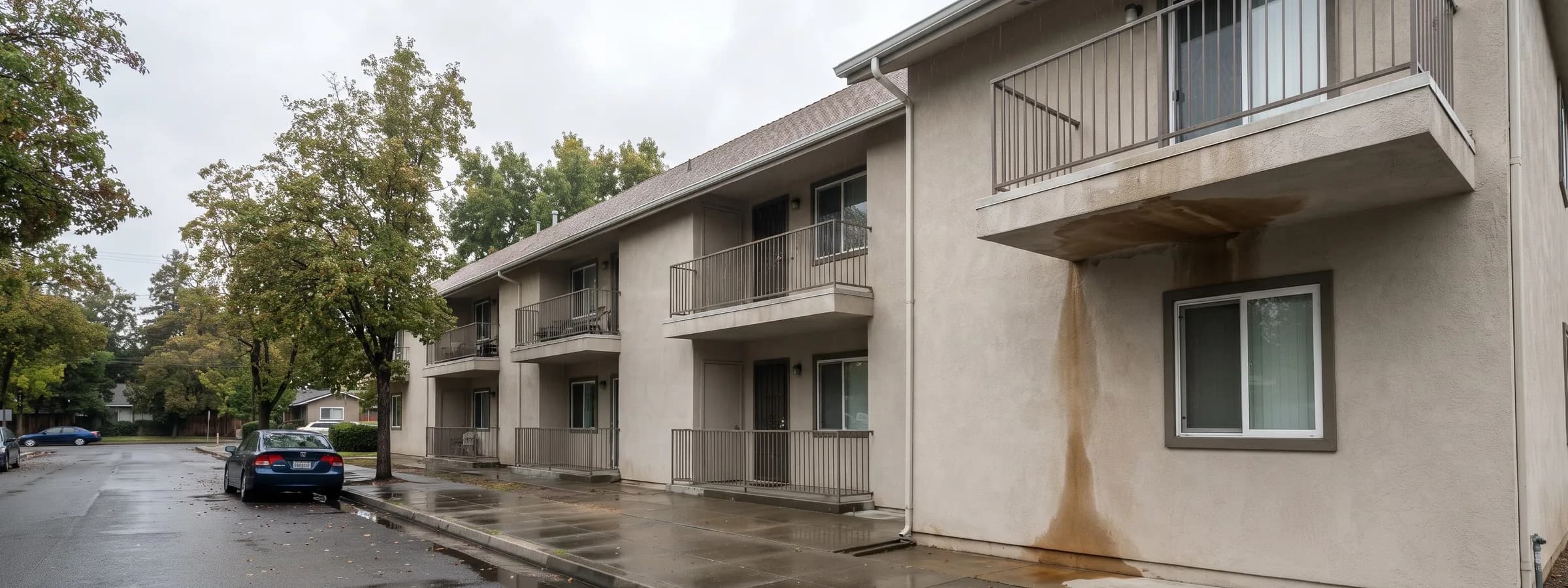

A brown ring on the ceiling under a balcony, a drip after rain, or paint bubbling along the wall means water is getting through the deck above, and the stain is rarely directly under the spot where it enters. Water travels through the deck framing before it drips, so patching the ceiling does nothing until the balcony itself is opened and fixed. A leak that has run through several rain seasons can already be a water damage restoration job that reaches insulation, framing, and the walls beside the balcony door.
Balcony leak water damage is water that passes through a failed balcony membrane, flashing, or drain and wets the framing, ceiling, insulation, and walls below it, and it is classified and dried under ANSI/IICRC S500, the standard for professional water damage restoration. The repair has two separate parts, a balcony contractor who stops the water at the source and a restoration company that dries and rebuilds the room, and who pays depends on which part of the balcony failed and who owns it.
Key insights
- The stain is rarely under the leak. Water travels along the plywood, joists, and wall connection before it drips, so the entry point can sit several feet from the ceiling stain.
- A ceiling repair fails until the balcony is fixed. Patching and repainting the stain while the membrane, flashing, or drain still leaks brings the stain back after the next heavy rain.
- A typical balcony leak job costs $3,500 to $7,900 in total. That covers membrane replacement at $25 to $40 per square foot on a 60 square foot balcony, drying the room below, and replacing a section of ceiling, and framing damage adds thousands more.
- Who pays follows the part that failed. A condo declaration, a lease, or the owner's own responsibility decides who covers the membrane, the structure, the surface, and the ceiling below.
- Mold can start within 24 to 48 hours. The EPA says wet materials dried in that window usually stay mold free, so the room below needs drying before the balcony repair is finished.
- Insurance often treats slow leaks as maintenance. Sudden, accidental damage is more likely to be paid than a membrane that failed gradually over several seasons.
What to do first
Move belongings away from the wet ceiling, shut off power to anything the water has reached, photograph the damage, notify whoever maintains the balcony in writing, and book drying and a source inspection. Acting on them stops the damage from spreading and starts the record that decides who pays, and none of it needs the cause to be known yet.
 A bucket protects the floor for now, but the wet drywall and insulation above the stain keep holding moisture until a restoration company dries them.
Water coming through a light fixture, a ceiling that bulges or sags, or a drip that will not slow turns this into an emergency water damage situation. Cut power at the breaker first, keep people out from under the ceiling, and call a restoration company the same day for extraction and drying while the balcony repair is arranged.
1. Protect the room below
Move furniture, bedding, and electronics out from under the stain, set a bucket under any drip, and lay plastic sheeting over what cannot be moved. Keep people out from under a ceiling that is sagging.
2. Cut power to wet circuits
Turn off the breaker for any light fixture, fan, or outlet near the wet ceiling or wall before touching anything else, and leave the circuit off until an electrician or restoration technician has checked it.
3. Photograph and date the damage
Take wide and close photos of the ceiling, walls, and floor, and of the balcony deck, drain, and railing posts if it is safe to stand there. Outline the edge of each stain in pencil with the date so growth after the next rain is visible.
4. Notify the right party in writing
Send an email or letter the same day to the association, property manager, landlord, or owner who maintains the balcony, attach the photos, and report the loss to your insurer. Keep copies of everything with dates.
5. Book drying and a source inspection
Call a restoration company to dry the wet ceiling, insulation, and wall cavity, and a balcony waterproofing contractor to trace the entry point. Hold off on patching the ceiling or caulking the deck until both have looked at it.
Power comes first because water in contact with wiring is an electrical shock hazard, which OSHA's flood response information covers for wet buildings. A ceiling fixture or fan that sits under a leak can carry water into its wiring, so a technician should confirm the circuit is safe before it is switched back on.
Is the balcony the source?
The balcony is usually the source when the stain sits under the balcony slab or along the wall that holds the balcony door, appears or grows after rain, and no pipes run in the ceiling above it. A stain that shows up in dry weather or follows water use points to plumbing or HVAC, and a sliding door sill that stays damp points to the threshold.
 Rust bleeding from a bolt shows water is already reaching the fasteners, which is the signal to have a contractor open the post base before anyone patches the coating.
A stain shows where water finally drips out of the structure. Water that passes the membrane runs along the plywood, the joists, and the wall connection until it reaches a gap, a fastener hole, or a low spot, so the entry point can sit several feet from the stain or on the far side of the deck. A stain beside a ceiling light can trace back to a cracked seal at a railing post across the balcony.
| Source | Pattern | Check |
|---|---|---|
| Balcony membrane or flashing | Stain appears or grows after rain, under the slab or along the door wall | Photograph after each rain and compare |
| Sliding door threshold | Damp sill, swollen baseboard, or soft floor just inside the door | Check the sill and baseboard after rain |
| Plumbing in the ceiling or unit above | Stain follows water use in any weather | Watch the water meter with every fixture off |
| Roof above | Stain on a top floor ceiling or near a roof edge | Look for stains away from the balcony after rain |
| HVAC condensate | Drips near vents or an air handler in warm weather | Check the drain pan and the condensate line |
A damp sill or swollen baseboard just inside the balcony door often means the threshold flashing has failed, which is a window or door leak repair that a door installer handles before the deck is touched. A stain that tracks water use instead of weather needs a plumber to look at the supply and drain lines.
Homeowner checks stay non-invasive: photograph the stain after each rain, clear leaves from the drain, and press on the deck near the wall and door for soft spots. Flood and dye tests are best left to the contractor, who can control the water and watch the room below during the test. Moisture that has already moved into the wall beside the door calls for tracing a leak in a wall with a meter before any finish is removed.
Why balconies leak
Balconies leak where the waterproofing is interrupted: a worn membrane, a cracked tile or open joint, a clogged drain, missing flashing at the wall or door, unsealed railing post holes, or a deck that holds water instead of shedding it. Most leaks start at a joint between two materials, such as the deck and the wall or the deck and a railing post.
 The membrane must tie into the flashing at the wall and the drain body, which makes those two joints the usual starting points when a balcony leaks.
A balcony works as a walkable roof over living space, so it relies on layers that all have to hold: a membrane over the plywood or concrete, flashing where the deck meets the wall and door, a slope toward the drain, and a drain that stays clear. Sun, foot traffic, and temperature swings wear the top layer first, and every joint, post hole, and penetration gives water a place to start.
| Cause | How water gets in |
|---|---|
| Worn or cracked membrane | Sun and foot traffic crack the coating, and water reaches the plywood or concrete |
| Cracked tile or grout | Open joints let water through to the layer under the tile |
| Clogged drain or scupper | Debris holds water on the deck until it finds a way in |
| Missing or failed flashing | Water runs behind the wall finish or under the door where the deck meets the building |
| Railing post holes | Each post hole is an opening, and water follows the fasteners into the framing |
| Poor slope | A flat or back-sloped deck holds water against every joint |
| Movement cracks | The building and the deck move separately, and rigid coatings split along seams |
Most of these causes build slowly, which is why many leaks first show during the heaviest rain of the season: a small opening passes little water until storm volume pushes through it. Resealing a joint or recoating the surface covers the opening without correcting the cause, so a repair that skips the cause leaves the leak in place.
Signs of a balcony leak
The clearest sign of a balcony leak is a water stain, ring, or bubbling paint on the ceiling or soffit under the balcony, but the deck itself often shows trouble first. Cracked or hollow-sounding tile, puddles that last for hours, rust streaks at the railing posts, and a door that sticks all point to water working into the structure.
 A tile that sounds hollow or lifts has lost its bond to the layer below, which often follows water getting underneath, so photograph it before anything is regrouted or replaced.
The deck shows where the waterproofing is breaking down, and the room below shows how far the water has traveled. A sign in both places that lines up along one joist bay or one wall is a strong indicator of the entry point, and it is worth photographing both spots before anything is cleaned or patched.
| Sign | Where to look | Urgency |
|---|---|---|
| Stain or ring on the ceiling | Under the slab or along the door wall | Inspect within days |
| Bubbling or peeling paint | Ceiling, soffit, or wall below | Inspect within days |
| Musty smell | Room below, closets, and ceiling corners | Inspect within days |
| Cracked or hollow-sounding tile | Balcony surface, tapped with a coin | Inspect within weeks |
| Puddles lasting hours after rain | Near the wall and the drain | Inspect within weeks |
| Rust streaks | Railing posts, fasteners, ledger hardware | Inspect within days |
| Sticking balcony door | Door frame, sill, and baseboard inside | Inspect within weeks |
| Soft or springy boards | Deck near the wall and door | Stay off and inspect now |
| White mineral deposits | Concrete or stucco below the deck | Inspect within weeks |
Photographing the same spots after every rain shows whether a sign is growing. A stain that spreads, a crack that widens, or a puddle that lasts longer gives a contractor a timeline, and a sign that appears only after heavy rain points to a joint or penetration that opens under higher water volume.
Hidden damage and balcony safety
Water that gets past the membrane soaks the plywood or concrete, the joists, and the beam or ledger that ties the balcony to the building, and the stain on the ceiling shows only a small part of that. A leak that has run through several rains can leave rotted framing, corroded fasteners, and wet insulation long before the deck feels soft.
 Rot at the wall board and rust at the hanger sit on the connection that carries the balcony's weight, so this combination calls for a contractor or engineer to inspect before anyone uses the deck.
Water usually reaches the room below through the soffit or the gap between the balcony and the wall, then spreads through the insulation and the ceiling drywall. A sagging section of ceiling water damage has held water long enough to add weight, and the ceiling should be treated as unsafe to stand under until it has been checked and opened.
How long a leak takes to cause damage
Mold can begin to grow on wet drywall, insulation, and wood within 24 to 48 hours, and the EPA says materials dried in that window usually stay mold free. Wood rot and rusting fasteners build over repeated wetting, so a stain that returns after several rains means the framing has been wet more than once and has had little chance to dry.
Wood and concrete balconies
On a wood framed balcony, repeated wetting rots the plywood, joists, and ledger and rusts joist hangers and fasteners, and the signs are a soft or springy deck and dark, crumbling wood at the fascia or beam. On a concrete balcony, water cracks and spalls the surface and corrodes the reinforcing steel, and the signs are rust staining and chunks of concrete breaking away.
When to stay off the balcony
A balcony can look sound from above while the framing under it has rotted, so these signs matter more than its appearance. Stay off the balcony and keep people and furniture away from it if any of these apply, and have a contractor or engineer check the framing before it is used again:
- The deck feels spongy, bouncy, or soft when pressed
- A railing post moves or rocks when pushed
- The balcony shows a gap, rust streaks, or movement at the wall connection
- Concrete is cracked or spalling with steel showing
- Part of the balcony or the ceiling below is sagging
A failed membrane is a waterproofing and maintenance problem until the water reaches the framing, the ledger, or the steel. After that it is structural water damage, and the repair scope depends on what an engineer or contractor finds when the deck is opened. Structural findings move the job from a membrane replacement to a framing repair with its own permit and engineering steps, and the written findings carry weight with the association and the insurer.
Who pays for a balcony leak
The party that owns and maintains the failed balcony component pays to fix it, and your own policy usually pays for your interior finishes and belongings. In a condo the declaration says who owns what, in a house the owner is responsible, and in a rental the lease and local landlord-tenant law decide.
 In a condo, written notice goes to the association even when the balcony belongs to the upstairs owner, since the board holds the declaration and the maintenance records that settle who is responsible.
Responsibility follows the part that failed. A failed membrane and a worn surface tile can belong to different parties, and the ceiling under the balcony can belong to a third. Finding the failed part first, with a contractor's report, is what lets the right party be asked to pay.
| Component | Often handled by | Check |
|---|---|---|
| Waterproofing membrane | Association, or the owner if the declaration says so | Declaration section on balconies |
| Deck, joists, and ledger | Association in most buildings | Declaration and board inspection reports |
| Surface tile or coating | Owner of the unit | Declaration definition of exclusive use areas |
| Drains, scuppers, and flashing | Association in most buildings | Maintenance schedule and work orders |
| Railings | Association or owner, varies by building | Declaration and house rules |
| Ceiling and finishes below | Owner of the unit below, through their own policy | Declarations page of the policy |
| Belongings below | Owner of the unit below | Personal property coverage |
In a condo
A condo declaration places each part of the building in one of three categories, a general common element, a limited common element, or the unit interior, and balconies often sit in the limited common element category. That makes the declaration the first document to read, since it sets whether water damage in a condo falls to the association or the owner. Ask the board for the balcony inspection reports and the master policy before anyone agrees to pay.
In a house or townhome
The owner is responsible for the balcony or deck and for the rooms under it, and the repair and the insurance claim both start with the owner. On a newly built home, ask whether a builder warranty still applies, since a leak that traces to a construction defect may be the builder's to fix within the warranty terms and period.
In a rental
The lease and local landlord-tenant law decide who repairs the balcony, and the landlord usually arranges repairs to the building. A tenant reports the leak in writing with photographs and protects their own belongings, and a renters policy generally covers the tenant's personal property while the landlord insures the building.
When a neighbor's balcony is the source
If the leak comes from the balcony of the unit above, the source may be the neighbor's own maintenance or the association's responsibility, and the neighbor may not be at fault at all. When the cause is inside the neighbor's unit instead, such as a fixture or supply line, the neighbor's liability coverage is generally the policy that responds to water damage from an upstairs neighbor.
Who to call and in what order
Call a restoration company first to dry the room, a balcony waterproofing contractor second to find and fix the entry point, and a structural engineer when the framing may be damaged. A plumber is the right call only when the leak appears in dry weather or follows water use.
 Opening the coating at the wall base shows whether the plywood is wet or rotted before anything is priced, which is why a quote given without opening the deck is only an estimate of the surface work.
The order matters because the two jobs run on different schedules: drying is time sensitive because wet drywall and insulation can grow mold, while the balcony repair waits on scheduling, permits, and weather. Starting drying first keeps the room from getting worse while the balcony repair is scoped.
Restoration company
The restoration company extracts water, dries the ceiling, insulation, and wall cavity, and documents moisture readings for the insurer. Check licensing, equipment, and written estimates before signing, and use the questions in choosing a water damage restoration company to compare quotes. Ask whether the estimate lists extraction, equipment days, and demolition as separate lines, and whether the company will coordinate timing with the balcony contractor so the ceiling is not closed before the leak is fixed.
Balcony waterproofing contractor
A balcony contractor finds the entry point, opens the deck to look at the framing, and rebuilds the waterproofing. Ask whether the quote includes opening the deck to the plywood or concrete before pricing, flashing at the wall and door, replacing rotted plywood, and a flood test before sign off, and ask for the scope of any extra framing work in writing.
Structural engineer
An engineer inspects the framing, the ledger connection, and the railing posts when rot, rust, or movement suggests the balcony may not carry its load. The report tells the contractor what to replace and gives the owner or association a document to attach to a claim or a repair demand.
Plumber
A plumber checks the supply and drain lines when a stain appears in dry weather, follows water use, or sits under a bathroom or kitchen. A water meter test, with every fixture off and the meter dial still moving, is a quick sign that a supply line is leaking somewhere. Ruling out plumbing early avoids paying for balcony work that would not have stopped the leak.
Drying and ceiling repair
A restoration company dries the wet ceiling, insulation, and wall cavity with air movers and dehumidifiers, removes materials that cannot be dried, and rebuilds the ceiling once moisture readings return to normal. Rain that comes through a balcony usually starts as Category 1 water under S500, and the technician classifies it again on site because water that crosses old insulation and deck debris may not stay clean.
Drywall and insulation that stay wet past that window often have to be cut out and discarded, since mold in porous materials is difficult to remove completely. Technicians use a moisture meter to find the edge of the wet area, which often extends past the visible stain, and they open the ceiling or wall only as far as the readings require. The balcony repair and the drying should both finish before the ceiling is closed.
Painting over a dry looking stain before the readings come back normal can seal damp material in. If a stain returns after the ceiling is repaired, the balcony is still leaking or the cavity was not fully dried. Moisture left in the cavity can lead to mold after water damage, and the EPA says to dry water damaged areas within 24 to 48 hours.
Balcony repair options
Balcony repair options range from a recoat to a full rebuild, and a leaking balcony needs at least the failed membrane and flashing replaced after the wet layers have been opened and checked. The right scope depends on what is under the surface, and a contractor can only price it honestly after looking at the plywood or concrete, the framing, and the wall connection.
 The new membrane is turned up at the wall and tied into the flashing, and that detail decides whether the repair holds, so a quote should say how the wall and door edges are handled.
Recoat or overlay
A recoat or overlay is a new coating over an existing membrane that is still intact, dry, and bonded. It maintains a balcony that is dry and intact, and a balcony that already leaks needs the membrane replaced. A recoat usually takes a few days.
Membrane replacement
The old membrane is removed, the surface is prepared, cracks and joints are repaired, flashing is installed at the wall, door, drain, and railing posts, and a new membrane and topcoat go on. This is the standard repair for a leaking balcony with sound framing, and the balcony is usually out of use for one to three weeks.
Substrate repair
Wet or rotted plywood is cut out and replaced, and cracked concrete is repaired before the new membrane goes on. Opening the deck often reveals this work, so a quote should say how it is priced if it turns up.
Framing repair or rebuild
Rotted joists, a damaged ledger, or corroded hangers are replaced, and a balcony that has lost its structure is rebuilt. This work usually needs permits and an engineer's report, and it can keep the balcony out of use for several weeks.
Balcony leak cost
A typical balcony leak job, meaning a 60 square foot balcony of about 6 by 10 feet with sound framing, a replaced membrane, one room dried, and a section of ceiling replaced, costs $3,500 to $7,900 in total. Framing damage, a larger balcony, or several wet rooms push the price higher, and a caught-early repair can cost far less.
 The membrane is priced by deck area, so measure the length and width in feet, multiply them, and compare each quote's rate per square foot.
Each figure applies to a different area. The membrane rate applies to the balcony deck area, the drying rate applies to the affected rooms, and the ceiling figures apply to one ceiling or one section of ceiling. Framing repair and a full rebuild are priced per balcony because the work depends on what the deck is made of and how far the rot has gone.
| Scenario | Area | Estimates per sq ft | Estimates |
|---|---|---|---|
| Ceiling patch and repaint, caught early | One ceiling | Flat fee | $150–$500 |
| Ceiling section replaced | One ceiling section | Flat fee | $500–$1,500 |
| Sealant, crack, and drain touch-up | Spot repair | Flat fee | $500–$2,000 |
| Membrane replacement | About 60 sq ft | $25–$40 | $1,500–$2,400 |
| Drying the room below | Affected rooms | $3–$7.50 | $1,500–$4,000 |
| Framing repair | One balcony | Varies | $3,000–$15,000+ |
| Full balcony rebuild | One balcony | Varies | $10,000–$30,000+ |
Worked through, a 60 square foot balcony at $25 to $40 per square foot costs $1,500 to $2,400 for the membrane, drying the room below costs $1,500 to $4,000, and replacing a section of ceiling costs $500 to $1,500, which adds up to $3,500 to $7,900 for the whole job. The membrane line scales with the balcony area, and the drying and ceiling lines do not.
Access and hidden damage also change the price. A balcony on an upper floor may need a lift or scaffolding, permits and an engineer's inspection add to structural work, and opening the deck can show rot that moves the job from the membrane row into the framing row. Drying the room below falls in the standard mitigation band of water damage restoration cost, and a written estimate should list each of these items separately.
Does insurance cover a balcony leak?
Insurance covers a balcony leak in some cases, depending on how the damage started, because homeowners insurance often covers sudden, accidental water damage and usually excludes gradual leaks that insurers treat as maintenance problems. A balcony membrane that failed slowly over several seasons is often denied, while damage from a sudden failure may be paid. The Washington State Office of the Insurance Commissioner says home insurance covers sudden and accidental leaks, while most policies do not cover gradual ones.
 Insurers look at when the damage began, so dated photos of the stain and of each rain since give the adjuster a timeline to weigh against the gradual leak exclusion.
A homeowners policy is not a maintenance contract and does not pay to repair items that wear out, according to NAIC's consumer information on home insurance, so a worn membrane is the kind of repair that usually falls to the owner. The NAIC also says to contact your insurer as soon as possible and to protect the home from further damage, and for a condo owner it says the condominium unit owners form covers personal property and the walls, floors, and ceiling.
The Washington regulator says mold coverage is usually limited and applies only when the mold results from a covered loss, so mold that follows a leak the insurer treats as gradual is unlikely to be covered. Report the leak promptly, photograph it, and keep the contractor's findings, because the report on how the balcony failed is the evidence the adjuster weighs.
Prevention
Clearing the drain, walking the balcony each season, resealing the joints at the door and railing posts, keeping planters off the drain, and checking the ceiling below after heavy rain catch most balcony leaks before they reach the framing. These habits take little time and give a contractor and an insurer a record that the balcony was maintained.
 A scupper is the small opening at the edge of a deck that lets rain run off, and a gloved hand is usually all it takes to keep one clear.
Clear the drain or scupper after storms
Leaves and debris hold water on the deck and push it toward every joint. Clear the drain after storms and in autumn, and confirm that water leaves the deck within minutes of rain stopping.
Walk the balcony each spring and fall
Look for cracks in the coating, loose or hollow tile, rust at the railing posts, and soft spots near the wall and door. Photograph what you see so changes show up over time.
Reseal joints at the door and railing posts
Joints around the door sill, the wall base, and the post bases are where sealant ages first. Replace sealant that cracks, shrinks, or pulls away before the water gets past it.
Keep planters and furniture off the drain
Heavy planters trap water against the deck and block the drain. Raise them on stands that leave a gap for water to flow underneath.
Check the ceiling below after heavy rain
A new stain, a spreading ring, or bubbling paint after a storm shows a leak weeks before the deck feels soft. Look at the soffit and the ceiling under the balcony after each heavy rain and photograph any change.
Frequently asked questions
Does insurance cover balcony leaks?
Sometimes, depending on how the leak started. Standard homeowners insurance often covers sudden, accidental water damage and usually excludes gradual leaks that insurers treat as maintenance problems, so a membrane that failed slowly over several seasons is often denied while damage from a sudden failure may be paid. Report the loss quickly and keep photographs of the original damage.
How much does it cost to fix a leaking balcony?
A typical balcony leak job costs $3,500 to $7,900 in total. That covers replacing the membrane on a 60 square foot balcony at $25 to $40 per square foot, drying the room below, and replacing a section of ceiling. Framing repair adds $3,000 to $15,000 or more per balcony, and a full rebuild costs $10,000 to $30,000 or more.
How long does it take for a leak to cause water damage?
Within 24 to 48 hours, mold can begin to grow on wet drywall, insulation, and wood, and the EPA says materials dried in that window usually stay mold free. Wood rot and rusting fasteners build over repeated wetting, so a stain that returns after several rains means the framing has been wet more than once.
Is a leaking balcony a structural defect?
It can become one. A failed membrane is a waterproofing and maintenance problem until water reaches the framing, the ledger, or the reinforcing steel, and then it is a structural problem that needs a contractor or engineer to inspect. On a newly built home, a leak that appears early may fall under the builder warranty, depending on its terms.
Who is responsible for a leaking balcony in a condo?
The declaration decides. It places the balcony structure, the waterproofing, and the surface finish with either the association or the owner, and the split differs between buildings. Photograph the damage, notify the association in writing, and ask for the declaration and the master policy before paying for anything.
Can I fix a leaking balcony with sealant or caulk?
Only as a short term hold. Caulk over a crack or stain rarely reaches the failed flashing, joint, or drain where the water enters, and it can trap moisture in the framing. A lasting fix opens the area, replaces wet or rotted material, and rebuilds the waterproofing.
Is it safe to use a leaking balcony?
No, not if the deck feels soft or anything moves. Stay off a balcony with spongy boards, a railing post that shifts, rust streaks at the wall connection, or cracked concrete that exposes steel, and keep furniture and people off it until a contractor or engineer checks the framing.
Should I report a balcony leak to the HOA right away?
Yes, in writing, the same day. A dated email or letter with photographs starts the record for the association and for any water damage insurance claim, and it shows when you first noticed the water. Keep a copy, and photograph the ceiling after each rain to show whether the stain grows.
Can the HOA charge me for a balcony repair?
Sometimes, depending on the declaration. The declaration says which balcony components belong to the owner, and an owner who is assigned a component pays to maintain it. Ask the association for the declaration, the board's inspection reports, and any repair estimate before agreeing to pay.
Who fixes a leaking balcony in a rental?
Usually the landlord, though your lease and local law set your tenant rights and the repair duty. Report the leak in writing the same day with photographs, keep a copy, and move belongings away from the wet area while you wait.
Sam Hickerson is the founder of RestoreAdvisor and writes consumer guides on mold remediation, water damage restoration, inspection, testing, and home recovery. His work focuses on helping homeowners understand costs, risks, and when to call a professional. He draws on guidance from the EPA, CDC, IICRC, and other authoritative sources to make complex home issues easier to navigate.