
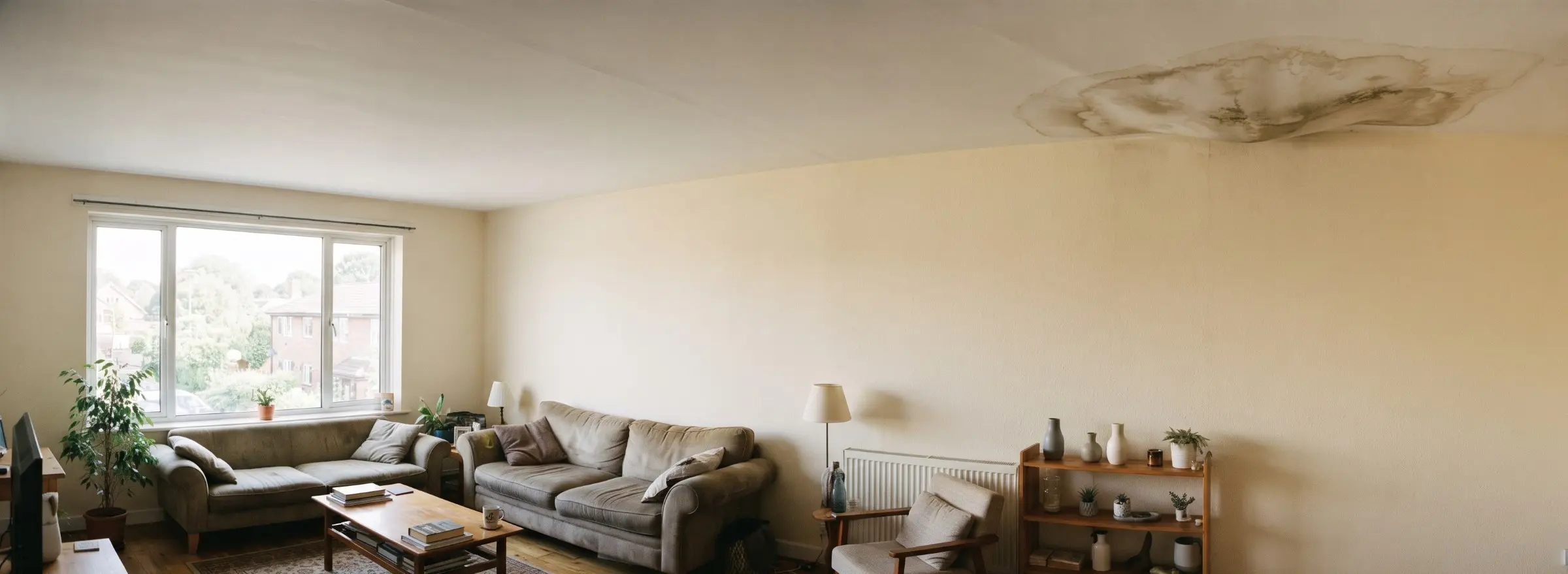

Water is coming through your ceiling or running down a wall, the unit above is the obvious source, and every hour it spreads adds to a bill you did not cause. The first job is to stop the damage and record it, and the second is to work out who pays, which depends on what caused the failure upstairs. Most water damage restoration jobs of this kind land between $1,500 and $7,000.
Water damage from an upstairs neighbor is a liability dispute between two households, settled through insurance, in which payment usually depends on negligence, and a lease or condo declaration can change that, while the drying of your wet materials follows ANSI/IICRC S500. Your own policy can usually pay first, so you can start repairs without waiting for a ruling on fault.
Key insights
- Liability usually depends on negligence, and a lease or condo declaration can change that. Knowing about a leak and not fixing it can support a negligence claim against the neighbor.
- Your own policy can pay regardless of fault. Homeowners, condo (HO-6), and renters policies pay for sudden water damage whoever caused it, and your insurer may then try to recover its payout from the neighbor through subrogation.
- The neighbor's liability coverage pays only for legal responsibility. The NAIC describes personal liability coverage as covering your loss if you are sued and found legally responsible, so an accident with no negligence usually produces no payment from it.
- Mold can start within 24 to 48 hours. The EPA ties mold growth to materials that stay wet past that window, so drying cannot wait for the neighbor, the insurers, or the association to agree on fault.
- Written notice on day one protects your claim. A dated message to the neighbor, the landlord or association, and your insurer fixes the timeline that every later dispute depends on.
- Typical drying and repair costs $1,500 to $7,000. A small contained spot can cost as little as $350, while extensive damage can pass $25,000.
First steps when the leak starts
Stop the water at its source, protect people and belongings, and document everything before it dries, all on the first day. Owners and renters take the same first-day actions, and each one also preserves the proof that decides who pays later. If water is still pouring and cannot be stopped, an emergency water damage restoration crew can extract it while the shutoff gets sorted out.
 Tell the occupant water is coming through your ceiling and ask them to close the shutoff valve. If no one answers, call the property manager or building emergency line, since the valve is often reachable only from inside that unit.
1. Move people and belongings out from under the drip
Clear furniture, electronics, and rugs from beneath the wet area and set a bucket under any active drip. Ceiling drywall holds water and can drop without warning, so keep people out from under a bulging or sagging section.
2. Cut power to wet ceiling fixtures
Turn off the breaker for any room with a wet light fixture, ceiling fan, or outlet, and avoid the switches while water is dripping nearby. Water in a ceiling cavity can reach wiring, so stay out of the room until an electrician clears it.
3. Get the water shut off upstairs
Knock on the door above, tell the occupant that water is coming through your ceiling, and ask them to close the shutoff valve for the fixture or the unit. If no one answers, call the property manager, the association, or the building emergency line, because the valve is often reachable only from inside that unit.
4. Photograph and video before anything dries
Record the stain, any dripping, and every damaged belonging, with the date and time on each clip. Keep wet items as they are until you have photographed them, then bag only what must go to stop further damage.
5. Put the neighbor and the building on written notice
Send a text or email the same day to the upstairs neighbor and to your landlord, property manager, or association, stating the date, where the water is showing, and that you will be making a claim. A written record fixes the timeline, which matters when negligence or a late report is argued later.
6. Call your insurer and a restoration company the same day
Report the loss to your own insurer, then book an IICRC certified restoration company to extract water and start drying within 24 to 48 hours. Ask the crew to record moisture readings, because those logs support both your claim and any claim against the neighbor.
Insurers look for proof of when the damage began and what it touched, so it pays to document the water damage for insurance with a written inventory of belongings, receipts for emergency costs, and copies of every message sent. Keep the originals of anything the neighbor or the building sends you in reply, including texts that admit what failed.
How to tell where the leak is coming from
A ceiling stain that grows right after the neighbor showers, runs the washer, or flushes usually traces to their plumbing, while a stain that spreads during rain or stays damp for days points to the roof, an HVAC line, a drain line, or a pipe in the wall, so tracing the source first prevents a claim against the wrong party. Ask the neighbor roughly when they use water, then note when your stain changes and mark its edge with a pencil and a date. Rule out your own plumbing next: look under your sinks and behind your toilet, and close your unit's main shutoff for an hour to see whether the dripping stops. If it keeps dripping with your supply off, the water is coming from outside your unit. A leak inside a shared wall or pipe chase can be the building's responsibility under many declarations, so check yours before you assume the neighbor owes you.
Is your upstairs neighbor liable?
Your upstairs neighbor is liable when they were negligent, meaning they caused the leak through carelessness or left a leak they knew about unfixed. Where the water started matters, but courts and insurers look for negligence before they assign the cost, and a lease or condo declaration can change that.
 A hose this worn is the kind of warning sign a plumber's report can point to, and the failed part is evidence of its age and upkeep. Keep it in a bag, because whether the neighbor was negligent often turns on how long the damage was visible.
Negligence means the neighbor owed a duty to keep their unit from damaging the one below, breached it, and caused your loss. A tub left running, a stain or drip ignored for weeks, a washing machine hose bulging with age, or a do it yourself pipe repair that failed can each satisfy that test. A pipe that fails suddenly with no earlier sign, such as a water leak in a wall that gave no stain or sound beforehand, usually does not, which leaves your own insurance as the main source of payment.
| Cause upstairs | Neighbor liable? | Why |
|---|---|---|
| Tub, sink, or appliance left running | Usually | Careless act that caused the overflow |
| Known drip or stain ignored | Usually | Notice of the problem and no action |
| Worn hose or supply line, never checked | Disputed | Depends on age, visible warning signs, and upkeep |
| Sudden pipe failure with no warning | Rarely | No negligence to prove |
| Botched repair by a contractor | Contractor, often | Faulty work, so the contractor's own liability policy may respond |
| Shared riser, roof, or common pipe | Not the neighbor | Responsibility shifts to the building owner or association |
A licensed plumber's written report carries more weight than a verbal account. Ask the neighbor or the building to have a plumber identify and document the failure, keep the failed part if you can get it, and have your restoration company map the moisture so the path from the source to your ceiling is on record.
Some condo declarations, bylaws, and leases make the owner responsible for water that escapes their unit whether or not they were careless. Read those documents early, because a rule like that can turn an apparent accident into a claim the neighbor's insurer will pay. Look for the sections on maintenance, responsibility for damage to other units, and insurance, because some declarations make the unit owner responsible for the master policy deductible when the leak starts in their unit.
How the insurance claims work
Your own insurer usually pays first, and the neighbor's liability coverage pays only if the neighbor is legally responsible. Your own policy is called first-party coverage and its payout does not depend on fault: you report the loss, an adjuster scopes the damage, and the insurer pays for covered repairs and belongings above your deductible. If the neighbor was at fault, your insurer can then pursue the neighbor or their insurer to recover what it paid, a process called subrogation, and you do not have to wait for that to finish.
 Your own insurer usually pays first whatever the cause, so report the loss before fault is settled. Tell the adjuster the water came from the unit above and ask for your claim number in writing.
Your second route runs through the neighbor's liability coverage. According to the NAIC, personal liability is coverage for your financial loss if you are sued and found legally responsible for damage to someone else, which is why the neighbor's insurer will ask whether negligence occurred before paying anything. As for the dollar amount, the policyholder chooses the limit, so check yours, and the claim is usually opened when the neighbor reports the leak to their carrier.
| Stage | Who pays | Condition |
|---|---|---|
| Drying and repair now | Your insurer, less your deductible | Sudden, accidental discharge |
| Reimbursement of that payout | Neighbor's liability insurer | Negligence or a building rule applies |
| Damage above their limits | The neighbor personally | A claim or small claims judgment |
| Shared pipe or roof source | Association or building owner | The source is a common element |
When you file a water damage insurance claim, tell the adjuster the water came from the unit above and give them the neighbor's name and insurer if you have them. That detail lets your insurer open the recovery file at the start. Ask for your claim number in writing and send it to the neighbor's insurer, so the two companies can match their files when subrogation begins.
Owners and renters pay differently
Owners start with their own homeowners or condo policy, renters start with their landlord for the building and their renters policy for belongings, and both can add the neighbor's liability route when negligence applies. Which policy answers for the ceiling and walls depends on who owns them. Check the lease or the condo declaration for that line first, because an owner and a renter in the same building can send the same ceiling repair to two different insurers, and calling the wrong one first can delay the claim.
 Who pays for the ceiling depends on who owns it, so check your lease or condo declaration for that line before you call anyone. An owner and a renter in the same building can send the same repair to two different insurers.
If you own your unit
An owner's policy pays for covered damage inside the unit, and what it pays for the walls and ceiling depends on where the unit's boundary falls under the building documents. For water damage in a condo, the association's master policy may cover the bare walls while your HO-6 policy covers everything inside them. Give written notice to the association as well as the neighbor, since the association may need to inspect shared pipes.
If you rent your unit
A landlord remains responsible for repairing the building when water comes from another unit, and because your lease is with the landlord, tenant rights after water damage start with written notice to the landlord. The landlord's insurer typically pays for the structure and may then pursue the neighbor, while your renters policy covers your belongings.
If the unit above is rented
When the upstairs unit is a rental, the tenant is usually the first person asked about fault, and the tenant's renters liability coverage is the likely payer if they were careless. The unit's owner can also be liable when the failure came from poor maintenance they knew about, such as a leaking fixture a tenant had reported without a repair.
When the neighbor will not cooperate
A neighbor who denies fault, ignores your messages, or has no insurance cannot hold up your repair. File under your own policy, keep your documentation current, and treat the neighbor claim as a separate track that your insurer or a court resolves afterward. Send every demand by email or by a mail service that gives a delivery receipt, so you can show the date the neighbor received it.
 A demand letter should list the date of the leak, the damage, your repair estimates, and a response date, and ask for the name of their insurer. Send it by email or a mail service that gives a delivery receipt so you can show when it arrived.
Start with a written demand that lists the date of the leak, the damage, your repair estimates, and a response date, and ask for the name of their insurer. A neighbor who has no policy can still be pursued directly by your insurer, although collecting from an individual is slower and less certain than collecting from a carrier. Keep every reply, even a refusal. Wording like this works as a first notice:
On [date], water from your unit came through the ceiling of my unit at [address], damaging the ceiling, walls, and my belongings. Please have your plumber document the cause and send me the name of your insurer and policy number by [date]. I have reported the loss to my insurer and will seek reimbursement for repair costs, my deductible, and any living expenses. Please keep the failed part so it can be inspected.
Building rules can help. Many associations and landlords can enforce maintenance obligations, order the source repaired, and in some cases bill the responsible unit for charges, so copy the association or landlord on your demand and ask in writing for inspection of the unit above. If the neighbor refuses access to the plumbing, many declarations and leases allow emergency entry, so check yours.
Court is the last step. Small claims is the usual forum for a loss that fits under your state's limit, and your evidence will be the same set you started on day one: dated photos, moisture logs, estimates, the plumber's report, and your notices. Filing fees vary by court, so confirm the fee and the required service method on your county court's website before you file.
What a claim covers and skips
A claim covers sudden, accidental water damage to the structure you are responsible for and to your belongings, and it skips slow leaks, wear and tear, and flood or sewer backup unless you bought extra coverage. Standard homeowners insurance coverage for water damage pays on the same sudden and accidental test that condo and renters forms use.
 Contents claims are paid from proof of what you owned, so photograph each damaged item and keep receipts. Ask your agent whether contents are paid at replacement cost or actual cash value, because a soaked chair pays very differently under each.
Read the declarations page and any endorsements before you file, because coverage for water backup from a sewer or drain is usually sold as an endorsement with its own limit. Ask your agent whether contents are paid at replacement cost or actual cash value, and whether the policy carries a separate water damage deductible. The NAIC describes replacement cost as the cost to repair or replace with materials of similar kind and quality, while actual cash value considers age and wear and often does not pay enough to fully repair or replace the damage, so a soaked sofa is paid at a depreciated amount under actual cash value and at the price of a comparable new one under replacement cost.
| Item | Usually paid by | Limit to know |
|---|---|---|
| Drying and mitigation | Your policy, or the landlord's | Sudden discharge only |
| Ceiling, wall, and floor repair | Owner policy, master policy, or landlord | Depends on who owns the surface |
| Furniture, clothing, electronics | Your contents coverage | Replacement cost or actual cash value |
| Hotel and extra living costs | Your loss of use coverage | Only if the unit is unlivable |
| Slow leak over weeks | Often excluded | Continuous seepage exclusion |
| Sewer or drain backup | Excluded without an endorsement | Needs added coverage |
Renters should note that a renters insurance policy covers belongings and personal liability, and the building itself belongs to the landlord's policy. The NAIC adds that a homeowners policy is not a maintenance contract, which matters when a leak ran for a long time before anyone noticed. Keep a dated inventory of what the ceiling water reached, with receipts or photos of each item, since contents claims are paid from proof of what you owned.
Many policies exclude constant or repeated seepage over weeks or months, so your own insurer may deny a loss that built up slowly. In that case the neighbor's liability coverage can become the main route if negligence can be shown. Read the seepage exclusion in your own policy for the exact wording, since the language differs between forms.
Drying, access, and mold risk
Drying should begin within 24 to 48 hours, because the EPA flood cleanup recommendations tie mold growth to materials that stay wet past that window. A restoration company classifies the water under IICRC S500, extracts it, and sets air movers and dehumidifiers to dry the ceiling cavity, wall cavities, and flooring.
 Do not close the ceiling back up until moisture readings are logged as dry. Ask the crew to record a reading on the wet drywall at the start and at each visit, so a final reading near unaffected drywall shows drying was complete.
Water from a failed supply line is typically Category 1, while overflow from a toilet without waste, a washing machine, or a dishwasher is typically Category 2 and needs antimicrobial treatment. Category 3 water, such as sewage, requires removing porous materials that it touched. The category sets the price per square foot, so ask the crew to write it on the estimate.
Wet ceilings often need to be opened. Insulation above the drywall holds water, and sealed cavities stay damp long after the surface feels dry, so crews cut inspection openings and run structural drying until readings return to normal. Do not close the ceiling back up, and do not rebuild, until the moisture readings are logged as dry.
Drying depends on the neighbor's cooperation, because the leak has to be stopped and the source repaired first, and the floor and subfloor of the unit above are often wet too, which is the neighbor's own drying job. If the source is not fixed, water can return within days, and a second wetting shortens the time you have before mold after water damage begins.
Policies expect you to take reasonable steps to protect the property from further damage, so keep your drying invoices and moisture logs, which show you acted inside the window. Ask the restoration crew to record a moisture reading on the wet drywall at the start and again at each visit, since a final reading near the level of unaffected drywall shows that drying was complete.
Repair costs after a ceiling leak
Drying and repair after a leak from the unit above typically costs $1,500 to $7,000, matching the national range for water damage restoration cost across all job types. A small spot with no material removal can cost as little as $350, while extensive damage with structural repair can pass $25,000.
 Replacing the drywall and paint adds roughly $20 to $37 per square foot on top of the drying bill. Ask for the water category on the estimate, and get both the after hours rate and the next morning rate before the crew starts.
The water category sets the per square foot rate for extraction and drying: clean water from a failed supply line runs $3 to $4, gray water from a washing machine or dishwasher overflow runs $4 to $6.50, and black water runs $7 to $7.50 or more. A 100 square foot section of wet ceiling and wall therefore costs roughly $300 to $750 to extract and dry before any drywall is replaced.
| Scope | Estimates | What is included |
|---|---|---|
| Minor spot mitigation | $350–$1,500 | Extraction and spot drying with no material removal |
| Standard mitigation | $1,500–$4,000 | Extraction, structural drying, antimicrobial treatment |
| 100 sq ft with repair | $2,300–$4,450 | Mitigation plus replacing the affected drywall and finish |
| Mitigation plus basic repairs | $4,000–$7,000 | Drying plus drywall and flooring in one or two rooms |
| Extensive loss | $10,000–$25,000+ | Multi room drying, framing repair, full replacement |
Repair and rebuild work such as new drywall and paint adds roughly $20 to $37 per square foot on top of mitigation. After hours calls usually carry a 25% to 50% premium, so ask the crew to quote both the after hours rate and the next morning rate before they start.
Deductibles typically run $500 to $5,000, so on a job near the $3,800 national average your own claim may pay little after the deductible. Weigh that against a possible mold remediation bill of $1,500 to $6,000 if drying is delayed, and ask your insurer what the neighbor claim could recover.
If your unit caused the leak
If the leak started in your unit, shut off the water, report it to your insurer before agreeing to pay anyone, and let your liability coverage handle the claim from below. A homeowners, condo, or renters policy includes personal liability coverage that responds when you are found legally responsible for damage to someone else's property.
 Keep the failed hose, valve, or fitting in a bag and have a licensed plumber replace it and write down what failed and when. Your insurer will want that record if negligence is disputed.
Tell the neighbor below what happened and give them your insurer's name and claim number. Avoid promising to pay or signing anything first, because liability policies generally expect the insurer to control payments, and a payment you promise on your own may not be reimbursed. Confirm your obligations with your state insurance department or an attorney before a dispute with the neighbor develops. If the neighbor offers to hire a contractor directly, ask them to wait until your adjuster has seen the damage.
Document your own side too: the failed part, the plumber's invoice, photos of the area, and the time you shut the water off. Your insurer will want the same evidence the neighbor below is gathering, and a prompt, accurate report gives you a record to point to if negligence is disputed, for example a dated photo of the failed part before it was replaced.
Stop the source for good before you leave it. Close the fixture's own shutoff valve or the unit's main valve, keep the failed hose, valve, or fitting in a bag, and have a licensed plumber replace it and write down what failed and when. Check the neighboring connections too: a washer's hot and cold hoses are often the same age, so replace both when one fails. Run the repaired line for several minutes while someone checks the ceiling below, and photograph the dry area afterward.
Your own unit may be wet as well. The subfloor, the cabinet base, and the drywall near the fixture hold water that can feed mold in the same 24 to 48 hour window, so book drying for your side and keep that invoice separate from the neighbor's. Your policy's water damage coverage pays for your own unit, while the liability section pays for theirs, and both can be reported in one call.
Preventing the next leak
Most upstairs leaks come from a short list of failure points, and replacing worn parts, checking connections, and shutting off water before you leave removes most of the risk. A washing machine leak is a typical example, because a hose under constant pressure can fail while no one is home, and in a multi unit building the water lands in someone else's home.
 Place sensors beside the water heater, behind the washing machine, under sinks, and at the base of each toilet. Choose models that send an alert to your phone, since a sensor that only sounds in an empty apartment warns no one.
Place leak sensors behind the washing machine, under the kitchen and bathroom sinks, beside the water heater, and at the base of each toilet, since those fixtures connect to pressurized supply lines. Choose models that send an alert to your phone, because a sensor that only sounds in an empty apartment warns no one, and replace the batteries on the schedule in the manual.
| Action | Frequency | Why it works |
|---|---|---|
| Replace washing machine hoses | Commonly every 3 to 5 years, sooner if a hose bulges or cracks | Rubber hoses weaken and burst under pressure |
| Check under sinks and around toilets | Every few months | A slow drip is found before it reaches the ceiling below |
| Install leak sensors | Once, test each year | A phone alert can warn you before the damage spreads |
| Know your shutoff valves | Once | A fast shutoff limits how much water travels |
| Shut off water before long trips | Each trip | Shutting the water off lowers the chance of a failure while no one is home |
| Check your liability limit | Each renewal | The policyholder chooses the limit, so check yours |
If you live below, photograph your ceilings now, because dated before and after images show that damage is new. Ask the building to share any plumbing repair history for the unit above, and keep your own policy current, since it is the coverage that responds first. Store the photos in cloud storage with the capture date intact, so you still have the proof if your phone is lost or damaged.
Frequently asked questions
Can I sue my upstairs neighbor for water damage?
Yes, in small claims court if your loss fits under your state's limit. The Connecticut Office of Legislative Research found general limits ranging from $2,500 in Kentucky to $25,000 in Delaware and Tennessee in 2023, so confirm your court's current cap.
Do I get my deductible back?
Sometimes. Your insurer recovers it through subrogation only if it proves the neighbor was negligent and collects, and recoveries may be shared with you depending on how much is recovered. Ask your insurer in writing whether it will pursue your deductible.
Will a claim raise my premium if the neighbor caused the leak?
Possibly. The NAIC says insurers report homeowners claims to databases such as CLUE, and that how often you file and the types of claims you file often affect your premium and whether your insurer renews your policy. Ask your agent how a claim that your insurer recovers from the neighbor's carrier is recorded before you file.
How long do I have to file a claim or a lawsuit?
It depends on your state and your policy. Policies require prompt notice of a loss, some policies require a lawsuit within one year of the loss, and deadlines for negligence claims vary by state. Report the loss now and ask for your deadlines in writing.
Who pays for a hotel while my unit dries?
Your own policy usually does, if the unit is unlivable. Loss of use coverage pays the increase over your normal living costs, such as a hotel bill or added meal costs, so keep receipts and ask the adjuster for the policy's dollar and time limits before you book.
Should I take cash from my neighbor instead of filing a claim?
Not until the full scope is known. A signed release can end your right to ask for more, and moisture inside a ceiling cavity can take days to show, so get a restoration estimate with moisture readings first and have your insurer or a lawyer review any release before you sign it.
Is the HOA or my landlord responsible?
It depends on your lease or declaration. Ask the landlord or association in writing for the clause on water damage between units and for the name of the building's insurer, so your adjuster can contact it.
How long does it take for a water damaged ceiling to dry out?
Usually three to five days for a saturated ceiling cavity. A small stain from a source you have already fixed can dry in a day or two with a fan and a dehumidifier.
Is the neighbor liable if the leak happened while they were away?
Only if they were careless. The question is whether they took reasonable care, such as replacing an old hose or shutting off the water before a long trip, and a sudden failure with no earlier warning is often treated as an accident with no one at fault.
When is a lawyer worth hiring?
When the loss is larger than your state's small claims limit, when a water damage insurance claim is denied without a clear reason, or when anyone was hurt. A short consultation also helps when a lease or the building documents say something unusual about who bears the cost of leaks between units.
Sam Hickerson is the founder of RestoreAdvisor and writes consumer guides on mold remediation, water damage restoration, inspection, testing, and home recovery. His work focuses on helping homeowners understand costs, risks, and when to call a professional. He draws on guidance from the EPA, CDC, IICRC, and other authoritative sources to make complex home issues easier to navigate.