
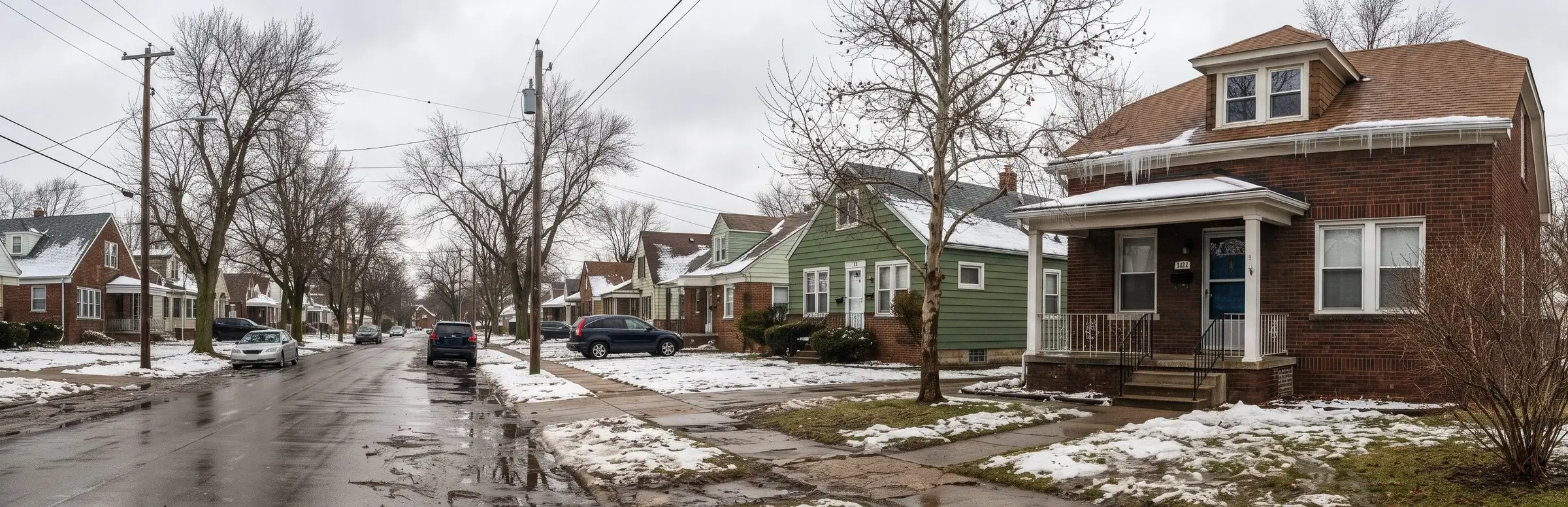

A stain that spreads across a Detroit basement ceiling on the first warm morning after a hard freeze usually means a supply line split during the cold and has been running since the thaw. Detroit Metro Airport averages 119.5 days a year with a low at or below 32°F in NOAA's 1991–2020 normals, so the homeowner has to pick a crew for water damage restoration and report the loss to the insurer before the day is out.
Detroit water damage restoration is water removal, structural drying and repair of the building under ANSI/IICRC S500, the Standard for Professional Water Damage Restoration, and a firm that rebuilds walls and floors on a project above $600 needs a residential builder or maintenance and alteration license from the Michigan Department of Licensing and Regulatory Affairs. Michigan law also gives an insurer 60 days after satisfactory proof of loss before interest applies, and its fire policy statute sets a one year limit on suing the insurer, counted from the loss and paused from notice until the insurer formally denies the claim.
Key insights
- Cost range. A typical Detroit job costs $1,600–$7,400 and averages about $4,000, a sewage backup begins near $7,400, and flooding through several rooms reaches $10,500–$26,500 or more.
- Freeze record. Detroit Metro Airport averages 119.5 days a year at or below 32°F and 44.8 days at or below 20°F in NOAA's 1991–2020 normals, and State Farm ranked Michigan third among states for frozen pipe losses in 2019.
- Payment clock. Under MCL 500.2006, unpaid insurance benefits bear 12 percent simple interest starting 60 days after the insurer receives satisfactory proof of loss.
- Suit limit. MCL 500.2833(1)(q) requires a fire policy to allow a suit within 1 year after the loss, with the time paused from the day the insurer is notified until it formally denies the claim.
- Contractor license. Michigan exempts a single project priced under $600 from residential builder licensing, so rebuild work above that amount needs a license from the Department of Licensing and Regulatory Affairs.
- Sewer backup claim. Under MCL 691.1419, an owner seeking compensation from a water utility for a sewer overflow or backup must notify it in writing within 45 days after discovering the damage.
Detroit job costs by cause and room
Most Detroit water damage jobs cost $1,600–$7,400, and the average is about $4,000. A spot caught the same day can start near $400, a sewage backup starts near $7,400, and a flood through several rooms runs $10,500–$26,500 or more, since the water category and the number of rooms decide how much material comes out.
 A swollen toe kick does not return to shape when it dries, so the crew prices the cabinet base and the flooring in front of it for replacement, which is why a kitchen costs more than a bathroom.
The Bureau of Labor Statistics put May 2025 pay for construction and extraction workers in the Detroit area about 5 percent above the U.S. average. The water damage restoration cost on a Detroit bid shifts with the water category, the number of wall cavities a split supply line soaked, and the after-hours rate for a loss found on a night below 20°F.
| Scenario | Estimates | What drives it |
|---|---|---|
| Minor spot mitigation | $400–$1,600 | One damp wall section or a spill caught within hours, needing a few days of airflow |
| Supply line burst or frozen pipe split | $1,100–$3,200 | Clean water in a wall cavity and the room beside it, dried before it degrades past Category 1 |
| Standard mitigation | $1,600–$4,200 | Extraction and drying across a full floor, with no tear-out |
| Washing machine or dishwasher overflow | $2,100–$5,300 | Soap and drain water that moves under flooring and into cabinet bases |
| Roof leak during a storm | $2,600–$7,400 | Soaked attic insulation and ceiling drywall, plus roof or attic access time |
| Mitigation plus basic repairs | $4,200–$7,400 | Drying followed by drywall, trim and flooring replaced room by room |
| Sewage backup | $7,400–$14,500+ | Category 3 water, so porous materials it touched are bagged out before drying begins |
| Storm flooding across rooms | $10,500–$26,500+ | Opened wall cavities, subfloor repairs and new finishes in every flooded room |
Crews bill drying by the square foot of wet floor, which means 300 wet square feet cost roughly the same in a 1,500 square foot house and a 2,000 square foot one. Rates climb with the water category, and the cost per square foot runs $3.25–$4.25 for Category 1 and $7.25–$8.00 or more for Category 3, with the rebuild after drying billed separately at $21–$39 for each square foot of damaged area.
| 300 sq ft area | Estimates | Estimates per sq ft |
|---|---|---|
| Dry a Category 1 floor | $975–$1,275 | $3.25–$4.25 |
| Dry a Category 2 floor | $1,275–$2,025 | $4.25–$6.75 |
| Dry a Category 3 floor | $2,175–$2,400+ | $7.25–$8.00+ |
| Rebuild after drying | $6,300–$11,700 | $21–$39 |
A room's price tracks what the water reached. A tiled bathroom costs least, a kitchen adds cabinet bases and flooring beside the dishwasher and sink lines, and a basement adds a concrete slab and wall bases that keep releasing moisture after extraction, so the dehumidifiers run more days. Carpet, pad and furniture push a living room to the top of the range.
| Room | Estimates | What drives it |
|---|---|---|
| Bathroom | $500–$4,700 | A small tiled floor and vanity that dry fast |
| Laundry room | $1,100–$5,300 | A failed hose or drain while no one is home, spilling into the next room |
| Kitchen | $1,600–$8,400 | Cabinet bases, toe kicks and flooring beside the sink and dishwasher lines |
| Basement | $1,600–$10,500+ | A split pipe, sump failure or backup, then a slab and wall bases that stay damp for weeks |
| Living or family room | $3,400–$19,500 | The largest floor, with carpet, pad and furniture to move |
Evening and weekend calls add 25–50 percent to the labor rate, and a plumber's repair of the failed pipe is invoiced on its own because restoration work ends when the structure reaches the dry standard. A lump sum with no equipment counts hides the part of a Detroit bid that varies most, and it cannot be compared line by line with a second quote.
Why Detroit pipes freeze and fail
Detroit pipes freeze and fail because the overnight low reaches freezing on about a third of the days in a year, and the swings between cold spells and thaws strain the plumbing in a house. The 1991–2020 normals for Detroit Metro Airport from NOAA's National Centers for Environmental Information show 119.5 days a year at or below 32°F, 44.8 days at or below 20°F and 3.6 days at or below 0°F, along with 34.3 inches of precipitation.
 A line fixed to an exterior masonry wall gets the least heat from the house, so it freezes before the supply lines in heated walls. The water shows only after the thaw, which is when the shutoff valve needs to be closed.
State Farm ranked Michigan third among states for frozen pipe losses in 2019, and its loss mitigation administrator told CBS Detroit that frozen pipes are the most common winter loss claim. Runs in exterior walls, garages, crawl spaces and attics fail first, because they sit closest to outdoor air and receive the least heat from the house. A split line can show up in a mild winter as well as a harsh one, so the shutoff valve and the heat setting matter every year.
| Water source | Category | What the crew faces |
|---|---|---|
| Split supply line in an exterior wall, garage or crawl space | Category 1 | Clean water that runs through framing and insulation and turns worse the longer it sits |
| Cracked line behind a frozen spigot | Category 1 | A leak that starts at the thaw, behind siding or inside a basement ceiling |
| Sump pump that quits during a thaw | Category 2 or 3 | Groundwater picks up soil on the way in, so wet carpet and pad usually come out |
| Rain or sewer water through a floor drain | Category 3 | Sewage surfaces at the lowest drain, and the porous materials it reaches are bagged and hauled out |
| Water from a broken main in the street | Category 2 or 3 | Water that crosses pavement and soil before it reaches a basement is assessed as contaminated |
The thaw is when the damage shows. Ice can plug a split line for days, so the water runs only after the temperature climbs and the plug melts, and a wall that was dry at night can be soaking by the time anyone is awake. A sudden thaw can also push water through a line toward a faucet that expanding ice had closed.
Category 1 water from a split line is clean when it leaves the pipe and degrades within about 48 hours as it soaks into drywall, insulation and flooring, according to the categories in ANSI/IICRC S500. That clock is why a burst pipe is a same-day call even when the water looks harmless and the stain is small.
The first 48 hours after a pipe bursts
In the first 48 hours after a Detroit pipe bursts, close the house valve, cut power to the wet area from dry footing, move dry belongings, photograph every wet surface, and call a crew and the insurer the same day. The valve comes first because a split line keeps releasing water until it is closed, and every other step waits on that.
 Water already in the line keeps draining after the valve closes. Note the time the valve was shut, since the written scope and the claim both start from when the flow stopped.
1. Turn the supply off at the house valve
Close the main shutoff where the water line enters the house. A valve that is stuck is a plumber's call, placed before any other, since the split keeps running until the water is off.
2. Switch off wet circuits from dry footing
Flip the breakers that feed the wet rooms only from a panel you can reach without standing in water. If water is near the panel, an outlet or a cord, leave the house and call an electrician.
3. Pull dry belongings out of the wet zone
Carry electronics, papers and small furniture to a dry room, and leave soaked carpet pad and drywall in place so the crew can measure them. An open floor lets technicians set equipment within the first hour.
4. Date-stamp the damage on camera
Photograph the split pipe, the stain on each wall and ceiling, and every damaged item, and keep the files with their original dates. The adjuster compares those images with the crew's written scope.
5. Call the crew, then the carrier
Book a firm that holds an IICRC certification and dries to ANSI/IICRC S500, then report the loss to the insurer the same day and note the time of the call and the name of the person who answered. Keep receipts for emergency repairs, rented equipment and any hotel stay.
When a faucet runs slowly in a hard freeze, the line may be frozen but still whole. Locate the shutoff before the thaw so a split can be stopped in seconds, and thaw a frozen pipe with a hair dryer or a heating pad, never an open flame. A line inside an exterior wall is a plumber's job, because heat applied to the wrong spot damages the pipe or the wall around it.
What to dry yourself and what needs a crew
Clean water from a small spill on a hard floor, mopped up within hours, is a job for towels and a fan. Once water has reached carpet pad, drywall, insulation or a ceiling cavity, a crew is needed, and an emergency water damage response that begins the same day keeps a small stain from becoming a wet wall. Water that came up a floor drain is never a homeowner job, and the EPA tells people with asthma or weakened immune systems to stay out of cleanup.
Michigan licensing for repair crews
Michigan requires a residential builder or residential maintenance and alteration contractor license for repair work on a home, and a single project priced under $600 is exempt. The Michigan Department of Licensing and Regulatory Affairs issues the license through its Bureau of Construction Codes, and the license lists the trades the holder may practice, which is the first place to look when a drying company offers to rebuild as well.
 A rebuild starts only after the drying log shows the dry standard, and carpentry is one of the 13 trades on a Michigan maintenance and alteration license while drying is not.
The $600 exemption in MCL 339.2403 covers one undertaking or project whose labor, material and other items add up to less than $600. It does not apply when the work is part of a larger operation or when a job is divided into contracts under $600 to avoid the law, and a contractor who needs the license and lacks it cannot bring a court action to collect payment for the work. A dried wall, new drywall and a replaced floor add up to far more than $600, so a crew that rebuilds is working in licensed territory.
The same statute exempts a licensed plumbing contractor for plumbing work and a licensed electrical contractor for electrical work, and each of them holds a separate license under the skilled trades laws. The plumber who replaces a split section of pipe and the crew that dries and rebuilds the wall can therefore be two companies with two licenses to check.
A maintenance and alteration contractor may practice only the trades printed on the license, and the state's list has 13 of them, among them carpentry, insulation work, tile and marble, roofing and basement waterproofing. Water mitigation and drying are not on it, so ask whether the trades the firm will perform are on the license it shows you. LARA's license lookup shows whether a number is active. IICRC certification is a training credential from the non-profit that publishes the S500 standard and shows a crew knows how to dry. The state license is what allows the firm to rebuild.
Seven checks before you hire a crew
Before a Detroit water damage company starts drying or signs a work authorization, a homeowner can confirm seven things: the IICRC certificate, the Michigan license, the water category, the equipment plan, the moisture log, the billing terms and the final payment. Each one can be checked against a document the crew provides, and a crew that will not put one in writing has not finished its assessment.
 A thermal camera shows where a wall is wet but gives no moisture reading, so the daily log still needs a reading on each material against a dry reference.
When you choose a restoration company, compare each bid against the same scope items. A bid that omits a wet room or an equipment count has priced a different job from the one next to it, and a cold snap that keeps phones busy is the moment crews are most likely to quote by phone and skip the walkthrough.
1. Match the IICRC certificate to the company name
Ask for the firm certificate and the technician certificate, and confirm the company name on the document is the company that will send the crew. A firm that dries to ANSI/IICRC S500 can explain why a supply line loss is Category 1 and a backup is Category 3.
2. Ask which Michigan license covers the rebuild
Get the license number in writing and confirm it is active before any rebuild work starts. If the drying company will not rebuild, ask for the name and license number of the firm that will.
3. Get the water category in writing
The written scope should name the category and the source, such as a split supply line or a floor drain backup. The category decides whether wet carpet and drywall are dried or removed.
4. Count the machines and the days
The scope should list the air movers and dehumidifiers in each room and the number of days each will run. A count of zero or a lump sum means the equipment plan has not been written.
5. Require a daily moisture log
Ask for daily readings on each wet material, with a dry reference reading from an unaffected piece of the same material. Equipment stays until the two match.
6. Settle who bills the insurer before signing
Ask in writing whether the firm bills the insurer directly, what the deductible is, and what happens if the insurer pays less than the invoice. Sign a direction to pay only after the scope exists.
7. Hold the last payment until the readings match
Pay the final invoice after the log shows every wet material at the dry standard. A crew that pulls equipment early and asks for the balance has not finished the job.
Drying proof, repairs and mold
Drying ends when daily moisture readings on every wet material match a dry reference reading from an unaffected piece of the same material, which is the dry standard in ANSI/IICRC S500. Most jobs need 3–7 days of equipment, and the EPA says drying usually takes several days to weeks, so a crew that pulls machines after a day or two has stopped early.
The drying log is the record that the job reached the standard. It lists each material's reading, the reference reading, the machines in each room and every change the crew made, and the written scope names the day repairs begin, which cannot come until the readings match. Repairs add 1–3 weeks when drywall, flooring or framing was removed, and a finished basement runs longer because the slab and the base of the wall framing release moisture slowly.
The EPA says mold can grow on wood, drywall, carpet and furniture that remain wet for more than 24 hours. A wall that still reads damp after the crew packs up, a musty smell that returns or a stain that keeps widening shows the drying ended early, and the next call is a mold assessment.
A late dry out after a sump failure, or after a frozen line split in a closed wall over a long weekend, is the case most likely to need Detroit mold remediation. Mold work brings an assessment, containment and clearance testing and carries its own price, so the reading log from the water job is the first document the mold contractor asks for.
What Michigan insurers owe you
A Michigan insurer must say in writing what proof of loss it needs within 30 days after receiving a claim, and unpaid benefits start earning 12 percent simple interest 60 days after satisfactory proof arrives. Both rules come from MCL 500.2006, the part of the Insurance Code on timely payment of claims, which covers the benefits an insurer owes its own insured under the policy.
 The insurer must state in writing within 30 days what proof of loss it needs, so ask the adjuster at the visit which documents count and get the answer in writing.
The suit limit is a separate clock. MCL 500.2833(1)(q) requires each fire insurance policy issued in Michigan to allow an action within 1 year after the loss, or within the period the policy specifies if that is longer. The time is paused from the day the insured notifies the insurer of the loss until the insurer formally denies liability.
| Clock | Limit | Starts when |
|---|---|---|
| Proof of loss list | 30 days | The insurer receives the claim |
| Payment | 60 days | The insurer receives satisfactory proof of loss |
| Interest on late benefits | 12 percent simple | The 60 days run out |
| Suit against the insurer | 1 year | The loss happens, paused from notice until formal denial |
The statute names fire policies, and the Michigan Court of Appeals applied it to a homeowners policy in Home-Owners Insurance Co. v. Perkins in 2019, where the policy's own suit clause repeated the one year limit and the tolling. Read that clause on the policy and ask the agent or an attorney how it applies to a water claim. The first call to the insurer sets the date that pauses the year, so the time and the name of the person who answered belong in the claim file next to the photographs, the written scope, the drying log and every letter from the adjuster. Whether a frozen pipe loss is covered depends on the policy's wording, and the declarations page and the exclusions for freezing, a vacant home and sewer backup are worth reading before a loss as well as after.
Backups, main breaks and permits
A Detroit basement that takes on sewer water, or a street main that breaks, starts with a call to the Detroit Water and Sewerage Department at 313-267-8000. Under MCL 691.1419, an owner who wants compensation from the department for a sewer overflow or backup must also notify it in writing within 45 days after discovering the damage. The water that comes up a floor drain is Category 3 under ANSI/IICRC S500, and a sewage backup cleanup removes every porous material it touched before drying begins.
 The curbstop, the turn-on and turn-off valve near the sidewalk, marks where the water department's responsibility ends and the owner's begins. A leak on the house side of it is the owner's to repair.
Which pipe failed decides who repairs it. The department maintains the water mains and the service lines up to the curbstop, the turn-on and turn-off valve near the sidewalk, and the property owner is responsible for the service line from the curbstop into the building and for the plumbing inside. The sewer line from the house to the connection at the city sewer pipe, which usually sits in the alley, also belongs to the owner.
To collect from the utility under MCL 691.1417, the owner has to show that the sewer system had a defect, that the utility knew or should have known about it and did not fix it in a reasonable time, and that the defect was a substantial cause of the backup, which means 50 percent or more of the cause. A backup is not covered when an obstruction in the owner's service lead, or a connection on the property such as a sump, building drain, gutter or downspout, was the substantial cause, so a plumber's written finding on where the blockage sat matters to the utility claim and to the insurer.
Flood cleanup after a heavy rain follows the same first calls, and the EPA says floodwater can carry bacteria, chemicals and other hazards. Children, pregnant people and anyone with asthma or a weakened immune system should stay out of the work, and wall cavities that flooded should not be sealed or painted until the materials are dry on the inside.
Southwest Detroit and the 2025 main break
On February 17, 2025, a 54-inch water transmission main broke at about 2 a.m. in Southwest Detroit, flooding streets and basements, and police and fire crews evacuated 54 adults, 22 children and 12 pets, some by boat, according to Michigan Public. The main was nearly 100 years old, and the city cited its age as one of many potential causes. The city opened a 24-hour hotline to start claims for uninsured damage to homes, and a water main break loss still goes to the insurer first, with the same photographs, scope and drying log as any other claim.
Permits for pipe repairs
The Detroit Water and Sewerage Department requires its own permit to replace a water service line, make a water or sewer tap or repair a sewer service. Water service work must be done by a licensed Master Plumber registered with the City of Detroit, and a project that needs the department's permit may also need a plumbing permit from the Buildings, Safety Engineering and Environmental Department. The plumber who pulls those permits is the one to ask what applies before walls are opened.
When a landlord or seller is involved
A Detroit landlord must keep a rental fit for its intended use and in reasonable repair under MCL 554.139, except when the disrepair comes from the tenant's willful or irresponsible conduct. A tenant whose unit floods from a frozen line should photograph the damage with the date on the files and send the repair request in writing the same day, because the renters rights that apply turn on who owns the failed pipe. The tenant's own furniture and clothing are covered only if the tenant carries a renters policy.
 Fresh paint can hide a water stain, but one that bleeds back through at the baseboard is worth a question to the seller about when the wall got wet and who dried it.
A Michigan seller completes the statutory seller's disclosure statement under MCL 565.957, which tells the seller to answer all questions and report known conditions. The form asks whether the basement or crawl space shows evidence of water, whether the property has had settling, flooding, drainage, structural or grading problems, and it lists the sump pump and the water heater among the items to report. A buyer can compare those answers with what the walls show, and stains at the base of exterior walls, patched drywall, fresh paint on a single wall or a damp smell in the basement are reasons to ask the seller for the plumber's invoice, the drying log and the insurance claim history before closing.
Prevention before the next freeze
Five fall actions protect a Detroit house from freeze and flood losses: test the main shutoff, keep the heat on or drain the water when away, insulate the pipes nearest outdoor air, test the sump pump, and disconnect the downspouts that feed the sewer. Each one limits how much water reaches drywall and insulation before a crew arrives with equipment.
 A foam sleeve slows heat loss from a pipe but adds no heat, so a line in a garage or crawl space can still freeze in a long cold spell.
Basement protection is a separate job from freeze protection. Roof water that drains into the sewer adds to the load during heavy rain, and a plumber can say whether a backwater valve or a sump pump fits a house with a history of backups. Both limit how much water reaches a finished lower level.
| Action | When | Why it works |
|---|---|---|
| Find and test the main shutoff | Before the first hard freeze | A valve unused for years can stick, and a split line leaves no time to learn that |
| Keep the heat on or drain the water | Every winter trip | Heat holds supply lines above freezing, and a drained system has nothing left to freeze |
| Insulate pipes in exterior walls, garages, attics and crawl spaces, and drain outdoor spigots | Before the first hard freeze | These runs get the least heat from the house, and a spigot left full can crack the pipe on the warm side of the wall |
| Test the sump pump and its discharge line | Each spring and before a thaw | A pump that stalls during snowmelt lets the basement fill with Category 2 or 3 water |
| Disconnect downspouts and ask a plumber about a backwater valve | Before heavy rain season | Less roof water reaches the sewer, and a valve stops sewer water from entering through the floor drain |
A sump pump failure at the thaw is a loss that a five minute test can prevent. Pour a bucket of water into the pit until the float rises and the pump starts, and watch the discharge outlet outside to see the water leave, since a line frozen shut leaves the water sitting in the pit. A finished basement with carpet and drywall down to the floor loses the most when the test is skipped.
Frequently asked questions
How much does water damage restoration cost in Detroit?
Most jobs cost $1,600–$7,400 and the average is about $4,000. Sewage backups start near $7,400, and floods across several rooms cost $10,500–$26,500 or more once wet carpet, pad and drywall are replaced. The cost per square foot for drying is $3.25–$4.25 on clean water and $7.25–$8.00 or more on Category 3.
How long does a Michigan insurer have to pay a water damage claim?
Within 60 days after satisfactory proof of loss, or the insurer owes 12 percent simple interest on the unpaid benefits. Under MCL 500.2006 a homeowners insurance carrier must also say in writing, within 30 days after the claim, what materials count as satisfactory proof of loss.
How long do I have to sue my insurer after water damage in Michigan?
One year after the loss, or the longer period the policy sets. MCL 500.2833(1)(q) pauses that time from the day the insurer is notified of the loss until it formally denies the claim, so the days before the first notice still count.
Does Michigan license water damage restoration companies?
Not for drying itself, because the 13 trades on Michigan's maintenance and alteration license do not include drying or mitigation, but a firm that also rebuilds drywall and flooring on a project above $600 needs a residential builder or maintenance and alteration license from the Michigan Department of Licensing and Regulatory Affairs.
Who pays for damage from a Detroit water main break?
It depends on which pipe failed and on the policy. The Detroit Water and Sewerage Department maintains mains and service lines up to the curbstop, the owner is responsible from the curbstop into the house, and after the February 2025 transmission main break in Southwest Detroit the city opened a 24-hour hotline to start claims for uninsured damage to homes, while an owner with insurance still opens an insurance claim first.
How long do I have to file a claim for a Detroit sewer backup?
45 days from the day you discover the damage. Under MCL 691.1419 an owner seeking compensation from the water utility must notify it in writing within that window, and the notice is separate from any claim with the insurer.
Does Detroit require a permit to repair a burst pipe?
Sometimes. Replacing a water service line or repairing a sewer service needs a Detroit Water and Sewerage Department permit and a Master Plumber registered with the City of Detroit, and the same project may also need a plumbing permit from BSEED. Work inside the house is a question for BSEED, so the plumber should confirm whether a plumbing permit applies before cutting into walls.
How do I choose a water damage restoration company in Detroit?
Start with the IICRC firm certificate, then ask for a written scope that names the water category and counts the equipment, and for a daily moisture log. Ask which firm rebuilds the walls and floors and what Michigan license it holds, because rebuild work needs one.
How long does water damage restoration take in Detroit?
Most jobs need 3–7 days of drying equipment, and repairs add 1–3 weeks once drywall, flooring or framing has been cut out. A basement slab can hold moisture longer, and the EPA says drying usually takes several days to weeks.
Is a Detroit landlord responsible for a burst pipe?
Usually yes, when the pipe is part of the rental. MCL 554.139 requires a landlord to keep the premises fit for their intended use and in reasonable repair, except when the disrepair comes from the tenant's willful or irresponsible conduct.
What must a Detroit seller disclose about water damage?
Known water problems, because the statutory seller's disclosure statement under MCL 565.957 asks whether the basement or crawl space shows evidence of water and whether the property has had flooding or drainage problems. The seller answers from personal knowledge and reports known conditions.
How fast can mold start after a Detroit pipe bursts?
Within 24 hours on wet wood, drywall, carpet and furniture, according to the EPA. When materials stayed wet past that mark, mold after water damage calls for remediation with assessment, containment and clearance testing.
- IICRC S500
- EPA: Flood Cleanup to Protect Indoor Air and Your Health
- NOAA NCEI: 1991–2020 annual normals for Detroit Metro Airport
- BLS: Occupational Employment and Wages in Detroit-Warren-Dearborn, May 2025
- Michigan Legislature: MCL 500.2006
- Michigan Legislature: MCL 500.2833
- Michigan Legislature: MCL 339.2403
- CBS Detroit: State Farm ranks Michigan third for frozen pipe damage
- Michigan Public: After water main break, officials say homes in Detroit's Southwest will get repairs covered
- City of Detroit: DWSD water and sewer maintenance and emergencies
Sam Hickerson is the founder of RestoreAdvisor and writes consumer guides on mold remediation, water damage restoration, inspection, testing, and home recovery. His work focuses on helping homeowners understand costs, risks, and when to call a professional. He draws on guidance from the EPA, CDC, IICRC, and other authoritative sources to make complex home issues easier to navigate.