
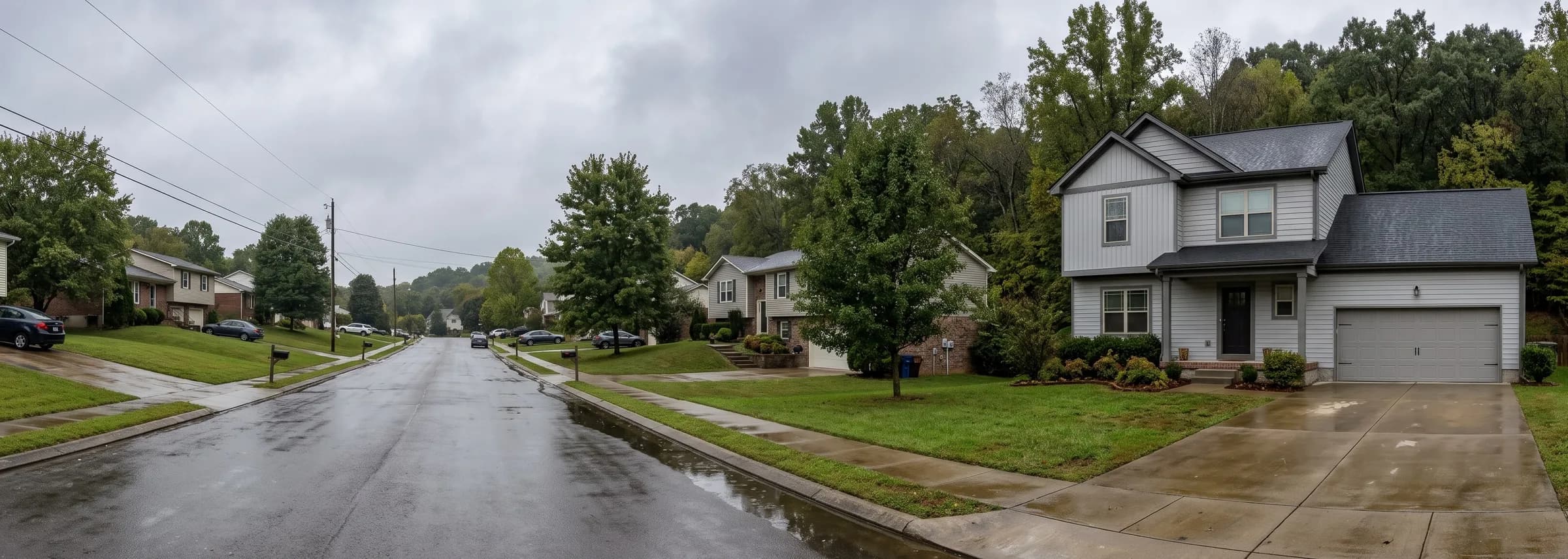

A split pipe after a freeze, or a creek at the back door, hands a Nashville homeowner a deadline and a question: drying has to start within a day, and the rebuild bid that follows may need a license the owner has never had to check. Davidson County is one of nine Tennessee counties where residential remodeling from $3,000 to $24,999 requires the Home Improvement license, so a repair bid in that range should come with a license number the owner can look up before any deposit changes hands.
Under ANSI/IICRC S500, water damage restoration covers the extraction, drying, cleaning, and repair of a wet structure, and in Nashville the Tennessee Board for Licensing Contractors, part of the Department of Commerce and Insurance, licenses the rebuild contractor while Metro Codes issues the permits for the repair. Which rules apply first depends on the source of the water, since a supply line, a creek, and a sewer each lead to a different policy, water category, and permit path.
Key insights
- Typical cost. Water damage restoration in Nashville costs $1,400–$6,400 for one affected area, and Category 3 creek, street, or sewage water on a ground floor can reach $9,100–$22,500 or more.
- License line. Davidson County requires a Tennessee Home Improvement license for residential remodeling projects from $3,000 to $24,999, and a $10,000 surety bond backs the license.
- Metro permits. Metro Codes requires a building permit for drywall repair or replacement over 100 square feet and does not require one for painting, flooring, new insulation, or wall tile.
- Last major flood. Over seven inches of rain fell in Nashville on March 27–28, 2021, the fourth largest two day total in city history, and Browns Creek at the State Fairgrounds rose more than nine feet in under six hours.
- Freeze risk. Nashville averages 67 days a year with a low at or below 32°F, and the January 2026 ice storm left about 230,000 customers without power.
- Mold clock. Wet wood, drywall, carpet, and furniture can start growing mold after 24 hours, according to the EPA.
The first 48 hours after a leak
The first 48 hours in a wet Nashville home go to stopping the source, naming the water, documenting the loss, and starting extraction, in that order. The EPA warns that mold can start on wet wood, drywall, carpet, and furniture after 24 hours, so a crew that starts the same day saves materials that a two day wait would condemn.
 A ball valve is open when its lever lies along the pipe and closed when the lever sits crosswise, so confirm the stop by opening a faucet on the lowest floor and watching the flow end.
Freeze damage follows its own sequence. A split in a frozen line often leaks nothing until the ice melts and the heat returns, so the flood can start hours after the power comes back. After any outage that left a house below freezing, shut the main valve before the heat comes back, then reopen it slowly and check ceilings, cabinet bases, and exterior walls for new stains.
1. Find the main valve and stop the supply
Close the valve for the failed fixture or the main valve for the house, then open a faucet on the lowest floor to confirm the line is dry. If the valve will not close or the leak sits on the street side of the meter, call Metro Water Services at 615-862-4600 to have the supply shut at the meter.
2. Sort the water into clean, gray, or creek water
Water from a supply line starts as Category 1, appliance overflow is Category 2, and anything that came from a creek, a storm drain, or a sewer line is Category 3 under ANSI/IICRC S500. Write the source on a note before cleanup starts, because the category decides whether wet drywall and carpet can be dried or must be cut out.
3. Photograph the water line before moving anything
Photograph the source, the height of the water on the walls, and each damaged item, then email the insurer the date, the source, and the photos so the notice has a time stamp. Keep receipts for hotel nights, dehumidifier rental, and emergency repairs, since they support the claim later.
4. Call a drying crew before the adjuster arrives
Hire a firm with IICRC certification to start extraction the same day instead of waiting for an adjuster's schedule. Keep windows and doors closed while the dehumidifiers run so humid outdoor air stays out of the drying rooms.
5. Ask Metro Water for a leak adjustment
After the pipe is repaired, call Metro Water Services Customer Care at 615-862-4600 with the date and type of repair, because Metro offers a leak adjustment on a bill raised by a burst pipe or leak. Keep the plumber's invoice, since the request asks for the repair date and type.
When water keeps spreading, the panel is wet, or sewage is in the house, emergency water damage restoration is the call to make, and everyone should stay out of the room until an electrician clears the circuits. Leave wet insulation, drywall, and carpet padding in place for the crew to inspect and photograph first, since both the adjuster and the drying log rely on seeing what the water touched.
Pricing a Nashville water loss
Most Nashville water damage jobs cost $1,400–$6,400 for one affected area, and the average is about $3,500. A leak caught within a day stays near the bottom of that range, while Category 3 water, several wet rooms, and a late start on drying move a job toward the top.
 Extraction and drying are priced by wet floor area and equipment days, so a bid should list both before any rebuild work appears.
Nashville construction and extraction workers earned about 91 percent of the U.S. average hourly wage in May 2025, according to the Bureau of Labor Statistics. Category 3 creek water, a rebuild that crosses the $3,000 Home Improvement license line, and the Metro building permit that drywall repairs over 100 square feet require all push a bid toward the top of the water damage restoration cost range.
| Scenario | Estimates | What drives it |
|---|---|---|
| Minor spot mitigation caught within a day | $300–$1,400 | Small clean water spill, a few equipment days, minimal demolition |
| Mitigation only, 300 sq ft of floor | $800–$2,000 | Drying priced per square foot of wet floor, with no rebuild work |
| Burst supply line or frozen pipe split | $900–$2,700 | Clean water from one split, with ceiling or cabinet drywall wet when the pipe runs through an attic, crawl space, or exterior wall |
| Washer or dishwasher overflow | $1,800–$4,500 | Category 2 water under flooring and into cabinet bases |
| Roof leak after a storm | $2,300–$6,400 | Wet attic insulation and ceilings, with the roof repair billed separately by a roofer |
| Mitigation plus basic repairs | $3,600–$6,400 | Drying followed by new drywall, paint, and flooring, with a Metro permit when the drywall area passes 100 sq ft |
| Sewage backup (Category 3) | $6,400–$12,500+ | Disinfection, protective gear, and removal of porous materials such as padding and lower drywall |
| Creek, street, or storm drain water across rooms (Category 3) | $9,100–$22,500+ | Flood cuts, flooring, drywall, and contents, often across several rooms |
Each factor should show as its own line on a written estimate: the water category, the hours before drying began, the number of rooms, and the equipment count with its days. Drying equipment is billed per piece per day, so a bid that lists air movers and dehumidifiers with run days lets the daily moisture log confirm what was needed. After a regional event such as the January 2026 ice storm, when about 230,000 Nashville customers lost power, crews and dehumidifiers book out, and a written start date keeps wet drywall from sitting in place for a week.
Drying is priced at about $2.75–$6.75 per square foot of affected floor, and the rate applies to the wet area only, so a 300 square foot loss is about $800–$2,000 for drying alone in a 1,500 or 2,000 square foot house alike. Repairs are priced separately from drying, and the full cost per square foot for each stage follows the water category and the materials involved.
| Work | Estimates per sq ft | Applies to |
|---|---|---|
| Mitigation, all categories | $2.75–$6.75 | Affected floor area, priced before any rebuild work |
| Category 1 mitigation | $2.75–$3.75 | Affected floor area after a supply line or condensate leak |
| Category 2 mitigation | $3.75–$6.00 | Affected floor area after washer or dishwasher overflow |
| Category 3 mitigation | $6.25–$6.75+ | Affected floor area after creek, street, or sewage water |
| Repair and rebuild | $18–$34 | Floor area where wet drywall, paint, and flooring are replaced |
A room's total depends on the materials the water reaches: floor covering, wall cavities, and cabinet bases. Living areas cost the most because they hold the most floor and wall area, bathrooms cost the least, and basements and kitchens climb when water collects under cabinets, tile, or a slab that gives up moisture slowly.
| Room | Estimates | Cause |
|---|---|---|
| Bathroom | $500–$4,100 | Supply line, toilet, and tub failures that wet the floor and the wall behind |
| Laundry room | $900–$4,500 | Washer hose failures and drain overflows beside an interior or garage wall |
| Kitchen | $1,400–$7,300 | Dishwasher and refrigerator lines with water running under cabinets |
| Basement | $1,400–$9,100+ | Water entering below grade, with extraction and a longer dry out for walls and slab |
| Living or family room | $3,000–$17,000 | The largest floor area, plus wall cavities that hold water |
Where Nashville water comes from
Nashville homes get wet from creek and street flooding, heavy rain through roofs and foundations, and winter freezes that split pipes, and the source decides the water category, the policy that responds, and the permit path. The National Weather Service office in Nashville puts the normal annual rainfall at the airport at 50.51 inches, with 13 days a year that bring an inch of rain or more, so wet weather is the baseline for every house in the county.
 The entry point and what the water crossed decide its category under ANSI/IICRC S500, so write down where it first appeared along the wall and floor joint before cleanup starts.
The most recent major flood on the National Weather Service's list of the deadliest Middle Tennessee floods is March 27–28, 2021, which killed 7 people in Davidson, Cheatham, and Maury counties. NOAA's Climate.gov reports that 5.75 inches fell on March 27, a record for the wettest March day in Nashville, and that over seven inches fell in two days, the fourth largest two day total in city history. Browns Creek at the State Fairgrounds rose more than nine feet in under six hours.
| Source | Category | Drying effect |
|---|---|---|
| Supply line or frozen pipe split | 1 | Clean at the start, and it can degrade to Category 2 if wet materials sit for 48 hours |
| Washer or dishwasher overflow | 2 | Contains contaminants, so soaked carpet padding is usually removed |
| Roof or window leak after a storm | 1 or 2 | Depends on what the water crossed, and wet attic insulation holds water for days |
| Creek, street, or storm drain flooding | 3 | Protective gear, flood cuts, and removal of porous materials |
| Sewage backup | 3 | Disinfection and removal of everything porous that the water touched |
The May 2010 flood was larger. The airport measured 7.25 inches of rain on May 2, 2010, the most on any calendar day on its record, and the National Weather Service ranks the May 1–3 flood as the second deadliest in Middle Tennessee since 1969, with 18 deaths across seven counties. Metro Water Services says all streams in Davidson County are subject to flooding and that a home does not have to sit in a FEMA special flood hazard area to flood, which is why an address outside the mapped zone can still need a flood policy.
Freezing returns every winter. The airport averages 67 days a year with a low at or below 32°F, and its record low is 17 degrees below zero in January 1985. Metro called the January 2026 ice storm the worst in modern Nashville history, with about 230,000 customers losing power, and a frozen pipe that splits inside an attic or exterior wall can run for hours before anyone sees the stain.
Tennessee license lines for repairs
In Davidson County, a rebuild bid from $3,000 to $24,999 needs a Tennessee Home Improvement license, which the Board for Licensing Contractors in the Department of Commerce and Insurance issues. The Board says the license is required for residential remodeling projects in that range in the counties that adopted the law, and it lists Bradley, Davidson, Hamilton, Haywood, Knox, Marion, Robertson, Rutherford, and Shelby.
 A rebuild like this needs a state license once the bid reaches $3,000, so look up the license number and ask for the drywall and finishing to be priced apart from the drying.
At $25,000 and above a prime contractor needs the Board's contractor license, and below $3,000 no state license applies. The Home Improvement license carries a $10,000 surety bond, a $250 application fee, and proof of general liability and workers' compensation insurance, so a licensed company has coverage on file that a homeowner can ask to see before work starts.
| Project size | State license | What to confirm |
|---|---|---|
| Under $3,000 | None required | IICRC firm certificate and insurance |
| $3,000–$24,999 | Home Improvement license | Active status, $10,000 bond, matching company name |
| $25,000 and above | Contractor license | Active status and a license limit that covers the contract |
Plumbing and electrical repairs belong to licensed trades. Metro Codes requires separate plumbing, electrical, and gas or mechanical permits for that work, and a licensed subcontractor obtains them after the building permit is issued. The Board's license types are general contractor, home improvement contractor, limited licensed electrician, and limited licensed plumber, so the drying crew's own credential is IICRC firm certification, which covers the S500 method and is not a state license.
To check a company, search its license number in the Board's online Verify a License search and confirm that the status reads active and that the license type fits the dollar amount of the bid. Ask the company to price drying and rebuild on separate lines, since each line then carries the right credential and the insurer sees the same division on the estimate.
Hiring a crew by job size
The right hiring checks depend on the dollar size of the job, because the Tennessee license line at $3,000 and the line at $25,000 change what a crew must show before work starts. A drying crew should always show an IICRC firm certificate, a certificate of insurance, and a written scope, and the rebuild contractor adds a license on top, which is why the usual steps for choosing a restoration company apply at every tier.
 A drying crew should show an IICRC firm certificate and a certificate of insurance at any job size, so ask for both at the door and verify them before the equipment comes inside.
Ask for the paperwork before the equipment is unloaded, and look up every credential yourself, because a logo on a truck or a card on a phone proves nothing about training or standing. More screening questions cover equipment counts, drying logs, direct billing, and how the company handles a claim that the insurer reduces.
Under $3,000: a drying crew and a short written scope
Small jobs need no state license, so the checks fall on the crew. Look up the IICRC firm certificate in the IICRC locator, ask for a certificate of insurance, and get a one page scope that lists each room, the equipment, and the number of days. Ask whether the company bills the insurer directly, and confirm in writing what the homeowner owes if the claim is denied.
$3,000 to $24,999: a Home Improvement license on the bid
Any rebuild bid in this range needs a Home Improvement license in Davidson County. Read the license number back, look it up, confirm the status is active, and match the company name on the license to the name on the contract. Ask for the drying log at the end of the dry out, with daily moisture readings for each wet room, before the rebuild starts and before the final payment.
$25,000 and above: a contractor license and a staged payment plan
Large jobs need the Board's contractor license, and the license limit on the card must cover the contract amount. Tie each payment to a finished stage such as dry goals met, drywall hung, and final inspection passed, and hold back the last payment until Metro Codes closes any permit that the work required. Get a written warranty for the repairs separate from the drying.
Drying standards and the timeline
Drying ends when daily moisture readings in each wet material reach the dry goal set under ANSI/IICRC S500, which usually takes 3–7 days of equipment followed by 1–3 weeks of repairs. The standard sorts water by category and the wet area by class, and each step up in either one adds equipment, labor, and days.
 Daily moisture readings, not the calendar, decide when the dehumidifier comes out, so the drying log should state the ANSI/IICRC S500 dry goal before the equipment is set.
A written drying log is the proof that the work was needed and finished. It records the reading of an unaffected wall as the reference, the readings in each wet room every day, and the number of air movers and dehumidifiers running, and the insurer's adjuster uses the same record to approve equipment days. Wet insulation, concrete slabs, and wall cavities that need drilling add days, and the repair phase stretches when a permit review or a backordered cabinet or floor delays the rebuild.
Homeowners can dry a small clean water spill without a crew when they catch it within a day. A mopped tile or vinyl floor with a fan and a dehumidifier running is a reasonable DIY job, but Category 2 or 3 water, wet drywall, soaked padding, water near outlets, and any loss that sat for more than a day need a crew with a moisture meter, because surface dryness hides water inside the wall.
Claims, coverage and low offers
A standard homeowners policy pays for sudden and accidental water damage such as a burst pipe or a storm damaged roof, and it excludes flood water, so the source of the water decides which policy responds. The details of homeowners insurance coverage vary by policy, and the claim should go to the insurer in writing with photographs on the day the damage is found.
 Creek water that reaches a house counts as flood under standard policy wording, so confirm a separate flood policy is in force before the creek rises.
Rising water from a creek or street needs a separate flood insurance policy, and an owner who finds that out after the loss has no claim to file. Metro says a home outside the mapped hazard area can flood, so the policy question is worth settling in a dry month.
| Water source | Homeowners policy | Flood policy |
|---|---|---|
| Burst or frozen pipe | Usually pays when sudden and accidental | No |
| Washer or dishwasher overflow | Usually pays | No |
| Roof leak from a storm | Usually pays for the interior damage | No |
| Creek or street flooding | Excluded | Pays, when the policy is in force |
| Sewer or drain backup | Pays only with a water backup endorsement | Usually no |
| Slow, long term seepage | Usually excluded | No |
A low offer usually comes down to equipment days, drying scope, or whether a stain is from a sudden event or from long term leaking, and the drying log and the dated photographs answer all three. Tennessee Code 56-7-105 allows a penalty of up to 25 percent of the loss when an insurer refuses to pay in bad faith, but only after the policyholder waits 60 days from a written demand for payment, and a public adjuster can handle the negotiation on a disputed claim.
Metro permits for the rebuild
Drywall repair or replacement over 100 square feet needs a Metro building permit, while painting, flooring, new insulation, wall tile, and glass replacement do not, according to the single family renovation table from Metro Codes. Fees for residential remodeling are based on the value of the improvements, so a larger rebuild also pays a larger permit fee, and the permit triggers the inspections that a buyer or an insurer may ask to see later.
 Wiring or plumbing work inside an opened wall like this needs its own trade permit, so ask the contractor which permits are pulled before drywall goes back up.
A property owner who lives in or plans to live in a single family house can pull the permit for the repair, and an owner holding the house in an LLC or trust can pull it only for work under $25,000. Registered contractors apply through Metro's e-permit system, and plumbing, electrical, and gas or mechanical work each needs a separate trade permit that a licensed subcontractor obtains after the building permit is issued.
| Work | Permit | Metro note |
|---|---|---|
| Drywall repair or replacement over 100 sq ft | Yes | Building permit, with trade permits for any wiring or plumbing behind the wall |
| Paneling, new or repair, over 100 sq ft | Yes | Building permit |
| Replacing a joist, stud, or rafter | Yes | Structural work needs a building permit |
| New roof layer or more than one third of the roof | Yes | Building permit |
| Relocating or adding a plumbing fixture | Yes | Plumbing permit |
| Painting and wallpaper | No | No permit |
| Floor laying, refinishing, and carpet | No | No permit |
| New insulation | No | No permit |
| Wall tile | No | No permit |
| Glass or window replacement | No | No permit when the window size and style stay the same |
Metro Codes recommends that owners in a floodplain overlay contact Metro Stormwater before repairing, since a flood repair can trigger floodplain review. After the January 2026 ice storm, Metro said its Codes department intended to suspend permit fees for rebuilding after the storm, and the Permit Issuance office at 615-862-6500 can confirm whether a fee waiver covers a given repair. These Metro rules apply inside Davidson County only.
When a dry out turns into mold
Water damage becomes a mold problem when materials stay wet past about 24 hours, according to the EPA. Hidden wet insulation, wall cavities that were never opened, and a crawl space or basement that stays damp let growth start where nobody looks, so the drying log matters again here as proof that the readings reached the dry goal.
Signs that a water job has become a mold job include visible growth, a musty smell that outlasts the drying, and readings that stay high after the equipment leaves. The timeline and warning signs for mold after water damage start at the same 24 hour mark, and a late dry out that grows into surface mold on drywall or framing moves from restoration to remediation.
Mold remediation uses containment, negative air, and independent clearance testing, and its cost sits in a different range from drying. A Davidson County owner who finds growth after a flood or leak needs a contractor qualified for mold remediation, and the restoration crew's drying log shows the remediator which materials were wet and for how long.
Nashville areas by water risk
Nashville's water risk follows its waterways: the Cumberland River and its tributaries, the creeks that cut through older neighborhoods, and the homes where a freeze splits pipes in unheated spaces. Metro says every stream in Davidson County can flood, so the neighborhood matters most when a homeowner is buying, pricing a flood policy, or planning a rebuild that must sit above the flood line.
 A debris line well above the current waterline shows how high the creek has risen, so ask the seller or a neighbor about past high water and check the address against the flood map.
Seven areas show how the risk changes by location, from creek corridors in the north and west to riverfront blocks along the Cumberland and the Harpeth. A buyer should look up the specific address, because a house two streets from a creek can sit in a different flood zone than its neighbor.
| Area | Risk factor | Homeowner notes |
|---|---|---|
| Fairgrounds | Browns Creek, which rose over nine feet in under six hours in March 2021 | Ask any seller near the creek for flood claim history and repair records |
| Whites Creek and Bordeaux | Whites Creek | Creek water is Category 3, so a wet ground floor needs flood cuts and a flood claim |
| West End and Belle Meade | Richland Creek, whose watershed includes Belle Meade | Check the address on the flood map, since the zone can change from one block to the next |
| Cane Ridge | Mill Creek, which runs through Cane Ridge and Antioch before reaching the Cumberland | Look up the address against the creek before buying, and price flood coverage at the same time |
| Opryland and Music Valley | Cumberland River floodplain, where the Opryland resort flooded in May 2010 | River stage drives the risk, so ask for the elevation certificate before buying |
| Hermitage | Stones River and the Percy Priest Lake watershed | Homes on low lots near tributaries should price flood coverage before closing |
| Franklin and Brentwood | Harpeth River, which rose 25 feet in about 15 hours in March 2021 | Both sit outside Metro and issue their own permits, so Metro Codes rules do not apply |
A buyer in any of these areas should look up the address on the FEMA flood map and ask for the seller's disclosure of prior flood damage and repairs. Metro says homes outside the mapped zone flood too, so the map is only a starting point, and a house with creek or street water across several rooms is a case of flood water damage with Category 3 handling.
Renters and condo owners
Tennessee's Uniform Residential Landlord and Tenant Act covers counties with more than 75,000 residents, so it applies in Davidson County, and a renter whose unit floods should send the landlord written notice with dated photographs before anything else. The landlord usually repairs the pipe and the building, and a renters policy covers the tenant's belongings, so the tenant rights that apply depend on who owned the source of the water.
Condo owners face a second layer. The association's master policy usually covers the building structure and the unit owner's policy covers interior finishes and belongings, and a leak from an upstairs unit can fall on either policy depending on the declarations. Report the loss to both the association and the unit owner's insurer in writing the same day, and keep the association's repair and permit records in the file.
When the water starts in a neighboring or upstairs unit, that neighbor's liability coverage or the association's master policy may respond, so the claim should name the unit, the date, and the source. Ask the landlord or association for the plumber's report, photograph the source side if access is allowed, and keep every message in writing.
Buying or selling a flooded home
A buyer of a Nashville house with a flood or leak history should ask for the seller's disclosure statement, the repair invoices, the drying log, and the Metro permit records, and should look up the address on the FEMA flood map before making an offer. Tennessee Code 66-5-202 requires a residential property disclosure statement that covers material defects the owner knows about, and the form is not a warranty, so a clean form does not prove a dry house.
Two floods on the National Weather Service's list of the deadliest Middle Tennessee floods, May 2010 and March 2021, reached Davidson County, so a house in a flood corridor may have been repaired once or twice. Ask whether the water was creek, street, or sewer water, because a sewage backup leaves porous materials that had to be removed, and ask whether a flood insurance claim was paid, since a paid claim shows how deep the water reached.
A pre-purchase inspection with a moisture meter and a crawl space check finds wet framing that the form never mentions. Metro permit history shows whether drywall repairs over 100 square feet were permitted and inspected, and a seller who repaired water damage should keep the drying log, the permit, and the invoices, because those records show buyers what was done and when.
Prevention before the next freeze
The best prevention for a Nashville home is to protect pipes before the first hard freeze and keep rain water away from the foundation, since freezing and heavy rain both return every year. The National Weather Service records 67 days a year at or below 32°F at the airport, so a pipe in an unheated space faces dozens of freezing nights in a normal winter.
 Foam insulation only slows heat loss and adds none, so it protects pipes in crawl spaces, attics, and exterior walls best when the heat stays on during a hard freeze.
After a hail or wind event, a storm damage inspection finds the entry point on a roof or window before the next rain does. Ask a roofer to check flashing, vents, and damaged shingles, and photograph the roof from the ground before and after any repair so the insurer sees the condition at both points.
| Action | When | Why it works |
|---|---|---|
| Insulate pipes in attics, crawl spaces, and exterior walls | Before November | Slows heat loss from the pipe during the 67 freezing days Nashville averages |
| Find and test the main shutoff valve | Once a year | A valve that moves freely stops a split pipe in seconds instead of minutes |
| Replace braided washer hoses and old supply lines | At the first bulge or crack | A hose that fails releases Category 2 water onto the laundry room floor and walls |
| Point downspouts away from the foundation | Every spring | Rain that drains at the wall wets the crawl space and the basement slab |
| Add a leak sensor with an automatic shutoff | Once | Cuts the supply when the sensor detects water, even when no one is home |
Frequently asked questions
What is the average cost of water damage repair in Nashville?
About $3,500 for a typical job, within a range of $1,400–$6,400. Category 3 creek or sewage water on a ground floor can reach $9,100–$22,500 or more, so ask any bid outside those ranges to explain each line.
When was the last major flood in Nashville, Tennessee?
March 27–28, 2021 is the most recent flood on the National Weather Service's list of the deadliest Middle Tennessee floods, with 7 deaths in Davidson, Cheatham, and Maury counties. The May 2010 flood was larger, with 7.25 inches of rain at the airport on May 2 alone.
How long does water restoration take in Nashville?
Usually 3–7 days of drying, then 1–3 weeks of repairs. Category 3 water, wet insulation, and permit review for drywall over 100 square feet can add days, and drying ends when daily moisture readings reach the dry goal.
Do I need a license for water damage repairs in Nashville?
Yes, for most rebuild bids of $3,000 or more. Davidson County requires the Tennessee Home Improvement license for residential remodeling from $3,000 to $24,999, and prime contractors on projects of $25,000 or more need the contractor license from the same Board. Ask any company for its license number and the other questions to ask before work starts.
Do I need a permit for water damage repairs in Nashville?
Sometimes. Metro Codes requires a building permit for drywall repair or replacement over 100 square feet, and none for painting, flooring, new insulation, or wall tile. Plumbing and electrical work need separate trade permits.
Does homeowners insurance cover a frozen pipe burst in Nashville?
Usually, when the break is sudden and accidental. A homeowners policy typically pays for a pipe that bursts after a freeze, but the insurer can deny a claim that traces to heat left off or to long term leaking, so keep the thermostat records and the plumber's invoice.
Does homeowners insurance cover creek flooding or a sewer backup in Nashville?
No, creek and street flooding needs a separate flood insurance policy, and a sewer backup usually needs a water backup endorsement on the homeowners policy. Metro says a home does not have to sit in a mapped special flood hazard area to flood, so price a flood policy even when the map shows the address outside the zone.
Should I call my insurer or a restoration company first?
Call both on the same day, starting with the restoration company if water is still spreading. Stop the source, send the insurer written notice with photographs, and start drying without waiting for the adjuster, because mold can grow on wet materials after 24 hours, according to the EPA.
Does Metro Water Services lower the bill after a burst pipe?
Yes, Metro offers a leak adjustment. A customer whose bill rose because of a burst pipe or leak can call Metro Water Services Customer Care at 615-862-4600 with the date and type of repair.
Does water damage restoration include mold removal in Nashville?
No, drying and mold removal are separate jobs. A restoration crew dries and cleans wet materials under ANSI/IICRC S500, while visible growth, a musty smell that outlasts the drying, or high readings after the equipment leaves call for mold remediation with containment and clearance testing.
Can I stay in my house during water damage restoration?
Often yes for a clean water loss confined to one area, but not for sewage or creek water. Category 3 water, a wet electrical panel, or a dry out that runs air movers through the whole house are reasons to stay elsewhere until the crew clears the rooms.
- IICRC S500
- EPA: Flood Cleanup to Protect Indoor Air and Your Health
- Tennessee Department of Commerce and Insurance: Home Improvement License
- NWS Nashville: Nashville Climate Records
- NWS Nashville: Tennessee Flood Statistics
- NOAA Climate.gov: Torrential spring rains lead to flash flooding around Nashville
- Metro Nashville: Flood Risk Information
- Metro Nashville Codes: Renovate a Single-Family Residence
- BLS: Occupational Employment and Wages in Nashville-Davidson, Murfreesboro, and Franklin, May 2025
- Metro Nashville Mayor's Office: Ice Storm Recovery Measures
Sam Hickerson is the founder of RestoreAdvisor and writes consumer guides on mold remediation, water damage restoration, inspection, testing, and home recovery. His work focuses on helping homeowners understand costs, risks, and when to call a professional. He draws on guidance from the EPA, CDC, IICRC, and other authoritative sources to make complex home issues easier to navigate.