
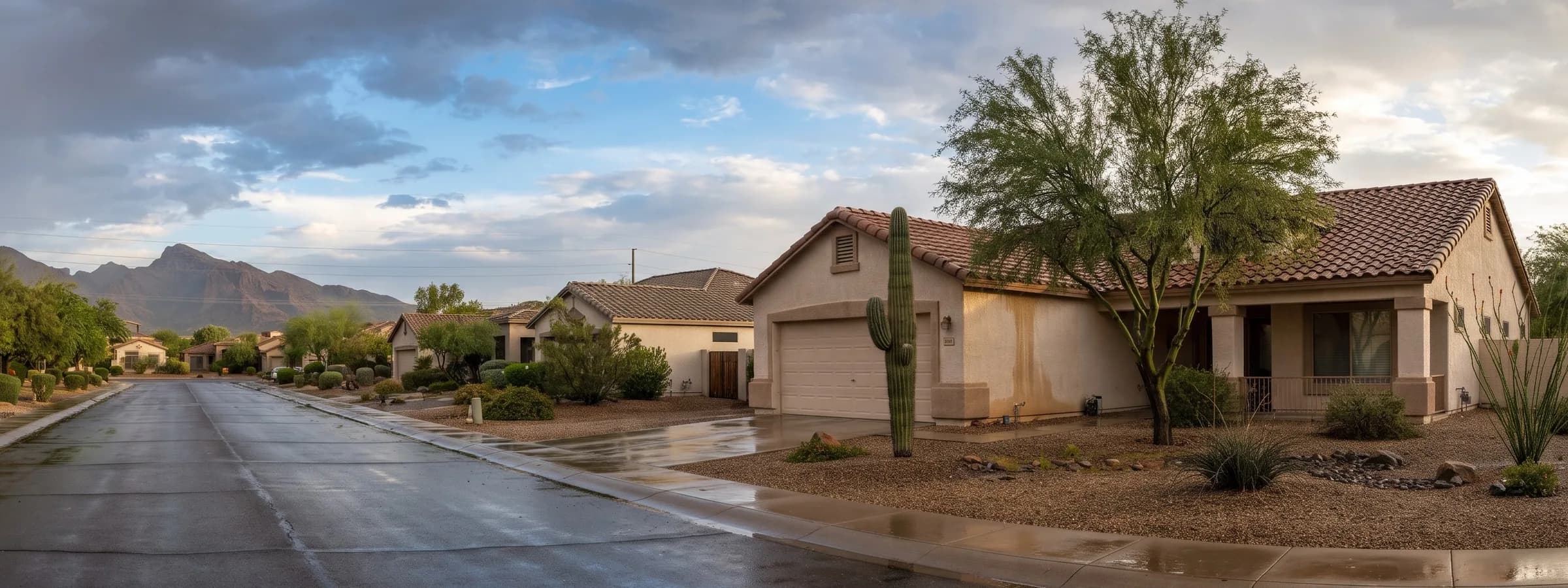

Arizona has no license for drying out a wet house on its own, yet it does license the contractor who tears out and repairs what the water ruined, and in Phoenix that line sits at $1,000. A homeowner with a stained ceiling or a floor soaked by a failed supply line is choosing between companies that may or may not be allowed to bill for the drywall, pipe, and flooring work that follows, and the answer decides who can legally collect, whether the City requires a permit, and how the insurer treats the bill.
In Phoenix, water damage restoration is the removal of water, the drying of the structure to the ANSI/IICRC S500 standard, and the repair of what cannot be saved, and the Arizona Registrar of Contractors (ROC) licenses the construction work in it while Arizona issues no separate license for extraction and drying. The water can arrive through a failed supply line, an overflowing air conditioner drain, or a roof that leaked during a monsoon storm, and the National Weather Service dates the monsoon from June 15 to September 30.
Key insights
- Typical cost. Water damage restoration in Phoenix costs $1,400–$6,600 for a typical job, with an average of about $3,600.
- The $1,000 line. Residential repair, demolition, or rebuild work totaling $1,000 or more needs an active Arizona ROC license, and splitting one operation into smaller contracts does not escape the rule (A.R.S. 32-1121).
- No drying license. Arizona issues no separate license for extraction and drying, so IICRC firm certification, insurance certificates, a written scope, and daily moisture logs are the checks.
- Insurer clocks. An Arizona insurer must acknowledge a claim within 10 working days and accept or deny it within 15 working days after proofs of loss (A.A.C. R20-6-801).
- Monsoon swings. Phoenix Sky Harbor recorded only 0.74 inch in the 2024 monsoon, the 7th driest on record, and the metro came in above normal in 2025, so storm exposure changes from year to year.
- Permits. The City of Phoenix exempts patching a hole in a drywall sheet and fixing a pipe leak, but requires a permit to replace a whole drywall sheet or a concealed section of pipe.
The first 48 hours after a Phoenix leak
The first 48 hours after water enters a Phoenix house are for stopping the source, recording the loss, protecting power and valuables, and starting drying. Clean supply water begins to degrade after about 48 hours under the IICRC S500 categories, so a same-day crew call limits how much material has to be torn out, which is why every emergency water damage response starts with the same shutoff and recording steps.
 Breakers for wet rooms are safe to switch off only from dry footing, and a panel that is damp or sits in standing water calls for an electrician instead.
1. Close the main valve
Turn off the main water valve to the house, then run a faucet to drain the lines. If the water comes from the roof or from outside, move belongings and call a crew before looking for the source.
2. Write down the discovery time
Note the date and hour you first saw water or a stain. Insurers measure their response clocks from the claim notice, and a dated first photograph shows the loss was sudden.
3. Film each wet room before cleanup
Record a slow video of every wet room, then photograph the source, the stain lines on walls, and each damaged item before anyone moves or discards anything.
4. Lift valuables and cut the circuits
Carry electronics, papers, and photographs to a dry room. Turn off breakers for wet rooms only if the panel is dry and reachable without stepping in water, and call an electrician if it is not.
5. Report the loss and book drying together
Report the loss to the insurer and hire a crew in the same hour, since drying should not wait for an adjuster's visit. Make temporary repairs, save every receipt, and hold permanent repairs until the insurer has inspected.
Water that came in from outside, such as runoff that crossed a threshold, carries soil and should be treated as contaminated. The EPA flood cleanup advice calls for gloves, boots, and sealed disposal of anything porous that the water touched, and that work belongs to a trained crew.
Where Phoenix water comes from
Phoenix water damage comes from inside the house through supply lines, water heaters, and air conditioner drains, from the roof during monsoon storms, and from runoff or sewer lines that bring contaminated water in from outside. The S500 category depends on the source and how long the water sat, since a supply line or water heater leak starts clean, while water that entered from a wash, a street, or a sewer line is contaminated from the first minute, and the category sets how much material a crew can dry in place and how much has to be removed.
 Water from an air conditioner drain starts as clean Category 1 water, and saturated ceiling drywall and insulation usually have to be removed even so.
The monsoon supplies the outside water, and the National Weather Service Phoenix office dates it from June 15 to September 30, with reviews that show how uneven it is: Sky Harbor recorded only 0.74 inch in 2024, the 7th driest monsoon on record, while the Phoenix metro came in above normal in 2025 after an inactive first half of the season across the region, with a massive dust storm through the metro on August 25 and multi day flash flooding in south-central Arizona from September 25 to 27. A quiet monsoon one year does not predict the next, and the NWS warns that flash flooding can occur many miles from the storm that caused it.
| Water source | Category | What it changes |
|---|---|---|
| Supply line or water heater | 1, then 2 | Clean at first and degrades after 48 hours, so drying has to start the same day to save drywall and baseboards |
| Air conditioner drain overflow | 1, then 2 | Wets a ceiling and insulation from above, and the wet insulation usually has to be removed even when the water was clean |
| Roof leak in a monsoon storm | 1 to 2 | Picks up attic dust and insulation on the way down, which moves the loss toward removal of ceiling material |
| Runoff or wash overflow | 3 | Soil and debris make it contaminated at once, so porous materials come out and a crew works under containment |
| Sewer backup | 3 | Contaminated by definition, and cleanup follows the sewage rules rather than ordinary drying |
A leak behind a wall is handled differently from standing water on a floor, and the source decides who is called first. For water that came through the roof, the roof leak repair and the drying are separate jobs billed apart, and the same holds for an overflowing air conditioner drain, where the drain fix and the wet insulation are separate line items. A leak in a concrete slab is a plumber's find first, located with listening equipment or a pressure test before anyone opens the floor.
Phoenix water damage costs
Most Phoenix water damage jobs cost $1,400–$6,600, and the average is about $3,600. A typical job here means one affected area that is extracted and dried and, at the high end, repaired, while a loss that reaches several rooms costs a multiple of that. Small leaks caught the same day start near $300, and storm or flood water through several rooms reaches $9,500–$23,500 or more.
 Swollen cabinet toe kicks and flooring that runs into the next room are what move a kitchen loss toward the top of its $1,400–$7,500 range.
In the Bureau of Labor Statistics' May 2025 figures, hourly pay for Phoenix construction and extraction workers comes to about 94 percent of the U.S. average. The final water damage restoration cost of a Phoenix job then depends on how many rooms the water reaches, whether the repair side needs a licensed contractor and a City permit, and how long the drying equipment runs, with calls after normal hours carrying a 25–50 percent premium.
| Scenario | Estimates | Drivers |
|---|---|---|
| Minor spot mitigation | $300–$1,400 | Caught the same day, one area, no material removal |
| Supply line burst | $900–$2,800 | Hours wet before the shutoff, and whether a concealed pipe section needs a permit |
| Standard mitigation | $1,400–$3,800 | Extraction and drying of one or two rooms with equipment running several days |
| Appliance overflow | $1,900–$4,700 | Water spreads under flooring and into cabinet bases |
| Roof leak in a storm | $2,400–$6,600 | Wet insulation and ceiling drywall, plus the roof repair billed by a licensed contractor |
| Mitigation plus basic repairs | $3,800–$6,600 | Drywall, paint, and baseboard work that passes the $1,000 license line |
| Sewage backup | $6,600–$13,000+ | Category 3 removal, containment, and disinfection |
| Storm flooding, several rooms | $9,500–$23,500+ | Category 3 runoff, flooring and drywall removal, and a longer rebuild |
Mitigation alone costs $2.75–$7.00 per square foot of affected floor, with Category 1 water at the low end and Category 3 near the top, while repair and rebuild cost $19–$35 per square foot. The rate applies to the wet floor area, so a 300 square foot loss in a 2,000 square foot home prices on 300 square feet.
| Room | Estimates | Drivers |
|---|---|---|
| Bathroom | $500–$4,200 | Small footprint, but tile and cabinet bases hold water |
| Laundry room | $900–$4,700 | Hose or drain failure, and water that runs into the adjoining rooms |
| Kitchen | $1,400–$7,500 | Cabinet toe kicks, dishwasher and sink lines, and flooring that continues into other rooms |
| Living or family room | $3,100–$17,500 | Large floor area, continuous flooring, and furniture that has to be moved and stored |
Ask whether the moisture mapping and the drying equipment days are priced separately or folded into the mitigation scope, because the total can look the same while the line items differ. A scope that says only "dry the house" has no count to check, while one that lists the air movers and dehumidifiers for a set number of days can be compared with the daily log and the invoice.
Jobs a homeowner can handle alone
A homeowner can handle a small spill of clean water caught within hours on a hard, sealed surface, and should call a crew for anything that reaches a wall cavity, a ceiling, insulation, carpet padding, or an electrical outlet. Water from outside or from a sewer line is contaminated from the start and is never a do-it-yourself job.
 Clean water on a sealed tile floor is the one case that dries safely by hand, and only when it is caught within hours, since mold can grow on wood, drywall, carpet, and furniture that stay wet for more than 24 hours.
Water from a burst pipe or a failed supply line starts as clean Category 1 water, which is why the first hours are the do-it-yourself window, and the EPA says mold can grow on wood, drywall, carpet, and furniture that stay wet for more than 24 hours. Rented fans and a dehumidifier move air, but they do not tell you whether the framing, subfloor, or slab has reached its dry standard.
| Situation | Who | Reason |
|---|---|---|
| Clean spill dried within hours on tile or sealed floors | Homeowner | Hard surfaces release water fast, and mopping with fans is enough |
| Wet carpet or padding after a clean leak | Crew | Padding that stays wet usually has to be pulled and replaced |
| Wet drywall, baseboard, or insulation | Crew | Moisture stays inside the cavity, and the EPA says not to seal flooded wall cavities |
| Water from outside or a sewer line | Crew | Category 3 water needs containment and removal of porous materials |
| Water near outlets, the panel, or a ceiling light | Electrician first | Wet wiring is a shock risk until it is checked |
| Anything wet for more than 24 hours | Crew | Mold can start on wood, drywall, carpet, and furniture after that point |
A homeowner who starts the work should still photograph the damage first, keep every receipt, and stop at the first sign that water has gone beyond the surface, because a partial dry-out that leaves wet insulation or padding behind can become a larger claim and a mold problem later. The insurer will ask what was done and when.
Arizona ROC licensing and hiring
An Arizona contractor who repairs, alters, demolishes, or rebuilds part of a residential structure for $1,000 or more needs an active license from the Arizona Registrar of Contractors, and no state license covers extraction and drying by themselves. The statute that sets the line, A.R.S. 32-1121, exempts casual work under $1,000 in total price including labor and materials, and it denies the exemption when a larger operation is divided into contracts under $1,000.
 Patching a hole in a drywall sheet needs no City permit, but once the repair bill reaches $1,000 the work belongs to a contractor with an active ROC license.
The license decides who can collect and who can be held to the work. It is unlawful to bid on or offer construction services without a license in good standing under A.R.S. 32-1151, an unlicensed contractor cannot go to court to collect payment under A.R.S. 32-1153, and the residential contractors' recovery fund in A.R.S. 32-1132 pays only for harm caused by a licensed residential contractor. The dollar line and the type of work set three tiers.
Jobs under $1,000
A job at this size is usually extraction and a few days of drying with no rebuilding. The ROC exemption covers casual work up to $1,000, but a crew that bills the drying under $1,000 and the drywall and paint separately is dividing one operation, and the statute treats that as a single job. Ask for one written scope and one total before work starts.
Jobs of $1,000 or more
At this size the demolition and repair side needs an active ROC license. Search the company name or number at the Registrar of Contractors and confirm the license is active, sits in the name on your contract, and covers residential work. Then check the IICRC Certified Firm listing by exact company name and ask for the insurance certificates, since the ROC license confirms legal standing and says nothing about drying skill.
Jobs with pipe, panel, or structural work
When the loss needs a concealed pipe section replaced, an electrical repair, or rebuilt framing, the work is billed by a licensed trade and may need a City permit. Ask who pulls the permit, who schedules the inspection, and whether the restoration company bills direct to the insurer or expects payment from you first. A written answer to each protects you if the scope changes after demolition.
How a Phoenix job runs
A typical Phoenix job runs 3–7 days of drying and then 1–3 weeks of repairs, depending on the materials and how many trades are involved. Hardwood, plaster, framing, and the slab dry slowest, and repair work waits for dry readings and, where the City requires it, for a permit and inspection.
The sequence is the same on most jobs: source control and a moisture survey on the first day, extraction and removal of materials that cannot be dried, equipment set for several days with daily readings, final readings against the dry standard, and then repair. For a loss with clean water caught early the repair may be paint and baseboard. For a loss that reaches the drywall, flooring, and cabinets it is a rebuild that passes the $1,000 license line and may pass the permit line.
The crew's schedule also depends on the season. A monsoon storm that damages several houses at once creates a backlog, and the first call is the one that gets a crew while the water is still shallow. Report the loss and confirm an arrival time in writing before the crew leaves your door, and keep photographs of the work at each stage.
Drying proof and moisture logs
A drying job is finished when the materials reach their dry standard, and a crew proves it with readings taken on a schedule. Under IICRC S500, the dry standard is set by comparing wet materials against unaffected materials of the same kind in the house, and a crew that cannot show those readings cannot show the house is dry.
 A cool spot on a thermal image marks where moisture may remain, but only moisture meter readings logged against the dry standard show that a material is dry.
A floor or wall can feel dry at the surface while framing, subfloor, and the concrete slab still hold moisture, and only a moisture meter shows which. The heat of a closed house in summer does not change what the meter reads. Ask for a daily log with the date, the room, the material, the reading, and the equipment count, and compare the final readings to the dry standard before the equipment is removed.
Equipment usually stays for days after the surface looks dry, and the daily readings are what justify each of those days. A final invoice with no logs behind it is hard to defend to an insurer, and the logs are also what a second company reviews if the first one leaves a job unfinished, which makes the logs worth requesting before the job starts.
Saving belongings after a water loss
Belongings that do not soak up water can usually be cleaned and dried after a water loss, while materials that soak up a lot of water and cannot be cleaned and dried should be thrown away, according to the EPA. Glass, metal, and sealed wood and plastic are the usual keepers, and mattresses, upholstered furniture, and carpet padding are the usual discards when the water was contaminated or sat for days.
Textiles can sometimes be saved by laundering, and the EPA says a restoration specialist for that type of item may be able to clean and dry precious items such as photographs and heirlooms. Water from a sewage backup changes that sorting, because porous items it touched are thrown away regardless of their value.
Photograph and list each discarded item with its age and approximate value before it leaves the house, since the insurer's contents claim is built from that list, and keep one sample of damaged flooring or carpet until the adjuster has seen it. Move salvageable items to a dry room before the crew sets equipment, so the team can work around furniture instead of stacking it on wet floors.
Arizona claim clocks and coverage gaps
An Arizona insurer must acknowledge a claim within 10 working days, finish its investigation within 30 days unless it reasonably cannot, and accept or deny the claim within 15 working days after receiving proofs of loss, under A.A.C. R20-6-801. A denial must cite the policy provision, condition, or exclusion it relies on, so a letter that names none is incomplete.
 The 10 working day acknowledgment clock starts when the claim is reported, so photographs of the damage and the date it was found should be ready before the call.
Coverage depends on where the water came from. Standard homeowners coverage generally pays for sudden water from inside the house, and excludes gradual leaks and runoff that enters from outside. Whether a leak counts as sudden depends on the policy wording and the cause, and storm water damage from monsoon runoff that enters from the yard belongs on a separate flood policy.
Keep the claim notice date, the adjuster's name, and each written response, since the 10 and 15 working day clocks run from the dates on those records. Keep the daily logs, the photographs, and the written scope in the same folder, because they are the evidence the insurer's reviewer will compare against its own estimate.
If the insurer's offer is low
A low or denied offer can be challenged by asking the insurer to explain each reduction in writing and by sending the daily moisture logs, photographs, and written scope that support the contractor's figure. Ask the adjuster which line items were cut and why, and keep the answers in writing.
The first question is whether the cause is covered at all, which turns on whether the water was sudden and accidental under the homeowners insurance policy, and the second is whether the dollar figure matches the scope. The numbers that decide a scope dispute are the drying days, the equipment counts, and whether each material can be saved, and the logs record all three.
If the insurer misses a deadline or refuses to explain a denial, a complaint to the Arizona Department of Insurance and Financial Institutions leads to an inquiry, and the insurer must answer the Department's inquiry within 15 working days under R20-6-801. A public adjuster negotiates the claim for a fee, so confirm that the adjuster holds an Arizona adjuster license with the Department and get the fee terms in writing before signing, and consider one only when the gap between the offer and the scope is large.
Phoenix permits and rebuild rules
In Phoenix, painting, patching a hole in a drywall sheet, and stopping a pipe leak need no permit, while replacing a whole drywall sheet or a concealed section of pipe does, according to the City's work exempt from permit list. The line matters because a repair that crosses it needs a City inspection before the wall is closed.
 A concealed section of pipe replaced inside a wall counts as new work, so the plumbing permit and the inspection come before the drywall goes back.
Plumbing has its own line. Repairing a leak in a pipe, valve, or fixture needs no plumbing permit unless a concealed section of pipe has to be replaced, in which case the work counts as new and needs a permit and an inspection, and replacing a fixture needs one only if the pipes are relocated. Replacing an existing water heater in a one or two family dwelling by a licensed contractor is also exempt.
Confirm the permit question with the City of Phoenix Planning and Development Department before demolition, because the exempt list does not cover every repair, and ask the contractor in writing who pulls any permit. A house outside the City limits, even one with a Phoenix mailing address, falls under its own city or county permit office. A job that crosses a permit line often crosses the ROC license line too, because repairs that need a permit usually cost more than $1,000.
Mold after a Phoenix water loss
Mold can begin growing within 24 to 48 hours on materials that stay wet, according to the EPA, so a water loss that dries late becomes a mold job. Phoenix's dry outdoor air does not help inside a closed house, where a wet wall cavity, wet insulation, or a damp slab stays humid after the surface looks dry.
A loss tips into remediation when wet drywall or insulation was left in place beyond the first two days, when a musty smell persists after drying, or when staining appears on the back of removed drywall. When drying is late, the mold after water damage timeline starts from the first wet day, and every day of delay adds to what has to be removed.
If the crew's final readings meet the dry standard, mold is unlikely to start, so the readings and logs are also the best defense against a later mold claim. A dry reading on each affected material on the day the equipment came out is what a mold assessor or an insurer asks to see if a smell or a stain shows up months later; a job that does tip over becomes Phoenix mold remediation with its own testing and cost questions.
Phoenix areas and their water risks
Phoenix water risk varies with the lot, the age of the house, and what sits above and beside it. Hillside lots receive runoff, low ground near the river sits in mapped flood zones, and condos and townhomes share walls and stacks that spread a leak to neighbors. These are general patterns for each area, and a house inspection or a plumber's report is the way to confirm one specific home.
 A wash can sit dry for months and carry runoff within minutes of a monsoon cloudburst, and the National Weather Service warns that the flooding can begin many miles from the storm.
Flood exposure follows the ground, and a house near a wash or the river bottom can sit in a mapped flood zone that a standard homeowners policy ignores. Pricing flood coverage before the monsoon starts matters because a new flood policy does not take effect the day it is bought.
| Area | Risk factor | Homeowner note |
|---|---|---|
| Sunnyslope | Hillside runoff | Lots below the slopes near the Phoenix Mountains Preserve can receive runoff in a cloudburst, so check where the lot drains before the monsoon |
| Moon Valley | Foothill washes | Homes beside desert washes face fast runoff, and a flood zone check belongs in any purchase |
| Camelback East | Condos and townhomes | Shared walls and stacks spread a leak from one unit to the next |
| Midtown | Mid rise and older apartments | Older units and shared plumbing stacks raise the question of who pays |
| Paradise Valley village | Aging fixtures | Homes from the 1970s through the 1990s may still have original supply lines, water heaters, and appliance hoses |
| South Mountain Village | Slopes and washes | Homes at the base of the mountain can sit below washes that carry monsoon runoff |
| Rio Salado corridor | Low ground by the river | Check the mapped flood zone before buying and price flood coverage separately |
Runoff that enters a ground floor from a wash or street follows the steps for flood water damage, which start with treating the water as contaminated and removing porous materials it touched. A foundation that sits lower than the street or the yard grade takes water first, so the shutoff and power steps apply to the lowest rooms before anything else.
Renters and condo owners
In a rental the landlord pays to repair the unit and the tenant's own insurance covers the tenant's belongings. Arizona law requires a landlord to keep the premises fit and habitable and to maintain the plumbing, heating, ventilating, and air-conditioning facilities under A.R.S. 33-1324, and a tenant whose unit has a leak should send written notice immediately. A tenant's remedy for a landlord's material breach, set in A.R.S. 33-1361, is a written notice that the lease will end if the breach is not remedied in 10 days, or in 5 days when it affects health and safety.
 A leak at a drain connection is the landlord's repair to make, and the date of the tenant's written notice is what starts the 10 day and 5 day clocks.
A tenant may also hire a licensed contractor for a minor repair and deduct the cost from rent under A.R.S. 33-1363, but only after written notice and a 10 day wait, and only when the cost is under $300 or half the monthly rent, whichever is greater. Most water losses cost more than that limit, so they go through the notice route instead.
In a condo, the association usually owns the building shell and common pipes while the owner is responsible for what sits inside the unit, so the declaration decides who pays, and a condo water damage claim starts with reading it. A leak that starts in a neighbor's unit raises a separate question of who pays, and the answer depends on the cause and on the policies on both units.
Buying a Phoenix home that leaked
A buyer of a Phoenix house with past water damage should ask for the repair invoices, the City permit records, and the insurance claim history, and then have an inspector read moisture in the walls and the slab. A replaced wall with no permit on file is a question for the seller, because the City requires a permit to replace a whole drywall sheet.
Arizona Revised Statutes section 32-2156 protects a seller from suit only for not disclosing specific facts, such as a death or a felony, so a known leak is not on that list, and a seller who knows of one should disclose it with the repair record. Ask for the drying logs and final readings from the original job, since a repair dried to the standard is a different risk than one that was painted over.
Check the mapped flood zone and ask whether the house has ever had a flood claim, because a standard homeowners policy does not cover runoff and the price of a flood policy depends on the zone. A buyer closing in summer should look at the roof and attic after the first monsoon storm, when a new leak is easiest to find.
Prevention before monsoon season
Phoenix water prevention follows two seasons: the cooling season, when air conditioner drains run for most of the year, and the monsoon, when roofs and grading are tested. A few checks, done on a calendar before each season starts, close most of the paths water uses to get in, and each one costs far less than the drying and repair it prevents.
 The National Weather Service dates the monsoon from June 15 to September 30, which is the stretch when the roof check applies after each storm.
Mark the main valve and test it
Every adult in the house should know where the main water valve is, and it should turn. Test it twice a year, because a valve that has not moved in years can seize when you need it.
Flush the condensate drain before cooling season
A clogged line backs water into the pan and onto the ceiling, which is how HVAC condensation becomes a ceiling stain. Flush it with a vinegar and water mixture or have it serviced before the cooling season starts.
Check the roof after every monsoon storm
Look for lifted or cracked tiles, torn underlayment at the edges, and damp insulation in the attic. A small leak found after the first storm costs far less than one found after the fourth.
Read the water meter with every tap off
If the meter dial moves when nothing is running, water is escaping somewhere, and a slab leak or a buried line is a common place to look. A plumber can locate it before it damages flooring.
Replace supply hoses on the calendar
Washing machine and dishwasher hoses and toilet supply lines age and burst. Replace them on a schedule, and choose braided stainless hoses when you do.
Frequently asked questions
How much does water damage restoration cost in Phoenix?
About $3,600 for a typical job, within a usual range of $1,400–$6,600. Extraction and drying are priced as one scope and repairs as another, so a loss that needs both adds the two, and mitigation alone costs $2.75–$7.00 per square foot of affected floor.
Does a Phoenix water damage company need a state license?
Only for repair, demolition or rebuild work of $1,000 or more. Arizona issues no separate license for extraction and drying, but a contractor who repairs, alters, demolishes or rebuilds part of a residential structure for $1,000 or more must hold an Arizona Registrar of Contractors license, and splitting a larger job into smaller contracts does not avoid that.
How do I check a Phoenix contractor's ROC license?
Search the company name or license number at roc.az.gov and confirm the license is active, belongs to the exact company on your contract, and covers residential work. Then check the IICRC Certified Firm listing separately, because the ROC license says nothing about drying skill.
How soon must an Arizona insurer decide a water damage claim?
Within 15 working days of receiving proofs of loss. The insurer must also acknowledge the claim within 10 working days, finish its investigation within 30 days unless it reasonably cannot, and cite the specific policy provision in any denial, under A.A.C. R20-6-801.
Does homeowners insurance cover monsoon flooding in Phoenix?
Usually not, because standard homeowners policies cover sudden water from inside the house, such as a burst supply line, while runoff or flood water entering from outside is a flood loss that needs a separate policy, which is what flood insurance coverage pays for.
Do I need a permit for water damage repairs in Phoenix?
Sometimes, since the City exempts patching a hole in a drywall sheet and fixing a pipe leak, but removing and replacing a whole drywall sheet needs a permit, and so does replacing a concealed section of pipe.
Is a water damage estimate free in Phoenix?
Often, but ask before anyone sets equipment. A free walkthrough should still end in a written scope that lists the rooms, the equipment count, and the planned drying days, because the final invoice is checked against that scope.
How do I choose the best water damage company in Phoenix?
Pick the company whose credentials you can verify yourself. Read back the ROC license number, look up the IICRC Certified Firm listing by exact name, read the insurance certificates, compare written scopes, and ask for daily moisture logs, which are the checks for choosing a restoration company.
Can I trust Phoenix water damage reviews?
Use them to spot patterns, then verify the credentials. Look for reviews that name a cause, a timeline and a final bill, treat a wall of five star reviews with no detail with caution, and confirm the license and the insurance certificates before signing.
Do residential and commercial water damage jobs differ in Phoenix?
Yes, a residential job is billed to the homeowner or the homeowner's insurer and falls under the residential contractor license, while commercial work uses a different license class, different insurance limits and often a property manager's approval, so confirm the company holds the residential license for a house.
- IICRC S500
- EPA: Flood Cleanup to Protect Indoor Air and Your Health
- NWS Phoenix: 2025 Monsoon Season Review
- NWS Phoenix: 2024 Climate Year in Review
- Arizona Registrar of Contractors
- A.R.S. 32-1121: Persons Not Required to Be Licensed
- A.A.C. R20-6-801: Unfair Claims Settlement Practices
- City of Phoenix: Work Exempt from Permit
- A.R.S. 33-1361: Noncompliance by the Landlord
- BLS: Occupational Employment and Wages in Phoenix-Mesa-Chandler, May 2025
Sam Hickerson is the founder of RestoreAdvisor and writes consumer guides on mold remediation, water damage restoration, inspection, testing, and home recovery. His work focuses on helping homeowners understand costs, risks, and when to call a professional. He draws on guidance from the EPA, CDC, IICRC, and other authoritative sources to make complex home issues easier to navigate.