
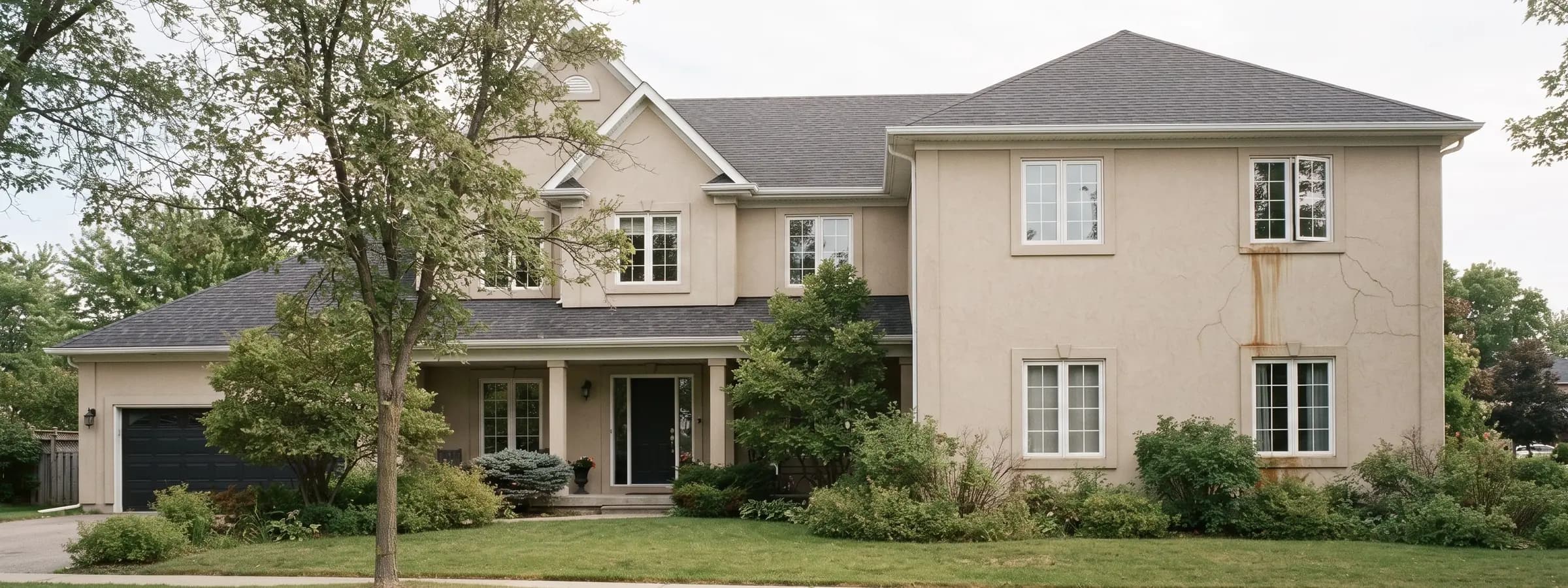

A brown stain under a window, a bulge near the base of a wall, or a hollow patch that gives under your thumb usually means water has already reached the layers behind the stucco. The visible damage is the smaller part of the problem, and a repair that lasts depends on finding where the water got in and how far it spread before anything gets patched or painted. Stucco hides wet sheathing and framing well, which is why a small mark outside can turn into a water damage restoration job inside the house.
Stucco water damage is moisture that gets behind the stucco finish and wets the lath, barrier, sheathing, framing, and insulation, and it falls under ANSI/IICRC S500, the standard for professional water damage restoration. Stucco sheds water only when the wall behind it can drain, so it fails where flashing and drainage fail: openings, joints, roof edges, and the base of the wall.
Key insights
- Surface signs understate the damage. Stains, bubbling, and cracks outside often sit in front of wet sheathing and framing, and the water can surface several feet from where it entered.
- A blocked drain path at the base traps water. Soil, mulch, and a clogged weep screed hold water against the bottom of the wall, where it soaks the sheathing from below.
- Probe testing is the most direct check. Small holes drilled through the finish let a meter read the sheathing directly, while surface meters and infrared cameras lose accuracy over the metal lath under stucco.
- A patch hides the problem unless the source is fixed. Caulk, filler, or paint over wet material traps the water, and the damage continues behind the repair.
- A typical water damage repair costs $600 to $5,000 in total. Repairing the damaged area costs $30–$50 per square foot of damaged wall, rebuilding a full wall after hidden damage costs $12,000–$20,000, replacing all the stucco on a sound house costs $7–$15 per square foot of wall, or $10,500–$22,500 or more, and rebuilding every wall of a house with hidden water damage costs $45,000–$75,000.
- Insurance usually covers sudden damage, not wear. A slow leak from failed flashing or caulk is typically excluded as maintenance, while storm damage that opened the wall may be covered.
Signs of water behind stucco
Water behind stucco shows up as stains that return after cleaning, bubbling or blistering in the finish, soft or hollow patches, and cracks that cluster around windows, doors, and vents. Stucco that stays dark for a week after rain, white chalky deposits, and rust streaks are further signs that the wall is holding water instead of shedding it.
 A hand check finds loose or hollow stucco but cannot show whether the sheathing behind it is wet, so a stain like this still needs probe testing before anyone patches it.
The location of a sign narrows down the source. Damage at the base of a wall points toward drainage and ground contact, damage under a window points toward flashing and sealant, and damage below a roof edge points toward a roof to wall joint. Water also travels along the barrier and sheathing before it surfaces, so a stain can appear a foot or more from the actual entry point.
| Sign | What it points to | Urgency |
|---|---|---|
| Stain that returns after cleaning | Repeated wetting from a leak or trapped moisture | Test within weeks |
| Bubbling or blistering finish | Water trapped between the finish and the base coat | Test within weeks |
| Soft, hollow, or loose areas | Stucco that has lost its bond to the wall | Test within days |
| Cracks clustered at windows, doors, and vents | Water entering at the openings | Test within weeks |
| White chalky deposits | Water moving through the stucco and evaporating | Recheck after rain |
| Rust streaks | Corroding lath or fasteners behind the finish | Test within weeks |
| Wall still dark a week after rain | A wall that is holding water | Test within weeks |
| Soft drywall or a stain inside below a window | Moisture that has crossed the full wall | Test within days |
The inside face of the wall gives the clearest confirmation. Press the drywall below windows and along exterior walls, and treat softness, a musty smell, or paint that bubbles at the baseboard as proof that moisture has crossed the wall. Damage that appears right after wind-driven rain, with new cracks or a stained corner, often traces to storm damage that opened a path the old finish was covering.
Water damage or normal wear?
Hairline shrinkage cracks, algae, dirt streaks, efflorescence from a single wetting, and sprinkler overspray look like water damage but do not mean water is inside the wall. Fine cracks from shrinkage and temperature swings are normal in cement stucco, and green or gray growth and dirt streaks wash off without any moisture behind them. A mark that returns after cleaning, grows after rain, or comes with softness or movement belongs in the water damage category.
 Irrigation spray leaves the same chalky band as a leak and also keeps the wall wet, so aiming the heads away from the stucco comes before any repair.
A few checks separate the lookalikes from real intrusion. Track a crack for a full season to see whether it widens, wash a streak with a soft brush and water to see whether it lifts, and compare a stain with the sprinkler schedule and rainfall. A stain that follows water use rather than weather may come from pipes or a hose bib, and a leak inside the wall needs a different fix.
| Lookalike | How it differs | Check |
|---|---|---|
| Shrinkage cracks | Fine, scattered hairlines with no staining or movement | Width stays the same through a season |
| Efflorescence after one wetting | Chalky film that stops returning once the wall dries | Brush it off and watch through the next dry spell |
| Algae and dirt streaks | Green, gray, or black film that wipes away | Wash with water and a soft brush |
| Sprinkler overspray | Mineral staining at the same height on one side | Run each zone and watch the wall |
| Plumbing inside the wall | Stain that follows water use rather than rain | Compare against a water meter test |
What to do right now
Photograph and mark the damage, redirect water away from the wall, check the inside face, cover any open gap, and book a moisture test before anyone patches or paints. These steps limit the water and preserve the evidence while the source and the extent of the damage are confirmed by a test.
 Moisture that has reached interior drywall has already passed through the barrier and sheathing, which makes a probe test of the exterior wall the next step.
Active water coming through an interior wall, a bulging section that could fall, or wet electrical fixtures on an exterior wall turn this into an emergency water damage situation. Shut off power to any affected outlet at the breaker and call a restoration company the same day, then deal with the cladding once the wall is safe.
1. Mark and photograph the stains
Take wide and close photos of every stain, crack, and soft area, and outline the edges of each stain with a pencil or chalk and the date so you can see whether it grows after the next rain.
2. Redirect water away from the wall
Turn off sprinklers that hit the wall, clear any overflowing gutter, and pull mulch or soil back from the base so rain and irrigation stop adding to the problem.
3. Check the inside face of the wall
Press the drywall below windows and along the wall, note any softness or musty smell, and move furniture and belongings away from the wall.
4. Cover an open gap temporarily
If a hole or open joint lets rain in, tape polyethylene sheeting over it and leave the rest of the wall uncovered so it can dry.
5. Book a moisture test before any patching
Call an inspector or contractor who does probe testing, and hold off on caulk, filler, and paint until the readings show where the wet areas end.
How water gets behind the wall
Water gets behind stucco at openings, joints, roof edges, penetrations, and the base of the wall, almost always where flashing or sealant has failed or was never installed. Once it is behind the finish, gravity moves it down the barrier until it finds sheathing, a wood sill, or an interior wall.
 A streak that starts at a roofline joint points to missing or failed kick out flashing, which a roofer or envelope inspector can confirm by checking the flashing at the end of the gutter.
Stucco was the principal exterior wall material on 25% of single family homes started in 2024, just behind vinyl at 26%, according to NAHB's analysis of Census Bureau Survey of Construction data. It led in the Pacific division at 64% and the Mountain division at 48%, so a large number of owners live with a wall system that depends on drainage details they cannot see from the yard.
| Entry point | How water gets in | Sign to look for |
|---|---|---|
| Window and door flashing | Missing or reversed flashing, failed sealant at the frame | Staining at the corners and under the sill |
| Roof to wall joints | Missing kick out flashing sends roof runoff down the wall | Streaks below the roof edge |
| Cracks and failed joints | Rain enters and the wall absorbs it | Dark lines after rain |
| Penetrations | Hose bibs, vents, light fixtures, and dryer vents with gaps | Stains radiating from the fitting |
| Decks and balconies | Ledger boards and railings attached through the cladding | Staining and softness around attachment points |
| Base of the wall | Soil, mulch, or sprinklers against the stucco, or a blocked weep screed | Damp or crumbling stucco near the ground |
| Past patches | Filler or paint that closed the surface but left the leak | Stains returning around an old repair |
Openings cause the most trouble because they interrupt the barrier. Flashing has to shed water over the cladding rather than behind it, and sealant that has cracked or pulled from the frame lets water follow the gap inward. The same failures that cause a window or door leak from inside also send water into the wall cavity from outside, long before anything drips.
Where a roof edge meets a wall, water runs down the cladding unless kick out flashing diverts it into the gutter. When that flashing is missing, a roof leak at the joint feeds a stripe of damage down the wall below, and the stain often shows only a few feet from the roofline.
Synthetic stucco, called EIFS, is a different system from cement stucco. It uses foam board with a thin finish, and water that gets behind the foam through failed joints or sealant has little way to drain. A wall that is thought to be traditional stucco should be identified before testing, since the repair method differs.
How to confirm moisture behind it
A moisture test confirms water behind stucco by reading the sheathing directly, usually with pin probes pushed through small holes in the finish and sealed afterward. Visual checks and tapping can find loose stucco but cannot show whether the wood behind it is wet, which is why a wall that looks sound can still fail a probe test.
 Holes drilled at the edge of a stain as well as in the middle show where the wet area ends, and each one is sealed afterward.
Surface meters and thermal imaging have limits on stucco because the metal lath under the finish interferes with readings, and a dry surface can sit in front of wet sheathing. Inspectors take readings at several spots, including a dry reference area on the same wall, because meter values are best compared from one spot to another. Readings on wood sheathing are judged against the normal moisture meter readings for wood.
| Method | What it shows | Limits |
|---|---|---|
| Visual and sound check | Cracks, stains, and hollow or loose areas | Cannot see the sheathing |
| Pin probe testing | Moisture content of the sheathing at each hole | Needs small holes that are sealed afterward |
| Surface moisture meter | Moisture near the surface of the finish and trim | Less reliable over metal lath |
| Infrared camera | Temperature patterns that may mark wet areas | Misses wet sheathing behind stucco without a temperature difference |
| Test removal | A small cut-out showing the barrier and sheathing | Used to confirm high readings, since it damages the finish |
An independent building envelope or stucco inspector has no repair to sell, which keeps the scope honest. The inspector maps readings across the wall, flags the wet areas, notes which spots read dry, and writes up the likely entry points. Every test hole should be sealed before the inspector leaves, and the dry readings are as useful as the wet ones because they show where the repair can stop.
What the water does inside the wall
Water behind the cladding wets the barrier, sheathing, framing, and insulation in turn, and each layer fails in its own way, from swollen sheathing to rusted lath to saturated insulation. Wood stays protected from decay below about 20% moisture content, the long recognized threshold described by Home Innovation Research Labs, and decay becomes likely once moisture content passes the fiber saturation point of roughly 26% to 29%.
 Rusted lath and stained plywood mean the water has been inside the wall long enough to corrode metal and soak wood, which is why a stain on the outside can understate the repair.
Readings above 20% at several test spots mark wood that has lost its margin of safety, readings approaching 26% to 29% mark wood where decay is likely, and the inspector's map shows how far those spots extend. The damage builds slowly, because a wall that dries between rains can stay below the threshold for long periods, while a wall that stays wet for months crosses it and starts to rot.
| Layer | Role | When wet |
|---|---|---|
| Finish coat | Weather surface and color | Stains, efflorescence, and blistering |
| Base coats and lath | Stucco body held on metal mesh | Lath rusts and the stucco loses its bond |
| Water resistive barrier | Drains water that gets past the cladding | Tears or laps that fail send water to the sheathing |
| Sheathing | Panel that holds the wall together | Swells, softens, and rots |
| Framing | Studs, plates, and headers | Rots and loses strength |
| Insulation | Thermal layer in the cavity | Holds water against framing and loses its value |
| Interior drywall | Finished wall surface | Softens, stains, and grows mold |
When framing has softened, the repair moves from cladding work to structural water damage, and a contractor may need to shore up or replace studs before the wall is closed. Rusted lath and fasteners can also weaken the hold of stucco, which is why loose or crumbling areas deserve testing even when no stain is visible.
Stucco repair or remediation
A surface patch is enough only when testing finds dry sheathing and a small, stable defect. Any reading in the decay range calls for remediation, which means removing the cladding to the base layer, fixing the source, and rebuilding the wall in order. Patching over wet material traps the water, and the damage continues behind the repair.
 Remediation rebuilds the wall in order, with the barrier on first and the lath fastened over it before any stucco coat, so a quote that skips either layer is not a full repair.
Remediation follows a fixed order. The contractor repairs the flashing, sealants, and drainage that let the water in, removes wet and damaged material, dries the cavity to a verified reading, replaces the barrier, sheathing, and rusted lath, and then rebuilds the stucco coats with time to cure between each. A repair that skips the first step leaves the leak in place.
| Option | What it involves | Fits when |
|---|---|---|
| Crack seal and recoat | Sealing fine cracks and repainting | Sheathing tests dry and cracks are stable |
| Patch repair | Cutting out a damaged section and rebuilding the coats | A small area is damaged and the substrate is dry |
| Local remediation | Opening the wall at the leak, replacing barrier and sheathing, rebuilding | Testing finds wet sheathing in one area |
| Full elevation remediation | Stripping one wall and rebuilding with new flashing | Wet readings run across most of the wall |
| Re-clad with other siding | Replacing stucco with a different cladding after repairs | The system keeps failing or the owner wants less maintenance |
Who to call for the repair
Call an independent building envelope or stucco inspector first, then a stucco contractor for the lath, barrier, and coats, and bring in a restoration company when the wall cavity or interior is wet, with a general contractor added only if the framing is rotted. The order matters because the inspector's map of wet areas sets the scope that every contractor prices.
 Tell the inspector when the stain first appeared and whether it grows after rain, since that history helps narrow down where the water enters.
Ask each contractor for a license, proof of insurance, and a written scope that names the flashing, barrier, and sheathing work, along with the warranty on the repair itself. The same checks used when choosing a water damage restoration company apply here, including written moisture readings before and after drying.
| Professional | Handles | Call when |
|---|---|---|
| Building envelope or stucco inspector | Moisture testing, mapping wet areas, writing the scope | First, before any repair quote |
| Stucco contractor | Stucco removal, lath, barrier, and rebuilt coats | Wall is stucco and testing finds damage |
| General contractor | Framing repair and coordinating trades | Framing is wet or rotted |
| Restoration company | Drying the cavity and interior, mold side | Interior drywall, insulation, or flooring is wet |
| Plumber | Pipes and fittings inside the wall | Stain follows water use rather than rain |
DIY or professional repair
Homeowners can reseal small gaps, clear gutters, and clean surface growth, while opening a wall, replacing sheathing or lath, and rebuilding stucco coats belong to a professional. The dividing line is whether the sheathing behind the finish has been tested and found dry, since sealing or patching over a wet wall traps the moisture behind the repair.
 Strip loose old sealant and let the joint dry fully before applying a new bead, because sealant applied over damp or dirty surfaces does not bond.
Hidden wiring and plumbing in the wall, ladder work on a second story, and the skill needed to match stucco texture add risk to a DIY repair. A patch that does not bond well fails early and lets water back in behind the new material, and a mismatched texture shows the repair from the street.
| Task | DIY? | Reason |
|---|---|---|
| Clear gutters and downspouts | Yes | Low risk, and it limits new water |
| Wash algae or dirt streaks | Yes | Surface cleaning with a soft brush |
| Reseal a small gap after testing is dry | Yes | Easy to do once the wall is confirmed dry |
| Fill cracks over a wet wall | No | Traps moisture in the wall |
| Cut out stucco | No | Hidden wiring, plumbing, and wet material |
| Replace sheathing or lath | No | Structural work that must be flashed and sealed correctly |
Stucco water damage repair cost
A typical stucco water damage repair, meaning an opened section of 20 to 100 square feet, costs $600 to $5,000 in total, but the price depends on which of four jobs the house needs. Repairing the damaged area costs $30 to $50 per square foot of damaged wall, rebuilding a full wall after hidden damage is found costs $12,000 to $20,000 in total, replacing all the stucco on a sound house costs $7 to $15 per square foot of wall, or $10,500 to $22,500 or more in total, and rebuilding every wall of a house with hidden water damage costs $45,000 to $75,000 in total.
 Tear-off is the first line item in a rebuild, so a quote should list removal and disposal separately from the new lath, paper, and coats.
Each rate applies to a different area. Repair rates cover only the square feet that are opened, and water travels sideways behind the finish, so the opened area is usually larger than the visible stain. Replacement rates cover the whole wall area of the house. Ask whether the quote includes moisture testing before the wall is opened and who pays for extra work if the sheathing turns out to be wet.
| Scenario | Area | Estimates per sq ft | Estimates |
|---|---|---|---|
| Moisture inspection | One wall | Flat fee | $100–$500 |
| Crack and patch repair | 10–100 sq ft | $8–$20 | $100–$2,000 |
| Interior drying and repairs | Affected rooms | $3–$7.50 | $1,500–$4,000 |
| Water damage repair, small area | 20–100 sq ft | $30–$50 | $600–$5,000 |
| Water damage repair, large area | 100–250 sq ft | $30–$50 | $3,000–$12,500 |
| Full wall rebuild after hidden damage | About 400 sq ft | $30–$50 | $12,000–$20,000 |
| Whole house stucco replacement | About 1,500 sq ft | $7–$15 | $10,500–$22,500 or more |
| Whole house rebuild, wet walls | About 1,500 sq ft | $30–$50 | $45,000–$75,000 |
Repair rates apply only to the damaged square feet that are opened, while replacement rates apply to the wall area of the house, so the two should not be mixed. A repair rate multiplied by the whole house overstates the job: a 2,000 square foot house at $40 per square foot would total $80,000 for work that only touches the damaged section.
Worked through, a 50 square foot opened section at $30 to $50 costs $1,500 to $2,500, a 400 square foot wall rebuilt at $30 to $50 costs $12,000 to $20,000, replacing 1,500 square feet of sound stucco at $7 to $15 costs $10,500 to $22,500, and rebuilding 1,500 square feet of wet wall at $30 to $50 costs $45,000 to $75,000. Wall area depends on the number of stories and openings, and a 2,000 square foot house often has 1,500 to 2,200 square feet of exterior wall.
Full wall and whole house rebuilds use the same $30 to $50 water damage repair rate as smaller repairs, applied to a larger area, because the wall is opened, the wet layers are replaced, and the stucco is rebuilt. The whole house replacement figure assumes the walls behind the stucco are dry, so a house with wet walls costs more. Height, access, and texture matching add to any of these jobs, since a second story wall needs scaffolding or lifts and a custom finish takes a skilled plasterer to blend. Drying the wet drywall and insulation inside the house is priced separately from the cladding work, and standard mitigation falls in the $1,500 to $4,000 band of water damage restoration cost.
Does insurance cover it?
Homeowners insurance usually covers sudden and accidental water damage and excludes wear, deterioration, and poor maintenance, so a slow leak behind stucco from failed flashing or caulk is often denied while storm damage may be covered. According to NAIC, these exclusions are written into the policy itself, so the wording of each policy decides whether a given loss counts as sudden or as maintenance.
 The cause of loss written in the adjuster's report decides whether the damage is treated as sudden or as maintenance, so keep your own dated photos of the stain and its history to compare with it.
The cause on the adjuster's report decides the outcome. Damage from a storm that tore stucco loose or opened a crack and let rain in may qualify, while the same stain traced to years of failing sealant is usually treated as maintenance. Interior damage from a covered event, like soaked drywall after a storm, can be handled separately from the cost of rebuilding the cladding.
Read the policy exclusions before assuming either answer, because homeowners insurance covers water damage only from the causes the policy names. An independent inspector's written map of the wet areas and entry points gives the adjuster concrete evidence of where the water entered and how far it spread.
Mold behind stucco
Mold is likely behind stucco that stays wet, and it can start growing within 24 to 48 hours once drywall, insulation, or wood is soaked, according to the EPA. A wall that has stayed damp for weeks is more likely to have it. Musty odors inside the house and dark growth on the paper and sheathing behind removed stucco are the usual signs.
 Wet insulation comes out of the wall, and the studs and bottom plate are dried and checked before the wall is closed, which is the step that heads off mold growth.
The EPA says a moldy area under about 10 square feet can usually be handled by the homeowner, and larger areas call for a professional, according to EPA instructions for mold cleanup in the home. It also says absorbent or porous materials, such as ceiling tiles and carpet, may have to be thrown away if they become moldy.
Mold treated only on the surface returns if the water keeps coming. The wet material is cut out and the leak fixed first, and moldy interior drywall is usually cut out rather than scrubbed, so removing mold from drywall depends on how much of the board is affected. Water damage restoration dries the wall, and a separate mold specialist handles any growth that has already taken hold.
Prevention
Clearing gutters, keeping soil and sprinklers off the base, recaulking openings, walking the wall after storms, and using a breathable coating reduce the risk of stucco water damage. The habits cost little next to the repairs, and they work by limiting how much water reaches the wall and keeping the drainage path open for the water that does.
 Leaves and debris in a gutter send water over the edge and down the stucco, so clear the gutters and run the downspouts out past the base of the wall.
Keep gutters and downspouts clear and discharging away from the wall
Overflowing gutters pour water down the cladding and soak the base of the wall, and a gutter and downspout overflow can also reach the foundation. Extend downspouts so they discharge several feet from the house.
Keep soil, mulch, and sprinklers off the base of the wall
Soil and mulch piled against stucco wick moisture into the finish and block the weep screed at the base. Keep a gap between the ground and the bottom of the cladding, and aim sprinkler heads away from the wall.
Recaulk and reflash openings before they fail
Inspect sealant around windows, doors, vents, and fittings each year, and replace it when it cracks or pulls from the frame. Add or repair flashing at any opening that has stained.
Walk the wall after storms and each spring
Look for new cracks, stains, bulges, and loose areas, and press on the stucco near the base and around windows for soft or loose spots. Catching a stain early keeps the repair at the patch level.
Repaint with a breathable coating
Choose a paint made for stucco, and avoid thick coatings that trap moisture.
Frequently asked questions
What happens if water gets behind stucco?
Water behind stucco wets the weather barrier, sheathing, framing, and insulation, and wood decay becomes likely once its moisture content passes roughly 26% to 29%, with 20% as the long recognized safe limit. Mold can start growing within 24 to 48 hours on wet drywall, insulation, or wood, and rusting lath makes the stucco loosen and crumble.
How do you repair water damaged stucco?
Fix the source of the water first, then open the wall, remove the wet material, dry the cavity, replace the barrier, sheathing, and rusted lath, and rebuild the stucco coats with time to cure between each. A surface patch works only when probe testing finds dry sheathing and the defect is small and stable.
When should stucco be replaced?
Replace it when probe testing finds wet sheathing across most of a wall, when stucco is loose, soft, or crumbling in several areas, or when the same spot keeps leaking after repairs. A wall with a few small, stable defects and dry sheathing can be repaired instead.
Is stucco expensive to repair?
Sometimes, depending on the damage. Crack and patch repair costs $100 to $2,000 in total, water damage repair costs $30 to $50 per square foot of damaged wall or $600 to $5,000 for an opened section of 20 to 100 square feet, and a full wall of about 400 square feet costs $12,000 to $20,000.
How much does it cost to re-stucco a 1,500 sq ft house?
About $10,500 to $22,500 for a house with 1,500 square feet of wall, at $7 to $15 per square foot of sound stucco wall. Wall area depends on the number of stories and the openings, so measure the wall instead of using floor area, and expect a higher figure if wet sheathing has to be replaced.
Will insurance pay for stucco repair?
Sometimes, depending on the cause. Homeowners insurance usually covers sudden and accidental damage, such as a storm that opened the wall, and excludes wear, deterioration, and poor maintenance, so stucco that fails after years of leaking flashing or caulk is often denied. Read the policy exclusions before assuming coverage.
Should I file an insurance claim before repairs start?
Yes, report the loss first. An adjuster needs to see the original condition of the wall, so photograph the damage and notify the insurer before anything is opened or removed. Keep any removed stucco, sheathing, or flashing until the adjuster has seen it, since that material shows how long the wall was wet once the water damage insurance claim is filed.
Is stucco waterproof?
No, stucco is porous. Cement stucco absorbs rain and releases it as the wall dries, so the wall relies on flashing, a weather barrier, and a drainage path at the base to move water back out. A wall where those parts are missing or blocked holds water that the stucco was never meant to stop on its own.
Is it safe to buy a house with stucco?
Yes, if probe testing comes first. A wall that looks clean can sit in front of wet sheathing, so an invasive moisture inspection before closing gives you readings to use in negotiating repairs or walking away from the sale.
Does a builder warranty cover water behind stucco?
Possibly, depending on the warranty terms and how long ago the home was built. Check which coverage period applies to water intrusion and exterior cladding. Ask the builder for the written warranty and read its exclusions for moisture and exterior finishes, since a builder warranty that covers water damage may set a deadline for reporting a defect.
Sam Hickerson is the founder of RestoreAdvisor and writes consumer guides on mold remediation, water damage restoration, inspection, testing, and home recovery. His work focuses on helping homeowners understand costs, risks, and when to call a professional. He draws on guidance from the EPA, CDC, IICRC, and other authoritative sources to make complex home issues easier to navigate.