
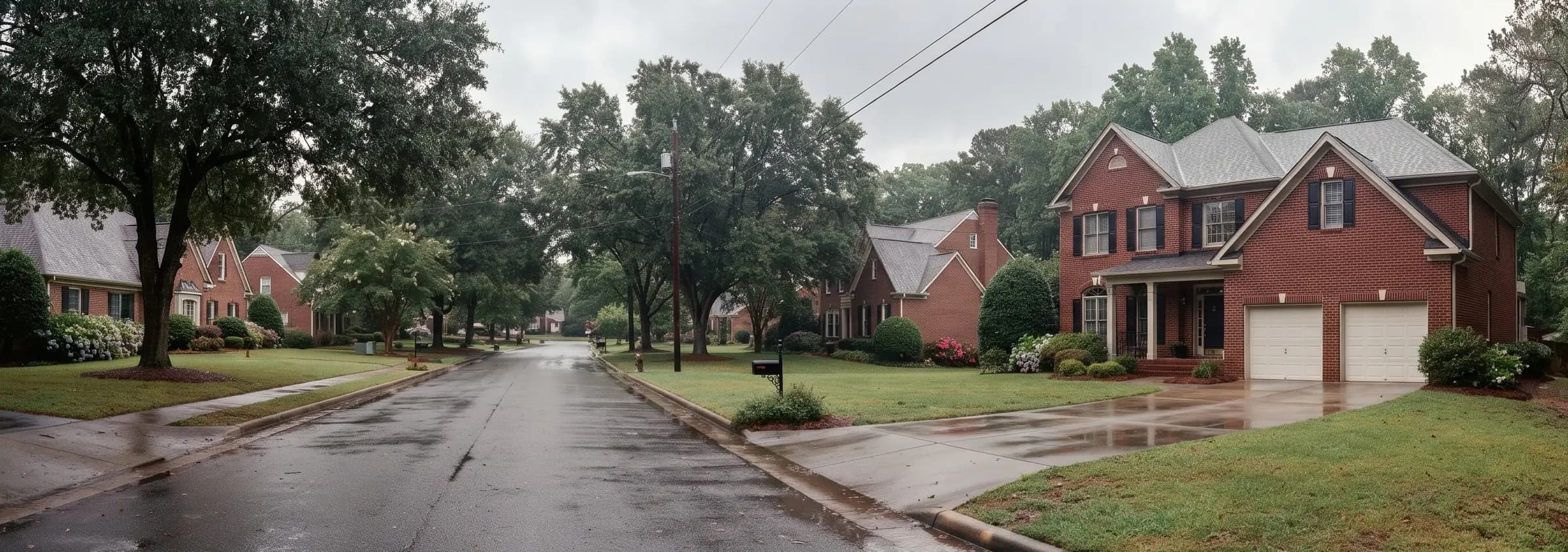

Mecklenburg County has bought out more than 490 flood-prone homes since 1999, and about 5,000 properties still sit in regulated floodplains that the county's stormwater office says are meant to flood in heavy rain. A Charlotte homeowner with a wet floor is working inside that system, where the source of the water decides which insurance policy responds, how the water is classified and which county rules reach the repair.
Charlotte water damage restoration is the extraction, drying, cleaning and repair of a soaked structure to ANSI/IICRC S500, with no North Carolina license for the drying work, the NC Licensing Board for General Contractors covering construction costing $40,000 or more, and Mecklenburg County Code Enforcement issuing the permits. Most repairs after a leak or a wet storm fall below those thresholds, which leaves the homeowner to check the water category, the company's credentials and the claim paperwork before the first invoice.
Key insights
- Typical cost. Water damage restoration in Charlotte costs $1,300–$6,100 for most jobs, and Category 3 water from a creek, a storm drain or a sewer on a ground floor can reach $8,800–$22,000 or more.
- Creek flood line. Mecklenburg County Storm Water Services regulates about 5,000 properties in floodplains, and county leaders recommend flood insurance, which is separate from homeowners insurance.
- Claim clocks. North Carolina's standard fire policy requires immediate written notice of a loss, a sworn proof of loss within 60 days unless the insurer extends the time in writing, and any suit within three years after the loss began, and a homeowners policy can set its own terms.
- No drying license. G.S. 87-1 ties the general contractor license to construction costing $40,000 or more, and extraction and drying build nothing, so IICRC firm status and proof of insurance are the checks that matter.
- Permit line. Mecklenburg County says permits may not be required for work costing $40,000 or less unless it involves load bearing structures, plumbing, heating or air conditioning, electrical systems, materials the code does not allow, or new roofing.
- Mold clock. Wood, drywall, carpet and furniture can grow mold if they stay wet for more than 24 hours, according to the EPA.
Charlotte creeks and the floodplain
A Storm Water Services staffer told WBTV that flooding is the most costly natural disaster in Mecklenburg County, and the county's buyout program describes its own floodplains as meant to flood during heavy rains. That makes creek water the first source to rule in or out when a Charlotte floor is wet, because it changes the water category and the insurance policy that answers the claim.
 The county's flood zone map shows whether a lot sits in the regulated floodplain, and creek water that reaches a house is a flood policy claim.
A county-wide soaking on November 12, 2020 shows how fast that happens. About 3.5 to 4 inches of rain fell across the region, the city closed more than 60 roads, and the fire department answered more than 112 calls about floodwater, according to WFAE. Storm Water Services' program manager said larger totals had fallen in the past 30 to 40 years, but not across the entire county at once.
The county's response has been to move people out of the worst spots and hold new building to a higher standard. About 85 percent of owners who go through the appraisal and offer process accept a buyout, the floodplain maps use future conditions instead of today's development, and homeowners who want to stay can have their houses elevated. Anyone in or near a mapped creek corridor should treat a wet floor as a possible flood loss until the source is known.
A level water line, silt, flooded neighbors and the flood zone map each separate creek water from a leak before the crew arrives. The answer decides the water category, the policy that responds and whether the county's floodplain rules reach the rebuild, so it is worth settling before the first invoice is signed.
Read the water line on the wall
Creek water leaves a level line across several rooms, often the same height on every wall, while a leak stains one wall, one ceiling or one cabinet base and spreads from a single point.
Look for silt and debris
Mud, grass, leaves or a gritty film on the floor mean the water crossed the yard, and anything that carried that much dirt is Category 3 no matter how clear it looks now.
Ask whether the street flooded
If neighbors have water in garages or the road was closed, the cause is almost certainly surface water, and the flood policy is the one to call first.
Look up the address on the flood zone map
The county's map shows whether the lot sits in a regulated floodplain, which tells the insurer and the contractor what rules apply to the rebuild.
Lake and river flooding is a separate case from creek flooding. Riverside Drive, where the county bought 11 homes, floods when Mountain Island Lake rises, and Hurricane Helene's September 2024 flooding below the lake dam came from the Catawba River instead of a neighborhood creek. Homes in that corridor that took on water and were not dried within a day or two also belong with the mold side of the loss.
What a Charlotte water loss costs
Most Charlotte residential water damage jobs cost $1,300–$6,100, and the average is about $3,300. A ground floor loss from creek water, sewage or a storm can reach $8,800–$22,000 or more, because Category 3 water adds removal, disinfection and rebuilding to the drying. A minor spot job caught within a day starts near $300, and a bid for several wet rooms that sits far outside these ranges without a stated category or equipment count deserves a line by line explanation before any deposit.
 A silt line at the same height along the wall marks Category 3 creek water, and porous materials it touched, such as the cardboard, are removed rather than dried.
Construction and extraction workers in Charlotte earned about 88 percent of the U.S. average hourly wage in May 2025, according to the Bureau of Labor Statistics. The water damage restoration cost of a Charlotte job depends more on the water category, the number of wet rooms and whether the water came from a creek or a drain than on the hourly rate, since contaminated water adds steps that clean supply water never needs.
| Scenario | Estimates | What drives it |
|---|---|---|
| Minor spot mitigation | $300–$1,300 | One wet wall section or a small clean spill caught within a day, with a few equipment days |
| Supply line burst | $900–$2,600 | Category 1 water that has to be dried before it degrades, usually in one or two rooms |
| Washing machine or dishwasher overflow | $1,800–$4,400 | Water that travels under flooring and into cabinet bases |
| Roof leak during a storm | $2,200–$6,100 | Wet insulation and ceiling drywall, plus attic access |
| Sewage backup | $6,100–$12,500+ | Category 3 water, so contaminated materials come out |
| Storm or creek flooding across rooms | $8,800–$22,000+ | Category 3 water, flood cuts, subfloor and every porous material in the wet rooms |
Drying is priced by the square foot of affected floor, and the rate rises with the water category, while repair and rebuild is priced separately at a much higher rate. The rate applies to the wet area only, so a 300 square foot loss costs the same to dry in a 1,500 or a 2,000 square foot house, and the full cost per square foot for each stage follows the category and the materials involved.
| Work, 300 sq ft | Estimates | Estimates per sq ft |
|---|---|---|
| Category 1 drying | $825–$1,050 | $2.75–$3.50 |
| Category 2 drying | $1,050–$1,725 | $3.50–$5.75 |
| Category 3 drying | $1,875–$1,950+ | $6.25–$6.50+ |
| Repair and rebuild | $5,400–$9,600 | $18–$32 |
Where the water lands changes the bill as much as how much there is, because each room brings its own materials and its own drying problem. Tile can be cleaned and kept after contaminated water while carpet and pad usually come out, and a basement slab keeps releasing moisture long after the standing water is gone.
| Room | Estimates | What drives it |
|---|---|---|
| Bathroom | $400–$3,900 | Tile, cabinets and a small floor area that dries fast |
| Laundry room | $900–$4,400 | A failed hose or drain that runs for hours, often into the next room |
| Kitchen | $1,300–$7,000 | Cabinet bases, flooring and appliance supply lines |
| Basement | $1,300–$8,800+ | Category 3 if creek or storm drain water enters, and concrete that holds moisture |
| Living or family room | $2,900–$16,500 | Large floor area, carpet and pad, and furniture |
A written estimate should break the job into lines a homeowner can check against the log: the water category, how many hours passed before drying began, how many rooms are wet, and how many air movers and dehumidifiers will run for how many days. Equipment is billed per piece per day, so the daily moisture readings show whether each unit was needed. Work started outside business hours can add 25–50 percent to the labor lines.
Day one in a wet Charlotte house
The first 48 hours go to stopping the source, naming the water, documenting the loss and starting extraction, in that order. The EPA says mold can grow on wood, drywall, carpet and furniture that stay wet for more than 24 hours, so a crew that starts the same day saves materials that a two day wait would condemn.
 The EPA says to keep a generator at least 20 feet from buildings, so one beside a door, window or crawl space vent is too close.
Before any cleanup, run a fuel powered generator only outdoors and at least 20 feet from the house, because it produces carbon monoxide that cannot be seen or smelled and can kill within minutes. Stay out of wet rooms until the power to them is off, and leave the heavy work to a crew with extraction and drying equipment, which carrying wet carpet out by hand cannot replace.
1. Cut the power and close the supply
Switch off the breakers for wet rooms if you can reach the panel without standing in water, then close the fixture valve or the main valve for the house. Open a faucet on the lowest floor to confirm the line is dry, and call a plumber or Charlotte Water if the valve will not close or the leak is on the street side of the meter.
2. Name the water before cleanup
Write down where the water came from, because supply line water is Category 1, appliance overflow can be Category 2, and anything from a creek, a storm drain or a sewer is Category 3 under ANSI/IICRC S500. That one note decides whether wet drywall and carpet can be dried or must be cut out, and it matters most after a heavy rain that put creek water in the house.
3. Record the damage with dated photos
Photograph the source, the height of the water line on the walls and each damaged item before anything moves. Keep receipts for hotel nights, dehumidifier rental and emergency repairs, since the insurer will ask for them later.
4. Send the insurer written notice
North Carolina's standard fire policy language requires immediate written notice of a loss, so email the insurer the date, the source and the photos the same day. The sent message is the time stamp that protects the claim, and the adjuster's first call will refer back to it.
5. Book drying the same day
Hire a firm with IICRC certification to start extraction without waiting for the adjuster's schedule, and keep windows and doors closed while the dehumidifiers run so humid outdoor air stays out of the wet rooms.
After the first day, sort what the water touched. The EPA advises throwing away anything that cannot be cleaned and dried, cleaning the hard surfaces that got wet, and drying the house and everything in it completely, and porous items such as carpet pad, upholstered furniture and ceiling tile that sat in creek water usually belong in the throw away group.
Mains, roofs and pipes
Most Charlotte water losses begin with plumbing, a roof or a street main, and the weather decides when they fail. Water from a burst supply line starts clean, rainwater that comes through a roof soaks insulation and ceiling drywall, and a broken main sends water across a yard or into a basement.
 Each entry path lands in a different category under ANSI/IICRC S500, and the category decides whether wet materials are dried in place or removed.
The category of the water sets how it is treated, and each Charlotte source lands in a different one under ANSI/IICRC S500. A burst supply line and a creek that reaches the carpet can look alike on day one, yet the first is usually dried in place and the second is mostly removed, which is why the category goes on the estimate before the equipment list.
| Source | Category | Treatment |
|---|---|---|
| Supply line or appliance | 1 | Dry in place if the crew starts within about 48 hours, before the water degrades |
| Roof leak through insulation | 1 or 2 | Wet insulation and ceiling drywall usually come out, framing is dried |
| Water main break at the house | 1 at the pipe, 2 or 3 after crossing soil | Category is set where the water ends up, so porous materials it reached are often removed |
| Creek or street flooding | 3 | Porous materials such as carpet, pad and drywall come out, and hard surfaces are cleaned and disinfected |
| Sewer backup | 3 | Contaminated materials removed and the area disinfected before drying starts |
Summer thunderstorms hit roofs and gutters. Heavy rain finds failed flashing, missing shingles and clogged gutters, and a ceiling stain that appears after a downpour usually means the insulation above it is already wet, and storm damage that starts at the roof tends to follow that path. A stain that keeps spreading over several days means the roof is still leaking, so the repair and the drying have to happen together.
When DIY drying is enough
DIY drying is enough only for a small, clean water spill caught within a day, such as a supply line leak in one room that wet a floor but not the walls. Anything from a creek, a storm drain or a sewage backup is Category 3 and belongs to a professional crew, and so does water that has been in the walls or under flooring for more than a day.
The EPA calls flood cleanup difficult and dangerous work, and it advises children, pregnant people and anyone with asthma or a weakened immune system to stay out of it. A professional can also judge whether a flooded house is safe to enter, and if hiring a crew is not possible, a professional inspector can say when cleanup has gone far enough.
The early steps a homeowner can take safely are closing the supply, photographing the loss, moving belongings off wet floors and shutting off power to wet rooms. A rented dehumidifier cannot confirm that wall cavities and subfloors are dry, because only a moisture meter reading compared with the dry goal shows that, so any loss that reaches the walls needs that measurement.
Hiring with no water license
A Charlotte homeowner can hire a water damage company without a license check for the drying itself, because G.S. 87-1 ties the general contractor license to construction costing $40,000 or more, and extraction and drying build nothing. The checks that stand in for one are IICRC certified firm status, proof of insurance, a written scope and a drying log, and each can be confirmed with a phone call or a lookup before a deposit changes hands.
 A scope should list each piece of equipment and the days it will run, so the drying log can show whether every unit was needed.
A license number on a restoration company's website points to a contractor license for building work, which covers repairs and says nothing about drying skill. The NC Licensing Board for General Contractors keeps the lookup, so check any number with the board, and treat a missing number as normal for a drying job and a missing certificate of insurance as a stop.
At the first phone call
Ask whether the firm is an IICRC Certified Firm and look it up in the IICRC locator yourself, because a logo on a truck proves nothing. Ask for a certificate of insurance, ask who will be on site, and ask whether the company bills the insurer directly. A company that will not answer these before it arrives will not answer them later, so call two or three and choose a restoration company on the answers and the written bids.
On the first visit
The scope should be in writing before the equipment comes in: each wet room, the water category, the moisture readings, and the number of air movers and dehumidifiers with the days they will run. A crew that starts demolition before writing any of this down is hard to check later. Photographs of every room with a moisture meter reading give the insurer the same record the crew uses.
At the last invoice
Pay the final amount only after the drying log shows every wet material at the dry goal and the crew has removed the equipment. Ask what the company bills the homeowner if the insurer pays less than the invoice, and get the answer in writing. Repairs, such as replacing drywall and flooring, are a separate contract with their own license and permit questions, and a warranty on the drying should state what it covers.
Walk away from a company that asks for a large deposit before it writes a scope, will not share its drying log, or says the work must wait for an adjuster's approval while water is still standing. A scope agreed in writing before the equipment is set also gives the insurer the equipment count it will check against the log.
Dry goals after a creek flood
Drying ends when each wet material reaches the dry goal, which takes 3–7 days of equipment on most jobs and is followed by 1–3 weeks of repairs. The ANSI/IICRC S500 standard sets the dry goal from a reading taken on an unaffected part of the same material. Drywall, wood framing and flooring each need their own readings, and the crew keeps drying any material whose reading is still above its reference.
 A reading is only useful next to a reference taken from a dry stud in the same house, so the crew records both before drying starts.
A job runs in a fixed order: moisture mapping and photographs, extraction of standing water, removal of materials that cannot be saved, equipment setup, daily readings, and a final reading at the dry goal before the equipment leaves. Repairs begin after that under a separate contract, and the permit check from the Code Enforcement rules applies to that second stage.
A written drying log is the proof that the work was needed and finished. It records the reference reading, the reading in each wet room every day, and the equipment running, and the insurer's adjuster uses the same record to approve equipment days. Wet insulation, concrete slabs and wall cavities that need drilling add days.
Creek and sewage water follow a different path, because Category 3 materials are removed instead of dried. Drywall, carpet and pad that sat in floodwater come out before drying starts, and flood water damage jobs then dry the framing and subfloor that remain, with hard surfaces cleaned and disinfected before the equipment is set. In a flooded basement the slab and the bases of the walls are the last materials to reach the dry goal.
S500 also assigns a class from 1 to 4 to the amount of wet material, which decides the equipment count. Class 1 is a small area of low porosity materials, Class 2 is a whole room of carpet and cushion, Class 3 is water from overhead that wets ceilings, walls and insulation, and Class 4 is deep saturation in dense materials such as hardwood and concrete that needs specialty drying. A creek flood that soaks a basement slab often lands in Class 3 or 4, and each step up adds equipment and days.
Claim clocks and the flood line
A Charlotte homeowner has 60 days after a loss to file a sworn proof of loss under North Carolina's standard fire policy unless the insurer extends the time in writing, and the same policy requires immediate written notice. The loss is payable 60 days after the insurer receives proof of loss and the amount is agreed or awarded, and any suit must start within three years after the loss began, according to G.S. 58-44-16. A homeowners policy can set its own terms, so read its notice and suit language.
 A level line on exterior brick marks surface flooding, which a flood policy covers and a homeowners policy leaves out.
Which policy answers the claim depends on the water. A burst pipe, an overflow or a storm that damages the roof usually falls under the homeowners policy, while creek and street water needs flood insurance, which county leaders note is separate from homeowners coverage. A sewer backup depends on an endorsement, so check the policy before assuming it is covered, because homeowners insurance coverage for water damage changes with the cause.
| Water source | Policy | Coverage depends on |
|---|---|---|
| Burst pipe or overflow | Homeowners | The loss is sudden and accidental, because gradual leaking is usually excluded |
| Roof leak in a storm | Homeowners | Storm damage to the roof, since long term wear is usually excluded |
| Creek or street flooding | Flood policy | A separate policy, since the homeowners policy leaves surface flooding out |
| Sewer backup | Endorsement | A water backup endorsement added to the homeowners policy |
When the insurer is slow or low
North Carolina insurers must acknowledge a claim within 30 days after written notice that identifies the coverage involved, and the Commissioner of Insurance can fine an insurer that does not. Under G.S. 58-3-100, an acknowledgement is a statement that the claim is under investigation, a payment, a written settlement offer or a written denial. Drying cannot wait 30 days, so the crew starts the same day and the written notice sent on day one starts the insurer's clock.
When the insurer and the homeowner disagree on the amount of the loss, the standard fire policy lets either side demand an appraisal in writing. Each side names a competent and disinterested appraiser within 20 days, the two appraisers choose an umpire, and a judge picks one if they cannot agree within 15 days. Each side pays its own appraiser and the two split the umpire's cost, so the drying log and the line item estimate are the documents the appraisers compare.
Insurers most often dispute equipment days, drying scope and whether a stain came from a sudden event or long term leaking. Keep the first email, the dated photographs and the drying log in one folder, because together they answer all three, and a written estimate with each equipment line separate is the easiest document to defend. If the insurer's offer comes in below the invoice, ask for the adjuster's line items in writing and compare them with the drying log day by day.
Permits and floodplain rebuilds
Charlotte repairs after a leak often need no permit, because Mecklenburg County Code Enforcement says permits may not be required for work costing $40,000 or less unless the work involves load bearing structures, a change in a plumbing, heating, air conditioning or electrical system, materials the code does not permit, or new roofing other than like for like replacement. Replacing wet drywall, insulation and flooring with the same material usually stays inside that line, and framing repairs, rewired outlets and new plumbing do not.
 Adding or changing plumbing needs a county permit, even when the wall was opened for a leak.
The county also requires separate permits for building, electrical, heating and air conditioning, and plumbing work, so a rebuild that touches several trades can need several permits, and the contractor or the homeowner acting as general contractor pays for them under the Mecklenburg County Code Enforcement permit rules. A drywall and flooring job that changes no plumbing or wiring usually stays a single trade, so the extra permits matter mainly when the rebuild opens walls.
In a regulated floodplain the rebuild has a second set of rules. Ask Storm Water Services' floodplain staff before signing a rebuild contract, because repairs that reach a set share of the building's value can trigger elevation requirements, and the county maps floodplains using future conditions, a higher standard than today's development alone. Confirm the scope with Code Enforcement before work starts too, since the county says only that permits may not be required below $40,000.
Wet crawl spaces and mold
Mold can grow on wet wood, drywall, carpet and furniture after 24 hours, according to the EPA, so a dry out that runs late becomes a mold job. The warning signs of a water job that has turned into a mold job are visible growth, a musty smell that outlasts the drying, and moisture readings that stay high after the equipment leaves.
Drying and mold removal follow separate standards. A crew drying a wet house works to ANSI/IICRC S500, and visible growth moves the job to remediation with containment and a clearance test, and the timeline for mold after water damage starts at the same 24 hour mark. A crew that sees growth on framing or drywall should stop and say so in writing, because the two jobs carry different scopes and prices.
Charlotte homes with crawl spaces add a second path, because moisture under the floor keeps framing wet after the visible water is gone. A crawl space that stays damp for days needs more than drying, because mold remediation in Charlotte adds crawl space moisture control, species testing and clearance testing that a drying crew does not provide.
Charlotte areas by creek
The Charlotte neighborhoods with the heaviest flood history are the ones where the county has bought out the most houses, led by Myers Park Manor, Shannonhouse and Shannon Park, and Country Club Heights. The county's Floodplain Acquisition and Demolition Address List, dated December 7, 2023, groups the purchased addresses by creek watershed and neighborhood, and the buyout counts come from it.
 The county turns bought-out lots into greenways, community gardens and reforested floodplain, so a vacant lot beside a creek can mark where houses flooded repeatedly.
Street flooding and main breaks add risks that the buyout list does not show. Freedom Drive was impassable in the November 2020 flooding, a car stalled in the Idaho Drive underpass off Rozzelle's Ferry Road, water crossed Mallard Creek Road in northeast Charlotte and undermined its shoulder, and a water main break sends street water into the lowest floor of a house below street grade.
| Area | Risk factor | Notes for homeowners |
|---|---|---|
| Myers Park Manor | Upper Little Sugar Creek | 68 addresses bought out of the floodplain, the most of any neighborhood on the list |
| Shannonhouse and Shannon Park | Briar Creek | 57 addresses bought out, in the same watershed as the Cavalier and Doral apartments |
| Country Club Heights | Briar Creek | 38 addresses bought out |
| Five Points and Smallwood | Irwin and Stewart Creek | 27 addresses bought out |
| Amay James and Clanton Park | Irwin and Stewart Creek | 23 addresses bought out |
| Madison Park | Little Hope Creek | 20 addresses bought out |
| Belmont | Upper Little Sugar Creek | 16 addresses bought out, with 18 more on nearby Cullman Avenue |
| Cavalier and Doral apartments | Briar Creek | 13 buildings with 192 units, and part of Doral with 19 buildings and 128 units, bought out beside a creek that still overflows at the Chantilly Ecological Sanctuary |
The county's Floodplain Buyout Program publishes the full list, and the county's flood zone map shows the risk at any address, so both are worth checking before buying or renting. Matching a listing's address against the list shows whether the block flooded often enough to be bought out.
Renters, condos and creek zone sales
A renter, a condo owner and a seller each need the same record after a Charlotte water loss: dated photographs, a written notice sent the same day and the drying log. A renter whose landlord owns the problem should report it by email, because the landlord's insurance covers the building and renters insurance covers only the tenant's belongings, and the renters' water damage rights that apply decide who pays for hotel nights and ruined furniture.
Condo owners face a split between the association's master policy and their own unit coverage. Where the line falls depends on the association's governing documents, so ask for them early, and a condo water damage claim moves faster when the owner already holds the photographs and the drying log.
Buyers of a house that flooded should ask the seller for the claim history, the drying log and the repair invoices, then check the county's purchased property list and flood zone map for the address. Sellers who kept those documents can answer the same questions from one folder, and a repair with no paperwork leaves a buyer unable to tell whether the wet materials were dried or only covered.
Prevention along Charlotte's creeks
Prevention in Charlotte starts with knowing the creek level before a storm arrives and keeping roof and street water away from the foundation. A homeowner can get warning before a creek or a main fails, send roof water away from the house and put a blocked storm drain on the county's repair list.
 A call to 311 sends a county crew to clear a blocked drain, and clearing it before the rain keeps street water from backing up.
Watch creek levels before a storm
The county's Flood Information and Notification System shows current rainfall and creek level data, so a homeowner near a mapped creek can see a rise before water reaches the yard. Check it when the forecast calls for several inches of rain.
Look up the address on the flood zone map
The county's three dimensional flood zone map shows a property's flood risk and ways to reduce it. Check it before buying a house and again before renewing a policy, since the maps use future conditions and can change.
Send roof water away from the foundation
Disconnect downspouts from the storm drain so roof water spreads across the yard, and use a rain barrel for the rest. A gutter that overflows at the foundation sends roof water straight toward the basement wall.
Call 311 about blocked drains
County staff say people see blockages before a storm does, and a call to 311 sends a crew to clear one. A blocked drain near a street low point can turn a heavy rain into a flooded garage.
Protect the pipes before a hard freeze
Pipes inside a house can split in a hard freeze, so shut off and drain exterior lines before the temperature drops and learn where the main valve is. Ice that melts inside a split pipe releases its water hours after the damage is done, which is how frozen pipes flood a house after the thaw.
Frequently asked questions
What is the average cost of water damage restoration in Charlotte?
About $3,300 for a typical job, within a range of $1,300–$6,100. Category 3 water from a creek, a storm drain or a sewer on a ground floor can reach $8,800–$22,000 or more, because contaminated materials have to be removed and replaced.
How long does water damage restoration take in Charlotte?
Usually 3–7 days of drying, then 1–3 weeks of repairs. Category 3 water, wet insulation and permit review for structural repairs can add days, and drying ends only when daily moisture readings reach the dry goal.
Does North Carolina require a license for water damage restoration?
No, not for the drying work itself. G.S. 87-1 ties the general contractor license to construction costing $40,000 or more, and extraction and drying build nothing, so look up IICRC firm status and ask for a certificate of insurance.
Do I need a permit for water damage repairs in Charlotte?
Usually not for like for like replacement of drywall, flooring and insulation, because Mecklenburg County says permits may not be required for work costing $40,000 or less unless it involves load bearing structures, plumbing, heating or air conditioning, electrical systems, materials the code does not permit, or new roofing.
Does homeowners insurance cover creek flooding in Charlotte?
No, creek and street flooding needs a separate flood insurance policy. County leaders recommend that coverage, and what flood insurance covers differs from what a homeowners policy pays.
How long do I have to file a water damage claim in North Carolina?
Immediately in writing, then a sworn proof of loss within 60 days unless the insurer extends the time in writing. North Carolina's standard fire policy requires any suit to start within three years after the loss began, and a homeowners policy can set its own terms.
When was the last major flood in Charlotte?
November 12, 2020 was the most recent county-wide creek flood in local reporting, when 3.5 to 4 inches of rain fell across the region and the city closed more than 60 roads. Hurricane Helene's September 2024 flooding below Mountain Island Lake was a separate Catawba River event.
Should I call my insurer or a restoration company first?
Call an emergency water damage crew first if water is still spreading, and the insurer the same day. Send the insurer written notice with photographs, and start drying before the adjuster visits, since the drying log and the photographs document the loss.
Does water damage restoration include mold removal in Charlotte?
No, mold removal is a separate job from drying. Visible growth, a musty smell that lasts after the dry out, or moisture readings that stay high once the equipment leaves point to mold remediation, which adds containment and clearance testing that a drying crew does not provide.
Can I stay in my house during water damage restoration?
Often yes for a clean water loss confined to one room, but not for sewage or creek water. Anyone with asthma or a weakened immune system, children and pregnant people should stay elsewhere until the crew clears the rooms, and a wet electrical panel is another reason to leave.
- IICRC S500
- EPA: Flood Cleanup to Protect Indoor Air and Your Health
- NC G.S. 58-44-16: Standard Fire Insurance Policy
- Mecklenburg County Code Enforcement: Permitting
- Mecklenburg County Storm Water Services: Floodplain Buyout Program
- WBTV: Flooding is the most costly natural disaster in Mecklenburg County
- WFAE: Charlotte Area Pounded By Torrential Rain, Flooding
- BLS: Occupational Employment and Wages in Charlotte-Concord-Gastonia, NC-SC, May 2025
- NC G.S. 58-3-100: Claim Acknowledgement
- NC G.S. 87-1: General Contractor Defined
Sam Hickerson is the founder of RestoreAdvisor and writes consumer guides on mold remediation, water damage restoration, inspection, testing, and home recovery. His work focuses on helping homeowners understand costs, risks, and when to call a professional. He draws on guidance from the EPA, CDC, IICRC, and other authoritative sources to make complex home issues easier to navigate.