
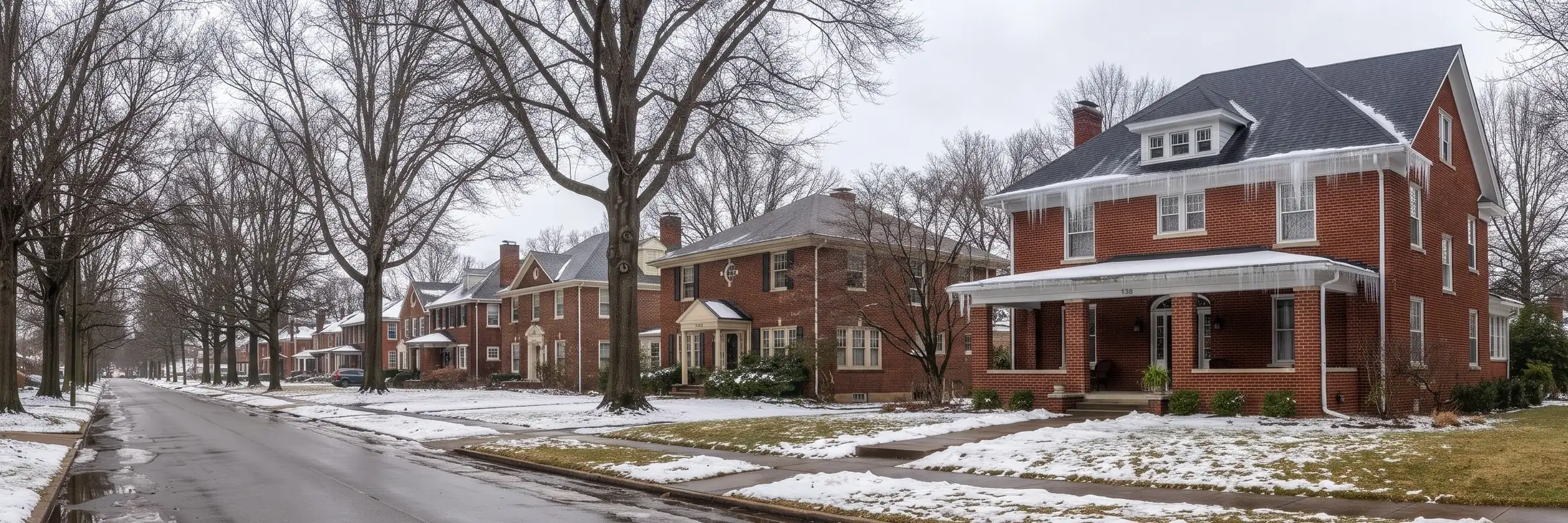

A Louisville cold snap does two kinds of damage at once: main breaks in the street and split lines inside houses, where the first sign is often a damp wall on the morning the ice lets go. The homeowner then has to book a crew for water damage restoration and open an insurance claim before the day ends, usually while every company's phone line is busy.
Louisville water damage restoration is water removal, structural drying and repair of the building to ANSI/IICRC S500, the Standard for Professional Water Damage Restoration, and Kentucky's Department of Housing, Buildings and Construction licenses the plumbers, electricians and HVAC contractors on the job but does not list drying among its trades. Kentucky insurers must also offer any payment due within 30 calendar days of proof of loss under 806 KAR 12:095.
Key insights
- Cost range. A typical Louisville job costs $1,400–$6,600 and averages about $3,600, a sewage backup starts near $6,600, and flooding through several rooms reaches $9,400–$23,500 or more.
- Freeze record. Louisville International Airport averages 74.1 days a year at or below 32°F and 13.2 days when the high never gets above 32°F in NOAA's 1991–2020 normals.
- Winter 2026 main breaks. Louisville Water said on January 30, 2026 that crews had repaired more than a hundred main breaks in a week and were averaging 12 to 15 a day.
- Payment clock. Under KRS 304.12-235, a settlement not made within 30 days of notice and proof of claim bears 12 percent interest from day 31 when the insurer did not make a good faith attempt to settle.
- Licensing. Kentucky licenses plumbers, and KRS 318.030 requires a firm that does plumbing to carry at least $250,000 in general liability insurance, while the state's licensing lists do not name water drying.
- Flood records. NOAA's Storm Events database logs flash flood or flood reports in Jefferson County on 47 days from January 2016 through October 2026, and most describe flooded roads and stranded vehicles.
What winter does to Louisville pipes
Louisville pipes split in winter because the temperature falls to freezing on about one day in every five. NOAA's 1991–2020 normals for Louisville International Airport, published through the National Weather Service in Louisville, count 74.1 days a year with a low at or below 32°F and 13.2 days when the high never gets above 32°F, along with 12.3 days with measurable snowfall.
 A low at or below 32°F is when an unprotected supply line can freeze, and the 13.2 days that never get above 32°F are all-day freezes.
The winter of 2026 showed what a cold snap does to a metro water system. In its January 30 update, Louisville Water said crews had handled more than a hundred main breaks in a week, most of them smaller neighborhood pipes, and that its dispatcher had been averaging 12 to 15 a day, including five in one hour and 15 minutes on a Tuesday morning. A water main break sends water across a street or yard, and a split supply line sends it into a wall cavity, so each loss goes to a different crew.
| Water source | Category | What the crew faces |
|---|---|---|
| Split supply line in an exterior wall, crawl space or unheated basement | Category 1 | Clean water that soaks framing and insulation and worsens with each hour |
| Cracked line behind an outdoor spigot | Category 1 | A leak that begins at the thaw, often behind siding or above a basement ceiling |
| Water from a broken street main | Category 2 or 3 | Water that has crossed pavement and soil before reaching a basement counts as contaminated |
| Sump pump or window well swamped during a thaw | Category 2 or 3 | Groundwater carries soil in, so wet carpet and pad usually come out |
| Sewer water through a floor drain | Category 3 | Sewage comes up at the lowest drain, and porous materials it reaches are bagged and removed |
Damage often shows at the thaw, because a line that split while frozen may leak little until the ice melts, so a wall that looked dry at midnight can be wet by breakfast. Category 1 water leaves the pipe clean, and under the ANSI/IICRC S500 categories it turns worse if it stays in drywall, insulation and flooring for 24 to 48 hours, so even a small stain deserves a same-day visit.
Pricing a Louisville water loss
The typical Louisville water damage job costs $1,400–$6,600, with an average near $3,600. The first hours decide where a loss lands: a wall caught while still wet can come in near $300, while sewage starts near $6,600 and a flood across several rooms reaches $9,400–$23,500 or more, because every porous material the water touched comes out.
 The visible ring can mark only part of what the water reached, so a scope should price the drywall and insulation above it as well as the stained area.
In May 2025 the Bureau of Labor Statistics measured Louisville area pay for construction and extraction work at about 94 percent of the U.S. average. A Louisville water damage restoration cost moves with the number of wall cavities a split line soaked, whether the pipe ran through a crawl space or a finished basement, and the after-hours rate for a loss found on a night in the teens.
| Scenario | Estimates | What drives it |
|---|---|---|
| Minor spot mitigation | $300–$1,400 | A single damp wall section or a spill mopped up within hours, finished with a few days of airflow |
| Supply line burst or frozen pipe split | $900–$2,800 | Clean water inside one wall cavity and the room next to it, dried before it slides past Category 1 |
| Standard mitigation | $1,400–$3,800 | Extraction and drying across a whole floor without cutting anything out |
| Washing machine or dishwasher overflow | $1,900–$4,700 | Soapy drain water that travels under flooring and into cabinet bases |
| Roof leak during a storm | $2,400–$6,600 | Wet attic insulation and ceiling drywall, plus the time to get onto the roof or into the attic |
| Mitigation plus basic repairs | $3,800–$6,600 | Drying first, then drywall, trim and flooring put back room by room |
| Sewage backup | $6,600–$13,000+ | Category 3 water, so every porous material it reached is bagged before drying starts |
| Storm flooding across rooms | $9,400–$23,500+ | Open wall cavities, subfloor repair and new finishes in each room the water reached |
Restoration crews price drying by the square foot of wet floor, so 300 wet square feet cost about the same whether the house has 1,500 or 2,000 square feet. The cost per square foot rises with the water category, and the rebuild after drying is a separate charge for each square foot of damaged area.
| 300 sq ft area | Estimates | Estimates per sq ft |
|---|---|---|
| Dry a Category 1 floor | $825–$1,125 | $2.75–$3.75 |
| Dry a Category 2 floor | $1,125–$1,875 | $3.75–$6.25 |
| Dry a Category 3 floor | $1,950–$2,100+ | $6.50–$7.00+ |
| Rebuild after drying | $5,700–$10,500 | $19–$35 |
What the water reached sets the price of a room. A tiled bathroom is the cheapest, a kitchen adds cabinet bases and flooring beside the dishwasher and sink supply lines, and a basement adds a slab and wall bases that keep giving up moisture after extraction, so the dehumidifiers run longer. Carpet, pad and furniture lift a living room to the top of the range.
| Room | Estimates | What drives it |
|---|---|---|
| Bathroom | $500–$4,200 | A small tiled floor and vanity that dry quickly |
| Laundry room | $900–$4,700 | A hose or drain that failed while no one was home, with water reaching the next room |
| Kitchen | $1,400–$7,500 | Cabinet bases, toe kicks and flooring beside the sink and dishwasher connections |
| Basement | $1,400–$9,400+ | A split pipe, sump failure or backup, then slab and wall bases that stay damp for weeks |
| Living or family room | $3,100–$17,500 | The biggest floor area, with carpet, pad and furniture to move |
After-hours calls add 25–50 percent to the labor rate, and the plumber's repair of the failed pipe is billed separately, since restoration ends when the structure reaches the dry standard. Equipment is billed per machine for each day it runs, so the machine count is the line to compare between two bids.
Your first two days after a split
Within 48 hours of a Louisville pipe failure, a homeowner needs to stop the water, make the wet area electrically safe, clear what is dry, document the damage and phone both a crew and the insurer. Stopping the flow comes first, since each minute a split line runs adds wall and floor to the scope.
 A ball valve is closed when its lever sits a quarter turn across the pipe, so after turning it, open a faucet to confirm the flow has stopped.
Louisville Water's cold weather tips say the shutoff valve may be in the basement, under the kitchen sink, in a utility closet, near the water heater or in a crawl space. To find it, turn the valve off and open each faucet, and if no water comes out the valve is the right one. The utility offers free waterproof tags that attach to the valve at its downtown office at 550 South Third Street.
1. Find the shutoff and close it
Turn the valve that feeds the whole house until it stops, then run a faucet to prove the flow is off. A valve that will not budge means a plumber goes first on the call list, since the line keeps pouring until it is shut.
2. Kill power to the wet area from dry ground
Throw the breakers for the wet rooms from a panel you can reach on a dry floor. Water at the panel, an outlet or an extension cord is the signal to leave and call an electrician instead.
3. Lift dry belongings clear of the water
Move electronics, papers and small furniture into a dry room, and leave wet carpet pad and drywall where they are for the crew to measure. A bare, open floor lets technicians set machines in the first hour.
4. Photograph each wet surface before anything moves
Shoot the split pipe, the stain on every wall and ceiling and each ruined item, and save the files with their original dates. The adjuster will compare these images with the crew's written scope.
5. Phone a certified crew and then the insurer
Call a firm with IICRC certification that dries to ANSI/IICRC S500, then report the loss to the insurer that day, logging the time and the name of whoever answers. Hold on to receipts for emergency repairs, rented equipment and a hotel stay.
A burst pipe that is found within an hour or two usually wets one wall and the floor beside it, while the same split found after a weekend away can soak a whole floor. That difference is why the crew's first visit should happen the same day, before the water category changes.
Crews start extraction and set air movers on the first visit, which stops water from wicking up the drywall and into the insulation. When calls pile up in a cold snap, a homeowner who has already closed the shutoff, taken the photographs and obtained the claim number can give the dispatcher the details needed to book a visit.
Who to phone first
The first call depends on which pipe failed: Louisville Water handles the street main after a break, the Metropolitan Sewer District handles sewer overflows, a plumber handles the house line, and the insurer opens the claim. Starting with the wrong office wastes the hours when water is still moving into drywall and insulation.
| Who | When | How to reach them |
|---|---|---|
| Louisville Water | A main break, a flooded street or no water at the meter | (502) 583-6610 on weekdays from 8 a.m. to 6 p.m., and its online emergency report form |
| Metropolitan Sewer District | Sewer water coming up a floor drain | (502) 540-6000, answered 24 hours a day |
| Licensed master plumber | A split pipe, a stuck shutoff or a pipe to replace | Check the license with the state before the work starts |
| Division of Plumbing | A plumbing construction permit | (502) 573-0397 |
| Your insurer | Any loss, the same day | The number on the policy, with the time and name noted |
A sewage backup is Category 3 under ANSI/IICRC S500, so every porous material the water touched comes out before drying begins. The Metropolitan Sewer District answers (502) 540-6000 around the clock, which makes it the first call when sewer water surfaces at a floor drain, and the crew's scope should then name the floor drain as the source so the insurer can sort the loss from a burst pipe.
When a broken main sends water into a basement, the street-side repair belongs to the utility, while the cleanup inside the house and the claim go to the homeowner's insurer first, with the same photographs, scope and drying log as any other loss. Louisville Water's phone line is open Monday through Friday from 8 a.m. to 6 p.m., so an evening or weekend main break goes through its online emergency report form.
Small spills you can dry alone
A small spill of clean water on a hard floor that gets mopped up within hours is a towel and fan job. Once water soaks carpet pad, drywall, insulation or a ceiling cavity, an emergency water damage crew is needed the same day, and anything that came up a floor drain is never a do-it-yourself task. The EPA advises people with asthma or a weakened immune system to stay out of flood cleanup altogether.
Who may repair a Louisville house
Kentucky's Department of Housing, Buildings and Construction licenses plumbers, electricians, boiler contractors, sprinkler and fire alarm contractors and building inspectors, and its HVAC division has licensed heating and air conditioning contractors since July 1995. Water extraction, structural drying and general repair work are not on those lists, so no state license separates a skilled drying crew from an unskilled one on a burst pipe job.
 Replacing a split supply line is plumbing work that Kentucky reserves for licensed plumbers, except for a homeowner working under a permit on their own residence. The plumbing permit comes before the wall is closed.
Plumbing is the licensed part of a pipe loss, and KRS 318.030 says no one may work at the trade of plumbing without a master or journeyman plumber's license, and a firm that does plumbing must carry general liability insurance of at least $250,000 and show proof of workers' compensation and unemployment insurance compliance. The Division of Plumbing adds that plumbing work must be installed by a licensed journeyman under a master plumber, with one exception for a homeowner who holds a permit for plumbing in their own residence.
IICRC certification is a training credential from the nonprofit that publishes S500, and it shows that a crew knows how to dry a structure to the standard. It is not a state license, and a crew that dries and rebuilds is working across two sets of rules. The written scope should list every license and permit the job needs, including any building or electrical permit from Louisville Metro Government, and name who pulls each one.
Screening a crew before work starts
A Louisville crew is worth hiring when it puts the plumbing permit, the water category, the demolition scope, the equipment count, the moisture log and the billing terms in writing before work starts, and when the firm certificate matches the name on the contract. A crew that declines to write one of these down has not yet scoped the job, and the questions to ask a restoration company are the same ones to put to every bidder.
 The scope should list every dehumidifier and air mover by room with the days each will run, so the invoice can be matched to what actually sits on the floor.
In a cold snap restoration phone lines fill up, and quotes by phone replace the walkthrough. When you choose a restoration company, hold each bid to the same scope items, because a bid that omits a wet room or an equipment count prices a different job than the one beside it.
1. Ask who pulls the plumbing permit
A split pipe that is replaced is plumbing work, and Kentucky requires a plumbing construction permit before plumbing is installed or altered. Get the name and license of the plumber in writing, and ask whether the drying company or the plumber arranges the permit.
2. Read the firm certificate against the contract name
Ask to see both the firm and the technician certificates, and confirm the firm named on them is the one sending people to your door. A company that dries to ANSI/IICRC S500 can say why a supply line loss is Category 1 and a floor drain backup is Category 3.
3. Ask what gets cut out and who hauls it away
The scope should say which materials come out, such as wet carpet pad, baseboard or a section of drywall, and who bags and removes them. Demolition that is left out of the scope shows up later as a change order.
4. Have the water source and category written down
The scope should name the source of the water, such as a split supply line or a floor drain, and the category that follows. That label decides whether wet carpet and drywall are dried where they sit or hauled out.
5. Get an equipment count for every room
List the air movers and dehumidifiers planned for each room and how many days each runs. A scope with no machine counts, or one lump figure, means the plan for drying has not been written.
6. Ask for a moisture log at each visit
Ask for readings on every wet material at each visit, next to a reference reading taken from dry material of the same kind. The equipment stays until the two numbers meet.
7. Settle billing, change orders and the last payment in writing
Get in writing whether the firm bills the insurer directly, how the deductible is handled and who owes the gap when the insurer pays less than the invoiced amount, and require a signed change order before any added work. Pay the last invoice only after the log shows every wet material at the dry standard.
Proof the structure is dry
S500 defines dry by comparison: every wet material has to read the same as a reference reading taken from an unaffected piece of the same material. A job usually runs 3–7 days of equipment, and since the EPA puts drying at several days to weeks, machines pulled after a day or two mean the readings were never met.
The moisture log records that comparison: each line gives a material, its reading, the reference value, the machines in that room and any change the crew made, and repairs start on the date in the scope, which can come only after the readings match. Rebuilding takes another 1–3 weeks when drywall, flooring or framing came out, and a finished basement takes longer because the slab and wall bases release water slowly.
The EPA says materials should read 15% or less to be ready for refinishing, and it describes a slab check for a basement: tape a clear plastic sheet to the concrete and wait about 16 hours, and moisture on the sheet means the slab is still too wet to cover. Flooring in a finished basement sits on a slab that can look dry and still be wet, so the slab check belongs in the scope before new floor goes down.
What Kentucky insurers must do
A Kentucky insurer must acknowledge a claim within 15 working days, offer any payment due within 30 calendar days after proof of loss, and send a status letter every 45 days while an investigation stays open. Those clocks come from 806 KAR 12:095, the regulation on unfair claims settlement practices for property and casualty insurance.
 The insurer's 30 calendar day payment clock runs from receipt of proof of loss, which makes dated photographs taken before anything is moved the first items to gather.
The regulation counts "days" as Monday through Friday except holidays for the acknowledgment rule, and it sets the other clocks in calendar days. It also tells an insurer to give a first-party claimant the claim forms and instructions needed to meet the policy conditions, and a separate statute adds a payment deadline with interest.
| Clock | Limit | Starts when |
|---|---|---|
| Acknowledge the claim | 15 working days | The insurer is notified of the claim |
| Offer payment due | 30 calendar days | The insurer receives proof of loss |
| Say more time is needed | 30 calendar days | The insurer receives proof of loss, with the reasons in writing |
| Status letters | Every 45 calendar days | 45 days after the first notice, while the investigation stays open |
| Written notice of a time limit | 30 calendar days before it expires | Applies to an unrepresented claimant whose rights a limit may affect |
KRS 304.12-235 adds that a claim is to be paid within 30 days after notice and proof of claim are furnished. When the insurer fails to make a good faith attempt to settle within that time, the final settlement bears 12 percent interest per year from the end of the 30 days, and a delay without reasonable foundation entitles the insured to reasonable attorney's fees.
The first call to the insurer starts the clocks, so write down the time and the name of the person who answered, then keep that note in one folder with the photographs, the scope, the drying log and each letter the adjuster sends. Coverage for a frozen pipe loss depends on the policy wording, and exclusions that apply to freezing in an unheated or vacant house are worth reading now, before a claim is filed.
If the estimate is low or the claim is denied
A homeowner who disagrees with a low estimate or a denial can dispute it in writing with the insurer, ask the adjuster which policy terms apply, and file a complaint with the Kentucky Department of Insurance. The department accepts consumer complaints about home insurance claims in writing, online, by mail or by fax, and it sends a copy to the insurer, which has 15 calendar days to respond.
When the amount is the dispute, a public adjuster can document the loss and negotiate for a fee, and the photographs, the written scope and the drying log are the evidence either side will use. KRS 304.12-235 adds 12 percent interest to a settlement the insurer failed to make in good faith within 30 days, so the dates in the claim file decide how far back that interest runs.
Mold after a wet winter
Mold can start on wet materials within 24 hours, according to the EPA, which says it can grow on wood, drywall, carpet and furniture that stay wet for more than 24 hours. A split pipe found after a long weekend, or a wall cavity that stayed closed while it dried, is the case most likely to turn a water job into a mold job.
Signs that drying ended early are a wall that still reads damp after the machines leave, a musty smell that returns, or a stain that keeps spreading. The moisture log from the water job is the first paper a mold contractor asks for, because it shows which materials stayed wet and for how long.
Mold work follows its own rules and its own price, with an assessment, containment and clearance testing. A water job turns into mold after water damage remediation when growth appears on materials that stayed wet past the 24 hour mark, and the written plan from that job replaces the drying scope.
Rain, rivers and sewers
Rain and river water reach Louisville homes on fewer days than freezing weather, and most reports describe flooded roads and stalled vehicles far more often than houses. NOAA's Storm Events database lists 87 flash flood reports and 38 flood reports in Jefferson County from January 2016 through October 2026, on 47 different days, with $1.1 million in recorded property damage.
 Most of the 125 flash flood and flood reports logged in Jefferson County since 2016 describe water on roads and in yards, and only a few name a house.
Fifteen of the 47 fall in 2018, when the Ohio River stayed above its 30 foot moderate flood stage at the upper McAlpine gauge from February 23 into March, and nine fall in the first ten months of 2026. July has 13 of the 47, February and June have nine each, and the narratives describe closed ramps, stalled cars and more than 50 water rescues during the February 2018 event, according to the Courier Journal.
Only a few narratives name a home: on June 18, 2026, a person in Shively could not leave their house because the water outside was waist deep, and an apartment parking lot and the streets around it flooded in Lynnview. Water that rises from outside a house is Category 3, which makes it a different job from a split supply line. The flood water damage sequence applies, with extraction the same day and every porous material that the water touched removed.
Flood and sewer backup are coverage questions that a homeowners policy usually treats separately from a burst pipe, so the policy's backup and flood terms are worth reading with an agent before the next heavy rain. After a loss, photograph the waterline on each wall at its highest mark and keep the date on the files, because an insurer sorts flood, backup and burst pipe losses by where the water came from.
Wind and hail open roofs as well. Storm Events lists 266 thunderstorm wind reports on 81 days and 56 hail reports on 18 days in Jefferson County from January 2016 through October 2026, and rain through a roof opened by either one reaches the attic insulation and the ceiling below, a loss priced at $2,400–$6,600 for a roof leak during a storm.
Louisville flood report points
Six parts of Jefferson County appear more than once in Storm Events flood narratives, and the narratives tie each to a creek, a river or flooded roads, with Highlands and Indian Hills leading at 14 reports. The counts are reports from spotters, police, fire departments and the public in which the place is named, which means they show where water was seen and leave the neighborhood boundaries open.
 In Storm Events narratives, an apartment complex entrance flooded in Richlawn in February 2018 and an apartment parking lot flooded in Lynnview in June 2026.
A report point shows where someone saw water, and a house in any of these areas can sit well above it, while a house on a quiet street elsewhere can take on water from a failed line. The narratives are the evidence that water reached these places, and a homeowner can compare them with the lowest drain in the house.
| Area | Reports | Risk factor |
|---|---|---|
| Richlawn and Oxmoor | 5 | The middle fork of Beargrass Creek rose out of its bank at Oxmoor Mall in February 2018, the entrance to an apartment complex flooded and Oxmoor Woods had high water |
| Strathmoor Manor and Strathmoor Village | 7 | Water rescues and cars stranded in water about 4 feet deep on February 24, 2018, and an underpass blocked by high water on February 20, 2019 |
| Fairdale and West Buechel | 3 | Significant flash flooding in the Holly Hills subdivision on Mitchell Hill Road, and fire department rescues of residents stranded in West Buechel on February 24, 2018 |
| Shively, Lynnview, Parkway Village and St. Regis Park | 10 | June 18, 2026 flash flooding with a resident unable to leave a house, a flooded apartment parking lot and several vehicle rescues |
| Highlands and Indian Hills | 14 | Ohio River backwater closed River Road near Zorn Avenue and Frankfort Avenue in February 2018, and Mellwood Avenue, Adams Street and parts of Cherokee Park flooded |
| Okolona and Staniford Field | 5 | Cars floating in water along West Indian Trail on February 24 and 25, 2018 |
Prospect and Springdale each have a single report, from a creek over Covered Bridge Road in April 2017 and a flooded subdivision near Ten Broeck Way in July 2020, and the database holds no home-level narrative for them. A homeowner in any of these areas can ask the crew to note the floor level of the lowest drain and the first wet material in the scope.
Leases, condos and home sales
A Louisville landlord must keep a rental fit and habitable and its plumbing in good working order under KRS 383.595, and must supply running water and reasonable heat between October 1 and May 1. Those duties apply to Louisville rentals because Jefferson County adopted the Kentucky Uniform Residential Landlord and Tenant Act in 1984.
If a rental floods after a pipe freezes, the tenant's first two tasks are dated photographs and a written repair request sent that day. The renters rights that apply depend on which pipe failed, and the tenant's belongings are insured only under a renters policy the tenant bought.
In a condo, the association's master policy and its bylaws decide who pays for the walls and the pipes inside them, so a split line in a shared wall can put the association and the owner on the same claim. The condo water damage rules turn on where the master policy ends, so an owner should ask the association for the policy and the bylaws before a repair scope is signed.
The Kentucky Real Estate Commission's seller's disclosure form asks whether the basement has ever leaked and whether the crawl space has water or drainage problems. A buyer can compare those answers with fresh paint on one wall, a stain at the foot of an exterior wall or a damp smell in the basement, and ask for the plumber's invoice and the claim history before closing.
Prevention between frost and thaw
A Louisville house gets through winter with five habits: a tagged shutoff valve, insulated pipes on cold runs, steady heat during a freeze, a working sump pump, and a drained system during absences. Each habit shrinks the volume of water that reaches drywall and insulation before a crew arrives.
 Insulation only slows heat loss, so a wrapped line on an exterior wall can still freeze in a long cold spell, which is why the heat stays on during a hard freeze.
A frozen pipe that has not yet split can be warmed with a hair dryer or heating pad, and an open flame is never an option. If the frozen run sits inside an exterior wall, bring in a plumber, and treat a faucet that dribbles in a hard freeze as the cue to locate the shutoff before the thaw.
| Action | When | Why it works |
|---|---|---|
| Locate, test and tag the shutoff valve | Before December | Louisville Water hands out free waterproof valve tags, and a valve found in advance stops a split in seconds |
| Wrap pipes in exterior walls, crawl spaces and unheated basements | Before the first hard freeze | Pipes near outdoor air lose heat fastest, which makes them the first to freeze |
| Keep the heat on and open sink cabinets during a hard freeze | Nights near or below 20°F | Warm air reaches the pipes under sinks on exterior walls |
| Test the sump pump and check where its discharge line empties | Each spring and ahead of a thaw | A pump that fails in a thaw leaves groundwater standing in the basement as Category 2 or 3 water |
| Shut off and drain the water before a long trip | Any winter absence | With the lines drained there is no water left to freeze while the house sits empty |
A house left empty is exposed, because a split line in an unoccupied house can run for days before anyone notices. Closing the main shutoff and opening the lowest faucet to drain the lines before a trip leaves little water in the pipes to freeze or to spill if a fitting fails.
Frequently asked questions
How much does water damage restoration cost in Louisville?
Most Louisville jobs cost $1,400–$6,600, with an average near $3,600. A Category 3 sewage backup begins around $6,600, and a flood across several rooms reaches $9,400–$23,500 or more once wet carpet, pad and drywall are replaced. Drying costs $2.75–$3.75 per square foot on clean water and $6.50–$7.00 or more on Category 3.
How many days a year does Louisville freeze?
About 74 days. NOAA's 1991–2020 normals for Louisville International Airport show 74.1 days a year with a low at or below 32°F, and 13.2 days when the high never gets above 32°F, the all-day freezes that put pipes in exterior walls, crawl spaces and unheated basements at the most risk.
How long does a Kentucky insurer have to pay a water damage claim?
Thirty days from notice and proof of claim. Under KRS 304.12-235, a settlement that is not made within that time bears 12 percent interest from day 31 when the insurer failed to make a good faith attempt to settle, and 806 KAR 12:095 tells the insurer to offer any payment due within 30 calendar days of proof of loss.
What can I do if a Kentucky insurer denies or underpays a water damage claim?
File a written complaint with the Kentucky Department of Insurance. The department accepts consumer complaints about home insurance claims in writing, online, by mail or by fax, and it sends a copy to the insurer, which has 15 calendar days to respond.
Does Kentucky license water damage restoration companies?
No, not for drying itself, as far as the state's licensing lists show. The Department of Housing, Buildings and Construction licenses plumbers, electricians, HVAC, boiler, sprinkler and fire alarm contractors and building inspectors, so a firm that also replaces a pipe needs a licensed plumber on the job.
Do I need a permit to repair a burst pipe in Louisville?
Yes, for plumbing that is installed or altered. The state Division of Plumbing requires a plumbing construction permit before anyone constructs, installs or alters plumbing, and it may be issued to a licensed master plumber or to a homeowner for plumbing in their own residence. Ask the plumber to confirm any Louisville Metro permit before walls are opened.
Who do I call when a water main breaks near my Louisville home?
Louisville Water at (502) 583-6610, open Monday through Friday from 8 a.m. to 6 p.m., or its online emergency report form. If water is already inside the house, close the house shutoff first, since the utility's crews work on the street main and the water inside the house is yours to stop.
How long does water damage restoration take in Louisville?
Drying takes 3–7 days of equipment on most jobs, and repairs add 1–3 weeks when drywall, flooring or framing came out. Thick materials such as a basement slab can hold water longer, and the EPA puts drying at several days to weeks.
How fast can mold start after a Louisville pipe bursts?
Within 24 hours, according to the EPA, on wood, drywall, carpet and furniture that stay wet. Materials that stayed wet past that point need a mold assessment, containment and clearance testing before they are rebuilt.
Is a Louisville landlord responsible for a burst pipe?
Yes, in most cases, when the pipe serves the rental unit. KRS 383.595 requires a landlord to keep the premises fit and habitable, to keep the plumbing in good working order, and to supply running water and reasonable heat between October 1 and May 1.
What must a Kentucky seller disclose about water damage?
Known water problems, because the Kentucky Real Estate Commission's seller's disclosure form asks whether the basement has ever leaked, whether the crawl space has water or drainage problems, whether the roof has leaked and whether the property has had drainage, flooding or grading problems. The seller answers for the conditions known at the time.
- IICRC S500
- EPA: Flood Cleanup to Protect Indoor Air and Your Health
- National Weather Service Louisville: Normal Number of Days With, Louisville Muhammad Ali, 1991–2020
- Louisville Water: Surviving Winter's Tight Grip
- BLS: Occupational Employment and Wages in Louisville/Jefferson County, KY-IN, May 2025
- Kentucky Administrative Regulations: 806 KAR 12:095, Unfair Claims Settlement Practices
- Kentucky Revised Statutes: KRS 304.12-235, Time of Payment of Claims
- Kentucky Department of Insurance: File a Complaint
- Kentucky Housing, Buildings and Construction: Division of Plumbing
- NOAA NCEI: Storm Events Database
Sam Hickerson is the founder of RestoreAdvisor and writes consumer guides on mold remediation, water damage restoration, inspection, testing, and home recovery. His work focuses on helping homeowners understand costs, risks, and when to call a professional. He draws on guidance from the EPA, CDC, IICRC, and other authoritative sources to make complex home issues easier to navigate.