
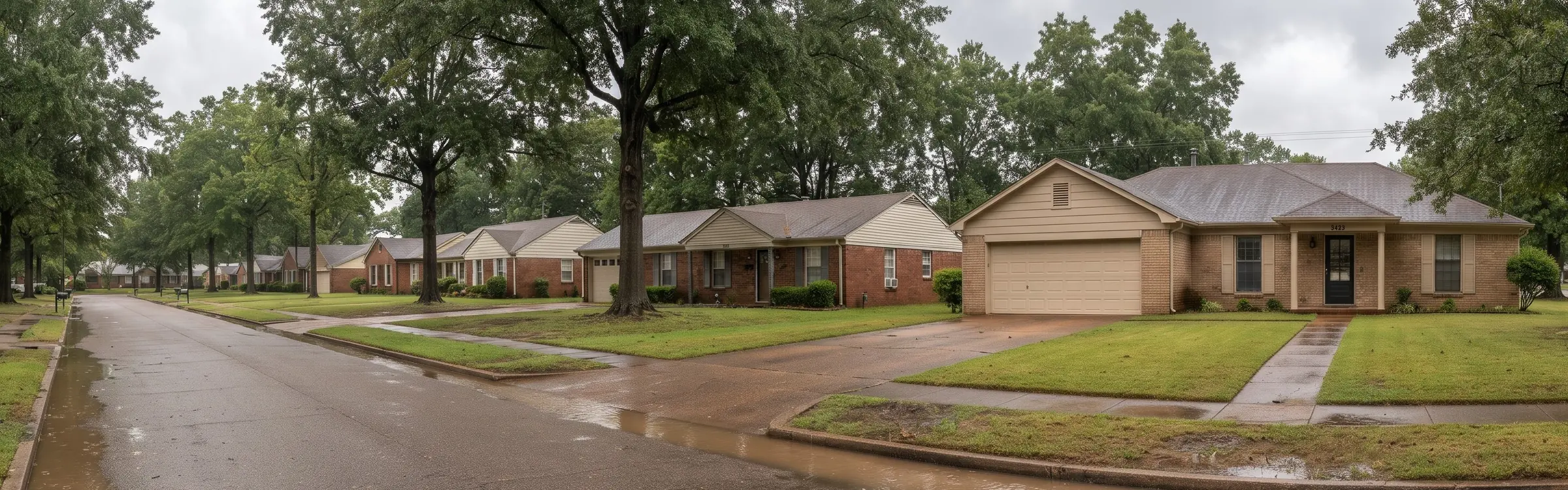

Shelby County has had flash flooding on 48 days since 2016, according to NOAA's Storm Events Database, and on the few days when that water reached a doorstep or a living room, the owner faced what is often Category 3 cleanup, a drying clock of about 24 hours, and bids that differed by thousands of dollars. Most of the reports describe flooded roads and parking lots, so the first question for a wet Memphis house is where the water came from, because the source decides the category, the policy, and the permit.
In Memphis, water damage restoration means extracting, drying, and cleaning a wet house to the ANSI/IICRC S500 standard and then rebuilding it under a license that the Tennessee Board for Licensing Contractors, part of the Department of Commerce and Insurance, requires by project dollar value. That dollar line is the first thing to check on a rebuild bid, and the claim, the drying log, and the permit all depend on what gets photographed in the first hours.
Key insights
- Typical cost. Memphis water damage restoration costs $1,300–$6,100 for most jobs, with an average of about $3,300, and a Category 3 flood or sewage loss across several rooms can reach $8,700–$22,000 or more.
- Flash flood days. NOAA's Storm Events Database lists flash flooding in Shelby County on 48 days from 2016 through 2026, and most of those reports describe roads and parking lots, with a few describing water at homes.
- Record creek crest. Nonconnah Creek rose to a record 27.5 feet on June 7, 2019, and the NOAA record says several homes flooded across Germantown and southeast Memphis.
- License line. Shelby is one of nine Tennessee counties where residential repairs from $3,000 to $24,999 need a Home Improvement license, and a contractor license is required at $25,000 or more.
- Insurer clocks. A Tennessee insurer must acknowledge a claim within 30 days and accept or deny it within 60 days of receiving proofs of loss, and FEMA says most homeowners policies exclude flood damage.
- Mold clock. The EPA says mold can grow on wood, drywall, carpet, and furniture that stay wet for more than 24 hours.
The first 48 hours after street water
The first 48 hours go to making the house safe, stopping any water the house itself supplies, recording how high the water stood, and starting extraction, because EPA says mold can grow on wood, drywall, carpet, and furniture that stay wet for more than 24 hours. A crew that starts extraction the same day saves flooring, baseboards, and insulation that a two day wait would condemn.
 Photograph the waterline in each room before anything is moved and send written notice the same day, because Tennessee's 30 day acknowledgment clock starts when the insurer receives notice.
Street water and a failed supply line need different phone calls. Memphis 311 takes reports of water in the street and sewer backups at the curb, while MLGW takes shutoff calls for a failed line and warns that a crew may take some time to arrive, so the valve at the house comes first. A call to 311 also creates a dated record that supports the insurance claim later.
1. Cut power to the wet rooms
Switch off the breaker for any room where water touched outlets, baseboard wiring, or appliances, and stay out of standing water until the circuit is dead. Go to the main panel only if you can reach it without stepping in water.
2. Close the house water valve
Close the main valve or the fixture valve, then open a faucet on the lowest level to confirm the flow stops. If the line that failed sits on the street side of the meter, call MLGW at 901-528-4465.
3. Report street water to 311
Call Memphis 311 at 901-636-6500 or use the online 311 portal for water in the street, a sewer backup at the curb, or a blocked storm drain. The request carries a date and a time that support the insurance claim later.
4. Mark the waterline on the wall
Photograph each room with a tape measure against the wall at the high-water mark, and photograph the street and the yard from the front door. Keep receipts for hotel nights, fans, and cleanup supplies.
5. Start extraction the same day
Call an IICRC certified crew and send the insurer written notice with the photographs on the same day, without waiting for the adjuster's visit. Carpet, padding, and insulation that soaked up floodwater usually go, so the first hours go to extraction and removal, and repair starts after the readings reach the dry goal.
The EPA says materials that do not soak up water can usually be cleaned and dried, and materials that soak up a lot of water and cannot be cleaned and dried should be thrown away. Photograph each discarded item before it leaves the house and keep the receipts for replacements, because the photographs and the receipts support the contents claim when the adjuster asks what was lost.
Electrical safety comes first in any emergency water damage job, and a wet panel, a submerged outlet, or a smell of burning plastic means the whole house stays off until an electrician clears it. If mold is already visible, hold off on fans and dehumidifiers until the visible growth has been gently cleaned, because the EPA says the fans can otherwise spread it.
How often Memphis water reaches homes
Water reaches a Memphis house on only a few flash flood days: according to NOAA's Storm Events Database, Shelby County had flash flooding on 48 days between 2016 and 2026, and only a few of those narratives describe water at a doorstep, in a yard, or inside a house. The count reached 9 days in 2025 and 7 days in 2021, so several flash flood days in a normal year are the baseline.
 Only a few of the 48 flash flood days since 2016 put water this close to a house. Rising creek or river water is Category 3 under IICRC S500, so porous materials it reaches inside usually go.
On March 11, 2016, four households on Covington Pike were evacuated when the Loosahatchie River flooded after heavy rain, and on March 1, 2021, water reached the front door of a house on Oakshire Cove in southwest Memphis. On June 7, 2019, Nonconnah Creek rose to a record 27.5 feet and several homes flooded across Germantown and southeast Memphis, and on July 21, 2023, floodwater entered a living room in Arlington.
| Source | Category | Effect on drying |
|---|---|---|
| Creek or river water entering the house | Category 3 | IICRC S500 lists rising water from rivers or streams as Category 3, so carpet, padding, and insulation usually go and hard surfaces are cleaned and disinfected |
| Sewer or drain backup | Category 3 | Sewage and wasteline backflow are Category 3 regardless of color, and the crew works in protective gear |
| Rain through a roof, window, or door | Set by inspection | IICRC says top-down water and wind-driven rain are not automatically Category 3, so the crew decides by whether the water is grossly contaminated |
| Supply line or water heater leak inside the house | Category 1 | Clean water that a crew can often dry in place when extraction starts the same day |
Reports cluster on a handful of days. On June 22, 2026, spotters reported flooding along Union Avenue in Midtown, on the Farm Road ramps near Shelby Farms, on Shelley Renee Road in Cordova, and on Billy Maher Road in Bartlett, and April 2–3, 2025 produced reports from Germantown, Cordova, Whitehaven, and Pisgah, including four feet of water at Humphreys Boulevard and Kirby Road. When one storm floods streets across the county, several households call for drying on the same day.
Flash flooding also follows a season. Of the 48 flash flood days, 27 fell in June, July, or August, 12 fell in March and April, 2 fell in May, and 7 fell from September through February, so the wet months for a Memphis house run from spring into late summer. The yearly counts run 8 in 2016, 3 in 2017, 2 in 2018, 3 in 2019, 1 in 2020, 7 in 2021, 2 in 2022, 5 in 2023, 3 in 2024, 9 in 2025, and 5 so far in 2026, so one quiet year says little about the next.
Roof leaks and freeze water
Wind and hail send water into a Memphis house from above, and a freeze sends it from inside the walls. NOAA's database lists thunderstorm wind reports in Shelby County on 78 days and hail reports on 32 days between 2016 and 2026, and a torn shingle or a lifted flashing lets rain into the attic and the ceiling below, so storm damage from wind and hail usually starts as a roof leak that wets insulation first and drywall second.
IICRC's S500 position statement says rain that enters from above is not automatically Category 3, so the category depends on how contaminated the water is, which an inspection settles before extraction starts. The inspection matters because the category decides how much material comes out, and a leak that wets one ceiling costs less than a flood across several rooms.
A pipe that splits in a freeze delivers clean water at first, and MLGW's January 2026 notices told customers to drip faucets whenever temperatures stay below 20°F for more than four hours and to keep cabinet doors open and thermostats at 55°F or higher. MLGW also says water main breaks often occur in winter, and it takes reports of leaks inside homes and on the street at 901-528-4465. A freeze loss follows the same drying rules as any supply line failure, with a one room burst costing $900–$2,600.
What Memphis water damage costs
Most Memphis water damage jobs cost $1,300–$6,100, and the average is about $3,300. Minor spot drying starts near $300, and a Category 3 flood or sewage loss across several rooms can reach $8,700–$22,000 or more, because demolition, disposal, and longer drying come before any rebuild. Water mitigation, which covers extraction and drying, is billed apart from the rebuild, and a bid should list each one.
 Category 3 mitigation costs $6.00–$6.50 or more per square foot of wet floor, and the EPA lists a respirator, goggles, gloves, and boots as the gear for floodwater cleanup.
Bureau of Labor Statistics data for May 2025 put pay for Memphis construction and extraction workers at about 87 percent of the U.S. average. Where a bid lands inside the water damage restoration cost range depends on how much drywall and flooring leave the house after street water, whether the water reached a slab or the subfloor above a vented crawl space, and how many days of drying equipment the house needs.
| Scenario | Estimates | Cost drivers |
|---|---|---|
| Minor spot mitigation | $300–$1,300 | One wet area with extraction and spot drying and no material removal |
| Supply line burst | $900–$2,600 | One room of clean water with little demolition |
| Standard mitigation | $1,300–$3,500 | Extraction, structural drying, and antimicrobial treatment across the affected rooms |
| Washer or dishwasher overflow | $1,700–$4,400 | Gray water in a kitchen or laundry room plus the rooms next to it |
| Roof leak in a storm | $2,200–$6,100 | Ceiling and wall damage, with attic insulation when the leak ran long |
| Mitigation plus basic repairs | $3,500–$6,100 | Drying, then new drywall and flooring in one or two rooms |
| Sewage backup | $6,100–$12,000+ | Category 3 water, protective gear, and removal of porous materials |
| Flood across several rooms | $8,700–$22,000+ | Category 3 street or creek water, a long drying cycle, and framing repair when the subfloor stays wet |
Mitigation priced at a cost per square foot of wet floor area rises with the water category, and repair and rebuild is priced apart from drying. The rate applies to the wet floor, so a 300 square foot loss costs the same in a 1,500 or a 2,000 square foot house, and multiplying a rate by the wet area gives the total for a loss of that size.
| Work | Estimates | Estimates per sq ft |
|---|---|---|
| Category 1 mitigation, 300 sq ft | $750–$1,050 | $2.50–$3.50 |
| Category 2 mitigation, 300 sq ft | $1,050–$1,725 | $3.50–$5.75 |
| Category 3 mitigation, 300 sq ft | $1,800–$1,950+ | $6.00–$6.50+ |
| Repair and rebuild, 300 sq ft | $5,100–$9,600 | $17–$32 |
| Mitigation plus repair, 300 sq ft | $5,850–$11,550 | $19.50–$38.50 |
A bid should split into extraction, removal and disposal, drying days with equipment, antimicrobial treatment, and the rebuild, so the owner can see which lines belong to the water and which belong to the repair. Category 3 water costs the most per square foot because it adds removal of porous materials and decontamination before drying starts.
Room by room, a ground floor kitchen or living area takes street water first and carries the longer replacement list, since cabinets, hardwood, built-ins, and electronics all add to the total. Each range is the cost to restore that room after one loss, and a loss that crosses a doorway adds the next room's range.
| Room | Estimates | Why it varies |
|---|---|---|
| Bathroom | $400–$3,900 | Small footprint, but fixtures often release Category 2 or 3 water |
| Laundry room | $900–$4,400 | Usually one area unless water travels to the floors beside it |
| Kitchen | $1,300–$7,000 | Cabinets, flooring, and appliances add replacement cost |
| Basement | $1,300–$8,700+ | Finished space costs far more than bare concrete |
| Living or family room | $2,800–$16,000 | Hardwood, built-ins, and electronics raise the total |
Crews that answer at night, on weekends, or on a holiday charge 25% to 50% more than the daytime rate, which matters after a storm that floods several streets on the same day. Ask each bidder to list drying equipment as its own line with the number of days, because drying days and equipment counts are lines an adjuster may question.
What a homeowner can dry alone
A homeowner can handle a small clean water leak on hard surfaces, while street water, creek water, and sewage call for a crew. The EPA says flood cleanup can be difficult and dangerous work and that it may be best to get help from experienced and qualified professionals if you can.
 A damp tile floor like this is a homeowner job only when the water came from a clean source such as a supply line, since the EPA says floodwater can carry bacteria, chemicals, and other hazards.
Clean water that stayed on tile, sealed concrete, glass, or metal responds to gentle cleaning with a damp cloth, clean water, and detergent, followed by a wet/dry vacuum for loose debris, according to the EPA. Disinfectants and sanitizers go on only after that cleaning and never on surfaces that absorb water, such as unfinished wood or fabric, and bleach is never mixed with ammonia or any other chemical.
| Situation | Who handles it | Why |
|---|---|---|
| Small clean water leak on a hard floor | Homeowner | Materials that do not soak up water can usually be cleaned and dried |
| Carpet, padding, or insulation soaked by street water | Crew | Materials that soak up a lot of water and cannot be cleaned and dried are thrown away |
| Creek water or sewage in any room | Crew | Floodwater can carry bacteria, chemicals, and other hazards |
| Wet HVAC system | Professional | The EPA says not to use an affected system to dry the house and that a professional should clean it |
| Wet wall cavities | Crew with a meter | Cavities stay unsealed until the materials are dry on the inside |
| Visible mold before drying starts | Gentle cleaning first | Fans can spread mold that has not been cleaned |
Anyone cleaning wears an N-95 respirator, goggles without vent holes, gloves, long pants, a long-sleeved shirt, and boots or work shoes, according to the EPA. People with asthma or weakened immune systems, children, and pregnant people stay out of flood cleanup, and a generator runs outside at least 20 feet from the building because the carbon monoxide it produces can kill in minutes.
Who may rebuild a flooded Memphis house
Shelby is one of nine Tennessee counties where a Home Improvement license is required for residential remodeling projects from $3,000 to $24,999, according to the Tennessee Department of Commerce and Insurance. The license carries a $10,000 surety bond and a $250 initial application fee, and the state defines home improvement to include repair, replacement, remodeling, and alterations to a residential building.
 Drywall and finish work like this counts as home improvement under the state's definition, so a rebuild bid of $3,000 or more should carry a Tennessee license number before the first deposit.
At $25,000 or more, a prime contractor needs a contractor's license before bidding or negotiating a price, and the monetary limit is the total dollar amount of each individual project. Ask any company for its license number in writing and look it up with the state before a deposit changes hands. A restricted residential contractor license also exists for work costing less than $125,000, so an owner may see that classification on a larger rebuild bid.
A rebuild bid of $3,000 or more, such as drywall and flooring in one or two rooms after drying, should come with a license number before the first deposit. A flood rebuild with framing repair can reach $22,000 or more and approaches the $25,000 line, and a bid split into several invoices to stay under it deserves a direct question about which license covers the whole project.
The state license pages describe repair, replacement, and remodeling work and do not mention extraction or drying, so a crew that only dries the house is vetted on IICRC credentials, insurance, and a written scope. The license questions begin when the same company quotes the rebuild, and a company that holds the license can show the number the same day.
Sorting crews with six questions
Six questions sort most Memphis water removal crews before any deposit: the license number, the IICRC status, the water category, the equipment count, the moisture log, and the billing method. A Memphis water damage company that has done the work before answers each one in writing and attaches the paperwork, and the answers can be compared line by line across bids.
 The EPA says drying usually takes several days to weeks, so the bid should say how many days the equipment runs in each room and what reading ends it.
The pressure to sign the first available bid peaks when several streets flood on the same day, which is when it pays most to choose a water damage restoration company on written answers. A company that quotes a start date should also quote the scope it will start with, and the quote should name the rooms, the materials marked for removal, and the equipment.
| Ask the crew | Credible answer |
|---|---|
| Which license covers the rebuild? | A Tennessee Home Improvement or contractor license number that matches the bid total and that the state's lookup confirms |
| Is the firm IICRC certified? | A certified firm listing that appears in the IICRC locator, plus the names of the technicians on your job |
| What water category did you assign? | A written category tied to the source, with photographs and a list of the materials marked for removal |
| How many drying days and how much equipment? | A count of air movers and dehumidifiers per room and a number of days, listed as its own line |
| Will I get daily moisture readings? | A log with readings from the same spots on every visit, ending at the dry goal |
| Do you bill my insurer directly? | A plain yes or no, the invoice format the adjuster accepts, and the deductible due at the start |
Deposits, warranties, and subcontractors are the next items to settle in writing, and a longer list of questions to ask a restoration company covers each one. Any bid that leaves out one of the six answers gets the question back in writing before the work starts, and the answers go into the contract so the scope the crew quoted is the scope it performs.
What dry means before the rebuild
A wet house is dry when the materials read at or below the target, and the EPA puts that target at 15% or less for materials that will be refinished. Drying usually takes several days to weeks, so a rebuild scheduled for the morning after extraction skips the part of the job that decides whether mold comes back.
The ANSI/IICRC S500 standard describes the procedures for water damage restoration in residential, commercial, and institutional buildings, and it assumes the property owner is responsible for finding and fixing the source of the water. The crew dries the house, and a plumber, a roofer, or a drainage contractor fixes whatever let the water in, so a drying invoice without a repair plan leaves the next storm with the same entry point.
S500 also sorts a job into classes by how much water the materials absorbed, and dense materials such as hardwood, plaster, and concrete fall in the class that needs specialty drying because the water sits deep inside them. A floor over a crawl space needs readings on the subfloor and joists as well as on the walls.
The EPA warns against sealing wall cavities that flooded and against painting or sealing wet surfaces until the materials are dry on the inside. Ask for the daily log and for the final readings before the drywall goes back, ask the crew to photograph the meter display on the final visit so the log carries images as well as numbers, and compare the equipment on the invoice with the drying days the crew quoted.
Insurer clocks and flood gaps
Under Tennessee's claim settlement rules, an insurer must acknowledge a claim within 30 days and accept or deny it within 60 days after receiving properly completed proofs of loss. The rules cover first party claimants, meaning policyholders who file under their own policy, and the 60 day periods relax when the insurer has a reasonable basis to suspect that the claimant fraudulently caused or misrepresented the loss.
 Tennessee's rules give an insurer 30 days after it finishes a coverage investigation, which includes an inspection like this one, to report its findings.
Flash flooding from a creek or a street falls on the flood side of the line. FEMA says most homeowners and renters insurance does not cover flood damage, so water that rose from outside needs a separate flood insurance policy, and a sewer backup through a drain is a third coverage question to settle with the insurer before a loss.
| Step | Deadline | Rule |
|---|---|---|
| Acknowledge notice of a claim | 30 days | Rule 0780-01-05-.07 |
| Accept or deny after proofs of loss | 60 days | Rule 0780-01-05-.08 |
| Update when the investigation is open | 60 days, then every 60 days | Rule 0780-01-05-.08 |
| Report findings after a coverage investigation | 30 days | Rule 0780-01-05-.08 |
| Pay once liability is affirmed and the amount is set | 30 days | Rule 0780-01-05-.08 |
Two other rules matter in a dispute. The insurer must give notice of an applicable statute of limitations at least 30 days before it expires, and after a full denial that the policyholder objects to in writing, it must notify the policyholder of the right to complain to the Consumer Insurance Services division of the Department of Commerce and Insurance. A public adjuster can prepare the proofs of loss and the scope when an offer comes in below the drying log and the bids.
Tennessee Code 56-7-105 allows a penalty of up to 25 percent of the loss when an insurer refuses to pay within 60 days after a demand and the refusal was not in good faith, and the statute counts attorney fees as part of the additional expense the refusal caused. A dated written demand, the drying log, and the photographs from the first 48 hours support a penalty claim.
Who to call and where permits go
Call Memphis 311 for water in the street or a sewer backup at the curb, MLGW for a failed water line, and Develop901 for repair permits. Develop901 issues building permits for renovations and repairs, residential and commercial, in Memphis, Arlington, Germantown, Lakeland, Millington, and unincorporated Shelby County, while projects in Bartlett and Collierville are permitted by their own offices, and the Develop901 office takes questions at (901) 636-7384. The portal also schedules inspections for permitted building, mechanical, plumbing, and electrical projects, so a repair that touches wiring or pipes can carry more than one permit.
 MLGW takes shutoff calls at 901-528-4465 and warns that a crew may take some time to arrive, so the valve at the house is the first stop for a failed line.
Ask Develop901 whether the scope needs a permit before the crew opens walls, and ask the contractor who pulls it. Plumbing, mechanical, and electrical work are inspected as separate trades, so the answer can differ between a drywall repair and a replaced water heater. The question costs one phone call, while a missed permit can surface later when an inspector or a buyer asks for the paperwork behind a replaced wall.
| Problem | Call | Number |
|---|---|---|
| Water in the street or a sewer backup at the curb | Memphis 311 | 901-636-6500 |
| Failed water line that needs a shutoff | MLGW | 901-528-4465 |
| Repair permit or inspection question | Develop901 | (901) 636-7384 |
After a freeze, frozen pipes split at joints and fittings, and MLGW treats a burst water pipe or water heater as an emergency that could flood a house. Call the shutoff line first and the insurer second, because the shutoff stops the loss and the insurer's 30 day acknowledgment clock starts when it receives notice.
A sewage backup is the one call where two numbers apply. IICRC treats a wasteline backflow that originates beyond a trap as Category 3 regardless of visible content or color, so a backup that looks clear still gets Category 3 handling. Report a backup at the curb to 311, and send a plumber to camera the line from the house to the street before assuming the city owns the failure. A Memphis ordinance defines the building sewer as the pipe from the building to the public sewer and puts its installation and connection costs on the owner.
When a wet house turns into mold
A wet house turns into a mold job when wood, drywall, carpet, or furniture stays wet past the EPA's 24 hour mark or when the dry out ends before the readings reach the target. Growth after that point calls for containment and clearance testing, which a drying crew does not provide, so the call goes to a mold remediation company with its own scope and price.
Three signs show a dry out that went wrong. A musty smell that outlasts the equipment, visible growth on baseboards or the lower drywall, and readings that rise again after the fans leave all point to moisture trapped in a wall cavity or under flooring. A reading that climbs after the equipment leaves means water is still moving inside the assembly, and the crew should come back before the walls close.
A job that grows mold after water damage is priced and scoped separately, with its own inspector, containment, and clearance sample. Keep the drying log, because it shows the date the materials reached the target and whether any room was closed up while it was still wet. A crew that finished the dry out with readings on file leaves the owner a clear record if growth appears weeks later.
Memphis flash flood report points
Memphis flash flooding clusters around Poplar Avenue, the Midtown underpasses, the I-55 corridor, and the Wolf River and Loosahatchie River basins. The reports come from NOAA Storm Events narratives, and a report point is the place a spotter named, so a row describes where water was seen, which can differ from the neighborhood boundary on a map.
 A creek that leaves its banks covers low parks, yards, and parking lots first, and NOAA's August 2023 report on Harrington Creek in Bartlett describes a flooded parking lot.
Most narratives describe cars, roads, and parking lots, and only a handful name a house. A house in any of these areas can sit on a street that floods and still stay dry, so the useful check is whether water has reached a doorstep or a yard on the block before. A street with no report may simply have had no spotter nearby.
| Area | Reports | Risk factor | Next step |
|---|---|---|---|
| Southeast Memphis and Germantown | June 2019 Nonconnah Creek record crest with several homes flooded; July 2023 Dogwood Creek subdivision cut off at Poplar Avenue; July 2024 water to car doors near Hickory Hill Road; April 2025 four feet of water at Humphreys Boulevard and Kirby Road | Nonconnah Creek and Poplar Avenue runoff | Check the flood zone and photograph any waterline inside |
| Midtown and Central Memphis | July 2023 flooding at the Walnut Grove Road and Poplar Avenue underpass and June 2026 flooding at Poplar and Union; cars stranded at Semmes Street and McCool Avenue in July 2023; Berclair flooding at North Highland Street and Summer Avenue in March 2023 | Low underpasses and street runoff | Look at the ground floor, the crawl space vents, and the street grade |
| Downtown, Mallory, and South Memphis | I-55 at McLemore Avenue flooded in January 2023 and December 2024, and near Trigg Avenue in April 2026; the Riverside Drive underpass flooded in July 2021 | Low corridors along I-55 | Ask the seller or landlord about past water at the doorstep |
| Southwest Memphis, Pisgah Heights, and Nutbush | March 2021 water reached the front door of a house on Oakshire Cove, with several inches on Nutbush roads | Heavy rain on low streets | Photograph the door sill and the lawn after every storm |
| Frayser, Raleigh, Millington, and Spring Lake | March 2016 four households evacuated on Covington Pike; December 2024 water rescues in Millington; repeat road closures on Billy Maher and Old Brownsville Roads | Loosahatchie River and rural road flooding | Confirm an evacuation route and keep a flood policy in force |
| Arlington, Bartlett, Cordova, and Shelby Farms | March 2016 Wolf River flooding closed Farm Road at Shelby Farms; July 2023 floodwater entered a living room in Arlington; August 2023 Harrington Creek out of its banks in Bartlett; April 2025 Walnut Grove Road flooded to the mailboxes | Wolf River basin and drainage ditches | Check ditch flow and yard grading before the next storm |
By report count, Germantown leads with 10 flash flood and flood reports, followed by Memphis with 9, Forest Hill with 7, and Aulon with 6, though a count reflects how many spotters called in as well as how often water rose. Poplar Avenue appears in reports from 2016, 2019, 2021, 2023, 2024, and 2026, from southeast Memphis to the Union Avenue intersection. Flood history belongs to a single address, so check the flooding risk for the exact address, ask neighbors whether water has reached yards on the block, and photograph the street after the next heavy rain.
Leases and HOA losses
Tennessee Code 66-28-304 requires a Memphis landlord to make repairs, keep the premises in a fit and habitable condition, and comply with building and housing codes that materially affect health and safety. The Uniform Residential Landlord and Tenant Act applies in counties with more than 75,000 residents under 66-28-102, a line Shelby County clears.
A renter whose unit took on water should send written notice that names the source, the rooms, and the date, and keep photographs of the water and the damaged belongings. The renter's own policy covers belongings while the landlord's policy covers the building, and the renters' rights that matter most after a flood come down to the written notice and the record of when the landlord was told.
A condo or HOA loss starts with a question about whose pipe, roof, or wall failed, because the association's master policy and the owner's policy split at the boundary the governing documents set. Ask the board for the declarations and for the deductible rule before approving any work, since condo water damage that traces to a neighbor's unit can shift the claim to that owner's policy.
Buying a house that took on water
A Memphis buyer receives either a disclosure statement or a disclaimer from the seller before accepting the contract, and neither replaces an inspection and a check of the street's flood record. Tennessee sellers of residential property must deliver one of the two under Tennessee Code 66-5-202 and 66-5-203, and the disclosure form carries the owner's representation about known material defects.
 A seller's disclosure form reflects only what the owner knows, and the owner is not required to investigate, so a waterline like this one still calls for questions and the buyer's own inspection.
A seller who fails to deliver either statement does not give the buyer a right to terminate, though the buyer keeps other actions at law or in equity. A buyer in a flash flood area therefore asks directly about water at the doorstep, in the yard, and under the floor, requests the repair invoices and any claim history, and orders an inspection that includes moisture readings.
NOAA's Storm Events Database can be searched by county and date, so a buyer can look for reports on the street or the nearest intersection before closing. A flood insurance policy normally takes effect 30 days after purchase, but FEMA lists an exception for a policy bought while making, increasing, extending, or renewing a mortgage, so a buyer who closes with a loan should ask the lender and the agent when coverage can start.
Prevention for street water
Prevention in Memphis means keeping street water away from the foundation, getting a flood insurance policy in force before the storm season, and protecting pipes on the nights the temperature drops below 20°F, the point at which MLGW asks customers to drip faucets. Five actions cover the flash flood and freeze risks that the NOAA and MLGW records describe.
 Spring carries the first cluster of flash flood days, 12 of the 48 in March and April, so downspouts should discharge well away from the wall before then.
The flood policy comes first because of the waiting period. According to FEMA's FloodSmart, a flood insurance policy goes into effect 30 days after the date of purchase in most cases, so a policy bought the week a storm is forecast does not cover that storm. Spring and summer carry 39 of the 48 flash flood days, which makes early February the practical deadline for being covered by the March and April cluster.
| Action | When | Why it works |
|---|---|---|
| Buy or renew a flood policy | By early February, 30 days before March | Most homeowners policies exclude flood damage, so the cover has to be bought in advance |
| Grade soil away from the foundation and clear gutters | Twice a year and after major storms | Rain that drains away from the walls does not pool at the sill |
| Raise stored items off the floor | Before March and again before June | Floodwater that stays under the floor line does not reach boxes and electronics |
| Drip faucets and open cabinet doors | When the temperature stays below 20°F for four hours | MLGW advises this and a minimum thermostat setting of 55°F to protect pipes |
| Locate and exercise the main shutoff valve | Once a year | A valve that turns easily stops a failed line in the first minute |
A split pipe floods a house the same way a creek does, and closing the main valve is the first step after any water loss. Test the main shutoff once a year, tell every adult in the house where it sits, and keep the wrench or key it needs in the same spot, because the shutoff at the house works faster than a call to a utility.
Frequently asked questions
How much does water damage restoration cost in Memphis?
Most jobs cost $1,300–$6,100, and the average is about $3,300. A Category 3 flood or sewage loss across several rooms can reach $8,700–$22,000 or more, because demolition, disposal, and longer drying come before the rebuild.
When was the last major flood in Memphis, Tennessee?
July 21, 2023 is the most recent date in the NOAA Storm Events record with floodwater inside a house, when water entered a living room in Arlington. The record crest came on June 7, 2019, when Nonconnah Creek rose to 27.5 feet and several homes flooded across Germantown and southeast Memphis.
How long does water restoration take in Memphis?
Drying usually takes several days to weeks, according to the EPA, and the rebuild starts after the readings reach the dry goal. How long water damage restoration takes also depends on whether the flood soaked framing or a subfloor, which adds days compared with a clean water leak in one room.
Does homeowners insurance cover flash flooding in Memphis?
Not usually, because most standard homeowners insurance excludes flood damage, according to FEMA. Water from a creek or a flooded street needs a separate flood policy, which takes effect 30 days after purchase in most cases.
How long does a Tennessee insurer have to respond to a water damage claim?
30 days to acknowledge the claim and 60 days to accept or deny it after receiving proofs of loss. Tennessee's rules also require payment within 30 days once liability is affirmed and the amount is not in dispute.
Do I need a license for water damage repairs in Memphis?
Yes, for most rebuild bids of $3,000 or more. Shelby County requires a Tennessee Home Improvement license for residential projects from $3,000 to $24,999, and a contractor license is required at $25,000 or more.
Do I need a permit for water damage repairs in Memphis?
Possibly. Develop901 issues repair permits in Memphis, Arlington, Germantown, Lakeland, Millington, and unincorporated Shelby County at (901) 636-7384, and Bartlett and Collierville use their own offices, so call the right one before the crew closes up walls and ask whether plumbing, mechanical, or electrical work needs its own permit and inspection.
Who do I call first when water floods my Memphis house?
Call a restoration crew first if water is still spreading, then report street water or a sewer backup at the curb to Memphis 311 at 901-636-6500. MLGW takes water shutoff calls for a failed line at 901-528-4465, and the insurer needs written notice the same day.
What is Category 3 water?
Grossly contaminated water that can carry harmful agents. The IICRC S500 definition lists sewage, wasteline backflows, and rising water from rivers or streams, and says rain through a roof or a window is not automatically Category 3.
Does water damage restoration include mold removal in Memphis?
No, drying and mold removal are separate jobs. Growth that appears after a late dry out calls for containment and clearance testing under a mold remediation scope, which has its own price and clearance sample.
When is flash flood season in Memphis?
June through August carries the most, with 27 of the 48 flash flood days in Shelby County since 2016, and March and April add 12 more. Only 7 fell from September through February, so a flood insurance policy bought by early February is in force before the spring cluster.
Does a roof leak after a storm count as Category 3 water?
Not automatically. IICRC's S500 position statement says water entering from above, including wind-driven rain, is Category 3 only when it is grossly contaminated, so the crew inspects the water before assigning a category.
Can I do flood cleanup myself in Memphis?
Not for street water, creek water, or sewage. The EPA says flood cleanup can be difficult and dangerous work and that it may be best to get qualified professionals, and anyone who does clean up wears an N-95 respirator, goggles, gloves, and boots while children, pregnant people, and people with asthma stay out.
- IICRC S500
- IICRC: Category of Water Damage and Weather-related Events (S500 position statement)
- EPA: Flood Cleanup to Protect Indoor Air and Your Health
- NOAA NCEI: Storm Events Database
- Tennessee Department of Commerce and Insurance: Home Improvement License
- Tennessee Department of Commerce and Insurance: Contractor License
- Tenn. Comp. R. & Regs. 0780-01-05-.08: Standards for Prompt, Fair and Equitable Settlements
- FEMA FloodSmart: Buy a Flood Insurance Policy
- BLS: Occupational Employment and Wages in Memphis, May 2025
Sam Hickerson is the founder of RestoreAdvisor and writes consumer guides on mold remediation, water damage restoration, inspection, testing, and home recovery. His work focuses on helping homeowners understand costs, risks, and when to call a professional. He draws on guidance from the EPA, CDC, IICRC, and other authoritative sources to make complex home issues easier to navigate.