
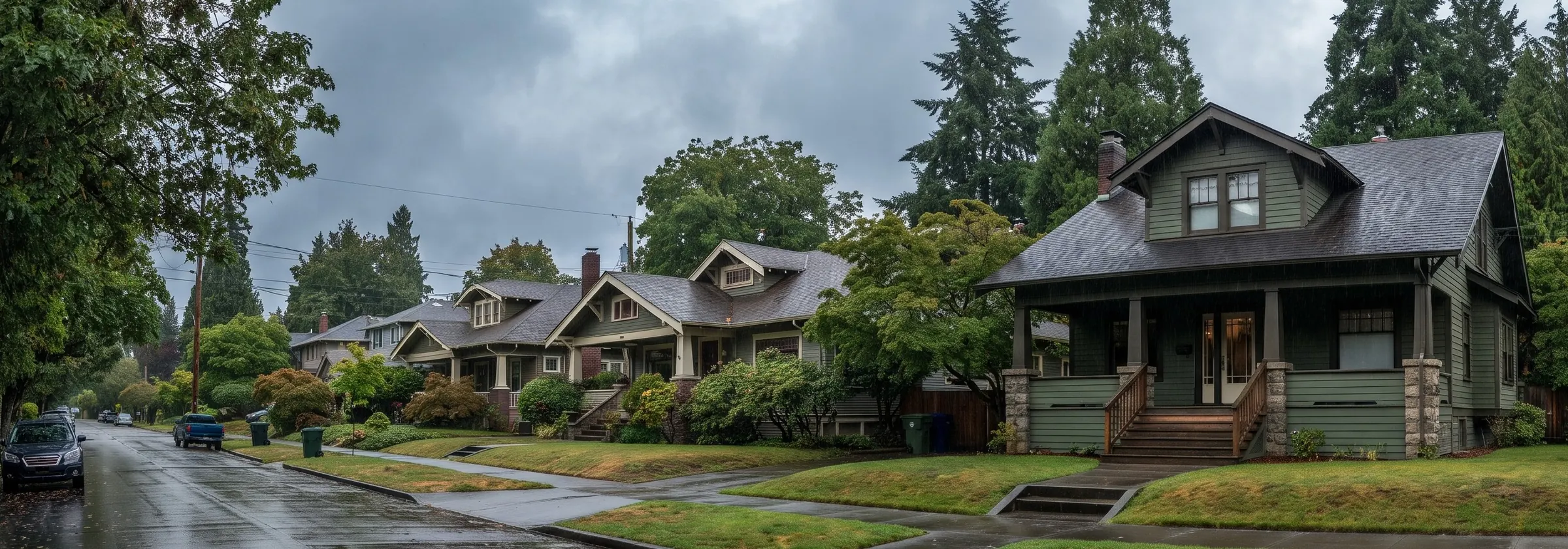

When sewage backs up into a Seattle basement, the homeowner owns the pipe from the house to the public sewer under the street. That ownership decides who calls the plumber, who pays for water damage restoration and whether the City is ever part of the claim, so the first hour matters as much for the paperwork as for the cleanup.
Seattle water damage restoration is the work of pumping out water, drying the structure and repairing what the water ruined to ANSI/IICRC S500, with repair contractors registered by the Washington Department of Labor & Industries (L&I) and side sewer repairs permitted by Seattle Public Utilities. Most Seattle homeowners meet that work after a backup, a roof leak or a failed supply line, and the source of the water, the firm's paperwork and the records kept in the first two days shape the outcome.
Key insights
- Cost range. Most Seattle water damage jobs cost $2,000–$9,400, while sewage backups and floods across several rooms can reach $9,400–$33,500 or more.
- Pipe ownership. Seattle Public Utilities (SPU) says an owner holds the side sewer from the building to the public sewer pipe, so a blockage or break in that run is the owner's repair.
- City claims. A claim to the City for reimbursement applies when an SPU sewer issue caused the backup, and SPU says to keep every cleanup invoice.
- Valve funding. SPU policy DWW-351 lets SPU consider funding a backwater valve when staff verify that the City system caused the backup because storm flows exceeded its capacity, or when a City sewer project cannot prevent backups to its service level.
- Rain and freezes. At Sea-Tac, NOAA's 1991–2020 normals give 39.34 inches of precipitation a year and 25.2 days with a low at or below 32°F, but only 1.0 day at or below 20°F.
- Claim clocks. Washington insurers must acknowledge a claim within 10 business days and accept or deny it within 30 calendar days, and the 30 day rule took effect October 18, 2026.
Where Seattle water damage starts
Water damage in Seattle homes starts in three places: the plumbing and appliances inside the house, the roof and walls during the wet season, and the sewer pipes that carry wastewater out, which is where a sewage backup begins. The sewer pipes decide who pays, because the private part of the line belongs to the homeowner and the public part belongs to the City.
 SPU advises a video camera inspection of the side sewer, and the owner who holds that pipe pays to clean or repair whatever the camera finds.
SPU says a property owner holds the side sewer from the building until it joins the public sewer pipe, and some properties share one. A backup usually happens when something blocks that pipe, and when SPU sends a crew it may check the flow in the public sewer main and run a camera through it, repairing the main or the City's part of the connection if either is damaged or obstructed.
| Part of the system | Responsible | What it means |
|---|---|---|
| Side sewer from the building to the public pipe | Property owner | A blockage or break here is the owner's repair, and some properties share one side sewer |
| Backwater valve | Property owner | The owner maintains it, including a valve that SPU funded |
| Public sewer main | SPU | A crew may check flow and run a camera, and SPU repairs damage or an obstruction |
| City's part of the connection | SPU | SPU repairs it if it has failed |
| Reimbursement for backup damage | City claim | Available only when an SPU sewer issue caused the backup |
Seattle rain, storms and seepage
Seattle's rain reaches homes through three weak points: roofs and window seals, foundation walls, and sewer pipes that fill faster than they drain. NOAA records 39.34 inches of precipitation a year at Seattle-Tacoma International Airport, and its 1991–2020 normals count 25.2 days when the low reaches 32°F or colder and just 1.0 day at 20°F or colder.
 Water that shows at the wall and slab joint after long rain usually comes from outside, so exterior drainage is the first thing to check before any interior repair.
That single day means a hard freeze that splits a pipe is rare, so the sources that return each wet season are rain at a roof, a window seal or a foundation wall. Combined pipes fill faster in a storm than dedicated sewer pipes, according to King County's wastewater division, which adds that plumbing fixtures lower than the City and County pipes are more likely to back up, especially without a backflow preventer, and that high tides can stop a combined system from releasing water to the river.
| Water source | Category | In a Seattle house |
|---|---|---|
| Side sewer blockage or break | Category 3 | Sewage rises at the lowest drain, usually a basement floor drain, shower or toilet, and the pipe repair belongs to the owner |
| Public sewer overloaded in a storm | Category 3 | Wastewater and stormwater back up through fixtures that sit lower than the City's pipes |
| Roof or flashing leak | Category 1 at first | Rain soaks insulation and ceiling drywall and degrades as it sits in the attic floor |
| Supply line or water heater | Category 1 | Clean water spreads under flooring and into walls until the line is shut off |
| Washing machine or dishwasher | Category 2 | Soap and soil in the water make carpet and pad hard to save |
| Seepage through foundation walls | Category 2 | Groundwater wets the slab edge and wall framing and keeps releasing moisture |
The source of the water sets its S500 category, and the category sets how much of the house has to come out. Sewage is Category 3 from the first minute, clean supply water is Category 1 until it sits, and a washing machine or dishwasher releases Category 2 water that carries soap and soil. Only the two sewer sources raise the question of whose pipe failed, while a claim for the others follows the policy's sudden and accidental water wording.
Wind driven rain and runoff that reach those weak points count as storm water damage, and the category depends on where the water entered. Groundwater that seeps through basement and crawl space walls after long rain is a slower source that leaves damp framing for weeks. It shows first at the slab edge, the lower wall framing and the baseboards, where moisture meter readings stay high after the surface looks dry, so the readings, not the look of the wall, show whether the seepage has stopped.
First 48 hours after a backup
For the first 48 hours after a Seattle sewer backup, the order is to quit using water, kill power and gas to the wet area, get a plumber on the line, record the damage and hire a crew certified for Category 3 water. Under ANSI/IICRC S500 sewage is Category 3, which means anything porous it soaked is cut out and hauled away.
 A quarter turn gas valve is closed when its lever sits crosswise to the pipe. SPU lists shutting off gas to the furnace and water heater among its steps when a backup floods those areas.
SPU's cleanup advice says to cut power, throw out anything the sewage touched, and either sanitize and repair or remove paneling, wallboard and wall coverings within 24 hours. Before anyone clears a blockage, SPU says to call Puget Sound Energy at 1 (888) 225-5773 so the work does not hit a gas line.
1. Keep every drain quiet
Stop flushing and stop running the sinks, showers and washing machine, since each gallon sent into a blocked line surfaces at the lowest drain in the house. SPU adds that nobody should try to block sewage flowing out of a floor drain.
2. Cut power and gas to the wet area
Flip the breakers for the wet area only when the panel is dry and can be reached without stepping into water, and shut the gas valves to the furnace and water heater as SPU advises. A generator belongs outdoors, at least 20 feet from the house, since its exhaust carries carbon monoxide.
3. Call the plumber, then SPU if the main is suspect
The plumber finds the blockage and says whether it sits in the side sewer or the public main. When the main or the City's connection looks like the cause, phone SPU at (206) 386-1800 so a crew can inspect the public sewer, and save the work order number on the door hanger.
4. Photograph the damage and keep receipts
Take photos of the water line, the backed-up drain and each damaged item, and save every invoice for cleanup, hotel stays and rented equipment. SPU says to document damage and keep those invoices, and the insurer will ask for the same records.
5. Book Category 3 drying
Hire an IICRC certified firm that will remove soaked carpet, pad and drywall before any drying equipment goes in, and give the insurer written notice the same day. A crew on site on day one saves more framing than one waiting for the adjuster.
According to the EPA, mold can take hold on wood, drywall, carpet and furniture left wet past 24 hours, so extraction that begins on day one protects framing and drywall that a three day wait would lose. A generator, a wet panel and standing sewage are the three hazards that make the first hours a job for people with the right gear.
When a spill is a DIY job
A homeowner can dry a small clean water spill without a crew, but sewage and any loss that has soaked a wall or subfloor belongs to professionals. The EPA says people with breathing problems such as asthma or with weakened immune systems should stay away from wet and moldy sites, and that children and pregnant people should not take part in flood cleanup.
 After mopping, check the cabinet base and toe kick for damp, since those materials hold water after the floor looks dry.
A clean spill from a supply line or a sink, found within hours and confined to a hard floor, can be mopped, ventilated and checked with a moisture meter until the readings match an unaffected area. Water that has reached carpet pad, drywall or insulation is a different case, because those materials hold water inside after the surface feels dry, and that is the point to call a crew.
SPU's advice for the sewage cleanup that falls to the owner is to wear long sleeves, long pants, rubber boots, gloves and eye protection, to discard items exposed to sewage, and never to eat or drink anything the sewage touched. Hard surfaces get hot water and mild dish detergent and then a rinse of eight tablespoons of liquid household bleach per gallon of water, and bleach is never mixed with ammonia. SPU also suggests considering a professional cleaning company, and the EPA calls flood cleanup difficult and dangerous work.
Sorting belongings comes after the room is cleared: photograph each item before it is discarded, list what it cost, and keep hard goods such as metal shelving and glazed tile that can be washed and disinfected. Anything porous that sat in sewage goes, which includes upholstered furniture and mattresses, because SPU says to discard items exposed to sewage.
What Seattle water damage costs
A Seattle water damage job usually costs $2,000–$9,400, with an average near $5,100. Sewage backups and floods that reach several rooms run $9,400–$33,500 or more, because with Category 3 water the crew demolishes and disinfects before it dries anything, while a small clean spill caught the same day can start near $500.
 Category 3 losses add demolition and hauling labor, and every flight of stairs between the wet room and the dumpster adds crew time to the estimate.
The Bureau of Labor Statistics puts Seattle-area construction and extraction wages at about 134 percent of the U.S. average for May 2025. The water damage restoration cost on a Seattle invoice moves with the water category, the basement stairs a crew carries wet debris up, and whether a broken side sewer needs a plumber before drying can finish.
| Scenario | Estimates | What drives it |
|---|---|---|
| Minor spot mitigation | $500–$2,000 | One wet section of wall, or a small spill caught within hours, dried in a few days |
| Supply line burst | $1,300–$4,000 | Clean water that reaches one or two rooms and must be dried before it degrades |
| Standard mitigation | $2,000–$5,400 | Extraction and drying across a floor or a basement, with nothing rebuilt |
| Washing machine or dishwasher overflow | $2,700–$6,700 | Soapy water that runs under flooring and soaks the bases of cabinets |
| Roof leak during a storm | $3,400–$9,400 | Rain that soaks attic insulation and ceilings, and a crew that has to reach the roof or attic |
| Mitigation plus basic repairs | $5,400–$9,400 | Drying, then new drywall, trim and flooring in each affected room |
| Sewage backup | $9,400–$19,000+ | Contaminated water that sends carpet, pad, drywall and other porous materials to the dumpster |
| Storm flooding across rooms | $13,500–$33,500+ | Flood cuts, subfloor repair and replacement of porous materials across several rooms |
Drying is priced by the wet floor area. A 300 square foot wet basement dries for the same amount whether the house above it has 1,200 or 2,000 square feet, and the cost per square foot rises with each water category before any rebuilding starts. Rebuilding the same floor after drying costs $27–$50 per square foot, which is more than the drying rate for any water category.
| 300 sq ft loss | Estimates | Estimates per sq ft |
|---|---|---|
| Dry a Category 1 floor | $1,200–$1,575 | $4.00–$5.25 |
| Dry a Category 2 floor | $1,575–$2,625 | $5.25–$8.75 |
| Dry a Category 3 floor | $2,850–$3,000+ | $9.50–$10.00+ |
| Rebuild after drying | $8,100–$15,000 | $27–$50 |
Rooms price differently because their materials differ. Bathrooms have tile and a small floor, kitchens add cabinet bases and appliance lines, and a basement keeps releasing moisture from its slab and walls after the standing water is pumped out, which stretches the equipment days. Living areas cost the most because they hold the most carpet, pad and furniture.
| Room | Estimates | What drives it |
|---|---|---|
| Bathroom | $700–$6,000 | Tile and a vanity on a small floor that dries fast |
| Laundry room | $1,300–$6,700 | A hose or drain that fails unattended and runs into the next room |
| Kitchen | $2,000–$10,500 | Cabinet bases, toe kicks and flooring around the dishwasher and sink lines |
| Basement | $2,000–$13,500+ | Sewer or street water coming in, then a slab and walls that keep releasing moisture for weeks |
| Living or family room | $4,400–$25,000 | The biggest floor area, with carpet, pad and furniture to move out |
A usable estimate lists the water category, when extraction began, each wet room, and the air movers and dehumidifiers with the days each will run. Each unit is billed per day, so daily moisture readings show whether every unit earned its charge, and an after-hours call can add 25–50 percent to the labor lines. When a loss starts in a private sewer, the restoration estimate covers cleanup and drying only, and the pipe repair is a separate invoice from a plumber or side sewer contractor.
Hiring a Seattle restoration company
A Seattle homeowner should hire a firm with IICRC certification for the drying and, for any repair or rebuild, an active Washington L&I contractor registration, and should confirm both before signing. The two credentials cover different work: IICRC certification covers the extraction and drying under S500, while L&I registration covers the repair and rebuild that follow, and a written scope ties both to the specific rooms, materials and dates on the job.
 Check the unit count and the days on site in the written scope before the equipment is set, because the invoice is built from those two numbers.
Washington requires construction contractors to register with L&I before they bid, advertise or perform work that includes repairing and remodeling buildings. Registration requires a surety bond of $30,000 for a general contractor or $15,000 for a specialty contractor, and a liability policy of $200,000 public liability and $50,000 property damage, or $250,000 combined. The EPA keeps no certification program or list of contractors for flood cleanup, so the firm's own paperwork is what a homeowner can check.
1. Is the L&I registration current?
Look up the firm's number in L&I's Verify a Contractor tool and confirm it is active and bonded before any work starts. A firm that cannot give a registration number for repair or rebuild work has not shown it can legally do that part of the job.
2. Does the firm hold IICRC certification?
Ask for the IICRC firm certificate and the lead technician's water damage certification. A crew that follows ANSI/IICRC S500 can explain its category call, its drying goals and its daily logs without hesitation.
3. Who repairs the broken pipe?
Side sewer repairs need a permit from SPU, and the work belongs to a plumber or sewer contractor rather than the drying crew. L&I says contractors working with plumbing have added education, examination and licensing requirements, so ask for the plumber's credentials separately.
4. Can I see the insurance certificate?
A registered firm must carry a general liability policy, and the certificate is the proof. Ask the firm's insurance agent to email the certificate, and check the policy dates and limits against the minimums L&I requires.
5. What does the Category 3 scope say?
The written scope should list which materials come out, such as carpet, pad, wet drywall and insulation, which surfaces are cleaned and disinfected, and the square footage of each. SPU's advice to sanitize or remove wallboard within 24 hours is the timeline the scope should follow.
6. How will drying be logged?
Ask for daily moisture readings, the number of air movers and dehumidifiers placed in each room, and the dry standard the crew is drying toward. Equipment leaves when the readings reach that standard, not after a set number of days.
7. Who bills the insurer?
Ask whether the firm bills the insurer directly, how it handles the deductible and whether it will accept a direction to pay. Get the answers in writing before equipment is set, because a balance left after a denied claim falls on the homeowner.
Online reviews show patterns in response time and billing, and the registration number, certificate and written scope are the records that can be verified before work starts. Anyone comparing several bids can apply the same checks when they choose a restoration company across all of them, and the answers belong in the written scope before any equipment is set.
Drying proof and the repair timeline
Crews dry a Seattle house by removing standing water, setting air movers and dehumidifiers, and checking moisture readings every day until each material matches the dry standard set from unaffected materials of the same kind. A typical job runs 3–7 days of equipment before repairs begin, and the machines run around the clock between visits while the crew returns about daily to read the meters and move the equipment.
 Repairs start only after the moisture readings reach the dry standard, so the drying log sets the date the rebuild begins.
An emergency water damage call starts with extraction, because the water left standing in carpet, pad and wall cavities does the most harm in the first hours. After sewage, crews remove and disinfect before they dry, so the early days of that job are demolition and cleaning and the equipment runs after them.
A Seattle job runs in order: extraction on day one, removal of anything porous, drying with daily readings for 3–7 days, then 1–3 weeks of repairs once the readings reach the dry standard. Basements and crawl spaces run longer because slabs and lower wall framing release moisture slowly. A roof leak that soaks attic insulation is checked with a moisture meter, and insulation that cannot be dried is removed.
The daily log is the record that shows when drying is finished. It lists the readings for each wet material, the dry reference reading from an unaffected area, the equipment count and any change the crew made. The slow materials are usually the last to reach the standard, and equipment that leaves before they do invites a damp smell and mold.
Who pays after a Seattle water loss
Who pays depends on the source: a standard homeowners insurance policy answers sudden water such as a burst supply line, a sewer backup usually needs an endorsement, flood needs its own policy, and the City pays only when its own sewer caused it. The insurer decides which cause applies, so the plumber's written finding on where the water entered becomes part of the claim file.
 Photograph the stain, the wall below it and the source before anything is repaired. The insurer decides coverage from the cause, and the cause is easiest to prove while it is still visible.
Washington's claim rules set the clock the insurer works under. Under WAC 284-30-380, effective October 18, 2026, an insurer must tell a first party claimant within 30 calendar days of a notification of claim whether the claim is accepted or denied. If it needs more time it must give all its reasons within those 30 days and send a written update every 30 calendar days. WAC 284-30-360 adds a 10 business day deadline to acknowledge a claim under an individual policy.
| Water source | Policy that answers | If it does not |
|---|---|---|
| Burst supply line or appliance hose | Homeowners policy | Deductible, plus damage the policy excludes as long term leakage |
| Roof or window leak in a storm | Homeowners policy | Damage blamed on poor maintenance is commonly excluded |
| Side sewer backup | Backup endorsement, if added | Owner pays, unless an SPU sewer issue caused it |
| Public sewer overloaded in a storm | Backup endorsement, if added | A claim to the City, which applies only if its system caused it |
| Rising water from outside | Flood policy | Owner pays, because homeowners policies exclude flood |
When an offer comes in short
A short offer can be challenged in writing, and Washington's claim rules give the homeowner specific tools for it. Under WAC 284-30-380 a denial has to be in writing and has to cite the specific policy provision, condition or exclusion the insurer relies on, and insurers are responsible for the accuracy of evaluations made on their behalf.
If the insurer prices the job with a database, survey or estimating software, the homeowner can ask for the date the data was collected, where it was collected and which businesses supplied the figures, and the insurer must provide them. Comparing those prices with the restoration firm's written scope and daily drying log shows whether an offer trims equipment days, demolition or rebuilding that the crew documented.
An outright denial follows a different path, and the steps after a denied water damage claim begin with the written reason and the policy language it cites. Keep the contractor's scope, the drying log and every photograph together, because each one answers a line in the insurer's estimate or a ground in its denial.
When the City or a flood policy pays
The City of Seattle pays for a sewage backup only when its own sewer caused it, and flood insurance is the separate policy that pays for rising water from outside the house. A claim to the City is filed through its online claims portal or on a signed claim form sent to the City Clerk, using one method for the same incident, and a portal claim is marked filed the next business day.
 SPU says the owner is responsible for maintaining a backwater valve, so follow the manufacturer's instructions for service and inspection.
SPU's backwater valve policy, DWW-351, says SPU may fund a valve on private property in two situations. In the first, both of two conditions are met: SPU technical staff verify that the City wastewater system caused the backup, and the discharge came from insufficient capacity in the sanitary or combined sewer during storm events. In the second, a City wastewater project is found unable to prevent backups from the City system within its project defined level of service. A funded valve is maintained by the owner, and the maintenance duty is recorded on the property title.
Permits and Seattle repair rules
A Seattle homeowner needs a side sewer permit from SPU for pipe repair work and no building permit for minor repairs or alterations that cost $6,000 or less in any 6-month period. A rebuild that reaches load bearing supports or the building envelope needs a permit at any price, so the restoration firm and the plumber should say who pulls which one.
The Seattle Department of Construction and Inspections (SDCI) counts the $6,000 on the fair market value of labor and parts, even when the owner does the work, and a property in an environmentally critical area should confirm with SDCI before assuming a repair is exempt. Painting, cleaning a building, installing kitchen cabinets and limited in kind repair of deteriorated parts are listed as work that usually needs no permit. Cutting out and replacing wet drywall and flooring may stay inside that exempt category, while a rebuilt basement past $6,000 needs a closer check with SDCI.
Since October 1, 2025, SPU has issued side sewer permits instead of SDCI. It generally charges $280 for a sanitary repair permit and $375 for a drainage repair permit, with one to two inspections included, and it says it processes repair permits by the end of the next business day after it receives the application.
Late drying and Seattle mold
A wet house turns to mold when materials stay wet past 24 hours or when drying ends before the readings reach the dry standard. The window SPU gives for removing sewage soaked wallboard is the same 24 hours, so the first day decides how much material can stay in the house.
 Crawl spaces release moisture slowly and are the last place to reach the dry standard, so ask for a final reading from the underside of the subfloor before the job is closed.
A basement that still reads damp after the equipment leaves, a musty smell that returns after the crew is gone or a stain that spreads after the first drying are signs that point to mold work. That is a separate job with its own assessment and containment, and the drying log shows which wet areas were dry and when.
A late dry out in a crawl space or a below grade room is the case most likely to need Seattle mold remediation, because those spaces release moisture slowly and are the last to reach the dry standard. The restoration firm that dried the house should hand over its readings so the mold assessor can see which materials were wet and for how long.
Seattle areas with a sewer record
Four Seattle areas have a public record of sewer backups or drainage shortfalls, according to Seattle Public Utilities and King County: Madison Valley, South Park, Crown Hill and the Aurora and Licton Springs corridor. These are areas where the City or County has studied, planned or built drainage work.
 Keep the work order number from any SPU crew visit, since it lets SPU tell you what its investigation of the public main found.
A house in any other area can still have a blocked or broken side sewer, because the private pipe is the owner's wherever it sits. In these four areas the public record shows the shared system struggling, so a homeowner there has a documented reason to ask SPU whether the main was the cause.
| Area | Risk factor | Notes |
|---|---|---|
| Madison Valley | Storm drains overwhelmed in the Mercer Bowl | SPU's director said the early 1970s drainage was built for a 25-year storm when the December 14, 2006 storm overwhelmed it, a storm that killed a resident trapped in a basement. A home in the area took 3 inches of water in its basement again on October 24, 2010 |
| South Park | Combined pipes and high tides | King County says combined pipes fill faster than sewer pipes in a storm and high tides can block releases to the river. It installed backflow preventers such as grinder pumps for individual homes in late 2022 and early 2023 and is planning a flapgate and a stormwater and sewer separation project |
| Crown Hill | Small, shallow pipes and ditches | SPU's 2024 area plan finds most blocks north of N 85th Street have only ditches and shallow small pipes, and it recommends a project for street flooding and sewer backups on 17th Avenue NW and NW 87th Street. Most blocks will improve gradually as redevelopment extends the system |
| Aurora and Licton Springs | Inadequate sewer and drainage capacity | SPU is developing an area plan to address flooding and sewer backups, and it describes drainage risks on Aurora Avenue N and its side streets that affect streets, homes and businesses |
SPU says an owner can download a property's side sewer information from the Seattle Department of Construction and Inspections website. That record shows where the pipe runs and where it joins the main, which gives a plumber and the homeowner a starting point for deciding whether a blockage sits in the private pipe or the public sewer.
Renters, condos, buyers and sellers
A Seattle tenant can ask the landlord to repair water damage because Washington law requires the landlord to keep the premises fit for human habitation. RCW 59.18.060 lists duties that include maintaining structural components such as roofs, floors, walls and foundations in reasonably good repair, and making the repairs needed to keep the premises in the condition the law or the rental agreement requires, except for wear from ordinary use.
A tenant should give the landlord written notice with dated photographs of the damage, and the tenant's own belongings are covered, if at all, by a renters policy and not by the landlord's. The renters rights that apply to a leak depend on who owns the failed pipe and whether the tenant caused it.
SPU notes that some properties share a side sewer, so a backup in a condo or a townhouse group can involve neighbors and an association, and the repair and its cost have to be sorted out with the other owners who use the same pipe. Photographs and the plumber's finding on where the blockage sits help every party see which part of the line failed.
A buyer should have the side sewer inspected before closing, because SPU advises a video camera inspection before purchasing a property. On the seller's side, the disclosure statement under RCW 64.06.020, in the form in effect through December 31, 2026, asks whether the roof has leaked within the last five years, whether the basement has flooded or leaked, and whether the house is connected to the sewer main, so a yes on any of them is a lead for the buyer's inspector.
Prevention for Seattle side sewers
Prevention in Seattle starts with the side sewer, because the owner holds that pipe and its failure sends Category 3 water into the house. Most of the actions that protect a Seattle house follow SPU and King County guidance on the private pipe, and one covers the rare hard freeze.
 Slide the sleeve over the whole run of exposed pipe, including the elbows, and seal the seams before a forecast hard freeze.
SPU says to have a plumber or sewer inspector run a video camera through the side sewer to find problems, and to clean or repair it before a blockage becomes a backup. Regular cleaning can prevent costly repairs, a broken side sewer must be fixed, and the repair itself needs an SPU permit before the pipe is opened.
| Action | When | Why it works |
|---|---|---|
| Camera inspection of the side sewer | Before buying and after a slow drain | Finds cracks, roots and sags before a blockage fills the basement |
| Flush only toilet paper, no grease | Every day | SPU lists it as the basic care step for a side sewer |
| Service the backwater valve | On the manufacturer's schedule | A valve that is not maintained or was installed wrongly can fail when the pipes surcharge |
| Check the lowest drains and fixtures | Before finishing a basement | Fixtures lower than the City's pipes are the ones most likely to back up |
| Insulate exposed pipes in unheated spaces | Before a forecast hard freeze | A freeze is rare, but a split pipe in a crawl space floods the house fast |
Hard freezes are rare in Seattle, with only 1.0 day a year at or below 20°F, but a line in an unheated crawl space can still split in one, and the frozen pipes steps cover thawing and shutting off a line before it fails. Insulation on exposed pipes is the usual protection.
Every household should know where the main shutoff valve is and that it turns, because the first minutes of a burst pipe decide how much of the floor is wet. Replace old rubber supply hoses on washers and dishwashers before they fail, since those lines release Category 1 water that degrades the longer it sits.
Frequently asked questions
How much does water damage restoration cost in Seattle?
About $5,100, within a range of $2,000–$9,400. Sewage backups and floods that reach several rooms cost $9,400–$33,500 or more, since soaked carpet, pad and drywall are removed and rebuilt.
How can I tell if a Seattle restoration company is reputable?
Check four records: an active L&I registration number, an IICRC firm certificate, an insurance certificate sent by the firm's agent, and a written scope with daily drying logs. Reviews help show patterns in response time and billing.
How long does it take for water damage to be repaired in Seattle?
Plan on 3–7 days of drying and 1–3 weeks of repairs. A basement slab and wall framing release moisture slowly, and the equipment stays until the moisture readings reach the dry standard.
Who is responsible for a sewer backup in Seattle?
The homeowner, when the blockage or break is in the side sewer. SPU says an owner holds the side sewer from the building to the public sewer pipe, and the City's responsibility starts at the public sewer main and its part of the connection.
Does Washington require a license for water damage restoration?
Contractors who repair or rebuild must register with L&I, and they must carry a surety bond and liability insurance. The IICRC firm certification is what covers the drying work, and the EPA says it keeps no certification program or list of contractors.
Is a sewer backup covered by homeowners insurance in Seattle?
Usually only with a backup endorsement, because most homeowners policies offer limited or no coverage for sewer and drain backups. A burst supply line is a different cause and is covered as sudden water damage, subject to the deductible. Rising water from outside needs a separate flood insurance policy.
Does Seattle Public Utilities pay for sewage cleanup?
Only when an SPU sewer issue caused the backup. A claim to the City can then reimburse documented costs, so keep every cleanup invoice, and a blockage in the side sewer is the owner's cost.
Can SPU help pay for a backwater valve?
Sometimes, under policy DWW-351. SPU may fund a valve when its staff verify that the City system caused the backup because storm flows exceeded capacity, or when a City sewer project cannot prevent backups to its service level, and the owner then maintains it.
How long does an insurer have to respond to a water damage claim in Washington?
Ten business days to acknowledge and 30 calendar days to accept or deny. An insurer that needs more time must give its reasons within 30 calendar days and update the claimant in writing every 30 calendar days.
Can I clean up a sewage backup myself in Seattle?
No, not safely. SPU says sewage contains hazardous germs and suggests considering a professional cleaning company, and the EPA calls flood cleanup difficult and dangerous work.
Do I need a permit to repair water damage in Seattle?
Usually not for minor repairs, but yes for side sewer work. SDCI requires no permit for minor repairs or alterations that cost $6,000 or less in any 6-month period, and SPU generally charges $280 for a sanitary side sewer repair permit.
How fast can mold grow after a Seattle water loss?
Within about 24 hours of continued wetness, according to the EPA, which says mold can grow on wood, drywall, carpet and furniture left wet past that point. A basement that still reads damp after the equipment leaves needs a mold assessment, and the steps for mold after water damage start with the drying log.
Do I have to disclose water damage when selling a house in Seattle?
Usually yes, through the seller disclosure statement under RCW 64.06.020, which asks whether the roof has leaked in the last five years and whether the basement has flooded or leaked. A buyer can waive the statement, and some transfers are exempt.
- IICRC S500
- EPA: Flood Cleanup to Protect Indoor Air and Your Health
- NOAA NCEI: U.S. Climate Normals, 1991–2020
- Seattle Public Utilities: Side Sewer Backups
- Seattle Public Utilities: Side Sewer Maintenance
- Seattle Public Utilities: Policy DWW-351, Sewer-Backup Prevention and Backwater Valves
- King County: Wastewater backup protection for South Park
- Washington L&I: Register as a Contractor
- WAC 284-30-380: Settlement standards applicable to all insurers
- BLS: Occupational Employment and Wages in Seattle-Tacoma-Bellevue, May 2025
Sam Hickerson is the founder of RestoreAdvisor and writes consumer guides on mold remediation, water damage restoration, inspection, testing, and home recovery. His work focuses on helping homeowners understand costs, risks, and when to call a professional. He draws on guidance from the EPA, CDC, IICRC, and other authoritative sources to make complex home issues easier to navigate.