
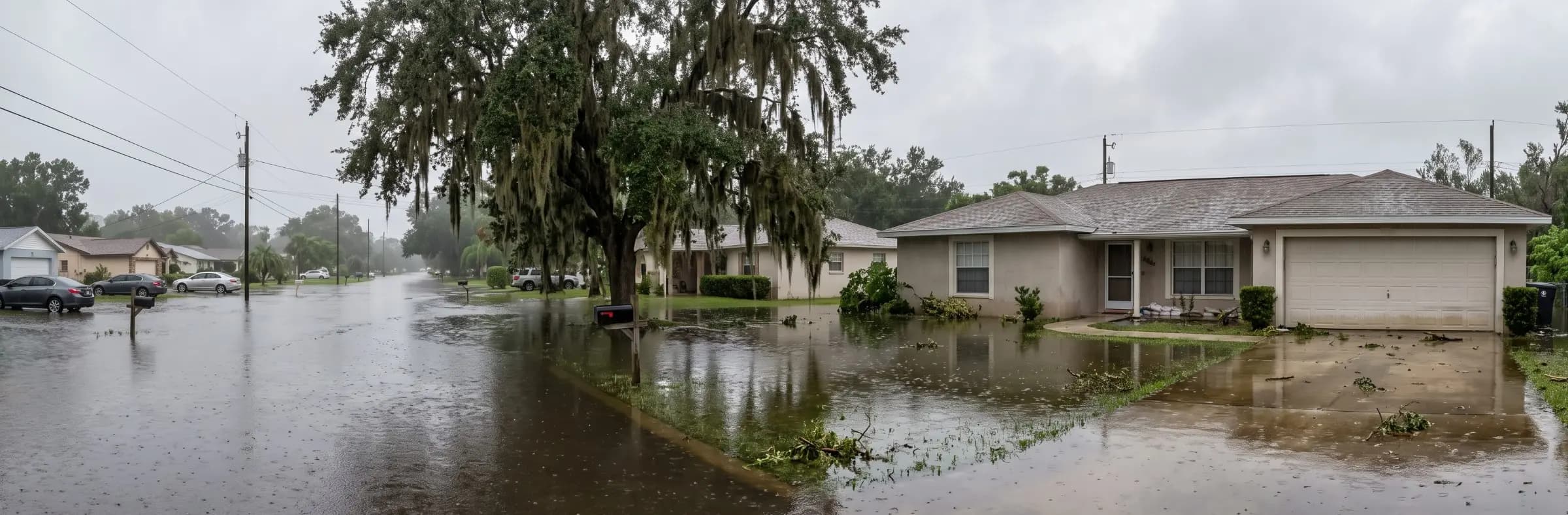

Water in a Tampa home starts a drying clock that Florida's heat and humidity shorten, and the 2024 hurricane season showed how quickly rain, bay surge, and overwhelmed drainage can put water in homes that had never flooded. Most Tampa jobs cost $1,500–$7,000 to dry and repair, and the first 48 hours decide whether a loss stays near the low end of that range or turns into a rebuild.
In Tampa, water damage restoration is the professional process of extracting water, drying structural materials, cleaning, and repairing a home to the ANSI/IICRC S500 standard for professional water damage restoration. Florida licenses mold work and the construction trades that rebuild a home but does not license extraction and drying as a separate trade, so IICRC credentials, a written drying scope, and the one year Florida claim deadline matter more than a company's marketing.
Key insights
- Typical cost. Water damage restoration in Tampa costs $1,500–$7,000 for one affected area, while Category 3 rain, surge, or sewage water on a ground floor can reach $10,000–$35,000 or more.
- Flood zones miss rain flooding. Forest Hills sat in FEMA Zone X, a moderate to low risk area, when Hurricane Milton's rain flooded it in October 2024, and few homes there carried flood insurance.
- One year claim deadline. Florida Statute 627.70132 bars a new or reopened property claim unless the insurer receives notice within 1 year of the loss, and for a hurricane the date of loss is the date of landfall.
- Separate hurricane deductible. A Florida hurricane deductible of $500, 2 percent, 5 percent, or 10 percent of the dwelling limit applies to covered wind damage, and no other deductible applies while it does.
- The 50 percent rule. In Flood Zone AE, Coastal A, and VE, repairs that exceed 50 percent of a structure's depreciated value before the damage can require rebuilding to flood resistant standards.
First 48 hours of water damage in Tampa
The first 48 hours come down to five actions: stop the water and identify its source, make the area electrically safe, photograph the damage and put the loss in writing to your insurer, start drying with an IICRC credentialed company, and check the flood zone before repairs. The EPA says mold can start growing on wet materials within 24–48 hours, and Tampa's humid air leaves little room to wait for an adjuster's schedule.
 Closing the supply valve first keeps clean Category 1 water from spreading, and under ANSI/IICRC S500 that water can slip into Category 2 within days if it sits in warm, wet materials.
The City of Tampa Water Department emergency line, (813) 274-7400, is staffed around the clock. Call it if the shutoff at your home will not close or water is coming from the line at the street, since the City controls the shutoff at the meter.
1. Stop the water and identify the source
If a pipe or appliance is the source, close its supply valve or the main shutoff right away, because every minute of flow adds to the loss. Rain, bay, or retention pond water entering from outside is flood water, a failed pipe or appliance is plumbing water, and rain coming through a roof or window opening is storm water. Each one falls under a different part of your coverage, so note which you have before you describe the loss to anyone.
2. Make the area electrically safe
Switch off power at the breaker only if the panel is dry and you can reach it without stepping through water. If water is still moving, sewage is involved, or the panel is wet, call for emergency water damage restoration and keep everyone out of the room until an electrician confirms the circuit is safe.
3. Photograph everything and put the notice in writing
Photograph the source, the water line on walls, and damaged belongings before moving anything, then email your insurer the date, the source, and the photos. Florida's 7 day acknowledgment clock starts when the insurer receives your communication, so a dated message is your proof of when it began.
4. Start drying the same day
Remove standing water and start airflow right away, and call a restoration company with IICRC credentials without waiting for the adjuster. Keep doors and windows closed, because Tampa's outdoor air often holds more moisture than the air inside a drying home.
5. Check the flood zone before you repair
If outside water entered the home, ask the City of Tampa Construction Services Division about substantial damage before you order repairs. The answer tells you whether the rebuild must meet flood resistant construction standards.
Why water damage differs in Tampa
Tampa homes take water damage differently because the city sits low on Tampa Bay, receives about 49.5 inches of rain in a normal year, and runs air conditioning for most of the year. Water arrives from above in thunderstorms, from the bay as surge, and from the street when retention ponds and pumps fall behind.
National Weather Service normals put annual rainfall at Tampa International Airport near 49.5 inches, with roughly 30 inches falling from June through September. The 2024 rainy season set a record at 51.87 inches in those four months, according to Bay News 9, breaking the 51.22 inches recorded in 1945.
Low ground and the bay
Much of Tampa and the communities across the bay sit close to sea level, so a storm that passes miles offshore can still put surge at street level. Hurricane Helene set surge records across the region in September 2024 while passing about 100 miles off the coast.
Humid air slows drying
Wet drywall, wood, and insulation dry slowly when the outdoor air is humid, so a loss that sits for two days costs more than one dried on the first day. Opening windows adds moisture to a drying room, which is why crews keep the structure closed and run dehumidifiers.
Tampa flood and hurricane history
Tampa's recent water events include Hurricane Debby's rain in August 2024, Hurricane Helene's record bay surge on September 26, 2024, and Hurricane Milton's rain on October 9–10, 2024. The National Weather Service Tampa Bay office ranks Helene and Milton among the most impactful storms for Florida's west coast in the last century, citing historic surge, record river levels, and a tornado outbreak.
 River flooding at this scale reached Hillsborough County in 2024, when County Public Works said the Hillsborough River hit its highest recorded level during Milton.
Helene passed about 100 miles offshore, yet every tidal gauge in the Tampa Bay region topped its previous record, and Axios Tampa Bay reported peaks of 7.2 feet at East Bay and 6.8 feet at Old Port Tampa. Roads to Davis Islands flooded, and the Alafia River reached 9.4 feet overnight as nearby residents waded out of flooded homes. Debby had already brought major flooding to the Alafia and Little Manatee rivers in Hillsborough County in August.
Milton's surge went south of Tampa Bay, but around 17 inches of rain fell in six hours in parts of Pinellas and Hillsborough counties, according to the Tampa Bay Times, and the National Weather Service declared a rare flash flood emergency. Hillsborough County Public Works said the Hillsborough River reached the highest level ever recorded.
Forest Hills in north Tampa flooded after Milton even though it sits in FEMA Zone X. Residents blamed pump station failures when backup generators did not run at two stations, the City said the historic rainfall would have flooded streets regardless, and Spectrum Bay News 9 reported that the water in homes carried stormwater and sewage.
Standard homeowners policies exclude flood water, so water damage from flooding depends on a separate flood policy, and few Forest Hills homeowners carried one. The City of Tampa also notes that evacuation zones and flood zones measure different things: evacuation zones reflect surge risk, while flood zones reflect flooding at any time of year, including from heavy rain.
Water damage risk by Tampa area
Water damage risk in the Tampa Bay area depends on elevation, distance from the bay and rivers, drainage design, and building age more than on ZIP code. The 2024 storms flooded coastal neighborhoods with surge and inland neighborhoods with rain, sometimes within two weeks of each other.
Look up the exact address before the next storm season, because the City of Tampa notes that every property is in a flood zone and that a home outside an evacuation zone can still sit in a high risk flood zone because of a nearby pond or stream. Temple Terrace, Plant City, St. Petersburg, and Clearwater run their own permit and floodplain offices, so rules change at the city line.
| Area | Main water risk | Where to start |
|---|---|---|
| Davis Islands and South Tampa | Bay surge; roads to Davis Islands flooded during Helene | Confirm the evacuation zone, flood zone, and lowest floor elevation |
| Forest Hills and the University area | Rain and pond flooding in Zone X during Milton, with stormwater and sewage in homes | Carry flood coverage even outside a mapped high risk zone |
| Palmetto Beach and East Bay | Record surge at the East Bay gauge, 7.2 feet during Helene | Check surge exposure and keep valuables above the first floor |
| Brandon and the Alafia River | River flooding, with the Alafia at 9.4 feet during Helene, and Zone X streets flooded after Milton | Look up the parcel flood zone and find out which ditch or pond drains your street |
| Plant City | Inland rain flooding after Milton that the city manager described as staggering | Confirm floodplain status with the city permit office |
| Seminole Heights and older neighborhoods | Original plumbing and aging drain lines that hide slow leaks | Inspect supply lines, drain lines, and roof flashing after every storm |
| St. Petersburg and the Pinellas coast | Surge into bowl shaped neighborhoods such as Shore Acres, which flooded repeatedly | Check the surge and flood zones, and use the Pinellas permit office |
Bungalows and ranch homes built before 1980 often carry original plumbing and wood framing, so water damage in an older or historic home calls for slower drying and more careful tear out. Plaster, old growth wood, and cast iron drains each change what can be dried in place.
Common water sources in Tampa homes
Five routes bring water into a Tampa home: storm and hurricane damage, air conditioner condensate, slab and plumbing leaks, roof, window, and door leaks, and sewage or drain backups. The route decides how far the water spread, how long it went unnoticed, and which part of an insurance policy responds.
 Rain that enters through a wind-opened roof is covered by the homeowners policy and its hurricane deductible, while surge and rising street water need a separate flood policy.
Hurricane and storm damage
After a hurricane in Tampa, wind driven rain through a roof, window, or door opening that the wind created falls under the homeowners policy and its hurricane deductible, while surge and rising street water fall under a flood policy. Because that split sends one storm into two claims, storm and hurricane water damage often involves two adjusters and two sets of paperwork.
The Florida Department of Financial Services counts interior rain damage as hurricane coverage when the wind first creates the opening. Tarp the opening, take dated photographs, and keep every receipt, because a wind opened roof wets insulation and ceilings long before a stain appears.
Air conditioner condensation
Tampa air conditioners run for most of the year, so a clogged condensate line, a cracked drain pan, or a stuck float switch is a leading source of water that has nothing to do with storms. Slow overflow from an attic or closet air handler can soak insulation and drywall for weeks, and HVAC water damage from condensation often goes unseen until a ceiling stain appears.
Because these leaks build slowly, adjusters ask how long the leak ran, and damage from repeated seepage can be excluded. Dated service records, the date of the first stain, and the day the system was shut off support a sudden and accidental claim.
Slab leaks and aging pipes
Many Tampa area homes sit on concrete slabs, which hide supply and drain lines under the floor. A slab leak can run for weeks before a warm floor spot, a rising water bill, or the sound of running water gives it away.
Cast iron drain lines under the slab in Florida homes built from the 1950s through the 1970s corrode from the inside out, and Tampa has neighborhoods from that era. A plumber's camera inspection shows whether a line is failing, and a leaking drain produces Category 2 or 3 water.
Roof, window, and door leaks
Wind driven rain gets into Tampa homes through the roof, windows, and doors before the structure fails. A ceiling stain after a storm points to an opening above, and water damage from a roof leak usually starts at flashing, valleys, ridge caps, or lifted shingles and soaks attic insulation before it reaches the ceiling.
Failed seals, flashing, and thresholds let rain past windows and doors, which shows as staining below the frame or bubbling paint at the wall base. Water that gets behind trim often runs down inside the wall, so the damage can appear well below the opening.
Sewer and stormwater backups
When heavy rain overwhelms a street drain or a retention pond, stormwater and sewage can enter a home together. That water is Category 3 from the start, which means disinfection, protective equipment, and removal of porous materials.
Report a sewage backup or overflow to the City of Tampa Wastewater Department right away, including after hours. Before cleanup starts, have a plumber document whether the blockage is in the public main or your own line, because that decides who repairs it and how a sewage backup claim is handled.
Signs of water damage in a Tampa home
A Tampa leak usually shows up as a musty smell, a brown ceiling stain, bubbling paint, a warm spot on a slab floor, or a water bill that climbs with no change in use. Air conditioning that runs most of the year and slab construction keep leaks inside walls and under floors, so small signs deserve a prompt look.
 Cupped boards mean moisture has reached the subfloor or slab side, so the flooring usually needs a moisture reading before anyone decides whether it can dry in place or must come up.
Photograph each sign with a date before anything is moved, because dated images help show whether a loss was sudden. The sign and its location usually point to the source of the water.
| Sign | Likely cause | Where to look |
|---|---|---|
| Musty or sour smell | Damp insulation or drywall behind a wall | Closets, garages, and rooms near the air handler |
| Brown stain spreading on a ceiling | Roof leak, air conditioner pan overflow, or an upstairs line | Under bathrooms, roof penetrations, and the air handler |
| Bubbling or peeling paint | Moisture moving through the wall | Lower walls, exterior corners, and bathroom walls |
| Warm or damp spot on a slab floor | Slab leak on a supply line | Hallways and tile floors |
| Water bill rises with no change in use | Hidden leak in a supply line or irrigation line | The water meter with every fixture off |
| Cracked or loose tile | Moisture under the tile or slab movement | Bathrooms, kitchens, and entry doors |
With every fixture off, a water meter dial that still moves means water is running somewhere in the system. A stain that returns after painting points to an active leak.
Water damage categories and classes
The IICRC S500 standard rates every water loss twice: by category, from 1 to 3, for contamination, and by class, from 1 to 4, for how much material the water wet and how much drying the structure needs. Together the two ratings decide how a Tampa job is handled and priced.
A category can worsen with time and heat. Tampa's warm indoor temperatures speed bacterial growth, so clean water that sits in wet materials for a few days can slip into Category 2.
| Category | What it means | Tampa sources |
|---|---|---|
| Category 1 | Water from a sanitary source with little risk at first | A failed supply line, a water heater leak caught early, or fresh condensate |
| Category 2 | Significant contamination that can cause illness on contact | Washing machine or dishwasher discharge, or pan water that has stood for days |
| Category 3 | Grossly contaminated water that can carry sewage and other harmful agents | Bay surge, river flood water, retention pond overflow, or a sewer backup |
Class 1 is a small area, Class 2 a whole room, Class 3 water that came from overhead, and Class 4 dense materials such as concrete and hardwood. An air handler overflow or a roof leak in Tampa often produces a Class 3 loss, so ask for the category and class in writing before accepting an estimate.
Water damage restoration cost in Tampa
Expect $1,500–$7,000 for one affected area in Tampa as of October 2026. Category 3 water, multiple rooms, older construction, and slow response push the bill up, while starting to dry within the first day pulls it down.
 Under ANSI/IICRC S500, carpet and pad soaked by Category 3 water are removed and discarded rather than dried, which shifts the bill from drying equipment toward demolition, disposal, and replacement.
No public dataset publishes Tampa only invoices, so these figures start from national ranges and adjust for ground floor rain and surge exposure, a year round cooling season, slab foundations, and post storm crew demand. Mitigation (extraction and drying) and reconstruction (drywall, flooring, paint) are usually billed as separate scopes, and an insurance estimate often splits them the same way.
| Scenario | Cost | What drives it |
|---|---|---|
| Water heater or appliance leak caught within a day | $500–$2,500 | Clean water and a small footprint; a garage or closet unit adds cabinet or drywall repair |
| Air conditioner condensate overflow from an attic or closet unit | $800–$4,000 | Wet insulation and ceiling drywall below the unit, often found after weeks of slow leaking |
| Burst or leaking supply line in one room | $1,500–$7,000 | Extraction, 3–5 days of drying equipment, and flooring or drywall replacement |
| Slab leak with wet flooring | $1,500–$6,000 | Cleanup only; locating and repairing the line under the slab is the plumber's invoice |
| Roof leak after wind damage | $1,000–$6,000 | Wet attic insulation and ceilings; the roof repair is a separate roofing invoice |
| Sewage backup (Category 3) | $2,000–$10,000 | Disinfection, protective gear, and removal of porous materials such as padding and lower drywall |
| Rain, surge, or pond water in a ground floor home (Category 3) | $10,000–$35,000+ | Flood cuts, flooring, drywall, and contents; severe multi level losses can pass $75,000 |
National water damage restoration cost ranges set the baseline, and Tampa jobs move above or below them with the contamination category, the hours before drying starts, the age of the building, and storm demand. Each of those factors should show up as a line on a written estimate.
Contamination category
Category 1 jobs are mostly extraction and drying, while bay, river, pond, and sewage water add disinfection, protective equipment, and removal of porous materials under ANSI/IICRC S500. That added tear out accounts for most of the price gap.
Hours before drying starts
Drying that starts within the first day keeps more drywall and carpet padding salvageable. Equipment is billed by the day, so a late start also means a longer rental.
Storm demand
After a named storm, crews, dehumidifiers, and drywall suppliers tighten across the bay area at once, so the same job starts later and costs more than it would in a quiet week. Ask for a start date in writing so a backlog does not leave wet materials sitting.
Contractors often quote mitigation by the square foot, and water damage restoration cost per square foot varies with the water category and the class of the loss. A quote far outside the usual range deserves a line by line explanation.
DIY or pro cleanup in Tampa
Most Tampa water losses are beyond DIY, with one exception: clean water on tile or sealed concrete that is dried within hours. What decides it is whether the water reached anything that cannot dry from the surface, such as drywall, insulation, a wood subfloor, or a duct.
 A thermal camera flags cooler, possibly wet areas behind a wall that looks dry, but it only shows temperature, so a moisture meter reading confirms the water before anyone decides what can stay.
A room that looks dry can still hold a wet wall cavity, and a company that logs moisture readings leaves the paper trail an insurer asks for later. Water from outside the house, from a sewage backup, or near electrical panels should always go to a professional.
| Situation | DIY or pro? | Why |
|---|---|---|
| Clean water on tile or sealed concrete, dried within a day | DIY | Surface water dries with towels, fans, and a dehumidifier before it reaches porous material |
| Air conditioner pan overflow caught the same day | DIY | Clear the drain line and dry the area, then call a pro if the insulation or ceiling below is wet |
| Water in a wall, under flooring, or in insulation | Pro | Wall cavities and subfloors stay damp while the surface looks dry, and mold can start within 24–48 hours |
| Bay surge, river, or retention pond water | Pro | Category 3 water carries contamination that needs protective gear and removal of porous materials |
| Sewage backup | Pro | Category 3 from the start, with health risks from direct contact |
| Water near outlets, panels, or ceiling lights | Pro | Shut off power at the breaker first, and have an electrician clear the circuit before anyone enters |
Tampa restoration process and timeline
A Tampa water damage job moves through six stages: inspection, extraction, removal of wet materials, drying, cleaning, and rebuild. The first four usually finish within a week, and the rebuild varies most from home to home. Each stage should appear on the written scope with a moisture reading attached, because daily readings show when drying is finished and are the record an insurer often asks to see before it pays for the rebuild.
| Stage | What happens | Time needed |
|---|---|---|
| Inspection and mapping | The technician finds the source, classifies the water, and maps wet areas with a moisture meter and thermal camera | 1–2 hours |
| Extraction | Pumps and wet vacuums remove standing water | A few hours |
| Removal | Wet drywall, insulation, baseboards, and pad that cannot dry are cut out | Same day to 2 days |
| Drying | Air movers and dehumidifiers run while daily readings track progress | 3–7 days |
| Cleaning | Surfaces are cleaned and treated, and Category 3 jobs are disinfected | 1 day |
| Rebuild | Drywall, paint, flooring, and trim are replaced, with permits where required | 1–3 weeks |
What to save and what to throw away
What you can keep depends on the water category and on how porous the item is. Glass, metal, and hard plastic can be cleaned and kept after almost any water, while soft, porous items that sat in flood water or sewage are usually discarded.
 ANSI/IICRC S500 treats Category 3 water as grossly contaminated, so porous items it soaks, such as mattresses, upholstery, and carpet, are discarded instead of cleaned.
Photograph every discarded item and keep a written list before anything leaves the house, because your insurer may need that record to value your contents. If the adjuster has not seen the damage yet, hold back a small sample of the carpet, pad, or flooring.
| Item | Category 1 water | Category 3 water |
|---|---|---|
| Glass, metal, hard plastic | Clean and dry | Clean and disinfect |
| Solid wood furniture | Dry and keep | Clean and disinfect if the finish is intact, discard if swollen or lifting |
| Upholstered furniture and mattresses | Keep if dried quickly and not soaked | Discard |
| Carpet | Dry in place if caught within a day or two | Discard |
| Carpet pad | Dry or replace | Discard |
| Drywall and insulation | Dry in place if caught early | Remove and replace |
| Books, papers, photos | Freeze, then dry | Discard, or copy first if irreplaceable |
| Food, medicine, cosmetics | Keep if sealed and dry | Discard |
Water damage repair permits in Tampa
Extraction and drying in Tampa generally begin before permit questions are settled because they do not alter the building, but rebuild work is a different question that depends on the trade and the scope. The City of Tampa's Construction Services Division answers it for a specific address.
 Permitted electrical and framing work is generally inspected before drywall covers it, so confirm each inspection is signed off before the walls are closed.
In a flood hazard area, the City of Tampa applies FEMA's 50 percent rule. If the property is in Flood Zone AE, Coastal A, or VE, repairs that exceed 50 percent of the structure's depreciated value before the flood damage, as listed by the Hillsborough County Property Appraiser, can require rebuilding to Florida Building Code flood resistant construction standards.
The Hillsborough County Property Appraiser offers an online 50 percent rule calculator for the repair value of a property. After Helene and Milton, the City also waived certain permit fees and a provision of its floodplain ordinance, so ask which orders apply to your repair date. The City also mailed about 1,900 substantial damage letters to owners in the flood hazard area after the 2024 storms, and the letter comes with a form to return.
A contractor should state in writing who pulls each permit, because the rules on when you need a permit for water damage repairs depend on the trade, the scope, and the flood zone. Unpermitted work can complicate a later insurance claim and a sale.
NFIP policyholders in a special flood hazard area can receive up to $30,000 in Increased Cost of Compliance coverage toward elevation or floodproofing, and that claim is filed separately from the flood claim. Ask the City for a written substantial damage determination before you sign a reconstruction contract.
Mold after water damage in Tampa
A slow dry out in Tampa often leads to mold, which can start growing on wet drywall and framing within 24–48 hours. Restoration dries and repairs the structure, and mold remediation follows as its own service under ANSI/IICRC S520 when growth is found.
Daily moisture readings from the drying job, kept in writing, are the best protection against a later mold dispute. Florida requires separately licensed assessors and remediators once mold passes 10 square feet, and that licensed team will ask for the drying log.
If mold appears after a loss, mold remediation in Tampa is a separate project with its own licensing, written protocol, and clearance testing. Water dried within two days rarely reaches that point.
Florida insurance rules for water damage
A standard Florida homeowners policy pays for sudden and accidental water damage, such as a burst pipe or a failed appliance, and excludes flood water and damage from constant or repeated seepage. Document both the source and how long the water ran, since those two facts decide which part of the policy responds.
 A sudden tank failure is the kind of water loss a homeowners policy typically covers, though the policy usually pays for the resulting damage and not the cost of replacing the heater itself.
Florida sets short deadlines on both sides of a claim. Under Florida Statute 627.70132, a new or reopened claim is barred unless the insurer receives notice within 1 year of the loss, a supplemental claim must be noticed within 18 months, and for a hurricane or other weather event the date of loss is the landfall date or the date NOAA verifies the event.
| Claim step | Deadline | Statute |
|---|---|---|
| Report a new or reopened claim | Within 1 year of the date of loss | 627.70132 |
| Report a supplemental claim | Within 18 months of the date of loss | 627.70132 |
| Insurer acknowledges your communication | Within 7 calendar days | 627.70131 |
| Insurer inspects after proof of loss | Within 30 days of receiving the proof of loss statements | 627.70131 |
| Insurer pays or denies the claim | Within 60 days of notice | 627.70131 |
Payments made after the 60 day window bear interest from the date the insurer received notice, and the insurer must send you a copy of any detailed estimate within 7 days after its adjuster generates it. Hidden damage found after repairs begin can be added as a supplemental claim.
A Tampa homeowner whose roof was opened by Milton on October 9, 2024 had about one year from landfall to give notice, so confirm a storm's loss date in writing early. Whether homeowners insurance covers water damage from a leak that ran for weeks is a separate question, and the policy's seepage exclusion usually decides it.
Hurricane deductible and flood coverage
Florida homeowners can carry a separate hurricane deductible that applies only to covered windstorm damage from a hurricane declared by the National Hurricane Center. Insurers must offer options of $500, 2 percent, 5 percent, or 10 percent of the dwelling limit, with exceptions for higher value homes, and while it applies no other deductible under the policy may be applied.
 Outside water that rises into a home is a flood under the NFIP definition, which a homeowners policy excludes, so payment depends on a flood policy already in force, usually after a 30 day wait.
The Florida Department of Financial Services explains that the deductible period starts when the National Hurricane Center issues a hurricane warning for any part of Florida and ends 72 hours after the last hurricane watch or warning. It applies on a calendar year basis, so a second storm in the same year uses the unused balance or the all other perils deductible, whichever is greater. On a home insured for $300,000, a 2 percent deductible is $6,000, a 5 percent deductible is $15,000, and a 10 percent deductible is $30,000.
| Water source | Homeowners policy | Flood policy |
|---|---|---|
| Burst pipe or appliance leak | Covered if sudden; standard deductible | Not covered |
| Air conditioner condensate overflow | Covered if sudden; excluded if gradual | Not covered |
| Rain through a roof or window opened by wind | Covered; hurricane deductible applies in a hurricane | Not covered |
| Bay surge or rising river water | Not covered | Covered up to policy limits |
| Rain that floods streets and enters the home | Not covered | Covered if it meets the NFIP flood definition |
| Sewer or drain backup | Only with a water backup endorsement | Only when part of a general flood |
| Slow or long term leak | Usually excluded as constant seepage | Not covered |
A flood insurance policy through the NFIP carries a 30 day waiting period, so a policy bought as a storm approaches does not cover that storm. Building coverage tops out at $250,000 and contents at $100,000, and a flood claim has a 60 day proof of loss deadline.
Zone X means a moderate to low mapped risk, and Forest Hills still flooded after Milton. The City of Tampa notes that every property is in a flood zone, so rain flooding can reach homes that never needed a mandatory flood policy.
Citizens policies and water damage
Citizens Property Insurance, Florida's insurer of last resort, covers many Tampa Bay homes, and its water damage terms differ from most private policies. Citizens has limited non weather water coverage, such as a burst pipe or an appliance leak, to $10,000 unless the policyholder agrees to use a contractor from its Managed Repair Contractor Network Program, in which case the cap does not apply.
The Florida Insurance Commissioner approved that cap with the managed repair option in 2017, and a Citizens spokesman said in October 2024 that takeout policies carry at least $10,000 of non weather water coverage. Terms vary by policy form and year, so the declarations page and endorsements on your own policy control.
Find the limit before the loss
Look for a water damage limit in the declarations or an endorsement. Weather related losses are handled separately from non weather water losses, so how the insurer classifies the cause of loss changes which limit applies.
Ask before you hire
Ask the adjuster in writing whether the loss falls under the non weather limit and whether the managed repair network lifts it. Get that answer before you sign a restoration contract, because it decides who chooses the contractor and how much the policy pays.
Document the cause
A dated photograph of the failed pipe or appliance, and the plumber's invoice, support the cause of loss that the insurer records. Keep the damaged part itself if the plumber removes it.
Who pays for restoration in Florida
In Florida you owe the restoration company, and your insurer reimburses the covered amount under the policy. Florida Statute 627.7152 bans assignment of benefits on policies issued on or after January 1, 2023, so a contractor cannot step into your claim, and the contract, the deductible, and any uncovered work stay with you.
A direction to pay can send insurer money to the contractor without transferring the claim, and reading any work authorization before signing is the safest way to tell the difference. Keep the estimate, the drying log, and receipts together for filing a water damage insurance claim.
Replacement cost or actual cash value
Replacement cost coverage pays current prices to repair, while actual cash value subtracts depreciation and pays less up front. Ask your insurer whether withheld depreciation is released after the work is finished and what proof it needs.
Who receives the check
Some insurers pay a contractor directly, and others issue the check to you, with your mortgage lender named on structural damage payments. A lender endorsement adds a step before contractors are paid, so ask about the timeline before you schedule rebuild work.
When a public adjuster makes sense
For a large or disputed loss, a licensed public adjuster works for you on the claim for a fee. A restoration company cannot play that role while it performs the repairs.
If your claim is denied or underpaid
A denial or a low estimate is not the end of a Florida claim. Policyholders have free mediation through the state, an appraisal clause in many policies, and the right to add damage found later, and the Florida Statute 627.70132 deadlines for reopened and supplemental claims keep running while a dispute is open.
 Measured and photographed damage on each wall, baseboard, and floor area gives a second estimate and the adjuster the same numbers to compare, which is what a request for a revised estimate needs.
The Florida Department of Financial Services runs residential property mediation for disputes of $500 or more after the deductible over what caused the damage or what the insurer offered for repairs. The insurer pays the $350 mediation cost, the conference must take place within 21 days of the mediator's assignment, and the helpline is 1-877-693-5236.
Ask for the reasons in writing
Ask the insurer to name the policy language or finding behind each denied or reduced item. If you have not received the adjuster's detailed estimate, request it in writing.
Get a second estimate
A written estimate from an IICRC credentialed company, with photographs and daily moisture logs, shows the scope the insurer left out. Send it to the adjuster in writing and ask for a revised estimate.
Match the tool to the dispute
Appraisal addresses disagreements over the amount of loss, and a licensed public adjuster can negotiate that amount for a fee. A coverage denial turns on policy language, which is the kind of dispute mediation and legal advice are built for.
Federal help after a Tampa flood
Federal help reaches Tampa homeowners only after a presidential disaster declaration, and it fills gaps that insurance leaves instead of replacing a claim. The two main sources are FEMA and the Small Business Administration, and both expect you to file your insurance claim first.
The deadlines are short. For Hurricane Helene (DR-4828) and Hurricane Milton (DR-4834), the FEMA application deadline was January 7, 2025, and Hillsborough County notes that a denial can be appealed within 60 days of the decision letter. FEMA home repair assistance pays for an owner occupied primary residence, and its repairs are meant to make the home safe to live in rather than restore it to its pre disaster condition.
SBA disaster home loans
The SBA lends up to $500,000 to repair or replace a primary residence and up to $100,000 for personal property. The fixed rate cannot exceed 4 percent for applicants who cannot get credit elsewhere, the first payment is deferred 12 months, and terms run up to 30 years.
Keep the paper trail
Save the insurer's payment letter, denial letter, and itemized estimates. FEMA can ask for a settlement or denial letter before it pays, and the SBA can subtract insurance proceeds from the amount it lends.
Hiring a Tampa water damage company
A Tampa water damage company should hold IICRC Certified Firm status, carry liability and workers' compensation insurance, name the water category and damage class in writing, and hold the Florida license that matches any rebuild work. Florida licenses mold assessment, mold remediation, and the construction trades, but it does not license extraction and drying as a separate trade.
 Look up the firm's IICRC listing and any Florida license number yourself before work begins, since a logo on a van or a shirt proves neither.
In October 2024, Florida's Third District Court of Appeal ruled in Incident365 Florida v. Ocean Pointe V Condominium Association that tasks unrelated to the physical structure, such as water extraction and dehumidification, did not require a building contractor's license, and it sent the remaining services back to the trial court. Work that alters the building, along with plumbing, electrical, roofing, and air conditioning work, can still require the matching license. Check any rebuild contractor, electrician, plumber, or mold professional in the Florida DBPR license search before work starts, and confirm the firm in the IICRC locator. The lookup shows whether a license is active and lists any disciplinary history.
| Question to ask | A credible answer | A red flag |
|---|---|---|
| Are you an IICRC Certified Firm, and can I verify it? | A firm listing I can look up in the IICRC locator | A logo or a claim of certified technicians with no firm listing |
| What category and class is this water? | A written category and class with the reason for each | No classification, only the words water damage |
| Will I get a drying log? | Daily moisture readings and equipment counts | Equipment left running with no readings |
| Who holds the license for the rebuild? | A named Florida licensee whose number I can check | No license number, or a license for a different trade |
| Will you ask me to sign an assignment of benefits? | No, because Florida bans them on 2023 and later policies | Pressure to sign over claim rights |
| How will you handle my deductible? | You pay it, and the company bills the balance | An offer to waive or absorb it |
The Florida Attorney General's Office advises getting at least three written, itemized estimates, never paying the full amount upfront, and insisting on lien releases from subcontractors before final payment. After Helene and Milton, unsolicited door to door offers and out of area crews were common, so ask for a local address and proof of insurance.
Walk away from a company that will not put its drying plan on paper, because a written scope is the main way to compare quality as well as price when choosing a water damage restoration company. The same scope gives your insurer the records it asks for later.
Condos and rentals in Tampa
After a leak in a Tampa condo, the first question is whether the water started inside your unit or in a shared system, because the association insures the common elements and your HO-6 policy covers the interior. Whether water damage in a condo is the association's cost or the owner's depends on where it started, and the declaration of condominium sets the boundary.
Report the leak to building management in writing the same day and request the master policy declarations before choosing which claim to file. Shared risers, drain lines, and air handler systems mean one failure can reach several units.
Tenants who find water damage in a rental should report it to the landlord in writing and insure their own belongings, since the landlord is generally responsible for the structure. A dated written notice starts the repair clock.
Buying or selling a water damaged home
Before a Tampa home sale contract is signed, the seller must give the buyer a flood disclosure. The form asks whether the seller has knowledge of any flooding that damaged the property during ownership, whether a flood insurance claim was filed, and whether the seller received assistance for flood damage.
The requirement comes from Florida Statute 689.302, and a 2025 amendment added the question about known flooding during the seller's ownership. A flood zone label does not rule out a flood history, so ask for repair invoices, claim history, and any substantial damage determination for the property.
Fresh paint only on lower walls can point to flood cuts and replacement. A clean permit record does not prove a dry history, so ask for moisture readings from an independent inspector before closing.
How to prevent water damage in Tampa
Most Tampa water losses begin with a clogged condensate line, a failed hose, or water the drainage system could not clear. Four habits address each one: flushing air conditioner drain lines, replacing aging hoses and supply lines, keeping drains and the roof ready for storm season, and carrying flood insurance before the season starts. Start with the condensate line, since the cooling season runs most of the year.
 A grate blocked by palm fronds and trash can turn a heavy downpour into street flooding that reaches driveways and garages, so clear debris from the inlet in front of your home before storm season.
Flush the condensate line and add a float switch
Flush the line on a regular schedule, every three to four months in Tampa's long cooling season, and add a float switch that shuts the unit off before the pan overflows. Check the drain pan at every filter change.
Replace hoses and shut off the water when you leave
Braided stainless supply lines on washers, toilets, and sinks resist bursting better than rubber hoses and should be checked yearly. Close the main valve before a trip of more than a few days, because a failed line in an empty home can run unnoticed.
Inspect the roof after every named storm
Check flashing, ridge caps, shingles, and the attic for wet insulation or stains after every named storm. A small opening repaired early costs far less than water damage from a roof leak.
Keep drains clear
Clear gutters and downspouts before hurricane season and keep the storm drain in front of your property free of leaves and trash. Report blocked storm drains and washouts to the City of Tampa.
Buy flood insurance before hurricane season
Hurricane season runs June 1 through November 30, and the 30 day NFIP waiting period means a policy has to be bought by early May to be active when it opens. Homeowners policies exclude flood damage entirely, including in Zone X.
Frequently asked questions
Does flood insurance cover rain flooding in a Zone X neighborhood?
Often yes, when the rain flooding meets the NFIP definition of a flood. The NFIP defines a flood as a general and temporary condition of partial or complete inundation of two or more acres or two or more properties, so water that reaches only your lot from a local drainage problem may not qualify. Any new flood insurance policy also carries a 30 day waiting period.
What should I do if I get a substantial damage letter from the City of Tampa?
Complete the Substantial Damage Determination form that came with the letter and email it to [email protected]. The letter does not mean your home was found substantially damaged, because it follows a visual assessment and the form is how the City reviews the extent of damage. If you had little or no damage, say so with your address, or contact Construction Services.
How long does water damage restoration take in Tampa?
Drying usually takes 3–7 days, and repairs add another 1–3 weeks. After a named storm, crew and material shortages can stretch both stages, and the exact schedule depends on the water category, the damage class, and the materials involved.
Should I keep the air conditioning running while the home dries?
Usually yes, if the air handler and wiring stayed dry. A closed house with the air conditioner running pulls moisture from Tampa's humid air, while an air handler that took on water should be inspected before it runs. Crews add dehumidifiers and air movers based on the drying plan for the loss.
Can I stay in my Tampa home during water damage restoration?
Often yes, for a clean water leak confined to part of the home. Sewage, flood water, electrical hazards, or the loss of the only bathroom or air conditioning can make the home unsafe. Additional living expense coverage may pay for a hotel when a covered loss makes the home unlivable.
Do I have to disclose water damage when selling a Tampa home?
Yes, known material defects must be disclosed. Under Johnson v. Davis (1985), Florida sellers must disclose known facts that materially affect a home's value and that a buyer cannot readily observe, and Florida Statute 689.302 adds a flood disclosure form that asks about prior flood claims and assistance received.
How do I look up my flood zone in Tampa?
Use the City of Tampa flood information tool at tampafl.withforerunner.com/properties, and call Construction Services with questions about a specific property. Evacuation zones come from a separate Hillsborough County lookup, and a home can sit in a high risk flood zone without being in an evacuation zone.
Is it safe to run a generator after a storm?
Only outdoors, far from doors, windows, and vents. Carbon monoxide from a generator run in a garage or near an opening can reach lethal levels indoors, and power outages after a major storm can last for days. Keep the generator dry, and never connect it to household wiring without a transfer switch.
Do restoration prices go up after a hurricane in Tampa?
Yes, prices often rise after a storm, and Florida's Attorney General takes price gouging reports at (866) 966-7226. Demand pulls crews, dehumidifiers, and drywall to the same jobs at once, so get at least three written, itemized estimates when you can and compare the scope as well as the price.
How long do I have to report water damage to my Florida insurer?
One year for a new or reopened claim, and 18 months for a supplemental claim. Florida Statute 627.70132 bars a new or reopened property claim unless the insurer receives notice within 1 year of the date of loss, and for a hurricane the date of loss is the date of landfall. Report in writing as soon as you find the damage, because policies also expect prompt notice.
Does Florida require a license for water damage restoration?
Not for extraction and drying as a separate trade. Florida licenses mold assessment and remediation through the DBPR, along with the construction trades that rebuild a home, and the Third District Court of Appeal held in October 2024 that tasks unrelated to the physical structure, such as water extraction and dehumidification, did not require a building contractor's license. Plumbing, electrical, roofing, air conditioning, and structural rebuild work still need the matching license, so check each trade in the DBPR license search.
Can I file both a wind claim and a flood claim after the same storm?
Yes, when each claim covers different damage. A homeowners policy pays for covered wind damage, including rain that enters through a wind created opening, while a separate flood policy pays for rising water, and neither pays for what the other covers. Document the damage from each source separately with dated photographs and estimates, because adjusters ask which water caused which damage.
Will my insurer pay the restoration company directly?
Sometimes, but only if you authorize it. Florida bans assignment of benefits on policies issued on or after January 1, 2023, so a contractor cannot take over your claim, though a direction to pay can route insurer money to the contractor. Read any form before signing.
Is water damage dangerous to my health?
Yes, flood and sewage water can cause illness, and mold can follow within 24–48 hours, according to the EPA. Category 2 and Category 3 water carry bacteria and other contaminants. Wear gloves, boots, and a mask, keep children, older adults, and anyone with asthma or a weakened immune system out of the area, and call a professional for Category 3 water.
- IICRC S500
- EPA: Flood Cleanup to Protect Indoor Air and Your Health
- NWS Tampa Bay: Significant Weather Events
- City of Tampa: Hurricanes
- Hillsborough County Property Appraiser: FEMA 50% Rule
- Florida Statutes: 627.70132 Notice of Property Insurance Claim
- Florida Statutes: 627.70131 Insurer's Duty to Acknowledge Communications Regarding Claims
- Florida Statutes: 689.302 Disclosure of Flood Risks to Prospective Purchaser
- Florida DFS: Florida's Hurricane Deductible
- Florida DBPR: License Search
Sam Hickerson is the founder of RestoreAdvisor and writes consumer guides on mold remediation, water damage restoration, inspection, testing, and home recovery. His work focuses on helping homeowners understand costs, risks, and when to call a professional. He draws on guidance from the EPA, CDC, IICRC, and other authoritative sources to make complex home issues easier to navigate.