
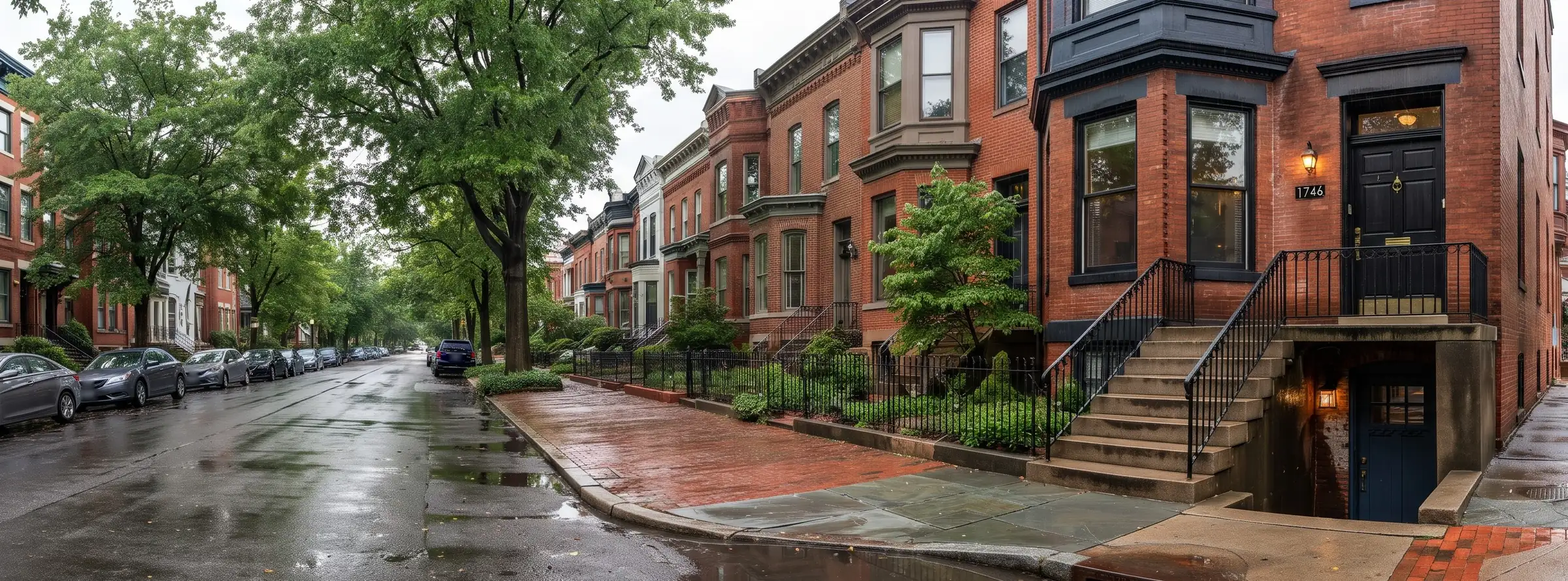

A Washington, DC basement can take on water from a split pipe, a leaking roof or the sewer under the street, and the sewer is the source that turns a wet floor into a Category 3 job. In a city where a block of rowhouses can share one aging combined sewer, a hard rain can send sewage up a floor drain, and the person standing in the basement needs to know what to do, who pays and how much of the room has to come out.
Washington, DC water damage restoration is the extraction of water and the drying and repair of a wet building under ANSI/IICRC S500, with repair contractors licensed by the DC Department of Licensing and Consumer Protection and building permits issued by the Department of Buildings. Most DC homeowners, condo owners and renters never meet that process until a backup or a leak forces it, so the checks that matter are the water's source, the company's paperwork and the claim record built in the first two days.
Key insights
- Typical cost. Washington, DC water damage jobs usually cost $1,600–$7,300, and a Category 3 sewage backup or a flood across several rooms can reach $7,300–$26,000 or more.
- Combined sewers. DC Water says its 19th century sewer system was undersized when built and ties it to decades of chronic flooding in Bloomingdale, LeDroit Park, the Rhode Island Avenue Metro Station area and Mount Olivet Road NE.
- Tunnel odds. The Northeast Boundary Tunnel, in operation since September 15, 2023, cuts the chance of flooding in chronic flood areas from about 50 percent to 7 percent in any given year, according to DC Water.
- Valve rebate. DC Water's backwater valve rebate pays up to $6,000 per property, at 100 percent of the cost, for eligible homes with documented back ups.
- Weather normals. NOAA's 1991–2020 normals for Reagan National Airport show 39.74 inches of precipitation, 9.4 days with 1 inch or more of rain and 10.4 days with a low at or below 20°F.
- Coverage gap. Water that comes up through a floor drain is usually excluded from a standard homeowners policy unless a water backup endorsement was added before the loss.
What DC restoration jobs cost
Most Washington, DC water damage jobs cost $1,600–$7,300, and the average is about $4,000. A sewage backup or a flood across several rooms costs $7,300–$26,000 or more, because Category 3 water adds demolition and disinfection to the drying, while a small clean spill found the same day starts near $400.
 ANSI/IICRC S500 treats sewer water as Category 3, so surfaces are cleaned and disinfected before drying starts, and that labor shows up as its own line on a sewage estimate.
According to the Bureau of Labor Statistics, hourly pay for construction and extraction workers in the Washington metro area ran about 104 percent of the U.S. average in May 2025. The final water damage restoration cost of a DC job moves more with the water category, the stairs a crew has to carry wet carpet and drywall up from a rowhouse basement, and the number of rooms the water reached than with that wage.
| Scenario | Estimates | What drives it |
|---|---|---|
| Minor spot mitigation | $400–$1,600 | A single wet wall section or a clean spill found the same day, with a few days of equipment |
| Supply line burst | $1,000–$3,100 | Clean water that must be dried before it degrades, usually reaching one or two rooms |
| Standard mitigation | $1,600–$4,200 | Extraction and drying across a basement or a floor, with no rebuilding |
| Washing machine or dishwasher overflow | $2,100–$5,200 | Water that spreads under flooring and wicks into cabinet bases |
| Roof leak during a storm | $2,600–$7,300 | Rain that soaks insulation and ceilings below the leak, plus the climb to the roof or attic |
| Mitigation plus basic repairs | $4,200–$7,300 | Drying followed by replacing drywall, baseboard and flooring in the affected rooms |
| Sewage backup | $7,300–$14,500+ | Contaminated water that forces out flooring, pad, drywall and anything porous |
| Sewer or storm flooding across rooms | $10,500–$26,000+ | Flood cuts, subfloor repair and replacement of every porous material the water reached |
Contractors price drying by the square foot of wet floor, so 300 wet square feet cost the same to dry in a 1,200 square foot rowhouse as in a 2,000 square foot house. The cost per square foot climbs with the water category, and rebuilding the same floor costs several times what drying it does.
| 300 sq ft loss | Estimates | Estimates per sq ft |
|---|---|---|
| Dry a Category 1 floor | $975–$1,275 | $3.25–$4.25 |
| Dry a Category 2 floor | $1,275–$2,025 | $4.25–$6.75 |
| Dry a Category 3 floor | $2,175–$2,325+ | $7.25–$7.75+ |
| Rebuild after drying | $6,300–$11,700 | $21–$39 |
Which room got wet moves the bill as much as how much water arrived. Bathrooms dry fast because tile and a small footprint shed water quickly, kitchens add cabinet bases and supply lines, and basements keep releasing moisture from slabs and brick after the standing water is gone. After contaminated water, living room carpet and pad usually go to the dumpster, and tile can often be washed and kept.
| Room | Estimates | What drives it |
|---|---|---|
| Bathroom | $500–$4,700 | Tile and a vanity on a small footprint that dries quickly |
| Laundry room | $1,000–$5,200 | A hose or drain that fails while no one is home and runs into the next room |
| Kitchen | $1,600–$8,300 | Toe kicks, cabinet bases and flooring under the dishwasher and sink lines |
| Basement | $1,600–$10,500+ | Sewer or street water that enters, and masonry that holds moisture for weeks |
| Living or family room | $3,400–$19,500 | The largest floor area in the house, with carpet, pad and furniture to move |
A fair DC estimate names the water category, the hours between the loss and the first extraction, each wet room, and the air movers and dehumidifiers with the days each will run. Equipment is billed per unit per day, which makes the daily moisture readings the proof that every unit earned its charge, and a crew called out at night or on a weekend can raise the labor lines by 25–50 percent.
First 48 hours with sewer water
The first 48 hours come down to five jobs: stop adding water to the drains, keep people out of the wet rooms, document the water line, report the backup and get a crew that handles Category 3 water on site. Water that comes up through a floor drain or toilet is sewage, and ANSI/IICRC S500 puts it in Category 3, so the porous materials it touched are removed instead of dried in place.
 Both the insurer and DC Water's backwater valve rebate rely on documentation, so take a dated photograph of the water line before any water is pumped out.
According to the EPA, wood, drywall, carpet and furniture that stay wet for more than 24 hours can grow mold, which is why extraction that begins on day one saves drywall and framing that a wait until day three would lose. The same guidance says to run a fuel powered generator outside and at least 20 feet from buildings, never inside a home, garage or shed, because its exhaust holds carbon monoxide, a gas with no color or odor.
1. Stop sending water to the drains
Stop flushing toilets and running sinks, showers and washing machines, because a surcharged sewer line sends every added gallon to the lowest drain in the house. If water is still rising at a floor drain, move belongings upstairs and leave the basement to the crew.
2. Close off the wet rooms
Keep people and pets out of the basement, and turn off the breakers for wet rooms only if the panel is dry and reachable without standing in water. Sewer water carries bacteria, so wet shoes and hands should not travel upstairs, and a generator belongs outdoors at least 20 feet from the house.
3. Photograph the line and the drains
Photograph the water line on the walls, the drain or toilet that backed up and every damaged item, and keep the receipts for hotel nights and rented equipment. A line at one height across the room points to water that came up from a drain, while a leak stains from a single point.
4. Report the backup twice
Call DC Water's Water and Sewer Emergency Line at (202) 612-3400 to report the backup, since a documented back up is what its backwater valve rebate asks for, and send the insurer a written notice the same day. Both records should carry the date, the address and the photographs.
5. Book a crew that handles Category 3 water
Call an IICRC certified firm that removes contaminated carpet, pad and wet drywall before drying starts. Waiting for the adjuster gives wet materials more time to grow mold, so the crew should start the same day and keep daily moisture readings.
Standing water that keeps rising is emergency water damage, and a call at midnight is justified because drying that starts within hours keeps more of the cabinets, framing and trim. After the first day, sort belongings into keep and discard, and photograph each discarded item before it leaves the house so the insurer can match the claim to the inventory. Upholstered furniture, mattresses and carpet pad that sat in sewer water are usually discarded, and hard surfaces such as metal shelving and glazed tile can be washed and disinfected.
Why DC basements flood
DC basements flood because large parts of the city drain through a combined sewer, a single pipe system that carries household waste and street runoff together, and a heavy downpour fills it faster than it can empty. When the pipe is full, the water rises to the lowest opening it can find, which in a rowhouse is usually the basement floor drain, toilet or shower.
 DC Water says combined sewers carry household wastewater and street stormwater in the same pipes, which is why the lowest drain in a rowhouse is where a surcharge shows first.
DC Water says the 19th century sewer system was undersized when it was built and that population growth and development made the shortfall worse. It ties that to decades of chronic flooding in the Bloomingdale and LeDroit Park neighborhoods, the Rhode Island Avenue Metro Station area and Mount Olivet Road NE, the same places the tunnel project was designed to relieve.
The federal government built much of the District's sewer infrastructure in the late 1800s and early 1900s, according to DC Water's description of the Northeast Boundary Tunnel. The tunnel was placed in operation on September 15, 2023, and DC Water says it reduces the chance of flooding in chronic flood areas from approximately 50 to 7 percent in any given year.
A 7 percent yearly chance works out to roughly one year in fourteen, so a basement in a chronic flood area can still take on sewer water after a record downpour. The estimate applies to the chronic flood areas the tunnel was built to relieve, which leaves a house elsewhere in the city outside it, and it describes the public sewer only, so a failed supply line, a leaking roof or a clogged drain inside the house is unchanged.
Two storms that filled basements
The two storms with the best documentation of damage to DC basements in recent years were the downpours of September 10, 2020 and August 10, 2022, and both were short and intense. Each filled streets and drains faster than the sewer could carry the water away, and each left owners with Category 3 cleanup.
 Water from a surcharged sewer is Category 3 under ANSI/IICRC S500, and in September 2020 the same overload that sent water out of manholes also pushed it up basement drains.
On September 10, 2020, a downpour overloaded the sewer, and a DC Water spokesperson told WTOP that the system cannot handle that much flow in so little time. The overflow filled the First Street tunnel, which was designed to hold more than 6 million gallons of stormwater, and sewage and runoff came out of manholes and up through basement drains.
In Edgewood, one homeowner reported more than 6 inches of sewage in the basement, with water coming up through the basement toilet and the floor drain, and neighbors on the same block had the same problem. Residents cut out and discarded drywall, carpet and furniture, which is the standard result when Category 3 water reaches porous materials.
On August 10, 2022, storms dropped at least 3 inches of rain in two hours, with more than 2 inches in 20 minutes in places, according to Fox Weather. DC Fire and EMS made water rescues along Rhode Island Avenue NE, floodwater reached about 3 feet on roads near the Catholic University of America, and water entered several businesses. The National Weather Service told residents to stay out of basements and rooms below street level because of rapidly rising water.
Leaks, freezes and water mains
Outside the sewer, DC water damage comes from the same sources as any older city: supply lines and radiators in houses built a century ago, roofs, freezes and a water main break in the street. A normal year at Reagan National Airport brings 60.6 days with a low at or below 32°F and 10.4 days at or below 20°F, according to NOAA.
 Water from a heating or supply line starts as Category 1 under ANSI/IICRC S500, and drying the floor within about 48 hours keeps it from degrading to a higher category.
The airport also averages 39.74 inches of precipitation a year, 9.4 days with 1 inch or more of rain and 15.4 inches of snow. Those counts put a split pipe or a roof leak on the calendar every year, and a freeze that drops the low to 20°F or below tests supply lines in exterior walls and unheated rear additions. The water from a burst frozen pipe often shows up after the thaw, when the ice that plugged the split melts. A supply line and a floor drain can leave the same stain on a basement wall, yet one is dried where it sits and the other drives demolition, so an estimate should state the category before it lists any equipment.
| Water source | Category | Why |
|---|---|---|
| Supply line or radiator line | 1 | Clean at the source, so the materials are dried in place if the crew arrives within roughly 48 hours |
| Frozen pipe that split | 1 | Clean at first, though water that ran inside a wall for days can reach Category 2 |
| Roof leak through insulation | 1 or 2 | Rain soaked insulation and ceiling board typically go, and the framing is dried |
| Street water through a window well | 3 | Runoff picks up soil, fuel and sewage before it reaches the house |
| Sewer backup through a drain | 3 | Contaminated materials are cut out and the area is disinfected before drying begins |
DC Water relief and valve rebates
DC Water's backwater valve rebate pays 100 percent of the cost of buying and installing a valve, up to $6,000 per property, for eligible homes that have documented a sewer back up. A backwater valve sits on the line that connects the building to the public sewer and lets flow go only one way, out, which keeps sewer water from entering during a surcharge or a storm backup.
 DC Water says a working backwater valve lets flow go only one way, out, which keeps sewer water from entering a building during a surcharge. Its rebate pays up to $6,000 per property for eligible homes.
The rebate covers owners in the combined sewer area with a documented back up since 2012, and owners with a documented back up from the July 1, 2012 or September 10, 2020 storms, according to DC Water. Eligibility is decided through DC Water's request form, so a photographed, dated report of the backup is the first thing to have ready.
After the September 2020 storm, DC Water's board approved $1.5 million to help homeowners clean up, with up to $5,000 in emergency cleanup relief for eligible homes on top of the valve rebate. That relief was set up for that storm. DC Water's own sewer backup instructions say cleanup and damage most often fall to the property owner, that the owner maintains the sewer lateral serving the property, and that DC Water generally does not pay for damage from backups. If DC Water finds the main clear, the owner must hire a registered master plumber to clear the lateral at their own expense, and a claim can be filed with DC Water when there is evidence it was responsible.
A valve protects against sewer water coming up the building's drain line. It does nothing for roof leaks, supply line failures or street water entering through a window well, and the installer's license and the rebate paperwork should be checked together before any work starts, since DC Water decides eligibility through its request form.
Drying a wet basement yourself
Drying a wet basement yourself works for clean water from a single source found within a day, such as a supply hose that dripped onto one floor and stopped short of the cabinets, walls and insulation. Sewer water, street water and any water that has sat in walls or under flooring for more than a day belong to a crew, because the contamination and the hidden moisture are out of reach of fans and towels.
The EPA calls flood cleanup hard and risky work and suggests bringing in qualified professionals where possible. It asks that children, pregnant people and anyone with asthma or a weakened immune system stay out of the cleanup, and when hiring is out of reach it says an inspector may help judge when the cleanup can stop.
Safe homeowner jobs include shutting the supply, lifting belongings off wet floors, taking photographs and running a dehumidifier in a room where only clean water reached the floor. A hardware store dehumidifier cannot prove that a wall cavity or subfloor is dry, since only a moisture meter reading set against a dry reference reading does, so a loss that reaches those places needs instruments.
Hiring under DC licensing
A company that repairs and rebuilds after water damage in DC needs a District Home Improvement Contractor license from the Department of Licensing and Consumer Protection, and a drying crew should hold IICRC firm certification. The two credentials cover different work: the license covers permission to repair and rebuild, and the IICRC certificate covers drying and Category 3 training.
 A DC repair contract should carry the Home Improvement Contractor license number, and the drying crew's IICRC certificate is a separate document to ask for before work starts.
DLCP runs a license verification tool, and the check takes a few minutes before any repair contract is signed. The tool shows whether a company's license is active, so a lapsed or missing license turns up before money changes hands. Ask the company for the license number before it sends a crew into the house, since the lookup works from the number and the legal business name and a mismatch between the two is itself a warning sign.
Beyond those two credentials, the ordinary work of choosing a water damage restoration company is a written scope, proof of insurance and a drying log. Each of the seven checks that follow produces a document the owner can keep, from the license lookup to the final drying readings.
1. Look up the license number yourself
Get the DC Home Improvement Contractor license number in writing and confirm it on DLCP's verification tool before the crew starts any repair or rebuild. Drying alone may begin before the repair contract, but the rebuild contract should carry the number.
2. Ask for the IICRC firm certificate
Firm certification is separate from a technician's personal card. A company that handles sewage should show Category 3 training and name the technician who will lead the job.
3. Have the insurer send the insurance certificate
A certificate of insurance should come from the insurer, not the contractor, and should show liability coverage active on the job dates. DLCP also lists a $25,000 surety bond among the requirements for a Home Improvement Contractor license, so ask whether one is on file.
4. Ask who pulls the permit
Ask the contractor in writing which parts of the repair need a Department of Buildings permit, and who applies. Permit numbers belong in the contract.
5. Get the Category 3 scope in writing
The written scope should say what is removed (carpet, pad, drywall to a stated height, baseboard), what is disinfected and what is dried. A lump sum for "water cleanup" gives the carrier room to dispute the claim.
6. Request the daily drying log
The log lists moisture readings by room, the equipment in place and the dry standard each material has to reach. It is the record that ends the equipment charges and supports the claim.
7. Settle billing before the equipment arrives
Ask whether the company bills the insurer directly, how the payment schedule works and whether the 25–50 percent after-hours premium applies to the first night. Pay the final installment only after the log shows every wet material at its dry standard.
Reviews help only when they describe a job like the one at hand. A review of a kitchen supply line leak says little about a sewer backup, so the useful ones mention Category 3 removal, a drying log or a claim that paid. No ranking can say which company is best for every house, and the written scope, the license lookup and the log are the evidence that separate one bid from another.
Dry goals and the drying log
A DC house is dry when the moisture reading in every wet material matches the reading of the same material in an unaffected part of the house, which ANSI/IICRC S500 calls the dry standard. The IICRC S500 standard also sorts jobs by class, from Class 1 for a small area with slow evaporation to Class 4 for dense, deeply saturated materials that need specialty drying.
 ANSI/IICRC S500 sets the dry standard as the reading of the same material in an unaffected area, so the camera finds the cool spots and a moisture meter confirms them against that baseline.
Older DC buildings put many jobs at the slow end. Plaster and lath walls, old growth hardwood floors, brick foundation walls and concrete slabs release water slowly, so a basement can read wet for days after the standing water is gone. A crew should take a baseline reading in a dry room, record readings in each wet room every day and move equipment as the wet area shrinks.
A DC job usually moves through four stages. Day one brings the assessment, the moisture map and extraction of standing water. Days one and two bring the removal of wet carpet, pad and drywall from a Category 3 loss. Equipment then runs for 3–7 days while the daily readings fall, and rebuilding takes 1–3 weeks once the structure is dry, longer when plaster, trim or a permit review is involved.
Air movers push dry air across wet surfaces while dehumidifiers pull the moisture out of the room. The daily readings decide when the equipment leaves, and a crew that pulls it on a fixed day without a reading at the dry standard can leave the owner with a hidden wet wall.
Wet insulation, a damp subfloor or a wall cavity that cannot be read from the surface can hold water long after the visible damage looks dry. A moisture meter and a thermal camera find those spots, which is why a loss that reaches walls or framing needs a crew with instruments.
Policies, endorsements and claims
Standard homeowners insurance coverage pays for sudden water damage, such as a burst pipe or a failed appliance hose, and excludes water that backs up through a drain unless a water backup endorsement was added. Water that rises from outside is flood damage and needs a separate flood policy, and slow seepage over months is usually excluded as a maintenance problem.
 Hotel nights are reimbursed only while the home is unlivable, so keep each receipt with a note of the date and why the rooms could not be used.
Two limits deserve a read before a loss. A water backup endorsement usually carries its own dollar limit, which can be lower than the dwelling limit, and loss of use coverage for hotel nights applies only when the home is unlivable under the policy's terms. A basement apartment or a house with sewage on the main floor can meet that test, so keep every lodging receipt and ask the insurer in writing which limit applies.
| Water source | Usual policy | Notes |
|---|---|---|
| Sudden supply line burst | Homeowners | Covered as sudden and accidental, with the deductible applied |
| Sewer backup through a floor drain | Water backup endorsement | Excluded from the base policy, so the endorsement must be in force before the loss |
| Street water or rising water | Flood policy | A new policy has a waiting period, so it must be in place before the storm |
| Slow leak over months | Usually excluded | Treated as a maintenance failure, not a sudden loss |
| Roof leak after a storm | Homeowners | Covered when the storm caused the opening, and denied when the roof was neglected |
D.C. Code 31-2231.17 sets DC's unfair claim settlement rules. It bars insurers from failing to acknowledge and act reasonably promptly on claim communications, refusing a claim without a reasonable investigation, and failing to give a reasonable and accurate explanation when a claim is denied or compromised. The statute sets no fixed number of days, and it applies to conduct "with such frequency as to indicate a general business practice," so one slow reply is a matter for a complaint to the Department of Insurance, Securities and Banking and a written record.
Adjusters commonly question the number of drying days and the equipment count, so the drying log is the evidence that answers them. Keep every receipt, keep damaged items until the adjuster has seen them if the carrier asks, and photograph the water line before cleanup starts. A written scope that ties each removed material to the Category 3 source also protects a claim against a line by line cut.
When a late dry out becomes mold
A late dry out becomes a mold job when materials stay wet for more than 24 hours, because mold can begin growing on drywall, carpet pad and framing after that point. Sewer water leaves a basement wetter for longer than a leak does, and a damp masonry wall can feed growth for weeks after the standing water is gone. A finished basement adds drywall, carpet and baseboard that trap moisture against the wall, so the crew should open any finished wall that reads wet instead of drying it from the room side and hoping the cavity follows.
Three signs move a job from drying to remediation: visible growth, a musty smell that returns after the equipment leaves and moisture readings that stay above the dry standard. The timeline for mold after water damage depends on how long the materials stayed wet and how humid the room was, and a drying crew does not provide the containment or clearance testing that a mold job needs.
DC licenses mold assessors and remediators through the Department of Energy and Environment once indoor growth reaches 10 square feet, according to DOEE, and an owner can handle smaller areas without a license. The DC mold remediation rules, the written protocol and the post-remediation verification all sit with that separate job, so a water damage contract should not promise mold removal.
Neighborhoods with a flood record
The DC neighborhoods with the clearest flood records are Bloomingdale, LeDroit Park, the Rhode Island Avenue Metro station area and Mount Olivet Road NE, which DC Water names as chronic flood areas, plus Edgewood and the streets near the Catholic University of America, which took water in the 2020 and 2022 storms. An owner can check an address against those areas before deciding how much protection a basement needs.
 ANSI/IICRC S500 puts both street water and sewer backup in Category 3, but the entry point still decides which policy responds, so photograph the water where it came in.
Knowing the pattern lets an inspection start in the right place. A basement near Bloomingdale or LeDroit Park starts with the floor drain and the sewer line, a house near Rhode Island Avenue should be checked for street water at window wells and doors, and an Edgewood house needs a valve decision.
| Area | Risk factor | Notes |
|---|---|---|
| Bloomingdale and LeDroit Park | Undersized combined sewer | DC Water names both among its chronic flood areas, so the floor drain and the sewer line are the first checks |
| Rhode Island Avenue and Metro station | Street flooding and sewer overflow | DC Water lists the station area as chronic, and water rescues took place along Rhode Island Avenue NE in August 2022 |
| Mount Olivet Road NE | Chronic flooding | Named by DC Water as a chronic flood location in 2022 |
| Edgewood | Sewage through basement drains | In September 2020 one basement took more than 6 inches of sewage and neighbors on the block had the same loss |
| Catholic University area | Flash flooding of streets | Roads held about 3 feet of water in August 2022, and floodwater entered several businesses |
Street flooding and sewer backups can arrive together in the same storm. Surface water at doors and window wells is flood damage and falls to a flood policy, and a basement that took water both ways needs photographs that show where each stream entered, at the door, the window well and the drain.
Water that comes up through a drain is a sewage backup and falls to a backup endorsement if the policy has one. Splitting the loss by entry point matters because the two policies pay differently, and an adjuster who sees one blended line of damage can assign the whole loss to the policy that pays less.
Renters, condos and buying
A DC renter who finds sewer water or a leak should notify the landlord in writing the same day, because the landlord owns the building's plumbing and the repair. Renters insurance covers a tenant's belongings and not the building, and sewer backup damage to belongings is typically excluded unless the policy has a backup endorsement. A landlord's repair duty and any rent relief fall under tenant rights, and DC's Office of the Tenant Advocate helps renters file complaints.
In a condo, the split runs between the association's common elements and the unit. Leaks in a shared stack, riser or roof fall to the association and its master policy, while a failure inside the unit's own fixtures belongs to the owner and an HO-6 policy. A licensed crew should document where the water started, because that line decides who pays. When the water came from the unit above, the neighbor's liability coverage may respond to the damage, so the crew's moisture map and the photographs of the ceiling and wall stains become the evidence in that claim as well.
Buyers of a DC rowhouse can ask for the history that matters here: whether the basement ever took sewer water, whether a backwater valve was installed and by whom, any DC Water report or rebate paperwork, and the claims record. A finished basement hides the evidence, so a buyer should look for a floor drain under flooring, new drywall low on the wall and a damp smell in a closed room.
Prevention for DC basements
The best prevention in a combined sewer area is a backwater valve on the building's sewer line, followed by clear drains, stored items kept off the floor and a plan for freezes. These five actions address the sources that fill DC basements, from the sewer under the street to the supply line in the back wall.
 Clearing leaves from window wells and area drains takes minutes and keeps rainwater from pooling against a basement wall during the heavy rain months.
1. Apply for the backwater valve rebate
Ask DC Water whether the property qualifies through its request form, and use a licensed plumber for the installation. The rebate reimburses a documented back up, so the dated photographs come first.
2. Keep drains and window wells clear
Clear leaves from floor drains, window wells and area drains before the heavy rain months, and test the floor drain with a bucket of water. A drain that backs up slowly is a warning to fix before the storm.
3. Lift stored items off the basement floor
Keep boxes, electronics and papers on shelves instead of the floor, so a flooded basement does not take them with it.
4. Redirect roof water away from the house
Clean gutters and extend downspouts so roof runoff leaves the foundation, because storm damage after a hard rain often starts at a clogged downspout. A gutter that spills along a wall soaks the same masonry the sewer fills.
5. Replace aged supply lines before a freeze
Replace braided supply hoses and any corroded lines, and insulate pipes in unheated rear additions before a night at or below 20°F. A burst pipe during a thaw can match the damage from a backup.
Frequently asked questions
How much does water damage restoration cost in Washington, DC?
About $4,000, inside a range of $1,600–$7,300. A sewage backup or flood across several rooms costs $7,300–$26,000 or more, since carpet, pad and wet drywall are cut out and replaced.
Does DC require a license for water damage restoration?
Repairs and rebuilding need a District Home Improvement Contractor license from the Department of Licensing and Consumer Protection. IICRC firm certification is the credential that covers the drying itself, so ask for both numbers before signing.
Does homeowners insurance cover a sewer backup in DC?
Only with a water backup endorsement, in most policies. A standard homeowners policy covers sudden water damage such as a burst pipe, and water that comes up through a floor drain is usually excluded unless that endorsement was added before the loss. A separate flood insurance coverage policy responds to rising outside water.
Does DC Water pay for sewage cleanup?
Generally not, since DC Water says cleanup and damage from sewer backups most often fall to the property owner, though after the September 10, 2020 storm its board approved up to $5,000 in emergency cleanup relief for eligible homes, and its backwater valve rebate pays up to $6,000 per property for documented back ups.
Did the Northeast Boundary Tunnel stop basement flooding?
Not entirely. DC Water says the tunnel, in operation since September 15, 2023, cuts the chance of flooding in chronic flood areas from about 50 percent to 7 percent in any given year, and it does nothing for a failed supply line, a roof leak or a clogged drain inside the house.
Which DC neighborhoods flood the most?
DC Water names Bloomingdale, LeDroit Park, the Rhode Island Metro station area and Mount Olivet Road NE as chronic flood areas. Edgewood basements took sewage in the September 2020 storm, and streets near the Catholic University of America filled in August 2022.
How long does water damage restoration take in DC?
Plan on 3–7 days of drying equipment and 1–3 weeks of rebuilding. Plaster, old hardwood and brick foundation walls dry slowly, and the equipment leaves only after daily readings reach the dry standard.
Can I clean up sewage in my basement myself?
No, sewage water is Category 3 and calls for a crew. The EPA says flood cleanup can be difficult and dangerous work, and carpet, pad and wet drywall that touched sewer water have to be removed and disinfected, not dried in place.
How soon does mold start after water damage in DC?
After about 24 hours when materials stay wet. A basement that still reads damp after the equipment leaves, or a musty smell that returns, points to mold remediation, which is a separate job with its own license threshold at 10 square feet.
How do I apply for the DC Water backwater valve rebate?
Through DC Water's backwater valve request form, which decides eligibility. Have a dated report and photographs of the documented back up ready, and confirm eligibility with DC Water before a plumber installs anything, so the cost qualifies for reimbursement.
What does sewage backup cleanup cost in DC?
$7,300–$14,500 or more. Contaminated flooring, pad and drywall are cut out and disinfected before drying starts, and a backup that reaches several rooms or a finished basement can push the job toward the $10,500–$26,000 flood range.
Should I call my insurer or a restoration company first?
Call the restoration company first when water is still spreading, then notify the insurer the same day. Written notice with photographs opens the claim, and a drying log started before the adjuster visits documents the loss.
- IICRC S500
- EPA: Flood Cleanup to Protect Indoor Air and Your Health
- NOAA NCEI: U.S. Climate Normals, 1991–2020
- DC Water: Northeast Boundary Tunnel Project
- DC Water: Backwater Valve Information and Rebate Program
- DC Water: Know What to do if You Have a Sewer Backup
- WTOP: DC Water offers flood relief for homeowners
- Fox Weather: Feet of water strands cars, businesses during rush hour in nation's capital
- D.C. Code 31-2231.17: Unfair claim settlement practices
- BLS: Occupational Employment and Wages in Washington-Arlington-Alexandria, May 2025
Sam Hickerson is the founder of RestoreAdvisor and writes consumer guides on mold remediation, water damage restoration, inspection, testing, and home recovery. His work focuses on helping homeowners understand costs, risks, and when to call a professional. He draws on guidance from the EPA, CDC, IICRC, and other authoritative sources to make complex home issues easier to navigate.