
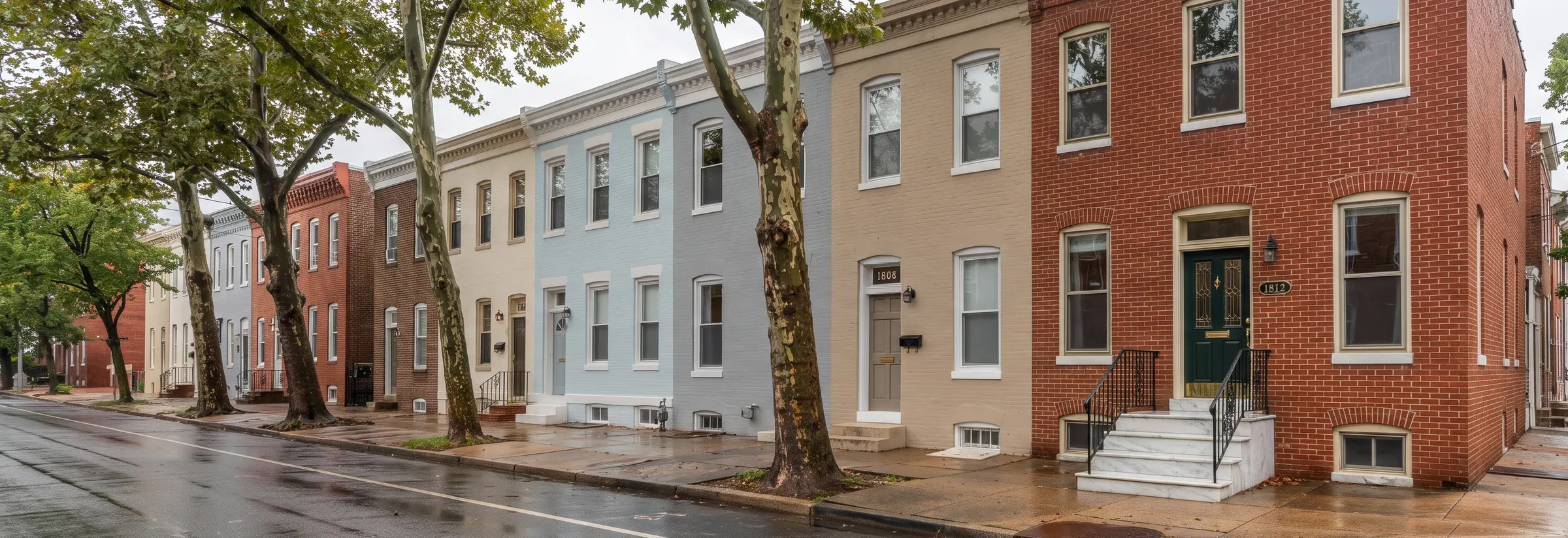

A floor drain that gurgles during a Baltimore thunderstorm and then pushes sewage across the basement leaves an owner asking who pays. On October 28, 2026 the city's Department of Public Works widened its free cleanup program to cover some basement sewage backups that happen in dry weather, but flooring and drywall stay outside the reimbursement program, so the first calls go to the insurer and to a crew for water damage restoration the same day.
Baltimore water damage restoration is the extraction, drying and repair of a home after water intrusion, done to ANSI/IICRC S500, with the Maryland Home Improvement Commission licensing the rebuilding work and the Maryland Insurance Administration regulating how insurers handle the claim. Maryland issues no license for extraction and drying itself, which puts the checks on certification, written scope and drying logs in the owner's hands.
Key insights
- Cost range. A typical Baltimore job costs $1,500–$6,800 and averages about $3,700, a sewage backup costs $6,800–$13,600 or more, and a multi-room flood costs $9,700–$24,500 or more.
- City cleanup. DPW's Sewage Onsite Support program sends a contractor at no cost after qualifying backups in wet or dry weather, and a dry weather backup qualifies only when the blockage is on the city-owned side of the lateral.
- City deadline. A property damage claim against Baltimore City must reach the Law Department in writing within 1 year of the incident, by hand or certified mail, under Courts and Judicial Proceedings 5-304.
- Coverage gap. Maryland Insurance Article 19-202 requires homeowners insurers to offer water backup coverage in writing at application and renewal, and the Maryland Insurance Administration says flood damage needs a separate flood policy.
- License gap. No Maryland license is named for water extraction or drying, and the Maryland Home Improvement Commission says demolition and cleanup alone are not home improvement, while rebuilding is.
- Weather record. NOAA's 1991–2020 normals for BWI show 45.00 inches of precipitation a year, 10.9 days with an inch or more, and 93.2 days at or below 32°F.
The first 48 hours after a backup
In the first 48 hours after sewage or water reaches a Baltimore basement, cut power to the wet area, report a sewage backup to 311 the day it is found, photograph the loss, and call both the insurer and a certified crew. Water that comes up through a floor drain is Category 3 under S500, so nobody should wade in or start hauling out wet materials with bare hands.
 Photographs taken from dry floor, before anything is moved, record the water line and the contents it reached. The 311 request number and those photos are what a claim to the city or the insurer starts from.
DPW says it helps to report a backup to the city as soon as it is discovered, and its inspector decides the cause before the city decides whether a cleanup program applies. For clean water from a failed fixture the sequence is shorter, and an emergency water damage response that starts the same day keeps a wet wall from turning into a rebuild.
1. Cut power and stay out of the water
Turn off the breaker for the basement or the whole house before anyone steps into standing water, and call an electrician if water has reached the panel, an outlet or a cord. The EPA says flood water can bring microorganisms from sewage into a building, and that children and pregnant people should not take part in cleanup.
2. Report it to 311 the day you find it
Call 311, or (443) 263-2220 from outside the city, and report the backup as soon as you find it, then keep the request number. DPW investigates the cause, and its finding decides whether the city's cleanup program applies.
3. Photograph the drain, the waterline and every loss
Record photos and video of the drain, the waterline on the walls, the flooring and each damaged item, with the date and time, and keep receipts for every cleanup expense. The reimbursement program asks for documentation of all cleanup, disinfection and disposal costs, so the same record serves the city and the insurer.
4. Phone the insurer before you pay anyone
Report the loss to the insurer the same day and write down who took the call. A resident whose property is insured against backups must receive the insurer's final determination before the city treats cleanup costs as eligible for reimbursement, so the claim has to start first.
5. Book a certified crew
Choose a firm with an IICRC firm certification that dries to ANSI/IICRC S500 and ask for the water category in writing. A backup that DPW accepts for its cleanup program is cleaned by the city's contractor at no cost, and rebuilding is not among the services the program lists.
When the water is clean
A burst supply line in a rowhouse wall starts as Category 1 water and can degrade to Category 2 within about 48 hours as plaster, lath and subflooring soak it up. Shutting off the main valve, opening the lowest tap to drain the line and calling a crew the same day keeps the loss in the cheaper category, while sewage gets the opposite treatment, with nothing saved and nothing touched until the contamination is assessed.
What an owner can dry alone
An owner can dry a small clean water spill on a hard floor the same day, and anything involving sewage, wet plaster or drywall, or soaked carpet and pad belongs to a crew. The line follows the water category and the material, since surface water on tile or sealed concrete comes up with towels and a fan, while water inside a wall or from a drain does not.
 Water that stayed on the surface of tile or sealed concrete can be dried the same day. If a baseboard or the wall above it still feels damp the next day, the water went somewhere a towel cannot reach and a crew should take readings.
A sewage backup is Category 3 under S500, and in a qualifying case the city's contractor does the cleaning, removal and drying at no cost, so photographs and a 311 report come before anything leaves the house. The EPA says flood cleanup can be difficult and dangerous work, that children and pregnant people should not take part, and that people with asthma or a weakened immune system should stay away from moldy sites.
| Situation | Who does it | Why |
|---|---|---|
| Small clean spill on tile or sealed concrete | Owner | Surface water comes up with towels and a fan, and the material does not absorb it |
| Supply line leak that wet drywall or plaster | Crew | The water sits inside the wall, where only a meter shows how far it went |
| Floor drain backup | City cleanup or a crew | It is Category 3, and a qualifying backup gets a contractor at no cost after the 311 report |
| Carpet and pad wet from a window well | Crew | Rain through a window well is Category 2 or 3, and soaked pad usually has to go |
| Party wall wet from the neighbor's side | Crew, plus the neighbor | Moisture can sit on both sides of a shared wall, and a crew needs readings from each |
A meter makes the call when a surface looks dry. Plaster and lath hold water the eye cannot see, so an owner who dried a wall with fans and still finds a stain, damp smelling air or a cool patch a day later should have a crew take readings before the wall is closed or painted. A wall that is wet from the other side of a party wall may carry water from a neighbor's leak, and the source decides who pays.
Why Baltimore basements back up
Baltimore basements back up because the city's sanitary sewers, more than a century old, surcharge in heavy rain and clog in dry weather, and the water rises to the lowest opening, which is often a basement floor drain. DPW counted 4,648 sewage backups in 2023 and almost as many in 2024, Baltimore Brew reported, a pace that makes a backup a baseline risk of owning a Baltimore basement.
 Heavy rain can overload the sanitary sewer line under the street, and the surcharge pushes water up to the lowest opening in the house. After a downpour, check the basement floor drain first.
Most of those backups happen without a storm. Blue Water Baltimore, summarizing DPW's October 2021 report to the City Council, counted at least 8,860 reported residential backups from 2018 through 2021 that were caused at least partly by conditions in the city-owned pipes, and 78 percent of them occurred in dry weather. Tree roots, grease, wipes and cracked or collapsed pipes cause the dry weather blockages, and a large water main break can push so much fresh water into the sanitary system at once that the effect resembles a wet weather backup.
| Water source | Category | What the crew faces |
|---|---|---|
| Supply line or water heater failure | Category 1 | Clean at first, then drawn into plaster, lath and subfloor, where it worsens with each day |
| Washer or dishwasher drain water | Category 2 | Soapy, lightly contaminated water that travels under flooring and wets the cabinet bases |
| Rain through a window well or foundation wall | Category 2 or 3 | Soil and silt arrive with the water, and wet carpet and pad usually have to go |
| Sewage through a floor drain | Category 3 | It rises at the lowest drain, and every porous material it reaches is bagged before drying starts |
| Main break water pushed into the sanitary sewer | Category 3 | A backup that behaves like a wet weather event, with no rain on the forecast |
Wet weather still matters. The city's reimbursement program defines a capacity related wet weather event as at least half an inch of precipitation in 24 hours that makes the sewer lines surcharge or overflow. NOAA's 1991–2020 normals for BWI show 45.00 inches of precipitation a year, 12.55 inches of it from June through August, with 30.3 days a year at half an inch or more and 10.9 days at an inch or more. Snow counts too, because the Hampden backups of January 27, 2026 followed a heavy snowfall.
Plaster and lath, old growth joists and brick release moisture slowly, so a rowhouse loss can need more drying days than the wet floor area suggests. A cold snap adds a second source, since BWI averages 93.2 days a year at or below 32°F, 20.8 days at or below 20°F and 0.1 days at or below 0°F, enough for a frozen pipe to split a supply line in an exterior wall or an unheated basement.
What a Baltimore job costs
Most Baltimore water damage jobs cost $1,500–$6,800, and the average is about $3,700. A spot caught the same day starts near $300, a sewage backup begins around $6,800, and water that reaches several rooms costs $9,700–$24,500 or more, since the water category and the room count decide how much plaster, carpet and subflooring has to go.
 Equipment on a narrow rowhouse stair moves one machine at a time, so a bid reflects the carry as well as the drying days. Ask the estimator how many machines the job needs and how long they will run.
Baltimore-area construction and extraction workers earned about 97 percent of the U.S. average in May 2025, according to the Bureau of Labor Statistics. A bid for water damage restoration cost in a rowhouse moves with the length of the basement stairs the equipment has to climb, whether plaster or drywall comes off the walls, and an after-hours premium of 25–50 percent for a backup discovered at night.
| Scenario | Estimates | What drives it |
|---|---|---|
| Minor spot mitigation | $300–$1,500 | One damp wall section or a spill caught within hours and dried with a few air movers |
| Supply line burst | $1,000–$2,900 | Clean water in a wall cavity and the next room, dried before it leaves Category 1 |
| Standard mitigation | $1,500–$3,900 | Extraction and drying over a full floor, with no wall or flooring removed |
| Washing machine or dishwasher overflow | $1,900–$4,900 | Soapy water that travels under the flooring and soaks the cabinet bases |
| Roof leak in a storm | $2,400–$6,800 | Soaked attic insulation and ceiling plaster, plus the time spent reaching the roof |
| Mitigation plus basic repairs | $3,900–$6,800 | Drying, then drywall, trim and flooring rebuilt room by room |
| Sewage backup | $6,800–$13,600+ | Category 3 water that came up a floor drain, so every porous material it reached is bagged and hauled out before drying begins |
| Storm flooding across rooms | $9,700–$24,500+ | Every flooded room loses lower wallboard, flooring and trim, and swollen subfloors are repaired |
Drying is billed on the wet floor area alone, so 300 square feet of wet floor costs the same in a 1,500 or a 2,000 square foot home. Category 1 water costs $3.00–$4.00 per square foot to dry and Category 3 costs $6.75–$7.25 or more, while rebuilding after the drying is priced separately at $19–$36 per square foot of damaged area.
| 300 sq ft loss | Estimates | Estimates per sq ft |
|---|---|---|
| Category 1 water | $900–$1,200 | $3.00–$4.00 |
| Category 2 water | $1,200–$1,875 | $4.00–$6.25 |
| Category 3 water | $2,025–$2,175+ | $6.75–$7.25+ |
| Rebuild after drying | $5,700–$10,800 | $19–$36 |
Room prices track what the water reached. A tiled bathroom costs least, a kitchen adds cabinet bases and the floor along the sink, a basement adds a slab and masonry wall bases that keep releasing moisture after extraction and keep the dehumidifiers running, and a living room tops the range with carpet, pad and furniture.
| Room | Estimates | What drives it |
|---|---|---|
| Bathroom | $500–$4,400 | A small tiled floor and a vanity, both quick to dry |
| Laundry room | $1,000–$4,900 | A hose or drain that fails while no one is home and spills into the next room |
| Kitchen | $1,500–$7,800 | Cabinet bases, toe kicks and flooring beside the sink and dishwasher lines |
| Basement | $1,500–$9,700+ | A floor drain backup or a sump failure, then a slab and wall bases that stay damp for weeks |
| Living or family room | $3,200–$18,000 | Wide floor area, with carpet, pad and furniture to move out |
What the city pays for
Baltimore's Department of Public Works pays for cleanup after some basement sewage backups through two programs: a free contractor cleanup called Sewage Onsite Support, and an Expedited Reimbursement Program that repays up to $5,000 per dwelling unit per event. Both require a resident of a City residential account, which includes homeowners and tenants, and a resident gets help from one program for a given backup, not both.
 A city contractor does this work at no cost, but only after DPW's inspection decides the backup qualifies. Photographs of the affected materials taken before anything leaves the house show what was lost.
On October 28, 2026 the city expanded the Sewage Onsite Support program to qualifying backups in dry weather when DPW determines the blockage sits on the city-owned side of the sewer lateral. It previously covered only backups tied to heavy or sustained rain. The program connects residents with contractors who clean and disinfect, remove and dispose of sewage-affected materials, treat odors and dry the area, and DPW asks residents to call 311 even when they are unsure the backup qualifies.
| Program | Covers | Condition |
|---|---|---|
| Sewage Onsite Support | Cleaning, disinfection, removal and disposal of sewage-affected materials, odor removal and drying, at no cost | A wet weather capacity backup, or a dry weather backup with a blockage on the city-owned side of the lateral, as DPW decides after its investigation |
| Expedited Reimbursement | Up to $5,000 per dwelling unit per event for reasonable, documented cleanup, disinfection and disposal costs | At least 0.5 inch of precipitation in 24 hours that surcharges the sewer, an application received within 90 days, and the insurer's final determination first if the property is insured |
The Expedited Reimbursement Program issues a final determination within 60 days of receiving all documentation, and it excludes property damage such as flooring, drywall and belongings. A tenant applying must attach a lease signed by the owner of record, and an applicant must include any insurance deductible paid in the expense records.
Few residents get through the reimbursement route. Baltimore Brew reported that in fiscal 2024 only 39 residents applied to the reimbursement program and 3 were approved, and that residents of two Hampden streets whose backups came days after a January 2026 snowstorm fell outside it. A backup that DPW traces to a private lateral, a root intrusion or grease falls to the owner, and for that loss the insurer and the crew's written scope carry the claim.
Filing a claim against the city
A property damage claim against Baltimore City must be in writing and reach the Law Department within one year of the incident, delivered by hand or sent by certified mail with a return receipt. Regular mail does not count, according to the Law Department, and the claim has to give the date, who was involved, where it happened and a brief explanation.
 Certified mail with a return receipt proves when the Law Department received the claim. Keep a copy of every photograph and page that goes in the envelope.
The rule comes from Courts and Judicial Proceedings 5-304, which bars an action for unliquidated damages against a local government unless written notice stating the time, place and cause of the injury is given within 1 year after the injury. For Baltimore City the notice goes to the City Solicitor, in person or by certified mail with a United States Postal Service postmark.
Claims go to the Department of Law, Central Bureau of Investigation, 100 N. Holliday Street, Suite 101, Baltimore, MD 21202, where an investigator reviews the claim and advises the claimant of the decision. DPW notes that the Law Department makes all determinations of liability for sewage backup claims, that acceptance or denial of a reimbursement application is not a finding of fault, and that a resident can file an application and a claim at the same time without recovering the same cleanup cost twice.
Larger losses are usually property damage: flooring, drywall, a furnace and stored belongings, all excluded from the reimbursement program. The one year clock runs from the incident, so the written notice belongs in the mail within the first weeks. The city does not give legal advice, and an owner facing a five figure loss can talk to an attorney before filing.
What your insurer owes you
A Maryland insurer must offer water backup coverage in writing at application and renewal, and Maryland Insurance Article 19-202 sets that duty. During a claim it must send a written update after each 45 days that an investigation stays open, warn an unrepresented claimant about the statute of limitations, and name the policy provision behind any denial. The Maryland Insurance Administration says most policies with the endorsement pay for the damage a backup does but not for repairing or replacing the pipe or drain.
 The adjuster's report is what the claim is measured against, so point out every affected area on the visit and photograph it yourself. Water backup coverage pays for the damage a backup does, not for repairing the pipe or drain.
A homeowners policy covers sewage that backs up through drains only with that endorsement, and the administration also says homeowners policies generally do not cover flooding, with water seeping through a foundation wall or floor covered by neither a flood policy nor, generally, a homeowners policy. The cause decides the policy: sewage through a drain is a backup claim, a pipe failure is an ordinary water damage claim, and rising surface water is a flood. A basement can see two of the three in one storm, so the written scope should name the route the water took, and homeowners insurance coverage differs by endorsement and limit.
| Rule | Limit | Starts when |
|---|---|---|
| Investigation update | 45 days | The insurer has not finished investigating within 45 days of notification, and it must repeat the written notice after each further 45 days |
| Limitations warning | On receipt | A claimant with no lawyer sends a written claim, and the insurer must tell them in writing that a statute of limitations may bar their rights |
| Denial reason | At denial | The insurer denies on a specific policy provision, condition or exclusion, and it must name which one |
Those duties come from COMAR 31.15.07.04, the Maryland Insurance Administration's rule on prompt investigation of claims. A written claim to the insurer starts the clock on the update notice, so send one with the dated photographs, the 311 request number and the crew's scope, and keep the date it was sent.
Pushing back on a denied claim
A Baltimore owner whose insurer denies or underpays a water claim can ask for the denial in writing, compare the adjuster's estimate with the crew's scope line by line, and file a complaint with the Maryland Insurance Administration. Under COMAR 31.15.07.04 a denial based on a specific policy provision, condition or exclusion has to name it, which turns the dispute into a question about one clause.
Disputes often turn on the route the water took and the length of the dry out. A carrier can point to the exclusion for seepage through a foundation wall, which the Maryland Insurance Administration says neither a flood policy nor, generally, a homeowners policy covers, or it can question how many drying days and machines the job needed, and the daily log and equipment counts answer the second point.
The Maryland Insurance Administration takes complaints at 1-800-492-6116. A public adjuster prepares the documentation and negotiates with the carrier for a fee, which suits a large sewage loss with a dispute over the scope, and dated notes of each call show when the 45 day update clock started.
Maryland licensing for the work
Maryland has no license that names water extraction or drying, and the Maryland Home Improvement Commission licenses the rebuilding that follows. The commission's licensing FAQ says its license covers home improvement services on homes and apartment buildings of three or fewer units, and its FAQ says demolition and cleanup alone are not within the definition of home improvement.
 Cleanup and drying are unlicensed in Maryland, but rebuilding work such as flooring, drywall and painting is not. Ask for the contractor's MHIC license number before signing the rebuild contract.
The license applies once rebuilding starts. The same FAQ lists house painting and installing tile, wood or other flooring as home improvement, so a company that replaces drywall, flooring and trim after drying is working in licensed territory. House Bill 1351 would have added disaster mitigation services, including setting water mitigation equipment, to that definition, and it passed the House 99–37 in 2026, but the General Assembly's bill page shows it waiting in a Senate committee, so drying itself is unlicensed today.
A salesperson who knocks on a door after a storm to sell home improvement work is covered by the Maryland Door-to-Door Sales Act, which gives the buyer until midnight of the fifth business day to cancel, or the seventh if the buyer is 65 or older. An IICRC firm certification shows training in S500 and no Maryland agency issues it, so the credential, the business registration and the MHIC license for rebuilding are three separate checks, and when you choose a restoration company all three belong on the list.
Checking a crew at each stage
A Baltimore owner can screen a water damage crew at three points: the estimate visit, the days the equipment runs, and the day the balance comes due. Each check rests on a document or a log, and a crew that cannot answer on paper has not looked closely enough at the house. Equipment counts, subcontractors and warranty terms add further questions to ask before anyone signs a work authorization.
 Count the machines when the crew sets up and write the number down, since the daily log and the invoice should both match it. A change in the count belongs in a written note to the insurer.
At the estimate visit
Ask which IICRC certificate the firm holds and look for it in the company's name. A credible crew names the water category and the source, lists every wet room, and gives the count of air movers and dehumidifiers and how many days each will run. Walk away from a lump sum with no equipment counts, a request for full payment up front, or a request to sign over the claim.
Ask who bills the insurer and whether the firm bills directly. A crew that bills the carrier should still hand over a written scope and its invoices, because the owner stays responsible for the deductible and for any amount the carrier does not pay. A company that rebuilds as well as dries should give an MHIC license number that matches its name, and one that only dries and demolishes can say plainly that it does no rebuilding.
Once the machines are running
Ask for the daily moisture log. A credible entry records the reading on each wet material, the dry reference reading taken on the same kind of material, and where each machine sits. If the crew removes carpet, pad or plaster, it should say why, tie the removal to the water category and photograph the material before it goes into bags.
Equipment that comes out after a day or two with no readings means the crew stopped drying on its own timeline with no reading to support it. A change in the number of machines should show up in the log and in a written note to the insurer. A sewage job adds one more record, since porous materials removed as Category 3 should be listed by room, which lets the adjuster match each removed item to a line in the estimate.
Before you pay the balance
Hold the balance until the final readings match the dry reference readings and the log is in your hands. The invoice should separate drying from rebuilding, so the insurer and the owner can see which lines belong to the water loss and which to repairs. Keep the final invoice, the log and the written scope together with the photographs from the first day, because a claim reopened months later after a stain returns is argued from those papers.
A company that sends a second crew for the rebuild should name that firm and its MHIC number before the work authorization is signed. A final bill that differs from the written scope needs a written change order, and the log is the paper the adjuster will ask for if the carrier questions the drying days.
Reading the meter at sign-off
Drying is complete when each wet material reads the same as an unaffected sample of that material taken in the same room, the dry standard in ANSI/IICRC S500. That standard gives each material its own target, since a plaster wall and a pine joist do not dry to the same number. Drying equipment typically stays 3–7 days, and the whole job with repairs takes 1–3 weeks.
Rowhouse materials make that comparison matter. Plaster and lath, brick and old joists read differently from drywall, so a reading taken on a party wall means little without a dry reading from a comparable dry section of the same wall. A pin or pad meter reads the surface, and a crew that suspects water behind plaster should take depth readings before trusting the first number.
The log is the record behind that standard. It lists each material's reading beside its reference reading, the machines in each room and any equipment changes, and the scope sets the repair start date once the readings meet. A final walk-through with the meter, comparing each wet area with its reference reading, closes the job.
Baltimore permits for repairs
Baltimore requires a plumbing permit before any plumbing work unless the building code specifically excepts it, and it issues that permit only to a master plumber licensed to do business in the city. The code allows emergency work on a possible health hazard to start before the permit, provided the plumber promptly notifies the city and obtains the permit within a reasonable time.
 Ask the plumber for the permit number before the wall is closed, since a concealed pipe cannot be inspected afterward.
Other repairs follow the Department of Housing and Community Development's list of work exempt from permit for one and two family homes, which includes interior painting, papering, tiling, carpeting, cabinets and counter tops, removal of debris except in demolition, and minor repair or patching of drywall or plaster. Opening and rebuilding walls beyond a patch is not on that list, so a homeowner who is unsure should ask the department before a crew cuts in, since a concealed pipe cannot be inspected once the wall is closed.
| Problem | Who to call | Contact |
|---|---|---|
| Sewage backup in a city home | Baltimore 311 | 311, or (443) 263-2220 outside the city |
| Reimbursement application | DPW Bureau of Water and Wastewater | 410-396-3500 |
| Property damage claim against the city | Law Department, Central Bureau of Investigation | 100 N. Holliday Street, Suite 101 |
| Dispute with an insurer | Maryland Insurance Administration | 1-800-492-6116 |
When mold follows a wet basement
A water loss turns into a mold job when materials stay wet for more than 24 hours, the EPA says, because mold can grow on wood, drywall, carpet and furniture that remain wet that long. A basement left wet through a weekend away is the likeliest to pass that point, and a crew that starts drying inside the window usually prevents it.
Damp readings after the crew leaves, a returning musty smell or a spreading stain mean drying stopped early, and a mold assessment is the next step. Confirmed mold after water damage becomes a separate job with its own containment, removal and clearance test, and the remediator will want the drying readings to date the moisture. The EPA adds that people with asthma or a weakened immune system should stay out of moldy sites and cleanup.
Category 3 water ends the drying option for porous material: carpet, pad and wet drywall it touched come out of the house, and the city's cleanup program lists removal and disposal of sewage-affected materials among its services. That removal also shortens the mold clock, since the materials most likely to grow mold leave the house in the first days, and a crew should log what was removed and when so a later mold assessment starts from a record.
Where Baltimore backups concentrate
Baltimore's 311 line logged 6,524 requests for sewer water in a basement in 2023, 6,035 in 2024 and 4,814 in 2025, according to Open Baltimore's 311 records, and Belair-Edison, Frankford and Glen sent the most. Through November 12, 2026 the count stood at 4,927, already above all of 2025.
 Several houses on one block can have backups at the same time, but each one needs its own 311 report and its own request number.
Those figures count calls for service, and DPW's own count of backups for 2023 was 4,648, so the counts rank where residents call most. A backup that never reached 311 leaves no record. Water that enters through a window well or a foundation wall instead of a drain is flood water damage and Category 2 or 3, which makes it a different claim from a sewage backup, with different coverage and a different crew scope.
| Area | Risk factor | Homeowner note |
|---|---|---|
| Belair-Edison | 557 requests in 2023–2025, the most of any neighborhood | Requests fell from 220 in 2023 to 192 in 2024 and 145 in 2025, and stood at 166 by November 12, 2026 |
| Frankford | 394 requests in 2023–2025 | 150 in 2023, 134 in 2024 and 110 in 2025, with 105 so far in 2026 |
| Glen | 326 requests in 2023–2025 | A peak of 139 in 2024, then 75 in 2025, with 89 so far in 2026 |
| Coldstream Homestead Montebello | 272 requests in 2023–2025 | 107 in 2024 and 68 in 2025, with 58 so far in 2026 |
| Howard Park | 269 requests in 2023–2025 | 106 in 2023 falling to 74 in 2025, with 60 so far in 2026 |
| Hampden | 174 requests in 2023–2025, plus the backups of January 27 and early February 2026 on Elm and Union avenues | Eight sets of homeowners represented by an attorney documented $120,000 in damage, and backups days after the snow fell did not fit the old wet weather rule |
| Canton | 167 requests in 2023–2025 | 63, 51 and 53 in the three years, with 65 so far in 2026 |
| Brooklyn | 141 requests in 2023–2025 | 49, 51 and 41 in the three years, with 40 so far in 2026 |
A neighborhood's count does not say which side of the lateral failed. DPW decides that after its investigation, which is why every backup belongs in a 311 report even on a block with many requests, and why the request number goes into the claim file next to the photographs and the crew's scope.
When you rent, share a wall or buy
A tenant, a neighbor on a shared wall and a buyer each have a different first move after sewage or water reaches a Baltimore rowhouse: written notice to the landlord, written notice to the neighbor and the insurer, and a request for the loss history. A tenant can send the landlord notice by certified mail, and Maryland's rent escrow law, Real Property 8-211, lists a lack of adequate sewage disposal facilities among the conditions a landlord must repair. The law presumes that a repair period longer than 30 days after notice is unreasonable, and a tenant who uses rent escrow must pay the rent into court.
A tenant's first steps are that letter, a 311 report and photographs of personal belongings, because renters rights after a leak depend on proof that the landlord was told. Tenants are also eligible for the city's cleanup program, and one applying for reimbursement must attach a lease signed by the owner of record. Renters insurance covers the tenant's belongings, and the structure falls to the landlord, so the tenant documents personal property for that claim.
A rowhouse shares walls on both sides, so water from a neighbor's pipe, roof or drain can reach a party wall from the other house. Photograph the wall on your side, write to the neighbor and to the insurer on the same day, and ask the crew to log readings on that wall separately, because the reading on your side is the evidence of what reached your house. The cause of that water decides who pays.
In a condominium, the declaration and the association's master policy set the line between the owner's coverage and the association's, so a claim starts by reading both. A buyer of a rowhouse can ask the seller for prior claims, drying logs and any 311 backup request numbers. Maryland Real Property 10-702 requires a seller of a single family home with four or fewer units to give a buyer either a property condition disclosure statement or a disclaimer statement on a Real Estate Commission form.
Protecting a basement from the sewer
Preventing a Baltimore sewage backup starts with a backwater valve and a clear lateral, and protecting against the cost starts with water backup coverage and a habit of reporting every backup to 311. A basement with a sump pit adds a pump to the list, and an exterior wall adds a freeze risk.
 Installing a backwater valve is plumbing work, so in Baltimore it needs a permit and a master plumber. Keep the access cap reachable so the valve can be checked.
A backup that happens on a dry day is easy to dismiss as a household clog, yet DPW decides the cause after an inspection, and the city's cleanup help starts from that finding. Reporting each backup to 311 the day it happens, and keeping the request number, preserves the record that the city programs, the insurer and a later claim against the city all rely on.
| Action | When | Why it works |
|---|---|---|
| Fit a backwater valve | Once, by a licensed plumber | It closes when flow reverses in the lateral, which stops a surcharge from the city main from reaching floor drains below the street |
| Keep grease, wipes and roots out of the lateral | Ongoing, with a camera inspection when drains slow | Roots, grease and wipes are named causes of dry weather blockages |
| Add water backup coverage | At renewal | Maryland Insurance Article 19-202 requires the insurer to offer it in writing, and most policies pay for the damage but not the pipe |
| Report every backup to 311 | The day it happens | DPW counts backups from reports, and its cleanup program starts with an inspector's finding |
| Insulate supply lines in exterior walls | Before the first hard freeze | BWI averages 93.2 days a year at or below 32°F |
A sump pump failure in a storm fills the pit and then the floor, so the pump, the outlet of the discharge pipe and the power supply are the first checks, and a battery backup carries the pump through a power cut. Filling the pit with a bucket of water ahead of spring storms shows whether the float switch starts the pump.
Warm air from a hair dryer can thaw a line that froze without splitting, and an open flame should never be used, while a frozen pipe that has split is a plumber's job. The main shutoff should be easy to reach, since closing it is the first move in any supply line loss.
Frequently asked questions
How much does water damage restoration cost in Baltimore?
Most jobs cost $1,500–$6,800, and the average is about $3,700. A sewage backup costs $6,800–$13,600 or more because the porous materials the water touched are bagged out, and flooding across several rooms costs $9,700–$24,500 or more. Drying runs $3.00–$4.00 per square foot for Category 1 water and $6.75–$7.25 or more for Category 3.
Does Baltimore pay for sewage backup cleanup?
Sometimes. The Sewage Onsite Support program sends a contractor at no cost after qualifying backups in wet weather, and since October 28, 2026 also after dry weather backups caused by a blockage on the city-owned side of the sewer lateral. DPW investigates after a 311 report and decides eligibility, and a resident gets help from this program or the reimbursement program for the same backup, not both.
How long do I have to file a claim against Baltimore City?
One year. Courts and Judicial Proceedings 5-304 requires written notice within 1 year after the injury, and the Baltimore City Law Department says it must receive the claim within one year of the incident, delivered by hand or sent by certified mail.
Does homeowners insurance cover sewer backup in Maryland?
Yes, with a water backup endorsement added to the policy, which Maryland Insurance Article 19-202 requires insurers to offer in writing at application and renewal. The Maryland Insurance Administration says most policies with it pay for the damage the backup does but not for repairing the pipe or drain.
Does flood insurance cover water that seeps into a Baltimore basement?
No, not when water seeps through a foundation wall or floor without a flood. The Maryland Insurance Administration says a flood policy will not cover that damage, and a homeowners policy generally will not either, so the cause of the water decides which policy answers. A true flood, defined by the National Flood Insurance Program as inundation of two or more acres of normally dry land or of two or more properties, falls under separate flood insurance coverage.
Does Maryland require a license for water damage restoration?
No license is named for water extraction or drying. The Maryland Home Improvement Commission licenses home improvement work such as rebuilding walls and floors, and its FAQ says demolition and cleanup alone are not within the definition of home improvement.
Can I hire my own crew and still get reimbursed by the city?
Yes, through the reimbursement program only. The Expedited Reimbursement Program repays up to $5,000 per dwelling unit for documented cleanup, disinfection and disposal costs after a capacity related wet weather backup, and an applicant with backup coverage needs the insurer's final determination first.
What can I do if my insurer denies a Baltimore water claim?
Ask for the denial in writing. Under COMAR 31.15.07.04 an insurer that denies a claim on a specific policy provision, condition or exclusion must tell you which one, and you can file a complaint with the Maryland Insurance Administration. A public adjuster can prepare the documentation for a fee.
Do I need a permit to repair water damage in Baltimore?
Minor drywall or plaster patching does not, but plumbing work does. The city's list of work exempt from permit names minor repair or patching of drywall or plaster, interior painting, tiling, carpeting and cabinets, while the plumbing code requires a permit before plumbing work unless an exception applies, issued to a master plumber licensed in Baltimore.
Can mold grow after a sewage backup in a Baltimore basement?
Yes, when porous materials stay wet for more than 24 hours, the EPA says. Removing sewage-affected carpet, pad and drywall in the first days shortens that window, and confirmed mold after water damage is a separate job with its own containment, removal and clearance test.
How long does water damage restoration take in Baltimore?
Drying equipment typically stays 3–7 days, and the whole job with repairs takes 1–3 weeks. A rowhouse basement with plaster or brick walls can take longer because those materials give up moisture slowly.
- IICRC S500
- EPA: Flood Cleanup to Protect Indoor Air and Your Health
- NOAA NCEI: 1991–2020 U.S. Climate Normals for BWI
- BLS: Occupational Employment and Wages in Baltimore, May 2025
- Baltimore DPW: Sewage Onsite Support Cleanup Program
- Baltimore DPW: Expedited Reimbursement Program for Sewage Backups
- Maryland Annotated Code: Courts and Judicial Proceedings 5-304
- COMAR 31.15.07.04: Standards for Prompt Investigation of Claims
- Maryland Insurance Administration: Flood damage vs water damage
- Maryland Home Improvement Commission: Do You Need a License to Do That?
Sam Hickerson is the founder of RestoreAdvisor and writes consumer guides on mold remediation, water damage restoration, inspection, testing, and home recovery. His work focuses on helping homeowners understand costs, risks, and when to call a professional. He draws on guidance from the EPA, CDC, IICRC, and other authoritative sources to make complex home issues easier to navigate.