
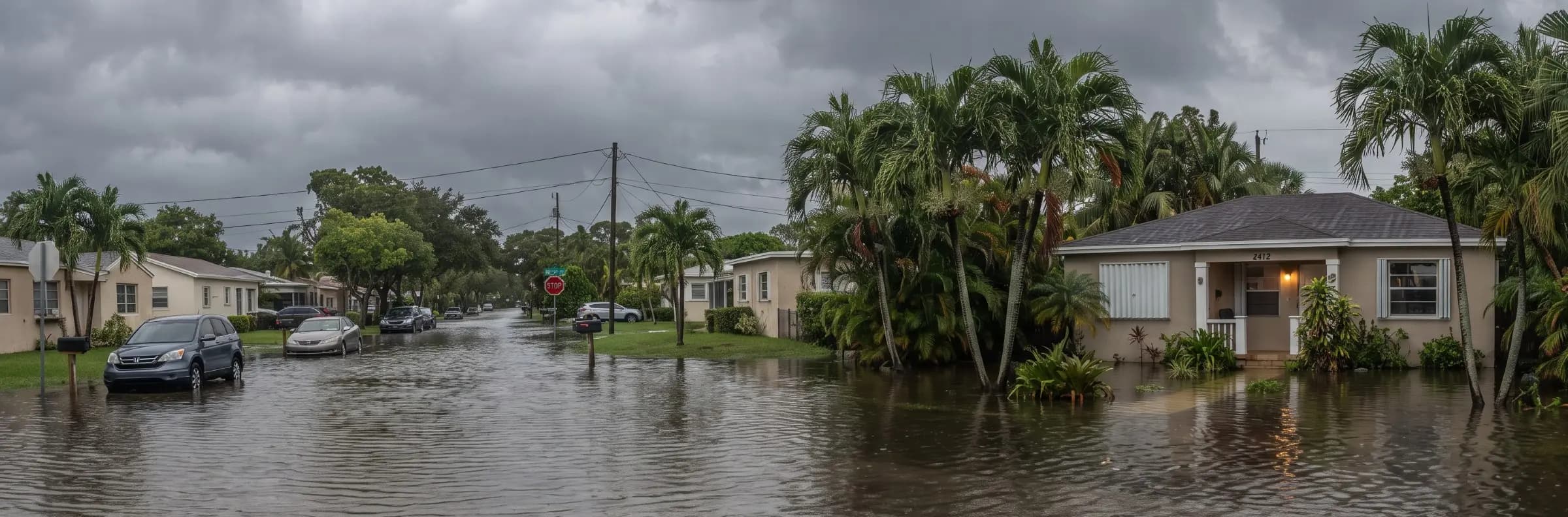

A Fort Lauderdale home that has just taken on water is racing a clock the local drainage makes harder to beat. The city's stormwater system is designed for about 3 to 3.5 inches of rain in a day, and on April 12, 2023 the airport gauge recorded 25.91 inches in 24 hours. Starting to dry within the first day is the most reliable way to keep the bill near the low end of the local range. Florida's one year claim deadline and the city's permit rules after a flood both start running before most homeowners have made a first call.
In Fort Lauderdale, water damage restoration is the extraction of water, drying of structural materials, cleaning, and rebuilding of a damaged home to the ANSI/IICRC S500 standard, and the Florida Department of Business and Professional Regulation (DBPR) licenses the rebuild trades but not extraction and drying. That gap makes IICRC credentials and a written drying scope the main screen for any company you consider.
Key insights
- Typical cost. Water damage restoration in Fort Lauderdale typically costs $1,300–$6,200, and Category 3 canal, street, or sewage water across several rooms runs $8,900–$22,500 or more.
- Drainage limit. The city's stormwater system is designed for about 3 to 3.5 inches of rain in 24 hours, so the 25.91 inches of April 2023 and the 9.5 inches of June 2024 put water in homes that had never flooded.
- Fifty percent rule. After the April 2023 flood the city sent substantial damage determination notices, and repairs that reach 50 percent of a building's market value must bring it up to current floodplain standards.
- Permit exemption. Under Florida House Bill 803, the city can exempt cosmetic repairs under $7,500, such as drywall repair and flooring replacement, from a building permit, but the building official decides each request.
- One year to report. Florida Statute 627.70132 bars a new or reopened property claim unless the insurer receives notice within 1 year of the loss, and a supplemental claim within 18 months.
- Flood needs its own policy. Standard homeowners policies exclude flood, and FEMA's July 2023 tally for the April 2023 disaster showed $171.5 million approved through the National Flood Insurance Program against $34.1 million in individual assistance grants.
Cost of a Fort Lauderdale water loss
Most Fort Lauderdale water damage jobs cost $1,300–$6,200, and the average lands near $3,400. The final cost of water damage restoration depends on the water category, the number of rooms the water reached, how soon drying began, and whether the loss needs separate rebuild trades such as plumbing, roofing, or electrical.
 Wet drywall and insulation are cut out above the visible waterline, and that removal moves a job from drying into rebuild pricing. Ask for the cut height and square footage in writing, since both set the estimate.
These ranges start from national restoration pricing and are adjusted for local labor costs. The Bureau of Labor Statistics reports that construction pay in the metro area that includes Fort Lauderdale ran about 89 percent of the U.S. average in May 2025, and each range reflects that ratio.
| Scenario | Estimates | Local cost drivers |
|---|---|---|
| Minor spot mitigation caught within a day | $300–$1,300 | Clean water on tile over a slab dries quickly, while wet baseboards and cabinet toe kicks add labor |
| Burst supply line in one room | $900–$2,700 | Extraction and equipment in a closed, air conditioned room, plus a moisture check of block and stucco walls |
| Standard mitigation, one room, 3–5 drying days | $1,300–$3,600 | Extraction, equipment billed per day, and removal of wet padding or baseboard |
| Washer or dishwasher overflow | $1,800–$4,500 | Water travels under cabinets and across tile before a stain appears |
| Roof leak during a storm | $2,200–$6,200 | Wet attic insulation and ceilings, with the roofer billing separately |
| Mitigation plus basic repairs | $3,600–$6,200 | Drywall, paint, and flooring replacement after drying is confirmed |
| Sewage backup | $6,200–$12,500+ | Antimicrobial treatment, respirators and suits for the crew, and tear out of anything the sewage soaked |
| Storm or canal flooding across several rooms, or extensive structural repair | $8,900–$22,500+ | Flood cuts, flooring, drywall, contents, and rebuild trades that each need a permit |
Contractors quote mitigation by the square foot at about $2.75–$6.75 and rebuilding at about $18–$33. Category 1 water runs $2.75–$3.50 a square foot, Category 2 runs $3.50–$5.75, and Category 3 runs $6.25–$6.75 or more.
| Part of the home | Estimates | Local reason |
|---|---|---|
| Bathroom | $400–$4,000 | Toilet and supply line failures, with tile over a slab limiting how far water spreads |
| Laundry room | $900–$4,500 | Washer hose failures, often beside a garage wall that wicks water upward |
| Kitchen | $1,300–$7,100 | Dishwasher and refrigerator lines, with cabinet bases billed as rebuild work |
| Living or family room | $2,900–$16,500 | The largest floor area, plus block walls that release moisture slowly |
| Sunken or below grade room | $1,300–$8,900+ | Uncommon here because of the high water table, but these rooms fill first and dry last |
Equipment is billed per unit for each day it runs, and moisture mapping often appears as its own line, so a written estimate should list unit counts and drying days. The scenario totals above already include both.
After a named storm or a regional flood, crews and dehumidifiers run short across Broward at once, and the same job starts later and costs more. Expect prices above these ranges until demand settles.
First two days after water gets in
In the first 48 hours, stop the water, make the circuit safe, document the loss, start drying, and report the claim. The EPA warns that mold can begin growing on wet materials within 24–48 hours, and Fort Lauderdale's humid air leaves little room to wait for an adjuster.
 Dated photos with a tape measure for scale show an adjuster how far the water reached before anything is moved. Keep the original files, since the insurer will compare them with the drying log.
First 15 minutes
Shut the valve feeding the failed pipe or appliance, or the main shutoff, and switch off power at the breaker only if the panel is dry and reachable without stepping through water. If water is rising from outside or sewage is involved, treat it as an emergency water damage restoration situation and stay out until an electrician clears the circuit.
First hour
Photograph the source, the waterline on the walls, and each damaged item, then email the insurer a short notice with the date, the source, and the photos attached. Florida starts its 7 day acknowledgment clock when the insurer receives your message, so a sent email gives you a dated record.
By hour 24
Remove standing water, keep the affected area moving with air, and run air conditioning and dehumidifiers with doors and windows shut, because Fort Lauderdale's outdoor air is often wetter than the air inside a drying room. Call an IICRC Certified Firm now instead of waiting for the adjuster to schedule a visit.
Hours 24 to 48
Cut out wet carpet padding, insulation, and drywall that cannot dry in place, and bag the debris after photographing it. Keep a small sample of any flooring for the adjuster, and ask the city whether the repairs could count as substantial damage before ordering a rebuild.
Why water collects in Fort Lauderdale
Water collects in Fort Lauderdale because the city is flat, drains through 165 miles of canals and waterways that once served as its gravity drainage, and sits over a high groundwater table. When canal levels are high, storm drains cannot empty, so rain, tides, and groundwater reach a home at the same time.
 Canal water that crosses a seawall is flood water, which a standard homeowners policy excludes and a flood policy may cover. Broward County lists August through December as the months when higher tides are more likely.
On April 12, 2023, the airport recorded 25.91 inches of rain in 24 hours, a Florida record that Broward County says equaled about a third of the city's average annual rainfall in an eight hour window. The National Weather Service logged 18.16 inches in Hollywood, 17.30 inches in Dania Beach, and 15.06 inches in Plantation the same night, so the flooding reached across southern Broward and not one neighborhood.
The June 12, 2024 storm tested the system again. The National Weather Service recorded 9.5 inches in Fort Lauderdale, the most ever for a June day, from a forecast that called for 2 to 2.5 inches, and heavy rain had also arrived during the king tides of November 2023, when canal levels were already high.
The city's recovery action plan classes the April 2023 rainfall as a 1 in 1,000 year event, counts more than 1,100 damaged homes, and records 11,241 households that registered for FEMA assistance. Those counts show how widely the water spread beyond the low lying streets people expect to flood.
Canals, tides, and groundwater
Broward County lists August through December as the months when higher tides are more likely. In those months a canal that is already full has little room to take storm drain outflow, and tide water can come up through drains and over low seawalls into yards.
Rain that falls on top of a high tide has nowhere to go, and the high water table keeps slabs and the bottoms of block walls damp for days afterward. With water damage from flooding, the first step is identifying which of those sources supplied the water, since each one changes the category and the claim.
Pipes, drains, and air handlers
Not every Fort Lauderdale loss starts outdoors. Homes on concrete slabs hide supply and drain lines under the floor, so a slab leak can run for weeks before a warm spot on the tile or a rising water bill gives it away.
Water from a slab leak travels sideways under the flooring before it shows, and tile hides it longer than carpet does. A plumber has to locate and isolate the line before drying can finish.
Cooling runs most of the year, which makes a clogged condensate line, cracked drain pan, or stuck float switch a leading source of water that has nothing to do with storms. The overflow soaks insulation and drywall below an attic or closet air handler, and the damage often stays hidden until a ceiling stain appears.
Local water sources by S500 category
The ANSI/IICRC S500 standard rates water by contamination category, 1 to 3, and by drying class, 1 to 4, and in Fort Lauderdale the category usually follows the source. The category decides which materials can be dried and which must be removed.
| Water source | Category | What it means here |
|---|---|---|
| Supply line or water heater failure | 1, can degrade to 2 | Clean at first, but warm indoor air speeds degradation when wet materials sit for days |
| Air handler condensate overflow | 1 to 2 | Water in a pan or soaked insulation picks up growth, and these leaks often run for weeks before discovery |
| Rain through a wind made roof opening | 1 to 2 | Wets attic insulation and ceilings before a stain shows, and drying depends on how long it sat |
| Canal, tide, or street flood water | 3 | Carries contamination from the waterway or street, so porous materials are removed and not dried |
| Sewer lateral or main backup | 3 | Contains sewage from the first minute and calls for disinfection and protective equipment |
| Leaking cast iron drain line | 2 to 3 | Corrodes from the inside, and a leak under a slab can wet the subfloor with contaminated water |
Concrete block walls and slab floors, common in South Florida homes, are dense materials that release water slowly. A loss in them can behave like a Class 4 job even when the wet area is small, with specialty drying and more equipment days than a wood framed room of the same size.
When a city sewer main fails
Sewage can enter a Fort Lauderdale home from a failed city main as well as from the home's own lateral, and that difference decides who repairs the line and who is billed. In December 2019 six sewer main breaks released about 126.9 million gallons of sewage, most of it in Rio Vista, and the city later approved $65 million to replace a seven mile stretch of aging main.
Treat water from either source as a sewage backup, which is Category 3 from the first minute. Ask a plumber to scope the line and document whether the failure is in the public main or your own lateral before cleanup begins, and photograph the backup and the fixtures it reached.
Neighborhood risk across Broward
Fort Lauderdale water risk follows elevation, runoff paths, and distance to the canals more than ZIP code, and the neighborhoods that flooded in 2023 were largely the ones the city had already flagged for drainage work. The city's five year, $200 million drainage plan targets seven areas, including Edgewood, River Oaks, Dorsey-Riverbend, Durrs, Progresso, Victoria Park, and Southeast Isles.
 A drain blocked by palm debris and silt cannot take runoff, which is how an ordinary rain floods a yard. Report the location and time to the city before the next storm.
Check your exact address before the next storm season, because a house a block from the canal and one a block from a drain outfall can face different sources. Each area tends to face a different source, so where to look first after a loss depends on the address.
| Neighborhoods | Main water risk | Check first |
|---|---|---|
| Edgewood and River Oaks | A low basin that fills when the drains behind it back up, and among the hardest hit in April 2023 | Whether wall cavities repaired since 2023 were fully dried before they were closed |
| Melrose Park and Melrose Manors | Street flooding in heavy rain, and culverts clogged with sediment after Tropical Storm Eta in 2020 | Floor drains in the garage and laundry, and the lowest door threshold |
| Victoria Park and Southeast Isles | Tide water and street flooding, both on the city's drainage list | Ground floor flooring near doorways and the driveway drain |
| Rio Vista and Cordova Road | The December 2019 sewage main breaks and canal side street flooding | Sewer cleanouts, floor drains, and lower walls |
| Sailboat Bend and Las Olas | Floodwater surrounded homes on Las Olas Boulevard in April 2023 | Lower walls and areas under cabinets |
| Dorsey-Riverbend, Durrs, and Progresso | On the city's list of flood prone areas | Slab level walls and electrical outlets |
| Coral Ridge and Harbor Beach | Cast iron sewer main breaks in December 2019 and early 2020 | Drains and sewer cleanouts |
| Downtown and beach high rises | Shared risers, roofs, and exterior wall seals, with downtown streets flooded in 2023 | Ceiling stains, shared walls, and garage levels |
Hollywood, Dania Beach, Plantation, Davie, Wilton Manors, and Oakland Park each run their own permit and floodplain offices, so the rules change at the city line even when the storm did not. Check the right city or county office before you plan repairs.
Signs of hidden water damage
Hidden water damage in Fort Lauderdale usually shows up as a change in a surface, a smell, or a bill before anyone sees water. Warm, humid air and concrete slab floors let a slab leak run for days or weeks without a puddle, so small signs are worth acting on within 24–48 hours, before mold can start.
Most hidden leaks trace back to a slab line, an air handler, a roof opening, or a sewer lateral, and the quickest way to tell them apart is where the sign appears. Check the room, then the wall or floor around it, and photograph what you find before anything is opened up.
| Sign | Likely cause | Where to look |
|---|---|---|
| Warm spot on tile or a high water bill | Slab leak on a hot water line | Near the water heater and the kitchen and bathroom plumbing runs |
| Brown stain or sag on a ceiling | Air handler overflow or a storm roof leak | Below the attic or closet air handler and under roof openings |
| Swollen baseboards or bubbling paint low on a wall | Moisture wicking up from a slab or block wall | Exterior walls, behind cabinets, and wall corners at floor level |
| Musty smell with no visible water | Wet insulation, carpet pad, or a wall cavity | Closets, under sinks, and rooms below an upstairs bathroom |
| Cupped, buckled, or gapped flooring | Moisture from below or a long running leak | Along walls and under appliances |
| Sewer smell or gurgling drains | Lateral blockage or a city main backing up | Lowest floor drains, tubs, and toilets |
When DIY is enough
A homeowner can handle clean water on a hard surface that is dried within 24 hours, and nearly everything else belongs to a professional. The test is whether the water reached drywall, insulation, a wood subfloor, ducts, or electrical, or came from a canal, street, or sewer.
 This works only for Category 1 water that has not reached drywall or cabinet bases, so check the lower wall with a moisture meter before calling it done. Clean water left to sit for days can degrade toward Category 2.
A moisture meter reading before furniture goes back confirms what touch cannot, since a surface can feel dry while a wall cavity stays wet. Water that rose from outside the home or from a sewer line should go straight to a certified firm.
| Situation | DIY or pro? | Why |
|---|---|---|
| Clean spill on tile or sealed concrete, dried the same day | DIY | Towels, fans, and a dehumidifier clear surface water before it soaks into anything porous |
| Condensate pan overflow found the same day | DIY | Clear the drain line and dry the floor, then call a pro if the insulation or ceiling below is damp |
| Dampness inside a wall, under flooring, or in insulation | Pro | Cavities and subfloors hold moisture long after the surface looks fine |
| Tide, canal, or street water inside the home | Pro | Category 3 water carries contamination and requires removal of porous materials |
| Sewage from a lateral or city main | Pro | Disinfection and protective equipment are part of the job from the first minute |
| Water near outlets, panels, or ceiling fixtures | Pro | Cut the breaker first and have an electrician clear the circuit before anyone steps in |
What to save and what to toss
Under the ANSI/IICRC S500 standard, what you can keep after a Fort Lauderdale water loss depends on the water category and on how long the item stayed wet. Clean water that is dried within about 48 hours saves far more than the same water left to sit, and canal, street, or sewage water changes the answer for anything porous.
Sort belongings into keep, clean, and discard piles before the crew starts demolition, and photograph each item with a list of what it was. The adjuster values contents from that record, so a discarded sofa without a photo is hard to claim.
| Item | Clean water | Flood or sewage |
|---|---|---|
| Glass, metal, and hard plastic | Wash and dry | Clean and disinfect, then keep |
| Solid wood furniture | Dry and keep | Clean and disinfect if the finish holds, then keep |
| Upholstery and mattresses | Dry quickly or replace | Discard |
| Carpet and pad | Dry in place or replace the pad | Discard |
| Drywall and insulation | Dry or replace | Remove and replace |
| Clothing and linens | Launder | Launder hot or discard |
| Books, photos, and papers | Freeze, then dry | Discard unless irreplaceable |
Licensing for water damage work
Florida does not license water extraction and drying as a separate trade, but the DBPR licenses the contractors who rebuild the structure and the plumbing, electrical, roofing, and air conditioning trades that often follow a loss. Mold work falls under 2 separate DBPR licenses, one for assessors and one for remediators.
In October 2024 Florida's Third District Court of Appeal held in Incident365 v. Ocean Pointe that water mitigation and dehumidification need no building contractor's license, though structural removal such as tearing out drywall may. Broward sits in the Fourth District, so the ruling is persuasive but not binding there, and the Florida licensing rules for water damage work still apply to demolition, rebuilding, and every licensed trade. A drying company can be legitimate without a contractor license, while the firm that replaces drywall, wiring, or a roof must hold the matching one.
Vetting a company before you sign
Vet a Fort Lauderdale water damage company in three passes: the first call, the first visit, and the final invoice. Before signing, confirm the company's IICRC Certified Firm status, a DBPR license for every rebuild trade it will use, and a written scope, and compare at least 3 itemized estimates. A credible company answers the questions in each pass in writing.
 Ask for the estimate as itemized lines for demolition, equipment days, and rebuild instead of one total. A bundled price hides gaps in scope that are hard to enforce once work begins.
Questions for the first call
Start with credentials and capacity. Ask for the company's IICRC Certified Firm listing and look it up yourself, ask how soon a crew can arrive, and ask who holds the Florida license for any rebuild work, which you can confirm in the Florida DBPR license search. A credible company gives a certificate number and a named licensee. Offering only certified technicians with no firm listing, or no license number for the rebuild trades, is not an answer.
What to check on day one
On the first visit the technician should state the water category and damage class in writing, take moisture readings room by room, and name how many air movers and dehumidifiers the plan needs. When canal or sewage water is involved, ask which materials will be removed instead of dried, since removal drives most of the cost.
Compare each written plan line by line instead of choosing a water damage restoration company on the total alone, which hides gaps in scope. A company that will not put its drying plan on paper should be dropped.
Before the final payment
Pay the final invoice only after drying readings match an unaffected reference area and the company hands over the drying log. Decline any assignment of benefits, since Florida bans them on policies issued on or after January 1, 2023, and plan on paying your own deductible instead of accepting an offer to waive it. Ask subcontractors for lien releases before the last check goes out.
Paperwork and drying logs
A complete Fort Lauderdale restoration file holds 5 records: a written scope, the water category and class, daily moisture readings, equipment counts, and photos taken before, during, and after the work. The insurer, the city floodplain office, and a later buyer can each ask for these records, so they have to exist before the crew leaves.
Photograph each stage and keep the originals, because documenting water damage for insurance means showing the loss before, during, and after cleanup. An adjuster may ask for it weeks after the crew has gone.
| Record | What it shows | Who asks for it |
|---|---|---|
| Written scope of work | Water category, damage class, rooms, and materials removed | Insurer and adjuster |
| Moisture log | Daily readings compared with an unaffected area of the same material | Insurer, lender, and later buyers |
| Equipment log | Air mover and dehumidifier counts and the days each ran | Insurer, which often disputes drying days |
| Photo record | The loss, the removal, and the finished repair, with dates | Insurer, FEMA, and the city |
| Final dry confirmation | Readings that match the reference area before walls close | Rebuild contractor and insurer |
| Permit and determination papers | Permits pulled and any substantial damage notice | City, buyers, and future insurers |
Moisture readings are compared with an unaffected area of the same material, which is how ANSI/IICRC S500 defines a dry structure. The same log protects you in a later mold dispute.
From first visit to rebuild
Most Fort Lauderdale jobs move through six stages, and the structure is ready for rebuild only when daily readings match the dry reference. The first four stages usually finish within about a week, and the rebuild is where permits and materials add the most time.
 Framing is generally considered dry at about 16 percent moisture content or lower, and the reading should match an unaffected reference area before the wall is closed. Keep the readings, since they show an insurer or buyer that the wall was dry.
A written scope should list each stage with a moisture reading attached, since an insurer often wants to see them before it pays for the rebuild. Skipping the final dry confirmation is how a drying job turns into a mold job.
| Stage | What happens | Time needed |
|---|---|---|
| Inspection and mapping | The technician finds the source, rates the water, and maps wet areas with a moisture meter and thermal camera | 1–2 hours |
| Extraction | Pumps and wet vacuums remove standing water | A few hours |
| Removal | Wet padding, insulation, baseboards, and drywall that cannot dry are cut out | Same day to 2 days |
| Drying | Air movers and dehumidifiers run while daily readings track progress | 3–7 days |
| Cleaning | Surfaces are cleaned, and Category 3 jobs are disinfected | 1 day |
| Permits and rebuild | Drywall, paint, flooring, and trim are replaced under any permits the work needs | 1–3 weeks |
When drying lags and mold starts
A water loss turns into a mold job when drying falls behind, because mold can start growing on wet drywall and framing within 24–48 hours. Restoration dries and repairs the structure, while mold remediation is a separate service performed to ANSI/IICRC S520.
Daily moisture readings kept in writing are the best protection in a later mold dispute, and a licensed mold team will ask to see them. If growth appears, mold remediation in Fort Lauderdale is its own project with a DBPR licensed assessor, a written protocol, and clearance testing.
Claim or pay out of pocket
File a claim when the full repair cost is well above your deductible, and pay yourself when it falls below it. Many Fort Lauderdale water losses land close to the policy deductible, so the first money question is whether a claim pays anything at all. Florida policies commonly carry an all other perils deductible of $1,000 or $2,500, and a typical local loss runs $1,300–$6,200, which means a small supply line leak can cost little more than the deductible.
A claim also leaves a record on your claims history that can affect renewal and pricing, so ask your agent before deciding on a borderline loss. Get a written scope that includes drying, demolition, and rebuild, because drying alone often understates the final bill, and keep every receipt either way in case hidden damage turns up and you need to file later.
| Situation | Usual choice | Why |
|---|---|---|
| Total repair cost below your deductible | Pay yourself | The insurer would pay nothing, and a claim record could still follow |
| Cost near your deductible | Ask your agent first | A small payout may not outweigh the effect on renewal |
| Cost well above your deductible | File | The payout covers the difference, and hidden damage found later is a supplemental claim |
| Sewage backup or storm flooding across rooms | File | Costs reach $6,200 and up once contents and rebuilding are included |
| Wind opening in the roof | File promptly | A hurricane deductible may apply, and the notice clock starts at landfall |
| Slow leak found after months | Check coverage first | Long term seepage is often excluded, so the date it began matters |
Claim deadlines and who pays
Florida gives a homeowner 1 year to report a new or reopened property claim and 18 months to report a supplemental claim, and the insurer must acknowledge your notice within 7 days and pay or deny within 60 days. Those clocks come from Florida Statute 627.70132 and its companion Statute 627.70131, and for a hurricane the date of loss is the date of landfall.
 A supplemental claim for hidden damage found after repairs begin must be reported within 18 months under Florida Statute 627.70132. A complete file of estimates, drying logs, and receipts is what supports it.
You owe the restoration company directly, and the insurer reimburses you for covered amounts. Florida's ban on assignment of benefits for policies issued on or after January 1, 2023 means a contractor cannot take over your claim, though a direction to pay can route insurer money to the contractor. Replacement cost coverage pays current prices to repair, while actual cash value subtracts depreciation, so ask when withheld depreciation is released.
A homeowners policy pays for sudden and accidental water damage and not for long term seepage, so the date a leak began decides the outcome. Whether homeowners insurance covers water damage from a slow leak is where adjusters most often push back, and they also dispute drying days and equipment counts, which is why the daily logs matter.
If Citizens Property Insurance is your carrier, read the water damage terms on your declarations page before approving work. Citizens policies have capped non weather water damage at $10,000 when the owner declines the company's managed repair contractor, and the limit and the notice steps are worth confirming with the agent in writing.
When a claim is denied or comes in low, ask for the denial or estimate in writing with the policy language cited, then compare it line by line against your drying log and contractor scope. Your policy's appraisal clause and the state mediation program are the next steps, and a payout that leaves out drying days or equipment is a common reason to push back.
Adjusters settle on paper, so the estimate, the drying log, and every receipt should sit together before filing a water damage insurance claim. A disputed claim can go to free mediation through the Florida Department of Financial Services at 1-877-693-5236.
Flood, wind, and city main coverage
A Florida homeowners policy pays for sudden and accidental water damage and for rain that enters through an opening the wind made, while flood water from canals, tides, or flooded streets needs a separate flood policy, which generally takes 30 days to take effect. A failed city main raises a possible claim against the city instead of the insurer.
 Rain that enters through a roof opening the wind made falls under the homeowners policy and may carry the hurricane deductible, while rising water needs a flood policy. Tarp the opening and keep the receipt, since policies expect reasonable steps to limit further damage.
FEMA's July 2023 tally for the April 2023 Broward disaster, DR-4709, showed $171.5 million approved through the National Flood Insurance Program, $34.1 million in Individual Assistance, and $26.4 million in Small Business Administration loans. Flood policies paid the largest share of that recovery, which is why the source of the water decides which policy responds.
| Water source | Policy that pays | Local example |
|---|---|---|
| Canal or tide water over a seawall | Flood policy | Higher tides are likely August through December |
| Rain that floods the street and enters the home | Flood policy | April 2023 and June 2024 |
| Rain through a roof opening the wind made | Homeowners policy, with the hurricane deductible in a hurricane | Wind driven rain during a named storm |
| Sudden supply line or appliance failure | Homeowners policy | A failed washer hose or water heater |
| Slow condensate or slab seepage | Often excluded as long term seepage | An air handler that overflowed for weeks |
| Sewer backup | Only with a water backup endorsement or a flood policy | A blocked lateral during a storm |
| City main break | A claim with the city, not the insurer | The December 2019 Rio Vista spill |
When one hurricane brings both wind driven rain and rising water, storm and hurricane water damage usually becomes two claims with two adjusters. A Florida hurricane deductible of $500, 2 percent, 5 percent, or 10 percent of the dwelling limit applies to covered wind damage, according to the Florida Department of Financial Services.
FEMA individual assistance and SBA disaster loans open only after a presidential declaration, and both expect you to file the insurance claim first. The application window for DR-4709 has closed, so a future declaration will set a new deadline.
Permits and the 50 percent rule
Extraction and drying generally begin before permit questions are settled, but the city decides which rebuild work needs a permit and whether repairs count as substantial damage in a flood zone, which means a cost of 50 percent or more of the building's market value. Ask before the walls close, because unpermitted work can complicate a later claim or sale.
 Wiring and plumbing exposed by demolition need their own permits and inspections before the walls close, even when cosmetic work qualifies for the House Bill 803 exemption. Ask the city which inspections apply before drywall goes back up.
Under Florida House Bill 803, the City of Fort Lauderdale lets owners of single family homes request a building permit exemption for certain cosmetic work under $7,500, including interior painting, flooring replacement, cabinet replacement, and drywall repair. The exemption is not automatic, the building official makes each determination, and window replacement is not exempt.
The exemption covers only the building permit, so work on wiring, supply lines, or framing exposed by a flood cut generally needs the matching trade permit. A contractor should state in writing who pulls each one.
After April 2023 the city inspected flooded buildings and sent determination notices under Ordinance C-23-46, which defines substantial damage as damage of any origin whose repair cost equals or exceeds 50 percent of the building's market value before the damage. At that ratio the building must be brought into compliance with current floodplain rules, and land value is not part of the calculation.
FEMA's substantial damage guidance says policyholders in a Special Flood Hazard Area can receive up to $30,000 in Increased Cost of Compliance coverage through an NFIP policy, and the city offered permit fee assistance for flood repairs. Request the written determination before you sign a reconstruction contract.
Leaks while you are away
Shutting off the main water valve before a trip is the most effective way to prevent a loss in a home left empty for 14 days or more, because a small leak can run unseen the whole time. This matters in Fort Lauderdale where many owners are seasonal or travel often. A supply line that fails on the first day of a trip can run until someone notices, soaking floors, cabinets, and the walls below.
Install a smart leak sensor under the water heater, sinks, and air handler, or an automatic shutoff valve on the main line, and ask a neighbor or property manager to walk through every few days, especially after a storm. Either one catches a failing line within hours or days instead of weeks.
High rise and condo leaks
In a Fort Lauderdale condo, the association generally maintains the common elements under Florida Statute 718.113 and the unit owner maintains the unit interior, so where the water started usually decides who pays. A roof, exterior wall, or shared riser failure points to the association, and a water heater or air conditioner drain inside the unit points to the owner.
Whether water damage in a condo is the association's cost or yours depends on the declaration of condominium. Report the leak to building management in writing the same day, ask for the master policy declarations, and expect the master policy to leave out floor coverings, cabinets, and belongings, which an HO-6 policy covers.
Beachfront and downtown towers share risers and air handler systems, so one failure can reach several units. Ask a restoration company whether it has worked in your building, because crews unfamiliar with a tower's access rules lose days.
Renting a home that took on water
A Fort Lauderdale tenant reports water damage to the landlord in writing, because Florida law requires landlords to keep plumbing and structural components in good repair and a dated notice starts the repair clock. Photographs of the damage and the moisture source support any later complaint.
Florida's landlord and tenant law, Chapter 83, Part II, gives a tenant who sends written notice and waits seven days under Section 83.56 the right to pursue remedies if the landlord materially fails to act, and Florida law sets no separate repair deadline for water damage. A tenant dealing with water damage in a rental should insure personal belongings separately, since the landlord's policy covers the structure.
Buying a home with flood history
A Fort Lauderdale seller must give the buyer a flood disclosure before the contract is signed under Florida Statute 689.302, and the form asks about flooding during the seller's ownership, flood insurance claims filed, and flood assistance received. A seller who answers yes to any of them should be able to explain what was repaired and when.
Ask whether the home received a substantial damage determination notice from the city, and request the repair invoices and permits. Those records show whether the work was inspected and whether the repairs triggered the 50 percent rule.
Fresh paint only on the lower walls can point to flood cuts and replacement, so get moisture readings from an independent inspector before closing. A clean permit record does not prove a dry history.
Preventing Fort Lauderdale water losses
Five habits prevent most Fort Lauderdale water losses: raising what water reaches first, sealing the lowest openings before the tide season, protecting the sewer lateral, keeping the air handler drain clear, and carrying flood coverage before you need it. Each one targets a source that appears in the city's own flood history.
 Seal the joint where the threshold meets the slab and replace a worn door sweep, since those gaps let yard water in first. Do it before August, when Broward County says higher tides become more likely.
Raise what water reaches first
Move the air handler, water heater, and stored belongings off the slab level where the floor plan allows it. A few inches of elevation can decide whether a street flood becomes a Category 3 job.
Seal the lowest openings before September
Check door thresholds, garage door seals, and sliding door tracks before the higher tides arrive in August. A tight seal keeps yard water out during the months when canals are already full.
Add a backwater valve to the sewer lateral
Ask a plumber about a backwater valve on the lateral, which keeps sewage from flowing back into the home when the main surcharges. Have the cleanout located and marked before storm season.
Flush the condensate line and fit a float switch
Clear the drain line every few months through the long cooling season, because HVAC water damage from condensation usually starts with a clogged line or a full pan. Add a float switch that shuts the unit off before the pan overflows, and check the pan whenever you change the filter.
Buy flood coverage 30 days ahead
A new National Flood Insurance Program policy has a 30 day waiting period, so a policy bought as a storm approaches will not cover it. Review the policy limits against the cost of rebuilding the ground floor.
Frequently asked questions
How much does water damage restoration cost per square foot in Fort Lauderdale?
Mitigation costs about $2.75–$6.75 per square foot and rebuilding costs about $18–$33. Those rates follow the national water damage restoration cost per square foot ranges adjusted for local labor, and Category 3 water sits at the top of the mitigation range because of disinfection and removal of porous materials. A quote far outside both ranges deserves a line by line explanation.
Do I need flood insurance in Fort Lauderdale if my home is outside a flood zone?
No, not by law, but it is still worth having. Federal rules require flood insurance only for federally backed mortgages on homes in a Special Flood Hazard Area, and FEMA's maps for Broward County took effect July 31, 2024. A policy bought outside a mapped zone can still pay when street flooding reaches two or more properties.
How do I look up my flood zone in Fort Lauderdale?
Use Broward County's FEMA flood zone maps and look up your address. FEMA's maps for the county took effect July 31, 2024, and the city floodplain manager can confirm how your zone applies to repairs.
Can I stay in my Fort Lauderdale home during restoration?
Often yes, when the loss is a clean water leak confined to part of the home. Plan to leave if sewage or canal water entered, the panel or outlets got wet, or the only bathroom or air conditioning is out. Additional living expense coverage may pay for a hotel when a covered loss makes the home unlivable.
Who do I call about a flooded street or blocked storm drain in Fort Lauderdale?
Call the City of Fort Lauderdale at 954-828-8000, the number the city has used to take reports of ponding water. Give the location and time, photograph the water at the curb, and keep the report number, since the date a street flooded can support a later claim.
Will the city pay for damage from a sewer main break?
Not automatically, but a claim is possible. After the December 2019 breaks, the city directed residents with damage to file with its Risk Management Division. Have a plumber document that the failure was in the public main, photograph the backup, and keep every cleanup invoice.
Can restoration start before the insurance adjuster visits?
Yes. Waiting for an adjuster can let a Category 1 loss degrade and mold start inside 24–48 hours, and policies expect reasonable steps to limit further damage. Photograph the loss first, keep a sample of any removed flooring, and save every receipt for equipment and labor.
Do restoration prices rise after a storm in Fort Lauderdale?
Yes, often. A regional flood or named storm sends crews, dehumidifiers, and drywall to the same jobs at once, so the same scope starts later and costs more than in a quiet week. Florida's Attorney General takes price gouging reports at (866) 966-7226, and three itemized written estimates, when time allows, show whether a quote reflects scope or demand.
Which belongings can I keep after canal or street flood water?
Hard nonporous items such as glass, metal, and hard plastic can usually be cleaned, disinfected, and kept. Porous items that soaked up Category 3 water, including mattresses, upholstered furniture, and carpet, are generally discarded. Photograph and list each discarded item first, because an adjuster values contents from that record.
Is it safe to run a generator after a storm in Fort Lauderdale?
Only outdoors. Run a generator at least 20 feet from the house, away from windows, doors, and vents, and never in a garage or carport, because carbon monoxide kills quickly. Keep it dry, plug appliances in with outdoor rated cords, and do not power a flooded home's wiring until a licensed electrician has checked the panel and circuits.
Is a public adjuster worth hiring after a large flood loss in Fort Lauderdale?
Sometimes, mainly on large or disputed claims. A licensed public adjuster for a water damage claim works for you on the settlement for a percentage fee, so the loss has to be large or the offer clearly low to justify it. Get the fee in writing before signing.
- IICRC S500
- EPA: Flood Cleanup to Protect Indoor Air and Your Health
- Broward County: FEMA Flood Zone Maps
- City of Fort Lauderdale: CDBG-DR Action Plan
- FEMA: Disaster 4709 News and Media
- FEMA: Substantial Improvement and Substantial Damage
- City of Fort Lauderdale: House Bill 803 Permit Exemption
- Florida Statutes: 627.70132 Notice of Property Insurance Claim
- Florida DBPR: License Search
- BLS: Occupational Employment and Wages in Miami-Fort Lauderdale-West Palm Beach, May 2025
Sam Hickerson is the founder of RestoreAdvisor and writes consumer guides on mold remediation, water damage restoration, inspection, testing, and home recovery. His work focuses on helping homeowners understand costs, risks, and when to call a professional. He draws on guidance from the EPA, CDC, IICRC, and other authoritative sources to make complex home issues easier to navigate.