
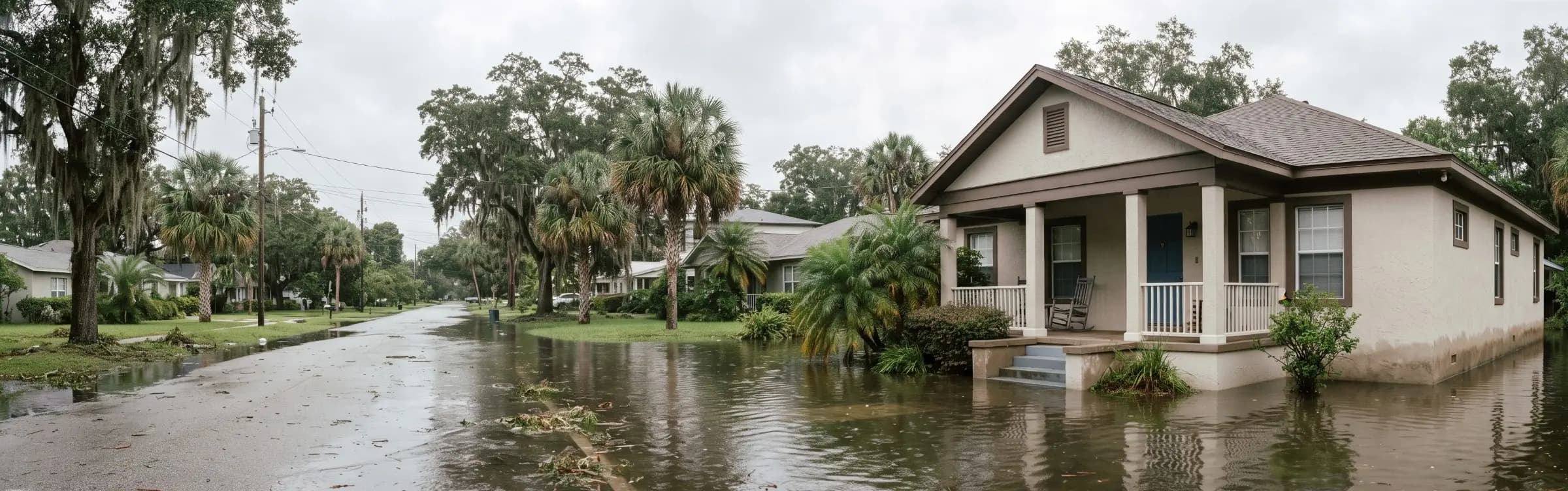

Orlando neighborhoods drain into lakes and retention ponds, so a storm that overwhelms them can flood streets that do not usually flood, as Hurricane Ian's nearly 14 inches of rain in one day did. Heat and humidity shorten the drying window, and a typical Orlando job costs $1,300–$5,900 to dry and repair, with a start inside the first day keeping it near the low end.
In Orlando, water damage restoration is the work of extracting water, drying building materials, cleaning, and rebuilding what cannot be saved to the ANSI/IICRC S500 standard, and Florida's Department of Business and Professional Regulation (DBPR) licenses the rebuild trades and mold work but not extraction and drying. That makes IICRC credentials, a written drying scope, and the one year claim deadline count for more than a company's advertising.
Key insights
- Typical cost. One affected area in Orlando runs $1,300–$5,900 and Category 3 rain, pond, or sewage water on a ground floor can push a job to $8,400–$29,500 or more.
- Rain outruns drainage. Orange County Public Works told commissioners its drainage can absorb 11–12 inches at most, and Ian dropped nearly 14 inches in 24 hours, which flooded low lying Orlo Vista homes.
- One year to report. Under Florida Statute 627.70132 a new or reopened claim is barred unless the insurer gets notice within 1 year, and for a hurricane the clock starts at landfall.
- Hurricane deductible. Covered wind damage from a hurricane carries its own deductible of $500, 2 percent, 5 percent, or 10 percent of the dwelling limit, which replaces the regular one.
- Sinkhole cover is narrow. Every Florida property insurer must cover catastrophic ground cover collapse, other sinkhole coverage is optional, and a leaking main or storm drain can imitate a sinkhole.
- Drying is unlicensed. Florida has no separate license for extraction and drying, so confirm IICRC Certified Firm status and look up each rebuild trade in the state license database.
The first 48 hours in an Orlando home
In Orlando, the first 48 hours start with working out whether the water came from a lake or retention pond, from rain, or from a pipe, because lake and pond overflow needs a flood policy while rain through the roof and plumbing failures go to the homeowners policy. The EPA warns that mold can begin growing on wet materials within 24–48 hours, and in Orlando's humid air an adjuster's schedule is not worth waiting on.
 Photograph the standing water and the water line before extraction starts, because those first photos anchor the insurance claim. A wet vacuum only clears surface water, so the subfloor and wall cavities still need moisture readings before the drying is considered finished.
Before you start on the water, check the power. The breaker is safe to switch off only when the panel is dry and reachable without wading through water, and if water is still flowing, sewage is involved, or the panel is wet, call for emergency water damage restoration and stay out of the room until an electrician clears the circuit.
1. Shut the water off at the right valve
Shut the valve feeding the failed pipe or appliance, or turn off the main, since each minute of flow adds to the damage. When the shutoff at the house will not close, or the water is coming from the line at the street, call your water utility, because only the utility can close the valve at the meter. OUC takes leak reports at 407-423-9018, and your water bill names the provider for your address, which may be Orange County Utilities or another system outside OUC's territory.
2. Decide whether it is pond, rain, or pipe water
Water that arrives from a retention pond, a lake, or the street is flood water, rain entering through a roof or window opening is storm water, and a broken pipe or appliance gives plumbing water. A homeowners policy and a flood policy pay for different sources, so settle which one you have before you describe the loss, and remember that during Ian it was retention pond overflow that flooded Orlo Vista homes.
3. Photograph it and email the insurer today
Before anything moves, photograph where the water came in, the line it left on the walls, and what it damaged, then email the insurer with the date and the photos attached. Florida starts its 7 day acknowledgment clock when the insurer receives your message, so the timestamp on a sent email is your proof of the start.
4. Dry in a closed house and ask about substantial damage
Get standing water out and air moving at once, and hire an IICRC credentialed company instead of waiting for the adjuster, keeping doors and windows shut because summer air outside in Orlando is often wetter than the air inside a drying house. If outside water got in, check with your city or the Orange County floodplain office on whether the repairs could count as substantial damage, since the answer tells you whether the rebuild has to meet flood resistant standards.
Ian, Irma, and Milton in Orange County
Three storms mark Orlando's recent water history: Hurricane Irma in 2017, Hurricane Ian on September 28–29, 2022, and Hurricane Milton on October 9–10, 2024. Ian is the benchmark, with the city reporting historic flooding from as much as 14 inches of rain and Orange County Fire Rescue saving 271 people from flooded homes in Orlo Vista.
 Storm water from Ian, Irma, and Milton pooled in Orange County streets and against driveways, and low lots with slab foundations are where it most often reached floors and drywall.
Orange County Public Works told commissioners its drainage systems can handle 11–12 inches at most, and crews pumped about 14 million gallons from the Orlo Vista pump station ahead of the storm and roughly 250 million gallons afterward. The county has since moved ahead with a $23 million flood project for the neighborhood.
Milton passed south of Orlando, and the National Weather Service in Melbourne recorded 4–8 inches of rain in Orange County, locally up to 10 inches, with minor freshwater flooding. County officials said more than 10 inches fell in West Orange, up to 12 inches around Winter Garden, and about 600 properties suffered significant damage.
Ian flooded other neighborhoods too. Orange County Fire Rescue evacuated residents of a nursing home off Semoran Boulevard that took about a foot of water in a part of the city that does not typically flood, so ask which pond, ditch, or lake drains your street instead of trusting a neighborhood's reputation. Standard homeowners policies exclude flood water, which makes water damage from flooding a matter for a separate flood policy, worth pricing for any home near a pond or lake before storm season.
Ponds, lakes, and limestone in Orlando
Three features set Orlando apart: the metro sits on a chain of lakes and retention ponds, it receives roughly 50 inches of rain in a normal year, and air conditioning runs most of the year. Water comes from above in afternoon thunderstorms, from low ground when ponds and drains fill, and from underneath when old pipes or the ground itself shift.
 Central Florida sits on limestone, and heavy rain or a broken underground line can open the ground under a street or a home.
The wet season runs June through September, and Spectrum News 13's summer rainfall summary puts the Orlando average at about 22 inches for June through August. By late summer the ground is saturated, so one tropical system can overwhelm drainage that coped with every earlier storm and cause water damage from flooding in neighborhoods that never had it.
Lakes and retention ponds
Neighborhoods here drain into lakes and retention ponds, and when several fill at once they can merge. During Hurricane Ian three lakes merged and poured water into Orlo Vista, and residents said Lake Venus had also overflowed during Hurricane Irma in 2017.
Limestone ground
Central Florida sits in what a University of Florida geologist calls sinkhole alley, which follows the I-4 corridor, and Lake Eola in Orlando and Lake Rose in Winter Park both began as sinkholes. Heavy rain adds weight and moves water through the ground, so a hurricane or a broken underground line can open the ground under a home.
Where water hits Orlando neighborhoods
Elevation, drainage design, distance to lakes and ponds, and building age predict Orlando area risk better than a ZIP code does. Ian flooded Orlo Vista, Milton’s heaviest rain fell in West Orange, and broken water mains have flooded blocks of older neighborhoods near downtown. Look up your exact address before the next storm season, because Orange, Seminole, and Osceola counties and the cities inside them run their own permit and floodplain offices, so the rules change at the city line. Orlando, Winter Park, Apopka, Ocoee, Winter Garden, and Kissimmee each handle repair permits inside their limits.
| Area | Main water risk | Where to start |
|---|---|---|
| Orlo Vista and west Orange County | Pond and lake overflow, with homes flooded in 2017 and again in 2022 | Ask the county which pond drains your street and confirm flood coverage |
| Winter Garden and Southwest Orange | Up to 12 inches of rain from Milton, with flooding along Reams Road | Check drainage near the lot and keep gutters and swales clear |
| Pine Hills and inner neighborhoods | A water main break opened a hole in Silver Star Road in 2018 | Save the utility's leak line and inspect supply and drain lines |
| Thornton Park and downtown | An 80 year old main under Summerlin Avenue broke twice in 2018 and flooded homes | Report pooling water in the street to the utility at once |
| Semoran Boulevard corridor | A nursing home took about a foot of water during Ian in an area not known for flooding | Check the parcel flood zone instead of trusting neighborhood reputation |
| Winter Park and Lake Eola | Sinkhole prone ground, where Lake Rose and Lake Eola began as sinkholes | Watch for new cracks and sticking doors, and review sinkhole coverage |
| Slab on grade homes across the metro | Slab leaks and air conditioner condensate overflow | Watch the water meter and service the condensate line |
Bungalows and mid century homes near downtown, College Park, and Colonialtown often keep original plumbing and wood framing, which slows drying and calls for more careful tear out. Plaster, old growth wood, and cast iron drains each limit what can be dried in place.
Six ways water enters an Orlando home
Six routes carry water into an Orlando home: storm and hurricane damage, air conditioner condensate, slab and plumbing leaks, roof, window, and door leaks, sewer and stormwater backups, and failures in underground mains or ground collapse. The route decides how far the water spread, how long it went unnoticed, and which part of the policy applies.
 Water reaches an Orlando home from above through the roof and air handler, from the sides through windows and drains, and from below through the slab and ground.
Storm rain and pond overflow
Hurricane water here divides by how it got in. Rain driven through an opening the wind made in a roof, window, or door falls under the homeowners policy and its hurricane deductible, while rising lake, pond, and street water needs a flood policy. That turns one storm into two claims, and storm and hurricane water damage often means two adjusters and two stacks of paperwork.
The Florida Department of Financial Services counts interior rain as hurricane coverage when wind made the opening. Tarp it, take dated photos, and save every receipt, since insulation and ceilings can be soaked long before a stain shows.
Air handler and condensate overflow
Because air conditioners run most of the year, a clogged condensate line, cracked pan, or stuck float switch is a leading source of water that has nothing to do with storms. A slow overflow from an attic or closet unit can soak insulation and drywall for weeks, and water damage from condensation often stays unseen until a ceiling stain appears.
The leak builds gradually, so adjusters ask how long it ran, and damage from repeated seepage can be excluded. Dated service records, the date of the first stain, and the day the system was shut off help show the loss was sudden and accidental.
Afternoon storms and roof openings
Wind driven rain finds the roof, windows, and doors before the structure itself gives way. A ceiling stain after a storm points to an opening above, and water damage from a roof leak typically starts at flashing, valleys, ridge caps, or lifted shingles and wets attic insulation first.
Orlando's summer storms test a small roof opening almost every afternoon, so a stain that appears after a dry week can trace back to an earlier storm. Mark the stain edge with a date and recheck after each rain to see whether it grows.
Worn seals, flashing, and thresholds let rain past the frame, so a window or door leak shows as staining under the opening or bubbling paint at the base of the wall. Water that slips behind trim can run down inside the wall, so the damage often appears well below the opening.
Slab leaks and cast iron drains
Beneath many Orlando area homes, supply and drain lines run through or under the concrete slab. A slab leak can go unnoticed for weeks until a warm patch on the floor, a climbing water bill, or the sound of running water gives it away.
Florida homes built from the 1950s through the 1970s often have cast iron drains that rust from the inside out, and Orlando has many neighborhoods from that era. A plumber's camera inspection shows whether a line is failing, and a leaking drain puts Category 2 or 3 water under the house.
Backups when drains and ponds fill
When heavy rain overwhelms a street drain or retention pond, stormwater and sewage can enter a home together. That water is Category 3 from the first minute, so it calls for disinfection, protective equipment, and removal of porous materials.
Before cleanup, have a plumber document whether the blockage sits in the public main or in your own line, since that finding decides who pays for the repair and shapes a sewage backup claim. Photograph the backup and the fixtures involved before anything is flushed or cleaned.
Water main breaks and sinkholes
Mains and storm drain lines under Orlando streets age like the plumbing inside homes, and one break can flood a block in minutes. An 80 year old, 20 inch OUC main under Summerlin Avenue near downtown failed in October 2018 and flooded 13 homes, and the same pipe had burst a few blocks away two months earlier.
When water bubbles up in a street or yard, tell the utility right away, because washed out ground can collapse. The Florida Department of Environmental Protection lists main breaks and storm drain leaks among the causes of ground collapses that merely look like sinkholes, and a University of Florida geologist told ClickOrlando that a hurricane can trigger real ones. Florida requires insurers to cover catastrophic ground cover collapse, but other sinkhole coverage is optional, and under Florida Statute 627.706 foundation settling or cracking alone does not qualify, so ask your agent in writing what your policy covers.
Early signs of a hidden Orlando leak
An Orlando leak usually shows up as a musty smell, a brown ceiling stain, bubbling paint, a warm patch on a slab floor, or a water bill that rises with no change in use. Near constant air conditioning and slab construction hide leaks inside walls and under floors, so even small signs justify a quick look. Take dated photos of each sign before anything is moved, since they help show whether the loss was sudden, and note where the sign appears, since that usually points toward the source.
| Sign | Likely cause | Where to look |
|---|---|---|
| Musty or sour smell | Wet insulation or drywall inside a wall | Closets, garages, and rooms beside the air handler |
| Brown ceiling stain that keeps growing | A roof leak, an overflowing condensate pan, or a line upstairs | Below bathrooms, roof penetrations, and the air handler |
| Bubbling or peeling paint | Moisture working its way through the wall | Low on walls, at exterior corners, and in bathrooms |
| Warm or damp patch on a slab floor | A hot water supply line leaking under the slab | Hallways, kitchens, and tiled areas |
| Higher water bill with no change in use | A hidden leak in a supply or irrigation line | The meter, checked with every fixture off |
| New cracks or sticking doors near wet ground | Soil washed out, or a leaking underground line | Walls and door frames closest to the yard or street |
A meter dial that keeps moving with every fixture off means water is escaping somewhere in the system, and a stain that returns after painting means the leak is still active.
DIY limits for Orlando water losses
Only a narrow slice of Orlando water losses suits a homeowner: clean water on tile or sealed concrete that gets dried within hours. What decides it is whether the water soaked into anything that cannot dry from the surface, such as drywall, insulation, a wood subfloor, or ductwork.
 Clean water on tile or sealed concrete is the one kind of Orlando water loss a homeowner can usually dry alone, if it is cleared within hours.
A room can feel dry while a wall cavity stays wet, and a company that records moisture readings leaves the paper trail an insurer will ask for. Outside water, sewage, and anything near electrical panels belong with a professional.
| Situation | DIY or pro? | Why |
|---|---|---|
| Clean spill on tile or sealed concrete, dried the same day | DIY | Towels, fans, and a dehumidifier clear surface water before it soaks into anything porous |
| Condensate pan overflow found right away | DIY | Clear the drain line and dry the floor, then bring in a pro if the insulation or ceiling below is damp |
| Dampness inside a wall, under flooring, or in insulation | Pro | Cavities and subfloors hold moisture long after the surface looks fine, and mold can begin in 24–48 hours |
| Lake, pond, street, or sewage water | Pro | Category 3 water carries contamination, so crews need protective gear and must remove porous materials |
| Water near outlets, panels, or ceiling fixtures | Pro | Kill the breaker first and let an electrician clear the circuit before anyone steps in |
Pond, pipe, and sewage water categories
ANSI/IICRC S500 rates a water loss twice: by category, 1 to 3, for contamination, and by class, 1 to 4, for how much material got wet and how much drying it needs. Category 1 comes from a sanitary source, Category 2 carries significant contamination, and Category 3 can carry sewage, so the rating also decides which materials can be dried and which are discarded. A category can also worsen with time, and Orlando’s warm interiors speed bacterial growth, so clean water that sits in wet materials for a few days can slide into Category 2.
| Category | What it means | Orlando sources |
|---|---|---|
| Category 1 | Water from a clean source that poses little risk at first | A broken supply line, a water heater leak caught early, or fresh condensate |
| Category 2 | Enough contamination to make a person sick on contact | Washer or dishwasher discharge, or pan water that sat for days |
| Category 3 | Heavily contaminated water that may carry sewage and other pathogens | Lake or pond overflow, street flooding, or a sewer backup |
Class 1 means little absorbent material, Class 2 a full room of carpet with water wicking up the walls, Class 3 water that came down from overhead, and Class 4 dense materials such as concrete and hardwood. An air handler overflow or roof leak in Orlando often produces a Class 3 loss, so get the category and class in writing before you accept an estimate.
What an Orlando restoration job costs
A single affected area in Orlando costs $1,300–$5,900, and a loss that reaches several rooms or involves Category 3 water can run well beyond that. Four things move the total most: how contaminated the water was, how many rooms it reached, how old the construction is, and how many hours passed before drying started. Older materials tend to hold more moisture and cost more to dry or replace, and every extra day of wet drywall and insulation adds equipment time and a higher chance of mold, which is why a job dried within the first day often stays near the low end of the range.
 Soaked attic insulation is bagged and carried out, and it, along with the ceiling drywall below it, is among the most common cost drivers in Orlando, especially when a condensate leak runs for weeks.
No public dataset tracks invoices for Orlando alone, so these ranges start from national figures, trimmed because Orlando area construction pay ran about 84 percent of the U.S. average in May 2024 according to the Bureau of Labor Statistics, and then adjust for ground floor rain and pond exposure, a long cooling season, slab foundations, and crew demand during storm season. Bills usually separate mitigation (extraction and drying) from reconstruction (drywall, flooring, paint), and an insurance estimate tends to split them the same way.
| Scenario | Cost | What drives it |
|---|---|---|
| Water heater or appliance leak found within a day | $400–$2,100 | Clean water over a small footprint, plus cabinet or drywall repair if the unit sits in a garage or closet |
| Condensate overflow from an attic or closet air handler | $700–$3,400 | Soaked insulation and ceiling drywall under the unit, usually discovered after weeks of seepage |
| Supply line failure in a single room | $1,300–$5,900 | Extraction, 3–5 days of drying equipment, and new flooring or drywall |
| Slab leak with wet flooring | $1,300–$5,100 | The cleanup only, because finding and fixing the buried line is a plumber's bill |
| Roof leak after wind damage | $800–$5,100 | Wet attic insulation and ceilings, with the roof repair billed separately by a roofer |
| Sewage backup (Category 3) | $1,700–$8,400 | Disinfection, protective gear, and removal of padding and lower drywall |
| Pond, lake, or street water in a ground floor home (Category 3) | $8,400–$29,500+ | Flood cuts, flooring, drywall, and contents, with severe multi level losses passing $75,000 |
Treat national water damage restoration cost figures as the baseline, then expect an Orlando quote to move with contamination, how fast drying began, the building's age, and storm demand. A written estimate should show each as its own line.
Pond, lake, and sewage water
Clean water jobs are mostly pumping and drying, while pond, lake, street, and sewage water add disinfection, protective equipment, and tear out of porous materials under ANSI/IICRC S500. That demolition explains most of the price jump.
Days of drying equipment
A start inside the first day saves more drywall and padding. Drying equipment is billed per day, so a late start also stretches the rental.
Post-storm crew demand
Once a named storm passes, the same jobs claim crews, dehumidifiers, and drywall stock across Central Florida, so yours starts later and costs more than it would in a quiet week. Ask for the start date in writing so a backlog does not leave wet materials sitting.
Contractors often quote mitigation by the square foot, commonly $2.50–$6.25, and repairs at $17–$31, so a quote far outside those ranges deserves a line by line explanation.
Saving belongings after a flood or leak
What survives an Orlando water loss depends on the water category and on how porous the item is. Under ANSI/IICRC S500, hard nonporous items such as glass, metal, and hard plastic can usually be cleaned and kept even after contaminated water, while porous items that soaked up Category 3 water are generally discarded.
 Glass, metal, and hard plastic can usually be cleaned and kept, so sort them from porous items before anything is thrown out, and photograph what you discard.
Time matters more here than in drier climates, since indoor humidity stays high and wet materials can start to grow mold within 24–48 hours. Photograph and list each discarded item before it leaves the house, and if the adjuster has not seen the damage yet, keep a small sample of the carpet, pad, or flooring as evidence.
| Item type | Category 1 water | Category 2–3 water |
|---|---|---|
| Glass, metal, hard plastic | Clean and keep | Clean, disinfect, and keep |
| Solid wood furniture | Dry and keep | Often cleaned if sealed, discarded if porous |
| Upholstery and mattresses | Dry quickly, often kept | Discard |
| Carpet and carpet pad | Pad is often replaced, carpet can sometimes dry in place | Discard both |
| Drywall and insulation | Dry in place if caught early | Cut out and replace |
| Clothing and linens | Wash and keep | Wash hot with disinfectant or discard |
| Food and medicine | Discard anything the water touched | Discard |
Slow drying and mold in Orlando
Mold can take hold on wet drywall and framing within 24–48 hours, and a slow dry out in Orlando's humidity makes that likely. Restoration dries and repairs the structure, and when growth is found, mold remediation follows as a separate service under ANSI/IICRC S520.
Keep the daily moisture readings from the drying job in writing, since they are the best defense in a later mold dispute, and any licensed mold team that follows will ask to see the drying log.
When mold does appear, mold remediation in Orlando is its own project with licensing, a written protocol, and clearance testing, and a structure dried inside two days rarely gets there.
Orange County permits for water repairs
Extraction and drying in Orlando can begin before permit questions are settled because they do not alter the building, while rebuild work may need a permit depending on the trade, the scope, and the jurisdiction. Orange County's Division of Building Safety answers for unincorporated addresses at 407-836-5550, and each city runs its own office inside its limits.
 Electrical, structural, and drywall repairs after water damage usually need a permit and an inspection, and the contractor should say in writing who pulls each one.
Orange County's published storm repair checklist separates work that needs a permit from work that does not. It was written after hurricanes, so confirm the current rule before you start, and it urges owners to hire a contractor licensed by the State of Florida or Orange County for any repair work.
| Work | Permit needed? | Orange County note |
|---|---|---|
| Roof repairs over 100 square feet | Yes | Smaller repairs under that size do not need one |
| Roof repairs under 100 square feet | No | A tarp on the roof does not need a permit either |
| Electrical repairs, weatherhead, or meter base | Yes | Water in a panel or meter base calls for a licensed electrician |
| Window or door replacement | Yes | Applies to storm damaged openings as well |
| Exterior siding replacement | Yes | Repairing a soffit does not need one |
| Structural repairs | Yes | Soft framing or a sagging floor system falls here |
| Drywall replacement | Yes, confirm | The county lists it as permit work and tells owners to check with the Building Division |
| Debris removal and tree removal | No | Clearing debris from the structure is exempt |
| Gutter replacement | No | Replacing rain gutters is exempt |
Because the county lists drywall replacement as permit work and tells owners to check with the Building Division, call before you order it. A city inside Orange County may answer differently than the county does.
In a flood hazard area, repairs that cost 50 percent or more of a structure's market value before the damage make it substantially damaged, and the building official or floodplain manager, not FEMA, makes that call. Land value does not count, and a substantially damaged home must be brought into compliance with the Florida Building Code and the community's floodplain rules.
Ask for the determination in writing before you sign a reconstruction contract. Flood policyholders in a Special Flood Hazard Area can receive up to $30,000 in Increased Cost of Compliance coverage toward elevation or floodproofing, and that claim is filed separately from the flood claim.
Have the contractor state in writing who pulls each permit, since whether water damage repairs need one depends on the trade, the scope, and the property's flood zone. Unpermitted work can complicate a later insurance claim and a sale, and Orange County warned after Hurricane Irma that work done without a permit may not be covered by homeowners insurance.
Claim deadlines and Citizens limits
A standard Florida homeowners policy covers sudden and accidental water damage, such as a supply line that bursts or a dishwasher hose that fails, but excludes flood water and slow, repeated seepage. Write down the source and how long the water ran before you call anyone, because those two facts decide which part of the policy responds.
 Write down the water source and how long it ran before you call the insurer, because those two facts decide which part of a Florida policy responds.
Most deadlines come from Florida Statute 627.70132, which bars a new or reopened claim unless the insurer gets notice within 1 year of the loss and a supplemental claim within 18 months. For a hurricane or other weather event, the clock starts at landfall or on the date NOAA verifies the event.
| Claim step | Deadline | Statute |
|---|---|---|
| Report a new or reopened claim | Within 1 year of the date of loss | 627.70132 |
| Report a supplemental claim | Within 18 months of the date of loss | 627.70132 |
| Insurer acknowledges your communication | Within 7 calendar days | 627.70131 |
| Insurer inspects after proof of loss | Within 30 days of receiving the proof of loss statements | 627.70131 |
| Insurer pays or denies the claim | Within 60 days of notice | 627.70131 |
A late payment carries interest back to the date of notice, and you are owed the adjuster's detailed estimate within 7 days. Damage found once repairs start can be added as a supplemental claim, but a leak that ran for weeks raises the question of whether homeowners insurance covers water damage of that kind, and the seepage exclusion usually answers it. Hurricane losses count from landfall, so the one year window opened by Milton's October 9, 2024 landfall has already closed for any claim not noticed in time.
Citizens Property Insurance, the insurer of last resort for many Orlando area homes, runs a Managed Repair Program for water damage not caused by weather, which offers free emergency water removal and a contractor network that guarantees its work, and hiring your own contractor instead can cap what the policy pays. Terms vary by policy and year, so ask the adjuster in writing which limit applies before you sign a restoration contract. Florida also bans assignment of benefits on policies issued on or after January 1, 2023, so a contractor cannot take over your claim.
Wind, pond, and street water coverage
Florida applies a separate hurricane deductible when a hurricane declared by the National Hurricane Center damages a home through wind, and it replaces the regular deductible for that loss. Insurers must offer $500, 2 percent, 5 percent, or 10 percent of the dwelling limit.
 Wind that opens a roof or window and a pond that spills onto the lawn are two different losses, and a Florida homeowners policy and a flood policy pay for them separately.
According to the Florida Department of Financial Services, the deductible window opens when the National Hurricane Center issues a hurricane warning for any part of Florida and closes 72 hours after the last watch or warning. It applies once per calendar year, so on a $350,000 dwelling limit the three percentage options come to $7,000, $17,500, and $35,000.
| Water source | Homeowners policy | Flood policy |
|---|---|---|
| Burst pipe or appliance leak | Pays if the leak was sudden, with the regular deductible | No coverage |
| Air conditioner condensate overflow | Pays if sudden, excluded if it built up slowly | No coverage |
| Rain entering through an opening the wind made | Pays, with the hurricane deductible during a hurricane | No coverage |
| Lake or pond water rising into the house | No coverage | Pays up to the policy limits |
| Street flooding that enters the home | No coverage | Pays when it meets the NFIP flood definition |
| Sewer or drain backup | Only with a water backup endorsement | Only as part of a general flood |
| Slow or long term leak | Usually excluded as constant seepage | No coverage |
An NFIP flood policy has a 30 day waiting period, so one bought as a storm approaches will not cover that storm, and Ian's rain showed that mapped zones miss real risk. Building coverage tops out at $250,000, contents at $100,000, and a claim has a 60 day proof of loss deadline, so buy flood insurance before hurricane season starts.
When the insurer denies or underpays
A denial or a low offer does not close a Florida claim, because a water damage insurance claim can still be disputed through mediation, appraisal, or a supplemental claim for damage found later. The statutory deadlines keep running during a dispute, so count them from the date of loss.
The state's free mediation program, run by the Department of Financial Services, handles disputes of $500 or more after the deductible over the cause of damage or the repair offer. The insurer pays the $350 fee, the conference is held within 21 days of the mediator's assignment, and the number to start one is 1-877-693-5236.
Get the reasons and a second estimate
Have the insurer cite the policy wording behind each denied or reduced item, then send it an itemized bid from an IICRC credentialed company with photos and daily moisture logs to show the scope it left out.
Pick the right remedy
Appraisal settles disagreements over how much the loss is worth, and a licensed public adjuster can negotiate that figure for a fee. When the fight is over whether the policy covers the loss at all, mediation or legal advice fits better.
FEMA and SBA aid for Orlando floods
Federal help reaches Orlando homeowners only after a presidential disaster declaration, and it fills gaps instead of replacing an insurance claim. FEMA repair assistance makes an owner occupied home safe to live in, and the Small Business Administration lends up to $500,000 for home repair and $100,000 for personal property. Both expect you to file your insurance claim first, each declaration sets its own deadline (DR-4673 for Hurricane Ian), and both can ask for the insurer's payment or denial letter.
Vetting an Orlando restoration company
Screening an Orlando water damage company starts with proof of IICRC Certified Firm status, liability and workers' compensation coverage, and a written scope that states the water category and damage class. Florida licenses the rebuild trades and mold work but not extraction and drying, so which license matters depends on what the job includes.
 A credible company can explain its drying plan, equipment, and daily readings in plain terms, and will put the water category, damage class, and schedule in writing before work starts.
In 2024, Florida's Third District Court of Appeal ruled that water extraction and dehumidification need no building contractor's license. Structural work, plumbing, electrical, roofing, and air conditioning can still need one, so look up any rebuild contractor, electrician, plumber, or mold professional in the Florida DBPR license search and confirm the firm in the IICRC locator.
1. Look up the firm in the IICRC locator
A credible company appears as a firm listing, not only as certified technicians, and can give you its certificate number to check. A logo on the van proves nothing.
2. Get the water category and class in writing
Both ratings should come with the reason for each. A company that writes only "water damage" has not assessed the loss.
3. Ask for a daily drying log
Moisture readings and equipment counts for every visit are what your adjuster will ask to see later, so be wary of machines left running with no readings.
4. Match each rebuild trade to a license
Look up the contractor, electrician, plumber, or mold professional by number in the DBPR license search, and treat a missing number or a license for a different trade as a red flag.
5. Decline any assignment of benefits
Florida bans them on policies issued on or after January 1, 2023, so pressure to sign over your claim rights is a warning sign.
6. Plan on paying the deductible
You owe it, and the company bills the remainder, so an offer to waive or absorb it is a red flag.
Florida's Attorney General suggests collecting at least three itemized written estimates, holding back full payment until the work is done, and asking subcontractors for lien releases before the final check. Door to door offers and out of town crews multiply after hurricanes, so ask any newcomer for a local address and proof of insurance.
A company that will not commit its drying plan to paper should be crossed off the list, because the written scope lets you compare quality as well as price when choosing a water damage restoration company. It also hands your insurer the records it will request later.
Condos, rentals, and vacant homes
In an Orlando condo, the association insures the common elements and your HO-6 policy covers the interior, so who pays for water damage in a condo depends on where the water began. Tell building management in writing the same day and ask for the master policy declarations.
A tenant who finds water damage should tell the landlord in writing and insure personal belongings separately, because the structure is generally the landlord's responsibility. Dated written notice starts the repair clock.
Vacation homes, rentals between guests, and listed properties can leak for days unnoticed, and Florida policies may limit coverage while a home sits vacant. Claims for water damage in a vacant or seasonal home turn on vacancy clauses and proof of reasonable care, so close the main valve, leave the air conditioner on, log dated visits, and give a caretaker written authority to approve emergency drying.
Buying or selling after Ian flooding
Under Florida Statute 689.302, an Orlando seller must give the buyer a flood disclosure before the contract is signed. It asks whether the property flooded during the seller's ownership, whether a flood claim was filed, and whether any flood assistance was received.
A flood zone label says nothing about past flooding, so ask for repair invoices, claim history, any substantial damage determination, and the permits and drying logs, especially in neighborhoods that flooded during Ian. A clean permit record does not prove a dry history, and fresh paint only on lower walls can point to flood cuts, so get moisture readings from an independent inspector before closing.
Preventing Orlando pond and pipe losses
Most Orlando water losses trace back to three things: a clogged condensate line, a failing hose, and storm water the drainage system could not move. Five habits cover them, starting with the condensate line, since the cooling season lasts most of the year.
 Clearing the condensate line every few months and adding a float switch that shuts the unit off before the pan overflows stops the most common non-storm water loss in Orlando.
Keep the air handler drain from backing up
Clear the drain line every three to four months through Orlando's long cooling season, and install a float switch that cuts the unit off before the pan overflows, which stops HVAC water damage from condensation before it starts. Look at the pan each time you change the filter.
Retire rubber hoses and close the main on trips
Braided stainless lines outlast rubber hoses on washers, toilets, and sinks, and every connection deserves a yearly inspection. Close the main valve before a trip of more than a few days, because a line that fails in an empty house keeps running until someone returns.
Look over the roof and attic after named storms
After every named storm, look over the flashing, ridge caps, shingles, and attic for wet insulation or stains. Fixing a small opening early costs far less than replacing a ceiling and soaked insulation.
Keep swales and street inlets clear
Clean gutters and downspouts before hurricane season, and keep the swale and the street inlet at your property clear of leaves and trash. Tell the city or county about blocked drains and washouts.
Buy flood cover by early May
The season runs June 1 through November 30 and the NFIP's 30 day waiting period delays coverage, so the policy should be bought by early May. A homeowners policy leaves out flood damage entirely, even in neighborhoods outside a mapped flood zone.
Frequently asked questions
How much does water damage restoration cost in Orlando?
Typically $1,300–$5,900 for one affected area. Category 3 pond, lake, or street water on a ground floor can reach $8,400–$29,500 or more, and an estimate far outside those ranges deserves a line by line explanation.
Do I need flood insurance in Orlando if I am not in a flood zone?
No, flood insurance is not required by law outside high risk zones. Federal rules require it only for federally backed mortgages on homes in those zones, yet Hurricane Ian's rain flooded Orlo Vista homes when retention ponds overflowed. The NFIP defines a flood by the area affected, so a flood insurance policy bought outside a mapped zone can still pay when rain flooding meets that definition.
Does Florida homeowners insurance cover water damage?
Usually yes, when the leak is sudden and accidental, such as a burst pipe or a failed appliance, but not for flood water or slow, repeated seepage. A dated plumber invoice and photos of the first stain help show when the leak started.
Can I file both a wind claim and a flood claim after the same storm?
Yes, you can file both a wind claim and a flood claim after the same storm as long as each covers different damage. The homeowners policy handles covered wind damage, including rain that comes through an opening the wind created, while a separate flood policy handles rising water, and neither pays for what the other covers. Document each source separately with dated photos and estimates, since adjusters will ask which water caused which damage.
How long does water damage restoration take in Orlando?
Plan on 3–7 days of drying, followed by 1–3 weeks of repairs. After a named storm, shortages of crews and materials can lengthen either stage, and the final schedule depends on the water category, the damage class, and the materials involved.
Should I keep the air conditioning running while the home dries?
Yes, keep the air conditioning running while the home dries, provided the air handler and wiring stayed dry. A closed house with the air conditioner on draws moisture out of Orlando's humid air, but an air handler that got wet should be inspected before it runs. The crew sets dehumidifiers and air movers according to the drying plan.
Can I stay in my Orlando home during water damage restoration?
Often yes, if a clean water leak stays in one area. The home becomes unsafe with sewage, flood water, electrical hazards, or no working bathroom or air conditioning, and additional living expense coverage may pay for a hotel when a covered loss leaves it unlivable.
Do restoration prices go up after a hurricane in Orlando?
Yes, restoration prices often rise after a hurricane in Orlando, and Florida's Attorney General takes price gouging reports at (866) 966-7226. Storms send crews, dehumidifiers, and drywall to the same jobs at once, so collect at least three itemized written estimates when you can and compare the scope along with the price.
Is it safe to run a generator after a storm?
A generator is safe only outdoors and well away from doors, windows, and vents. Carbon monoxide from a generator in a garage or near an opening can reach lethal levels indoors, and outages can last for days, since Hurricane Milton alone cut power to more than 91,000 Duke Energy customers in Orange County. Keep the unit dry, and never tie it into household wiring without a transfer switch.
Is water damage dangerous to my health?
Yes, water damage can be dangerous to your health. Flood and sewage water can make people ill, and the EPA says mold can follow within 24–48 hours. Category 2 and 3 water carry bacteria and other contaminants, so wear gloves, boots, and a mask, keep children, older adults, and anyone with asthma or a weak immune system away, and hand Category 3 water to a professional.
How do I look up my flood zone in Orange County?
Enter your address in FEMA's Flood Map Service Center at msc.fema.gov, then confirm the result with the Orange County or city floodplain office. A flood map does not show whether a nearby pond or ditch can overflow, so also ask which one drains your street.
- IICRC S500
- EPA: Flood Cleanup to Protect Indoor Air and Your Health
- NWS Melbourne: Hurricane Milton Impact Narratives
- FEMA: Substantial Damage Determinations
- Orange County: Is a Permit Required for This Scope of Work
- Florida Statutes: 627.70132 Notice of Property Insurance Claim
- Florida Statutes: 627.706 Sinkhole Insurance and Catastrophic Ground Cover Collapse
- Florida DFS: Florida's Hurricane Deductible
- Florida DBPR: License Search
- Citizens Property Insurance: The Claims Process
- BLS: Occupational Employment and Wages in the Orlando Metro Area, May 2024
Sam Hickerson is the founder of RestoreAdvisor and writes consumer guides on mold remediation, water damage restoration, inspection, testing, and home recovery. His work focuses on helping homeowners understand costs, risks, and when to call a professional. He draws on guidance from the EPA, CDC, IICRC, and other authoritative sources to make complex home issues easier to navigate.