
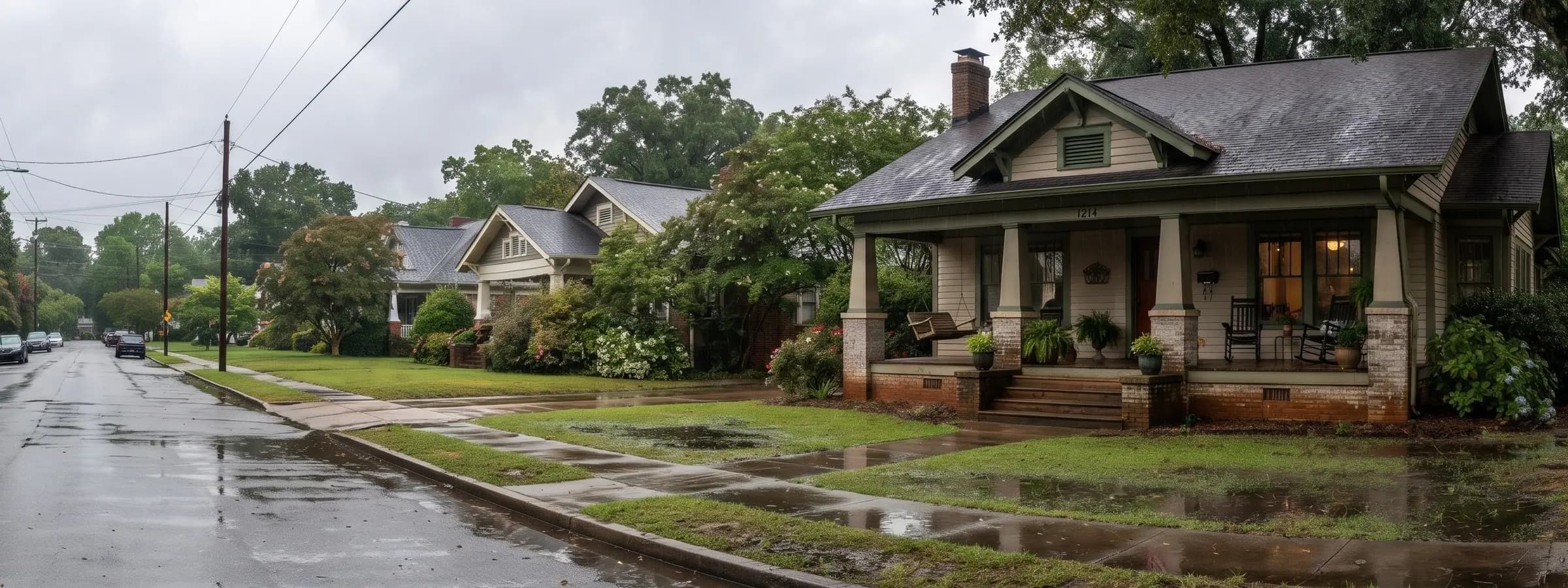

Crabtree Creek has 50 years of flood marks on poles along its trail, and the city's stormwater program manager says it is always going to flood. A Raleigh homeowner with a wet floor still has to work out whether the water came from the creek, a pipe that split in a freeze or an appliance, because that answer decides how the water is classified, which insurance policy responds and how much of the house has to come apart.
Raleigh water damage restoration is the removal of water and the drying and repair of a wet house under ANSI/IICRC S500, overseen by the City of Raleigh for permits and, for construction costing $40,000 or more, by the NC Licensing Board for General Contractors, while the drying itself needs no state license. Repairs on most houses stay under that dollar line, so the owner is the one who checks where the water came from, what the company can prove and how the claim is documented before an invoice arrives.
Key insights
- Typical cost. Raleigh water damage jobs usually cost $1,300–$6,200, and a ground floor loss from creek, storm drain or sewer water can climb to $9,000–$22,000 or more.
- Creek flooding. Crabtree Creek's record crest of nearly 28 feet came from an unnamed storm in 1973, and the City of Raleigh says homeowners policies do not cover flood losses.
- Freeze and rain. NOAA's 1991–2020 normals for Raleigh-Durham International Airport show 64.7 days with a low at or below 32°F, 7.6 days at or below 20°F and 11.6 days with 1 inch or more of rain.
- Claim clocks. Under North Carolina's standard fire policy, notice of a loss is due in writing right away, sworn proof of loss within 60 days unless the insurer extends the time, and any lawsuit within three years of the loss's start.
- No drying license. G.S. 87-1 sets the general contractor license at construction costing $40,000 or more, so IICRC firm status and a certificate of insurance are the checks for a drying crew.
- Permit line. The City of Raleigh says repair work costing $40,000 or less can still need a permit when it involves load-bearing structures or certain plumbing, heating and cooling, electrical or roofing work.
First hours in a wet Raleigh house
The first 48 hours belong to four jobs in a fixed order: stop the source, cut power to wet rooms, name the water and start extraction. A frozen line adds a delayed risk, because a pipe that split during a hard freeze can stay quiet until the ice melts, so water may appear hours after the temperature climbs and look like a new leak.
 Clean water from a split line is Category 1 under ANSI/IICRC S500, but water that has run through insulation and framing for days can reach Category 2. Close the main valve before anything thaws, because the split releases its water as the ice melts.
According to the EPA, wood, drywall, carpet and furniture that stay wet past 24 hours can grow mold, which is why extraction that starts on day one saves materials that a wait until day three would lose. Stay out of any room where water reaches outlets or the panel, and run any fuel powered generator outdoors and at least 20 feet from the house, because its exhaust contains carbon monoxide, a gas with no color or odor that can kill in minutes.
1. Shut off the water at the valve
Close the valve under the failed fixture or the main valve for the house, then run the lowest tap in the house until the flow stops to confirm the line is shut. If a frozen section is still iced over, leave the valve closed and call a plumber before any thawing, because a split pipe releases its water as it warms.
2. Switch off power to wet rooms
Turn off the breakers for wet rooms only if the panel is dry and you can reach it without standing in water. A wet panel, a ceiling dripping near light fixtures or water around outlets means an electrician comes before anyone else enters the room.
3. Label the water by its source
Write down whether the water came from a supply line, an appliance, a roof, the AC drain, a creek or a sewer, because ANSI/IICRC S500 puts creek, storm drain and sewer water in Category 3. That one line decides whether wet drywall and carpet can stay and dry or have to be cut out.
4. Record the water line and the damage
Photograph the source, the water line on the walls and every damaged item, and save every receipt for hotel stays, rented dehumidifiers and emergency plumbing. A line at one height across several rooms points to surface flooding, since a single leak stains from one point.
5. Email the insurer, then call a drying crew
Send the insurer a written notice with the date, the source and the photographs, because North Carolina's standard fire policy asks for immediate written notice of a loss. Book an IICRC certified firm the same day instead of waiting for the adjuster, and keep doors and windows shut while the dehumidifiers run.
Standing water, or a leak that cannot be stopped, is emergency water damage and justifies a call in the middle of the night, since drying that begins within hours keeps more of the carpet, cabinets and drywall. Once the first day is over, sort belongings into keep and discard. Carpet pad, upholstered furniture and ceiling tile that sat in creek or sewer water are usually discarded, and hard surfaces can be washed and disinfected.
What a homeowner can dry alone
A homeowner can dry a small spill of clean water caught within a day, such as a supply line leak that wet one floor and did not reach the walls, cabinets or insulation. Creek, storm drain and sewer water always call for a crew, and so does water that has sat in walls or under flooring for more than a day.
 A clean water spill caught within about 48 hours is still Category 1 under ANSI/IICRC S500, so towels and airflow can finish the job. Once water has wicked into cabinet bases or under the flooring, only a moisture meter can confirm it is dry.
The EPA calls flood cleanup difficult and dangerous work and says it may be best to get help from experienced and qualified professionals when that is possible. Children, pregnant people and anyone with asthma or a weakened immune system should not take part, and when hiring is not possible, the EPA says an inspector may be able to help decide when the cleanup has gone far enough.
A homeowner can safely close the supply, move belongings off wet floors, photograph the loss and run a dehumidifier in a room where only clean water reached the floor. A rented dehumidifier cannot show that a wall cavity, a subfloor or the joists above a crawl space are dry, because only a moisture meter reading compared with the baseline reading does, so any loss that reaches those spots needs a crew with a meter.
A burst pipe in a crawl space or attic is the common exception. The water may be clean, but it runs into insulation and framing out of sight, and a homeowner cannot tell how far it traveled. A small split caught while the water was still running into a bucket is a DIY job, while a ceiling stain that appears after the thaw is not.
Crabtree Creek and the floodplain
Crabtree Creek is notorious for flooding, and the city's stormwater program manager says it is always going to flood. The creek, a tributary of the Neuse River in central Wake County, runs through Cary, Morrisville and William B. Umstead State Park, crosses the northern part of Raleigh and empties into the Neuse at Anderson Point Park, according to WRAL.
 Water that leaves a creek bank and reaches a house is Category 3 under ANSI/IICRC S500, so porous materials come out and the claim falls to a flood policy.
Lake Lynn and Shelley Lake hold back some of the upstream water, and the manager told WRAL that they help but have not stopped the flooding. The city also spent years on voluntary buyouts, purchasing and demolishing buildings along Capital Boulevard, because every building placed in a floodplain takes away room for floodwater to spread and can raise the water downstream.
A 50 year record of flood events is marked on poles along the Crabtree Creek Trail between Crabtree Valley Mall and Glenwood Avenue, and the city's Flood Early Watch System manager told CBS17 that many of the storms behind the top floods were unnamed. The all time record of nearly 28 feet came from an unnamed storm in 1973, and the system can predict creek flooding up to two hours ahead, which gives city crews time to close roads and position resources before the water arrives.
Creek water leaves a level line at the same height on every wall, a film of silt or grass on the floor and neighbors with the same problem, while a leak stains from a single point and spreads outward. Water that crossed a yard or a street carries soil, fuel and sewage with it, so it is Category 3 even when it looks clear, and the porous materials it touched come out instead of drying in place.
Freezes, rain and leaks
A normal Raleigh year brings freezing nights and heavy rain, according to the 1991–2020 normals from NOAA for Raleigh-Durham International Airport. The airport averages 46.07 inches of precipitation a year, 11.6 days with 1 inch or more of rain, 64.7 days with a low at or below 32°F and 7.6 days with a low at or below 20°F.
 A downspout that stays dry while the gutter spills points to a blockage at the roof edge, and clearing it is a far smaller job than drying a wall.
Those counts put a split pipe or a roof leak on the calendar every year, long before a creek reaches a house. A freeze that drops the low to 20°F or below, which happens on about eight days in an average year, is the kind that tests unprotected supply lines in crawl spaces, attics and exterior walls, and the water from a burst frozen pipe often shows up after the thaw, when the ice that plugged the split melts.
Heavy rain exposes weak spots in a roof. A downpour finds flashing that has pulled loose, shingles that have lifted and gutters packed with leaves, and a ceiling stain that appears the next day typically means the insulation above it is soaked. Summer humidity adds a quieter source, since an air handler in an attic or closet drains its condensation through a small line that can clog and overflow into insulation and ceiling drywall.
ANSI/IICRC S500 sorts water into three categories, and the Raleigh sources fall into different ones. On the first morning a split supply line and creek water in the carpet can look identical, yet the supply line is usually dried where it sits and the creek water drives demolition, so the estimate should state the category before it lists any equipment.
| Source | Category | Handling |
|---|---|---|
| Supply line or appliance | 1 | Dried in place if the crew arrives within roughly 48 hours, before the water turns |
| Frozen pipe that split | 1 | Dried in place, though water that ran inside a wall for days can reach Category 2 |
| AC condensate overflow | 1 | Clean at first, so it is dried in place if caught early, though wet insulation that sat for days is usually removed |
| Roof leak through insulation | 1 or 2 | Rain soaked insulation and ceiling board typically go, and framing is dried |
| Creek or storm drain flooding | 3 | Carpet, pad and wallboard are removed, and hard surfaces are cleaned and disinfected |
| Sewer backup | 3 | Contaminated materials are cut out and the area is disinfected before drying begins |
Pricing a Raleigh dry out and rebuild
Most Raleigh homeowners with a wet house pay $1,300–$6,200, and the average job is about $3,300. A ground floor loss from creek, storm drain or sewage water can reach $9,000–$22,000 or more because Category 3 adds demolition, disinfection and rebuilding on top of the drying, while a small spill found the same day can start near $300.
 Moving from Category 1 to Category 3 water roughly doubles the drying rate per square foot of wet floor, so the category is the first line to check on a bid.
According to the Bureau of Labor Statistics, hourly pay for construction and extraction workers in the Raleigh area came to roughly 88 percent of the national average in May 2025. The water damage restoration cost of a given house moves more with crawl space access, wet insulation under older floors and the water category than with that wage, because a contaminated source adds removal and disinfection that clean supply water skips.
| Scenario | Estimates | What drives it |
|---|---|---|
| Minor spot mitigation | $300–$1,300 | A single wet wall section or a clean spill found the same day, with a few days of equipment |
| Supply line or frozen pipe burst | $900–$2,600 | Clean water that has to be dried before it degrades, usually reaching one or two rooms |
| AC condensate overflow | $1,300–$3,500 | Soaked attic insulation, stained ceiling drywall and the work of reaching the air handler |
| Washing machine or dishwasher overflow | $1,800–$4,400 | Water that spreads beneath flooring and wicks into cabinet bases |
| Roof leak during a storm | $2,200–$6,200 | Rain that soaks insulation and ceilings below the leak, and the climb into the attic |
| Sewage backup | $6,200–$12,500+ | Contaminated water that forces out flooring, drywall and anything porous |
| Creek or storm flooding across rooms | $9,000–$22,000+ | Flood cuts, subfloor repair and replacement of every porous material the water reached |
Contractors price drying by the square foot of wet floor, which means 300 wet square feet cost the same to dry in a 1,500 square foot ranch as in a 2,000 square foot two story. The cost per square foot climbs with the water category, from $2.75–$3.50 for Category 1 to $6.25–$6.50 or more for Category 3, and rebuilding the same floor costs several times what drying it does.
| 300 sq ft loss | Estimates | Estimates per sq ft |
|---|---|---|
| Dry a Category 1 floor | $825–$1,050 | $2.75–$3.50 |
| Dry a Category 2 floor | $1,050–$1,725 | $3.50–$5.75 |
| Dry a Category 3 floor | $1,875–$1,950+ | $6.25–$6.50+ |
| Rebuild after drying | $5,400–$9,900 | $18–$33 |
The room that gets wet changes the bill as much as the volume of water. A bathroom's tile and small footprint dry fast, a kitchen adds cabinet bases and supply lines, and a basement slab keeps giving off moisture after the standing water is gone. Carpet and pad in a living room usually come out after contaminated water, while tile can be cleaned and kept, so two rooms of the same size can price very differently.
| Room | Estimates | What drives it |
|---|---|---|
| Bathroom | $400–$4,000 | Tile and a vanity on a small footprint that dries quickly |
| Laundry room | $900–$4,400 | A hose or drain that fails while no one is home and runs into the next room |
| Kitchen | $1,300–$7,000 | Toe kicks and cabinet bases, flooring under the dishwasher and sink lines |
| Basement | $1,300–$9,000+ | Creek or storm drain water that enters, and concrete that holds moisture for weeks |
| Living or family room | $2,900–$16,500 | The largest floor area in the house, with carpet, pad and furniture to move |
A fair Raleigh estimate names the category of water, the delay before drying started, each wet room, and the air movers and dehumidifiers with the days each will run. Equipment is billed per unit per day, which makes the daily readings the proof that every unit earned its charge, and a crew called out at night or on a weekend can raise the labor lines by 25–50 percent.
Vetting a company without a license
A Raleigh homeowner hiring a drying crew has no license to check, since G.S. 87-1 starts the North Carolina general contractor license at $40,000 of construction and extraction and drying build nothing. Four checks fill that gap: IICRC certified firm status, proof of insurance, a written scope and a drying log, all of which can be confirmed before any deposit is paid.
 Before any equipment comes inside, the crew at the door should be able to say who supervises the job and how many air movers and dehumidifiers the scope calls for.
A license number printed on a restoration company's truck or website relates to building work, not drying skill, and the NC Licensing Board for General Contractors runs the lookup for any number a company provides. Reviews help when they describe the work, such as arrival time, equipment that stayed on for the full job and an invoice that matched the estimate, and a firm that calls itself the best is making an advertising claim that a homeowner cannot verify.
| Ask | Credible answer |
|---|---|
| Are you an IICRC Certified Firm? | Yes, and the firm shows up in the IICRC locator when you search the name yourself |
| Can I see a certificate of insurance? | A certificate from the insurer, sent to you directly, listing general liability coverage |
| What will the written scope list? | Each wet room, the water category, starting moisture readings and the count of air movers and dehumidifiers |
| How long will the equipment run? | A number of days with daily readings, ending when each material reaches its dry goal |
| Will you give me the drying log? | Yes, with the baseline reading and every daily reading by room |
| Do you bill my insurer directly? | Yes or no, plus, in writing, what you owe if the insurer pays less than the invoice |
| Who does the rebuild and under what contract? | A separate contract for repairs, with its own license and permit answers |
Call two or three firms, ask each the same questions and choose a restoration company on the written bids and the answers they give. Cross off any firm that asks for a big deposit before putting a scope on paper, withholds its drying log or insists on waiting for an adjuster while water is still standing.
Hold the last payment until the log shows each wet material at its dry goal and the equipment has left the house. Ask for any warranty on the drying in writing, along with the name of the person who supervises the crew, who will be on site each day and how to reach that person after hours.
What finished drying means
A dry out ends when each wet material reaches its dry goal, usually after 3–7 days of equipment, and repairs add 1–3 weeks. Under ANSI/IICRC S500, the goal comes from a baseline reading on dry material of the same type elsewhere in the house, so drywall, framing and flooring are each measured against their own baseline.
A crew that logs the baseline first and then reads each wet room every day can show an insurer why the equipment stayed. In a house on a crawl space, the joists and subfloor above the dirt dry last, so the final readings should include the framing as well as the carpet, and a homeowner can ask to see each material's last reading next to its baseline.
S500 grades the extent of wetting in four classes, and the class drives how much equipment the crew sets. Class 1 means little wet material that absorbs slowly, Class 2 a full room of wet carpet, pad and wall bases, Class 3 water from above that soaked ceilings, walls and insulation, and Class 4 deep saturation of hardwood, plaster or concrete that calls for specialty drying. A roof or AC leak often lands in Class 3, and a creek that soaks a basement slab can reach Class 4.
The work follows a set sequence, starting with moisture mapping and photographs, then extraction, removal of anything unsalvageable, equipment setup, daily readings and a last reading at the dry goal. Rebuilding comes afterward under its own contract, and that second stage is where the permit rules apply, so a company that quotes drywall, flooring and cabinets in the same bid as the drying should show the two jobs as separate lines.
Which policy pays and by when
The source of the water decides which policy answers a Raleigh claim. A burst pipe, an appliance overflow or wind and rain damage to the roof normally go to the homeowners policy, creek and street water needs a flood policy, and a sewer backup needs a water backup endorsement that was on the policy before the loss.
 Adjusters check whether a stain looks sudden or old. Dated photos taken before cleanup, with the cause written beside them, show the loss was sudden.
Under G.S. 58-44-16, North Carolina's standard fire policy requires written notice of a loss right away, a signed and sworn proof of loss within 60 days unless the insurer extends that time in writing, and any lawsuit within three years after the loss began. Homeowners forms can write their own terms, so the notice and suit language in the actual policy deserves a read in the first week.
| Water source | Policy | Coverage depends on |
|---|---|---|
| Burst or frozen pipe | Homeowners | The loss is sudden and accidental, and a claim can be denied when the heat was off or the leak ran for months |
| AC condensate overflow | Homeowners | A sudden overflow qualifies, while slow seepage over time is usually left out |
| Roof leak in a storm | Homeowners | Storm damage to the roof qualifies, while wear and age are usually left out |
| Creek or street flooding | Flood policy | Surface flooding sits outside a homeowners form, so a separate flood policy is required |
| Sewer backup | Endorsement | A water backup endorsement attached to the homeowners policy |
The City of Raleigh states plainly that homeowners and business policies do not cover floods, and a new flood policy carries a waiting period, so one bought after the forecast changes will not answer that storm. The cause that the adjuster writes down decides how homeowners insurance coverage treats a given loss, so the source note from the first hours belongs in the claim file.
When an insurer offers too little
When an insurer's offer comes in below the invoice, the next step is to ask the adjuster for the line items in writing and compare each one with the drying log. If the two sides still disagree on the amount of the loss, North Carolina's standard fire policy lets either side demand an appraisal in writing.
Under that appraisal clause in G.S. 58-44-16, each side names a competent and disinterested appraiser within 20 days of the demand, and the two appraisers choose an umpire. If they cannot agree on an umpire within 15 days, a judge selects one, each side pays its own appraiser, the two sides split the umpire and other appraisal costs, and a written award signed by any two of the three sets the amount.
Adjusters most often question how many days the equipment ran, how much material was removed and whether a stain is old. The claim email, dated photos and drying log answer all three, and a line by line estimate with each piece of equipment listed separately is the easiest paper to defend when the insurer's figure falls short of the invoice.
The loss is payable 60 days after the insurer receives the proof of loss and the amount is settled by written agreement or an appraisal award. A dispute over the amount can therefore hold the payment past that date, so drying cannot wait for it to resolve, and the first invoice should carry the same line items the drying log shows.
Raleigh permits and the floodplain
Whether a Raleigh repair needs a permit depends on the work as well as the price. The City of Raleigh residential permit rules say project cost alone does not decide it, and that work costing $40,000 or less can still need a permit when it involves load-bearing structures or certain plumbing, heating and cooling, electrical, roofing or Fire Code work.
 A repair that needs no permit can still sit in a mapped floodplain, so ask the city about the permit and the floodplain separately.
The city lists some jobs as needing a permit but no plans, among them replacing an existing water or sewer line, a water heater and HVAC equipment. Replacing an existing water or sewer line or HVAC equipment after a loss therefore needs a permit even without plans, and the Planning and Development Customer Service Center at One Exchange Plaza, Suite 400, and the Permit Helpline at 919-996-2500 can say whether a specific repair is covered.
Raleigh's 2022 floodplain rule reaches only vacant land. The city's floodplain regulations took effect in July 2022 with the updated FEMA maps and apply only to vacant properties larger than 0.5 acres, about 400 properties and 1,545 acres, so properties that are already developed are exempt from the ban on new structures in the floodplain.
A house in or near a mapped floodplain still deserves a question before a rebuild contract is signed or any wall comes down. The Raleigh Floodplain Team at [email protected] or 919-996-3777 can say in writing whether a repair counts as a substantial improvement, a determination that can add flood protection requirements to the scope and change the price.
When a slow dry out turns to mold
A drying job that stalls turns into a mold job once wet materials pass the 24 hour mark, and Raleigh's warm, humid summers shorten the margin because indoor air that is already damp slows the drying of a wall cavity or a wet subfloor. A crew that starts late or pulls its equipment early leaves behind the damp framing and drywall that mold needs.
Three signs mark the switch: visible growth on framing or drywall, a musty smell that lingers after drying and readings that stay high once the equipment is gone. If a crew sees growth it should stop and say so in writing, since mold after water damage calls for containment, a different scope and a clearance test that a drying contract leaves out.
A house on a crawl space has a second wet zone, because moisture under the floor can keep joists and insulation damp once the visible water is gone. A crawl space that remains damp for days is where mold remediation begins, with moisture control, species testing and clearance testing added to the drying.
Where Raleigh water collects
The Raleigh areas with a documented flood history sit along Crabtree Creek, from Cary and Morrisville upstream through Crabtree Valley and Five Points to Anderson Point Park at the Neuse. Street flooding, storm drain overflow and storm damage can reach houses well outside the creek corridor during a heavy rain, so a lot near a creek or a low point in the street deserves a closer look before a purchase or a policy renewal.
 Photograph where the water sits in the yard and how close it came to the house before it drains, because a flood claim starts with where the water came from.
A water main break in the street can push water into a garage or basement that sits below street grade, and water that crosses pavement and soil is no longer clean, so the category is set where the water ends up. If the break is on the street side of the meter, call the water utility to shut the supply, and photograph the street and the water line on the walls before cleanup starts.
| Area | Risk factor | Notes for homeowners |
|---|---|---|
| Cary and Morrisville | Upstream Crabtree Creek | The creek flows through both towns before it reaches Raleigh, so heavy rain upstream arrives downstream |
| Crabtree Valley and Glenwood Avenue | Crabtree Creek | Flood marker poles on the creek trail between Crabtree Valley Mall and Glenwood Avenue show past high water |
| Five Points | Crabtree Creek | WRAL reports that the area floods consistently, even in storms without names |
| Capital Boulevard corridor | Crabtree Creek floodplain | The city bought and demolished buildings along it through voluntary buyouts |
| Anderson Point Park | Creek and Neuse confluence | The last stretch before Crabtree Creek empties into the Neuse River |
Rentals, condos and flood history
In a rental, the landlord's policy pays for the building and a renters policy pays only for the tenant's own belongings, so a tenant should email the landlord about the leak the same day and keep receipts for hotel nights and ruined furniture. Tenants, condo owners and sellers all need the same paper trail after a Raleigh water loss: dated photos, a written notice sent that day and the drying log.
In a condo, the association's master policy and the owner's unit policy divide the loss, and the association's governing documents set where the dividing line sits. Asking for those documents early speeds a condo water damage claim, because an owner who already holds the photos and the log can show the loss started inside a wall or above the unit.
Anyone buying a house that has flooded should request the claim history, the drying log and the repair invoices, then look the address up on the city's flood maps. Sellers who kept that paperwork can hand it over at once, whereas an undocumented repair gives a buyer no way to know whether wet materials were dried or simply covered up.
Prevention for rain and freezes
Prevention in Raleigh follows the three events that hit in a normal year: heavy rain, hard freezes and a clogged AC drain. A homeowner can keep roof water away from the foundation, protect supply lines before the temperature falls and clear the air handler's drain before summer, and anyone near the creek should keep a flood policy in force before the rain starts.
 Close the two wall valves after the last load of the day or before a trip, since a failed hose cannot run once its valve is closed.
Watch creek warnings before heavy rain
Check the flood warnings for Crabtree Creek whenever several inches of rain are forecast, and move cars and stored items off low floors early.
Extend downspouts away from the walls
Clear gutters before fall leaves drop and extend downspouts several feet from the house. A gutter that overflows at one corner can soak a crawl space or basement wall, and the damage often shows up as a damp wall long after the storm.
Wrap exposed supply lines before a hard freeze
Insulate pipes in crawl spaces, attics and exterior walls before the first night that is forecast to fall to 20°F. Know where the main valve is, because a homeowner who finds a split line can close it in seconds and limit the water.
Clear the AC condensate line each spring
Flush the drain line from the air handler and test the safety float switch, if the system has one, before summer. A clogged line backs up into insulation and ceiling drywall, and HVAC condensation leaks often go unseen until a stain appears.
Replace old supply hoses
Swap rubber washing machine and dishwasher hoses for braided stainless ones every few years. A hose that fails while the house is empty can run for hours and wet the floor below.
Frequently asked questions
How much does water damage restoration cost in Raleigh?
About $3,300, inside a range of $1,300–$6,200. A creek, storm drain or sewer loss on a ground floor can reach $9,000–$22,000 or more, since carpet, pad and wet drywall are removed and replaced.
How many days does water damage restoration take in Raleigh?
Plan on 3–7 days of equipment and 1–3 weeks of rebuilding. Wet insulation, a damp crawl space and permit review for plumbing or framing can add days, and the equipment leaves only after daily moisture readings reach the dry goal.
Do water damage restoration companies need a license in North Carolina?
No state license covers drying. G.S. 87-1 sets the general contractor license at construction costing $40,000 or more, so a drying job reaches it only when the rebuild grows that large, and IICRC firm status and proof of insurance are the checks that matter.
Does Raleigh require a permit for water damage repairs?
Sometimes, depending on the work, since the City of Raleigh says cost alone does not decide it, and work costing $40,000 or less can still need a permit when it involves load-bearing structures or certain plumbing, heating and cooling, electrical, roofing or Fire Code work. Call the Permit Helpline at 919-996-2500 before replacing a water line or framing.
Does homeowners insurance cover creek flooding in Raleigh?
No, the City of Raleigh says homeowners and business insurance policies do not cover losses from floods. Creek and street water needs a separate flood policy, and a new policy has a waiting period, so it has to be in force before the rain. A sewer backup is a different loss, since it needs a water backup endorsement, and sewage backup cleanup is Category 3 work.
What is the deadline for a water damage claim in North Carolina?
Written notice goes to the insurer right away, and the sworn proof of loss is due within 60 days unless the insurer extends that time in writing. The standard fire policy gives three years from the start of the loss to sue, and a homeowners policy may set its own terms.
How often does Crabtree Creek flood?
Dozens of times in the past 50 years, according to the flood record the city displays along the Crabtree Creek Trail. The all time record of nearly 28 feet came from an unnamed storm in 1973, and the city's flood early watch manager says many of the top flooding storms were not named, which is why creek flood water damage can follow an ordinary afternoon storm.
How many freezing nights does Raleigh get?
About 65 a year, according to NOAA's 1991–2020 normals for Raleigh-Durham International Airport, and 7.6 of them fall to 20°F or below. Those colder nights are the ones that test uninsulated pipes in crawl spaces and attics.
Who do I call first, the insurer or a restoration company?
Call a crew first when water is still spreading, then notify the insurer that day. Written notice with photographs opens the claim, and a moisture log started before the adjuster visits documents the loss, while waiting only gives wet materials more time to grow mold.
Is mold removal part of water damage restoration in Raleigh?
No, mold work is a separate job with its own scope. Visible growth, a musty smell that lingers after drying or readings that stay high once the equipment leaves point to mold remediation in Raleigh, which adds containment and clearance testing that a drying crew does not provide.
- IICRC S500
- EPA: Flood Cleanup to Protect Indoor Air and Your Health
- NOAA NCEI: U.S. Climate Normals, 1991–2020
- WRAL: Fewer buildings, more vegetation along Crabtree Creek should limit flooding
- CBS17: Crabtree Creek flood history shows weekend surge is possible
- City of Raleigh: Current Floodplain Development Regulations
- City of Raleigh: Permits, Residential
- NC G.S. 58-44-16: Standard Fire Insurance Policy
- NC G.S. 87-1: General Contractor Defined
- BLS: Occupational Employment and Wages in Raleigh-Cary, May 2025
Sam Hickerson is the founder of RestoreAdvisor and writes consumer guides on mold remediation, water damage restoration, inspection, testing, and home recovery. His work focuses on helping homeowners understand costs, risks, and when to call a professional. He draws on guidance from the EPA, CDC, IICRC, and other authoritative sources to make complex home issues easier to navigate.