
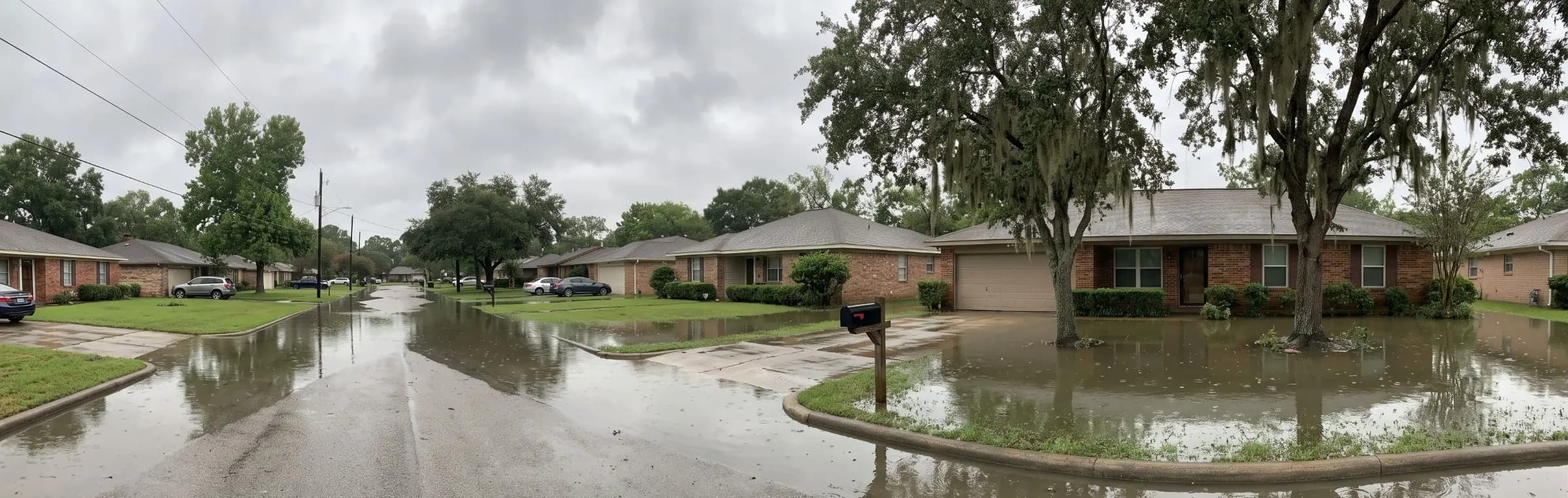

The first 24–48 hours after water enters a Houston home decide whether the loss stays a drying job or turns into a rebuild. Houston adds bayou flooding, slab foundations, and Texas insurance rules that treat plumbing leaks, wind damage, and flood water as three different claims.
In Houston, water damage restoration is the professional process of water removal, drying structural materials, cleaning, and repairing a home, performed to the ANSI/IICRC S500 standard for professional water damage restoration. The final cost depends on the water's contamination category, how long it sat, and whether a named storm has stretched local crews thin.
Key insights
- Typical cost. Water damage restoration in Houston costs $1,500–$7,000 for one affected area, while Category 3 flood water on the ground floor can reach $10,000–$35,000 or more.
- Flood water is always Category 3. Under ANSI/IICRC S500, flood water inside a home requires removal of porous materials such as carpet padding and lower drywall, which is why flood jobs cost far more than plumbing leaks.
- Storms bring wind and flood claims. Hurricane Beryl in July 2024 left more than 2.2 million Harris County households without power and caused an estimated $2–$3 billion in insured wind losses, according to Verisk.
- Policies split by water source. Texas homeowners policies cover sudden plumbing leaks and rain entering through storm damage, but not flood water or gradual leaks.
- Deductible waivers are illegal. A Texas contractor cannot legally waive, rebate, or absorb your insurance deductible, and an offer to do so is a red flag.
- The 50 percent floodplain rule. In the 100 year floodplain, repairs costing 50 percent or more of a home's value trigger the City of Houston's substantial damage rule, which requires elevation before a repair permit is issued.
48 hours after water damage in Houston
In the first 48 hours, identify and stop the water source, make the area electrically safe, photograph the damage, give your insurer written notice, and start drying with an IICRC credentialed company. In Houston, the type of water (flood, plumbing, or storm) decides which insurance policy responds, so identify it before anything else.
 Take one wide shot of the room and one close shot of the water line so the adjuster can see both the extent and the height of the damage.
1. Identify the water source
Rain or bayou water entering from outside is flood water, a failed pipe or appliance is plumbing water, and rain coming through a roof or window damaged by wind is storm water. Texas homeowners and flood policies respond to different sources, so note which one you are dealing with before you describe the loss to anyone.
2. Make the area electrically safe
Switch off power at the breaker only if the panel is dry and you can reach it without stepping through water, and call an electrician or your utility if not. If water is still moving, sewage is involved, or the panel is wet, treat it as an emergency water damage restoration situation and stay out of the room until power is confirmed off. Run generators outdoors, far from doors and windows, because carbon monoxide poisoning is a recurring danger during Houston power outages.
3. Photograph everything and put the timeline in writing
Photograph the source, the water line on walls, and damaged belongings before moving anything, then email your insurer a short written notice. Texas prompt payment deadlines under Chapter 542 of the Insurance Code run from the date the insurer receives notice of the claim, so an email that follows your phone call gives you a dated record of when the clock started.
4. Start drying and call your insurer the same day
Remove standing water and start airflow right away, because the Texas Department of Insurance advises policyholders to stop the leak, dry the area, and avoid permanent repairs until the insurer has seen the damage. Call a restoration company with IICRC credentials at the same time you call the insurer, since drying cannot wait for adjuster scheduling.
5. Check the floodplain status before you repair
If the water was flood water, look up the address in the Harris County Flood Education Mapping Tool and ask the City of Houston Floodplain Management Office about substantial damage before you order repairs. The answer tells you whether to expect an elevation requirement before the city issues a repair permit.
Water damage categories and classes
ANSI/IICRC S500 sorts water damage into three categories by contamination level and four classes by how much water the materials absorbed and how fast it will evaporate. The category decides what gets cleaned or thrown away, and the class decides how much drying equipment the job needs.
 Flood water is Category 3 from the moment it enters a home under ANSI/IICRC S500, so carpet, padding, and drywall it touches are removed rather than dried.
A category can get worse with time. Clean water from a supply line that sits for 48–72 hours can degrade to Category 2, and Houston's warm indoor temperatures speed that up, while flood water is Category 3 from the moment it enters the home.
| Category | What it means | Common Houston sources |
|---|---|---|
| Category 1 | Water from a sanitary source with no significant contamination | Supply line failures, water heater leaks, and sink or tub overflows |
| Category 2 | Significant contamination that can cause illness if exposed or consumed | Washing machine or dishwasher discharge, toilet overflow without solids, and Category 1 water that has aged |
| Category 3 | Grossly contaminated water that can cause severe illness | Bayou and street flood water, storm surge, sewage backups, and standing water that has grown microbes |
Class 2 covers most Houston appliance and supply line leaks, where an entire room of carpet and padding is wet, and Class 3 describes water that came from above, as in an attic air handler overflow or a roof leak. Class 4 covers water bound in dense materials such as hardwood, plaster, brick, and concrete, which dry slowly and need specialty equipment, while Class 1 is a small, low absorption spill.
DIY or pro cleanup in Houston
A small spill of clean water that you catch the same day is a reasonable DIY job in Houston. Flood water, a sewage backup, and anything that has stayed wet for more than 48 hours should go to a professional.
 A same day towel and fan job fits a small clean water spill on sealed tile. Water that reaches the cabinet base, baseboard, or drywall needs moisture readings because the surface can dry while the wall cavity stays wet.
Three things decide it: the water's contamination category, how much of the structure is wet, and how long it has been wet. The EPA says wet materials need to be dried within 24–48 hours to limit mold growth, and past that point it is hard to judge what is still damp inside a wall without meters, so a missed spot can turn into a mold problem weeks later.
| Situation | DIY or pro | Why |
|---|---|---|
| Small clean water spill on tile or sealed floors, dried the same day | DIY | Towels, fans, and a dehumidifier are usually enough |
| Appliance leak soaking a small patch of carpet, caught within a day | DIY with care | Pull and discard the pad, then dry the carpet and subfloor completely |
| Water in drywall, baseboards, or wall insulation | Professional | Wall cavities need moisture mapping and drying equipment |
| Flood water, storm water, or sewage | Professional | Category 3 contamination requires protective equipment and removal of porous materials |
| Water that has been wet longer than 48 hours | Professional | Mold may already be growing, which turns the job into a separate remediation project |
If you may file a claim, call your insurer before you start and keep receipts for fans, dehumidifier rental, and supplies, since some policies reimburse reasonable costs to prevent further damage. Never use a household vacuum on standing water, and stay out of any room where water reached outlets, appliances, or the electrical panel. If you are unsure which category the water falls into, treat it as the more contaminated one until a professional tells you otherwise.
Water damage restoration cost in Houston
Water damage restoration in Houston typically costs $1,500–$7,000 for one affected area, with mitigation priced around $3–$7.50 per square foot and repairs around $20–$37 per square foot. Costs rise with Category 3 water, multiple rooms, and slow response, and they fall when drying starts within the first day.
 Moisture readings set the scope of an estimate, because drywall and insulation that read wet beyond the visible stain are removed and billed as mitigation. Ask for the readings in writing so the adjuster and contractor price the same area.
No public dataset publishes Houston only invoices, so Houston cost figures are RestoreAdvisor estimates as of October 2026. They start from national water damage restoration cost ranges and adjust for conditions that shape Houston losses: ground floor flood exposure, attic air handlers, slab foundations, and post-storm demand. Mitigation (extraction and drying) and reconstruction (drywall, flooring, paint) are usually billed as separate scopes, and an insurance estimate often splits them the same way.
| Scenario | Typical cost | What drives it in Houston |
|---|---|---|
| Water heater or appliance leak caught within a day | $500–$2,500 | Clean water and a small footprint; units in attic closets add ceiling repair |
| AC condensate overflow reaching an attic or ceiling | $800–$4,000 | Wet insulation and drywall below the air handler, often found after weeks of slow leaking |
| Burst or leaking supply line in one room | $1,500–$7,000 | Extraction, drying equipment for 3–5 days, and flooring or drywall replacement |
| Slab leak with wet flooring | $1,500–$6,000 | Cleanup only; locating and repairing the line through the slab is billed separately |
| Roof leak after a storm | $1,000–$6,000 | Wet insulation and ceilings; the roof repair itself is a separate roofing invoice |
| Sewage backup (Category 3) | $2,000–$10,000 | Disinfection, protective equipment, and removal of porous materials |
| Freeze event with several burst lines | $5,000–$25,000+ | Hours of flowing water across rooms, ceilings, and floors before the main valve is closed |
| Flood water on the ground floor (Category 3) | $10,000–$35,000+ | Flood cuts, flooring, drywall, and contents; severe multi level losses can pass $75,000 |
Contamination category
Category 1 jobs are mostly extraction and drying, while Category 3 flood and sewage jobs add protective equipment, disinfection, and removal of porous materials under ANSI/IICRC S500. That added tear-out is where most of the price gap comes from.
Hours before drying starts
The EPA says wet materials need to be dried within 24–48 hours to limit mold growth, and Houston's humid summer air makes that window harder to hit. Every extra day of wet drywall and carpet padding adds demolition and replacement cost.
Storm demand
After a named storm, crews, dehumidifiers, and drywall suppliers tighten at once, so the same job costs more and starts later than it would in a quiet week. Insurers' Xactimate price lists are also updated after regional events, which can shift an adjuster's estimate relative to a contractor's bid.
Ground floor construction
Houston has few basements, so most losses sit in ground floor flooring and lower drywall. Air handlers and ducts in attics and two story ceilings raise demolition and drying costs when a leak starts above the living space, and slab foundations hide supply lines under the floor.
Houston restoration process and timeline
A professional restoration job moves through five stages: inspection, water extraction, removal of unsalvageable materials, structural drying, and final verification. Drying usually takes 3–7 days in Houston and repairs add another 1–3 weeks for a typical room, while a flood loss with permits and an elevation question can run for months.
 Lifting the carpet edge lets air reach the pad and subfloor, which hold moisture longer than the carpet surface.
Houston's humid outdoor air changes how the drying stage works. Crews keep the building closed and rely on dehumidifiers rather than opening windows, because outdoor air in a Gulf Coast summer can be wetter than the air inside a drying home.
1. Inspection and moisture mapping
A technician finds the source, classifies the water, and maps the wet area with moisture meters and often a thermal camera. Response runs from the same day to 48 hours, and longer after a named storm.
2. Water extraction
Pumps and wet vacuums remove standing water in a few hours to a day, because every hour of standing water pushes moisture further into flooring and walls. Faster extraction shortens the drying stage that follows.
3. Removal of unsalvageable materials
Saturated carpet padding, wet insulation, and soaked drywall come out, and in flood jobs drywall is cut above the wicking line, the height water climbed up the wall. Porous materials touched by Category 3 water are discarded rather than dried.
4. Structural drying
Air movers and dehumidifiers run for roughly 3–5 days while technicians return daily to take readings and adjust equipment. Dense materials such as hardwood, plaster, and concrete dry more slowly and can extend the job.
5. Cleaning and verification
The crew cleans and, where the water category calls for it, applies antimicrobial treatment, then checks that readings match an unaffected area of the same material. Wet HVAC components should be inspected before the system runs again.
Ask for the drying log at the end of the job. It lists the readings from each visit, shows when the structure reached its dry standard, and gives the adjuster the documentation behind the mitigation invoice.
After a hurricane or hard freeze, supplies and skilled labor tighten across the metro and every stage runs longer. Ask your contractor for a written schedule with the drying dates and the expected start of repairs.
What to save and what to throw away
Most of a water damaged Houston home can usually be saved if the water was clean and drying started within a day or two. The EPA advises that you can usually clean and dry materials that do not soak up water, and you should throw away materials that soak up a lot of water and cannot be cleaned and dried.
 Carpet, padding, drywall, and insulation that touched Category 3 flood water are discarded rather than dried under ANSI/IICRC S500. Photograph and list them before they go to the curb so the insurer can count them.
Flood water changes the answer for porous items. Bayou, street, and sewage water carry bacteria and chemicals, so carpet, padding, drywall, insulation, and upholstered furniture that touched it generally go in the dumpster even when they look fine.
| Item | Category 1 water | Category 3 water |
|---|---|---|
| Carpet and padding | Padding is usually replaced; carpet is often cleaned and dried if extracted within a day or two | Discard both |
| Drywall and insulation | Often dried in place if caught early; wet insulation is usually removed | Cut out and discard |
| Hardwood and laminate flooring | May dry with specialty equipment, though cupping is common | Usually replaced |
| Mattresses and upholstered furniture | Sometimes professionally cleaned | Discard |
| Electronics and appliances | Do not power on until a technician inspects them | Do not power on; most are replaced |
| Documents and photos | Air dry or freeze quickly, then call a document drying specialist | A specialist can sometimes save valuable items; copies are safer |
| Food and medicine | Discard anything the water touched | Discard everything the water touched |
Photograph and list damaged items before you discard them, and keep a sample of carpet or drywall if the adjuster has not yet seen it. The EPA says materials should read 15 percent or less on a moisture meter before they are refinished.
Houston flood history and your home
Houston floods often because it sits on flat, clay heavy Gulf Coast terrain crossed by bayous. It receives roughly 50 inches of rain a year according to National Weather Service records at Bush Intercontinental Airport, and any flood water that enters a home is Category 3 under ANSI/IICRC S500, so water damage from flooding requires removal of porous materials and professional drying, not just extraction.
Hurricane Harvey in August 2017 put 26–47 inches of rain on Harris County and flooded 154,170 single family houses, about 9–12 percent of all buildings in the county, according to the Harris County Flood Control District's final report. The City of Houston accounted for 96,410 of those houses, unincorporated Harris County for 34,600, and Pasadena for 4,610.
Floodplain maps do not capture the full risk. A little less than half of the homes that flooded in Harvey sat outside the 100 and 500 year floodplains, and only 36 percent of flooded homes carried flood insurance. Houston also flooded in Tropical Storm Allison in 2001 and in the Memorial Day 2015 and Tax Day 2016 storms.
Hurricane and storm damage in Houston
Houston storm damage arrives in two forms that Texas insurance treats separately: wind driven rain entering through a damaged roof, window, or door, and flood water rising from outside. Most Houston hurricanes involve both, so storm and hurricane water damage is usually claimed under two different policies.
 A tarp keeps rain out but does not dry the insulation and ceiling beneath it. Have those checked even when the roof looks sealed.
Hurricane Beryl made landfall near Matagorda Bay as a Category 1 storm on July 8, 2024, and Verisk reported that more than 2.2 million households in Harris County lost power while insured wind losses reached an estimated $2–$3 billion. Roof damage, broken windows, and fallen trees let rain into homes across the metro, and days without air conditioning in July heat left wet materials slow to dry.
A roof opened by wind or a fallen limb lets water into insulation and ceilings long before a stain appears, which is why water damage from a roof leak should be dried inside the 24–48 hour window even when the roof still waits on a contractor. Tarp the opening, photograph the damage, and keep receipts, because insurers expect homeowners to prevent further damage.
Homes east of Highway 146 inside the city limits of Seabrook, La Porte, Shoreacres, Pasadena, and Morgan's Point can get wind and hail coverage through the Texas Windstorm Insurance Association, according to the Texas Department of Insurance, and that coverage excludes flood. Homeowners in that area often carry a TWIA policy for wind and hail, a separate homeowners policy for plumbing and other perils, and a flood policy for rising water.
Slab leaks and plumbing in Houston
A slab leak is a supply or drain line that fails inside or beneath the foundation, and it is among the most common hidden causes of water damage in Houston. Most Houston homes sit on concrete slabs over expansive clay, which swells when wet and shrinks when dry, and that movement strains buried pipes and joints. The first sign is often a warm floor spot, a rising water bill, or the sound of running water with every fixture off.
Water from a slab leak travels sideways under flooring before it shows, so by the time wet carpet or a lifted floor plank appears, the leak may have run for weeks. A plumber has to locate and isolate the line first, and restoration begins once the water is shut off and the repair path is clear.
Because clay movement links plumbing failures to foundation water damage, Texas policies often treat slab and foundation damage from a plumbing leak separately from the leak itself, so ask your agent whether your policy carries a foundation endorsement before you file. A leak that ran continuously for weeks is also treated as gradual, and the Texas Department of Insurance says most home policies do not cover gradual leaks.
AC condensation damage in Houston
Air conditioner condensation is one of the most common non storm causes of water damage in Houston, because the long cooling season keeps air handlers running most of the year. A clogged condensate drain line or a cracked drain pan can leak for weeks before a ceiling stain appears, and HVAC water damage from condensation soaks insulation and the drywall below long before anyone notices. Air handlers in attics are the usual source.
 Rings in a ceiling stain usually mean the area has been wet and dried more than once, which points to a slow leak and not a single sudden event.
Because these leaks build slowly, adjusters often ask how long the leak ran, and a leak an insurer judges to be gradual can be denied under the exclusion for continuous or repeated seepage. A dated record of the last AC service, the first stain you noticed, and the day you shut the system off supports a sudden and accidental claim.
Freeze damage and Winter Storm Uri
Freeze damage in Houston means burst pipes in attics, exterior walls, garages, and outdoor lines that were never insulated for a hard freeze, and it can flood a house within hours once temperatures rise and ice melts. Winter Storm Uri in February 2021 showed the scale: the Texas Department of Insurance reports more than 450,000 insurance claims and more than $8 billion in insured losses statewide, with much of the damage caused by water from broken pipes.
Most frozen pipes in Houston fail where they are exposed: attic supply lines, pipes in exterior walls, and hose bibs. Shutting off the main valve before a forecast hard freeze and draining exposed lines removes the water that would otherwise pour out at thaw, and the same steps apply when a grid outage takes away heat.
Most homeowners policies cover water damage from leaks and broken pipes, but an insurer may deny a claim when the policyholder did not protect the property by shutting off the water and moving valuables. Photograph the shutoff, keep plumber and restoration invoices, and record when you first noticed the leak.
Signs of water damage in a Houston home
The most reliable signs of water damage in a Houston home are a musty smell, stains that spread or darken, bubbling paint, and flooring that cups or lifts. A hidden leak gives fewer signals than a burst pipe, so a rising water bill or a warm spot on the floor is often the earliest warning.
 Blistered paint above the baseboard means moisture is sitting behind the surface. Take a moisture reading before repainting, because new paint hides the problem and can trap damp drywall.
Houston's humidity masks damage because wall cavities, attic insulation, and the layers under a floor can stay damp while the surface looks dry. Start with the places where plumbing and air handlers sit: under sinks, around the water heater, below the attic air handler, and along exterior walls after heavy rain.
| Sign | Likely cause | Where to look |
|---|---|---|
| Musty odor with no visible source | Wet insulation or drywall from a small supply or drain leak | Closets near the air handler, under sinks, and behind baseboards |
| Brown or yellow ceiling stain that keeps growing | Roof leak or air conditioner condensate overflow | Ceilings below the attic air handler and under roof penetrations |
| Warm spot on the floor or running water sound with fixtures off | Hot water line leaking under the slab | Floors along the path from the water heater to kitchen and baths |
| Water meter dial moves with every fixture off | Active leak between the street and the house or inside it | The meter box or leak indicator near the street |
| Cupped or buckled wood and laminate flooring | Moisture rising from below or seeping in at the edges | Near exterior doors, dishwashers, and refrigerators with ice makers |
A moisture meter gives you a reading instead of a guess. Professionals compare readings in the suspect area with an unaffected spot of the same material, as ANSI/IICRC S500 describes, and the EPA advises keeping indoor relative humidity between 30 and 50 percent. If the water meter near the street keeps turning with every fixture off, call a plumber to isolate the leak before you order any restoration work.
Water damage risk by Houston area
Houston's flood driven water damage risk is concentrated along the Addicks and Barker reservoirs, Brays Bayou, Clear Creek, and the San Jacinto River, though Harvey also flooded homes outside mapped floodplains. Risk depends on bayou proximity, reservoir position, elevation, and the age of the home more than on the ZIP code, so local patterns are a starting point for what to check at your address.
 Flood risk follows bayou proximity, reservoir position, and elevation more than ZIP code. Check the mapped floodplain for the exact address and ask the seller about past flooding before relying on a neighborhood name.
Homes built before 1960 inside Loop 610 carry a different set of risks, including original cast iron drains and pier and beam floors that hide slow leaks. Water damage in an older or historic home often involves plaster and lead paint rules that newer homes avoid.
| Flood area | Main water risk | Where to start |
|---|---|---|
| Buffalo Bayou and the reservoirs (Katy, west Houston) | Addicks and Barker reservoir flooding during Harvey, including areas that had not flooded before | Ask the seller for flood history and price a flood policy |
| Brays Bayou corridor (Meyerland, Bellaire) | Repeated bayou flooding in recent major storms | Check the mapped floodplain and prior claims history |
| San Jacinto River and Lake Houston (Kingwood, Humble) | River and lake flooding during Harvey | Confirm elevation and flood coverage |
| Clear Creek (Pearland, Friendswood) | Low lying neighborhoods along the creek | Check drainage and floodplain status |
| Cypress Creek and Spring Creek (Cypress, Spring, The Woodlands) | Creek flooding and tree damage to roofs | Trim trees and inspect the roof after storms |
| Galveston Bay shoreline (Pasadena, La Porte, Seabrook) | Storm surge exposure and wind coverage through TWIA | Confirm wind and flood policies separately |
| Older inner Loop (Heights, Montrose) | Older plumbing and pier and beam floors rather than a single flood source | Inspect supply and drain lines for slow leaks |
Water damage in the greater Houston area
Outside the City of Houston, water damage comes from the Brazos River in Fort Bend and Brazoria counties, Galveston Bay surge in Galveston and Chambers counties, and West Fork San Jacinto River flooding and Lake Conroe dam releases in Montgomery County. Each of those counties has its own floodplain administrators, drainage districts, and coastal insurance exposure, so the rules change at the county line.
 Newer subdivisions rely on retention ponds and drainage channels, so a street far from any bayou can still flood when those systems overflow.
The City of Houston's Chapter 19 rule applies only inside city limits, so a home in unincorporated Harris County or in a suburb answers to a different floodplain office, though the Harris County Flood Education Mapping Tool shows floodplain status for any address in the county. Communities that take part in the National Flood Insurance Program must still apply a substantial damage rule, generally at the same 50 percent threshold, so call the local floodplain administrator before you sign a repair contract.
| Area | Main water pattern | What to check |
|---|---|---|
| Sugar Land, Missouri City, and Richmond | Brazos River and San Bernard River flooding, both at record heights in Harvey | County and drainage district floodplain maps |
| Alvin, Manvel, and Brazoria County | Brazos River flooding that was slow to recede after Harvey | Flood zone and the separate TWIA wind policy |
| League City, Webster, and Clear Lake | Clear Creek overflow and drainage that backs up through Clear Lake | Clear Creek floodplain status and elevation |
| Galveston and Texas City | Storm surge that overtopped the seawall in Hurricane Ike | Separate flood and wind policies, and elevation rules |
| Baytown and Chambers County | Galveston Bay storm surge, as in Hurricane Ike | Flood zone and local permit rules |
| Conroe, Willis, and Montgomery County | West Fork San Jacinto River flooding and Lake Conroe dam releases in Harvey | Floodplain status and distance from the river and lake |
Outside Harris County, ask the local building department which water repairs need permits, because trade permit rules differ by city. Response times from restoration companies can also run longer in the outer counties, so confirm travel coverage before you rely on a 24 hour promise.
Texas insurance rules for water damage
In Texas, homeowners insurance covers water damage that is sudden and accidental, such as a burst pipe, but it does not cover flood water or damage from gradual leaks. Those exclusions decide whether a Houston loss is paid by your homeowners insurer, by a flood policy, or by you.
 Texas homeowners policies usually cover a sudden supply line failure but exclude a drip that runs for weeks as gradual. Shut off the valve, photograph the leak, and keep the plumber's invoice to show when it started.
Wind driven rain is covered when a storm damages the roof or a window first, and many policies apply a separate wind and hail deductible to that claim. Sewer or drain backup is excluded unless the policy carries a water backup endorsement.
| Water source | Homeowners policy | Flood policy |
|---|---|---|
| Burst pipe or appliance leak | Usually covered if sudden | Not covered |
| Rain through a roof or window damaged by wind | Usually covered, possibly with a wind and hail deductible | Not covered |
| Bayou, creek, or street flooding | Not covered | Covered up to policy limits |
| Slow leak or slab leak seepage | Usually excluded as gradual | Not covered |
| Sewer or drain backup | Only with a water backup endorsement | Only when part of a general flood |
A flood policy through the NFIP or a private carrier covers rising water that a homeowners policy excludes. Because flood insurance carries a waiting period, buying it after a storm forms is too late for that storm.
As of October 2026, Chapter 542 of the Texas Insurance Code, the Prompt Payment of Claims Act, requires insurers to acknowledge a claim, begin investigating, and request needed documents within 15 days of receiving notice of the claim, to accept or reject the claim within 15 business days after receiving everything requested, and to pay within five business days of accepting. The deadlines extend by 15 days after a weather related catastrophe as defined by the insurance commissioner, and late payment triggers statutory interest.
How insurers pay for restoration
A restoration company usually bills in two scopes, mitigation first and reconstruction later, and the insurer pays on its own schedule. Your deductible comes out of the claim payment, and anything the policy does not cover, such as flood damage under a homeowners policy, stays your bill.
 Get a copy of every document you sign, and ask the contractor to explain any line about payment before you initial it.
Who the check goes to
Some insurers pay a contractor directly when you sign a direction to pay, and others issue the check to you. If you have a mortgage, the lender is usually named on payments for structure damage, which adds an endorsement step before you can pay contractors. Read any work authorization or direction to pay before you sign it, because it can give the company a right to collect from your claim payment.
Replacement cost or actual cash value
The Texas Department of Insurance explains that replacement cost coverage pays to repair or rebuild at current prices without subtracting for age or wear, while actual cash value coverage subtracts depreciation and pays less. Check which one your policy carries before you approve repairs, and ask your insurer whether any withheld depreciation is paid after the work is finished.
Supplements for hidden damage
Demolition often reveals wet framing, insulation, or subfloor that the first estimate missed. The contractor can send the adjuster a supplement with photographs and moisture readings, which is why the drying log matters.
When a public adjuster makes sense
A licensed public adjuster works for you on the claim for a fee. This can help after a large or disputed loss, and it is separate from the restoration company, which cannot act as your adjuster while doing the repairs.
Houston permits and floodplain rule
Most water damage repairs in Houston, including drywall patching, painting, flooring, tile, carpet, and cabinets, do not need a city permit, but mechanical, plumbing, electrical, and structural work does. In the 100 year floodplain, repairs costing 50 percent or more of the structure's value count as substantial damage and require the home to be brought into compliance by elevation before a repair permit is issued.
The City of Houston's Chapter 19 floodplain ordinance applies this rule to properties in Zone A, AO, and AE, and the Floodplain Management Office will complete a Substantial Damage Estimate at no charge when you submit a Harris County Appraisal District summary or a private appraisal. The estimate takes about five business days and requires an on site inspection, so request it before you sign a reconstruction contract.
Extraction and drying do not require permits, so mitigation can start the same day while permit questions are settled. Reconstruction that touches wiring, supply lines, or framing needs the matching trade permit, and a contractor should state in writing who is responsible for pulling each one because the permit you need depends on the work and on the home's floodplain status.
Federal help after a Houston flood
After a federally declared flood, Houston homeowners and renters may qualify for FEMA assistance and SBA disaster loans on top of insurance. That federal help depends on a disaster declaration, and it covers needs that insurance and other sources leave unmet.
 FEMA applications can be started online or by phone, and SBA loan applications can be filed online, so a laptop and a folder of records are enough to begin.
In past floods the City of Houston has asked residents to report damage through 311, because those reports feed the official damage count used to request federal recovery assistance. Report even if you plan to rely on insurance, and keep your photographs and receipts either way.
FEMA individual assistance
FEMA's Individuals and Households Program provides financial help and direct services for uninsured or underinsured necessary expenses and serious needs after a declared disaster. The FEMA Helpline at 800-621-3362 can answer questions and give referrals.
SBA disaster loans
The U.S. Small Business Administration lends to homeowners and renters in declared disaster areas. As of October 2026, homeowners can borrow up to $500,000 to repair or replace a primary residence, and renters and homeowners can borrow up to $100,000 for personal property. The loans cover losses not fully covered by insurance, and insurance proceeds may reduce the amount.
NFIP Increased Cost of Compliance
Most standard NFIP flood policies include up to $30,000 in Increased Cost of Compliance coverage. It applies when the community determines that flood damage equaled or exceeded 50 percent of the building's value, which is the same threshold behind the City of Houston's substantial damage rule. It helps pay for elevation, relocation, or demolition, and it is filed separately from the regular flood claim.
Federal assistance does not replace a flood policy, and applying does not pause your insurer's deadlines. File the insurance claim first and tell FEMA or the SBA about any payments you receive.
Who pays in a rental, condo, or townhome
Landlords generally repair the structure, tenants insure their own belongings, and condo associations handle common elements while owners handle their units. Renters, condo owners, and townhome owners each have a different first call.
 Dampness at a door or shared wall may come from another unit, so the source has to be identified before anyone knows whose coverage applies. Ask management or a plumber to inspect before you pull up the carpet.
Renters
Under Chapter 92 of the Texas Property Code, a landlord must make a diligent effort to repair conditions that materially affect the health or safety of an ordinary tenant after notice, as long as the tenant is current on rent and did not cause the problem. Send written notice and keep a copy, because the law presumes seven days is a reasonable time to repair. A landlord must also give written notice at or before lease signing on whether the dwelling is in a 100 year floodplain, and must separately disclose known flooding in the previous five years. A renters policy covers belongings damaged by a sudden event such as a burst pipe, but flood damage still needs a separate flood policy.
Condo owners
The condominium declaration decides what the association insures and what the owner insures, and an HO-6 policy covers the owner's interior improvements and belongings. Report a leak to the association or management company right away, since they often control the shutoffs and risers.
Townhome owners
Many Houston townhomes are separately owned lots, so the owner's own homeowners policy usually responds. Shared roofs, party walls, or common plumbing may fall to the association, so check the governing documents before you assume the damage is yours to repair.
Water that comes from a neighbor's unit can be covered by that neighbor's liability coverage or by the association's policy, depending on the cause. Photograph the damage, note when you first saw it, and ask the association in writing which policy it treats as primary.
Buying a Houston home with flood history
Texas sellers must complete the state's seller's disclosure notice, and a Houston buyer should treat its flood answers as a starting point rather than proof of a dry history. The notice asks about flood insurance, past flood water entering the structure, reservoir releases, and floodplain location.
If the seller delivers the notice after the contract is signed, the buyer may terminate within seven days of receiving it. Many Houston homes that flooded were repaired and resold, and because drywall, paint, flooring, and cabinet work do not need a city permit, a clean permit record does not prove a dry history. That is why buying a house with water damage history calls for moisture readings even on a recently renovated home.
Look for signs of undisclosed flood repair
Fresh paint or new baseboards only on the lower few feet of walls, drywall seams about two feet above the floor, and flooring that does not match from room to room can all point to flood cuts and replacement. Ask a pre-purchase inspector to take moisture readings and use a thermal camera on exterior walls and garage walls.
Request the paper trail
Ask for repair invoices, the CLUE claim history, and any Substantial Damage Estimate issued for the property. Records of what was removed and dried matter more than a statement that the work was done.
Price flood insurance before closing
Most NFIP policies carry a waiting period, so a buyer who waits until after closing may be uninsured for the first weeks of ownership. A quote also shows how an insurer views the address, which is useful information even if you never buy.
Sellers should answer the flood questions accurately, because an inaccurate answer can expose them to a claim after closing. Repair invoices, dated photographs of the drying, and a moisture reading report make a flooded home easier to sell, and they answer the questions a buyer's inspector will ask first.
Hiring a Houston restoration company
Hire a Houston water damage company that holds current IICRC certification and puts a written scope with water category and damage class in your hands. Texas licenses mold assessors and remediators, plumbers, and electricians but does not issue a license specific to water mitigation, so check credentials and ask for the scope in writing.
 A thermal camera shows temperature differences that can point to wet material, but it does not measure moisture. Ask the company for the moisture meter readings behind any heat map.
The Texas Department of Insurance says it is illegal for a contractor to offer to waive, rebate, or absorb a deductible, and contracts of $1,000 or more that involve an insurance settlement must carry a notice that the policyholder pays the deductible. A contractor also cannot act as your public adjuster while doing the repair work, so a company that offers to negotiate your claim and also rebuild your house is breaking that rule.
| Question to ask | A credible answer | A red flag |
|---|---|---|
| Are you an IICRC Certified Firm, and can I verify it? | A firm listing I can look up in the IICRC locator | A logo or "certified technicians" with no firm listing |
| What category and class is this water? | A written category and class, with the reason for each | No classification, or only "water damage" |
| Will I get a drying log? | Daily moisture readings and equipment counts | Equipment left running with no readings |
| How will you handle my deductible? | You pay it, and the company bills the insurer for the balance | An offer to waive, rebate, or absorb it |
| Who pulls permits for trade work? | Named licensed trades, with responsibility stated in writing | "No permits needed" for wiring, plumbing, or framing |
| Will you negotiate my claim for me? | A referral to a licensed public adjuster if you want one | An offer to act as your adjuster while doing the repairs |
Ask for a local address and proof of general liability insurance, especially after a named storm brings in out-of-town crews, and compare two written scopes line by line before you hire a water damage restoration company. A good scope names the water category, damage class, and equipment, so you can see where two bids differ.
Mold after water damage in Houston
Mold can begin growing on wet materials within 24–48 hours, and Houston's humid outdoor air slows drying when doors and windows stay open. Water damage restoration dries and repairs the structure, while mold remediation is a separate service with its own standard, ANSI/IICRC S520.
A moisture meter reading that confirms materials are dry is the best protection against a later mold claim, so ask your restoration company to give you the readings in writing. Water dried inside two days rarely reaches the point where remediation is needed.
If mold does appear after a loss, mold remediation in Houston is a separate service that Texas regulates differently from water damage work. It carries its own licensing thresholds, paperwork, and clearance testing.
How to prevent water damage in Houston
Four steps prevent most water damage in a Houston home: know your shutoff valves, replace hoses and supply lines on a schedule, insulate exposed pipes, and carry flood insurance. Most Houston losses start with a failed hose, a frozen line, or a flood with no policy behind it, and each step closes off one of those paths.
 Check hose connections for bulges, rust at the fittings, and drips at the wall valve. Corrosion at a coupling is often the first sign of a slow leak behind the machine.
Know your shutoff valves
Locate and test the main water shutoff and the valve at each appliance so you can stop a leak in seconds. Every hour a leak runs adds drying and replacement cost.
Replace hoses and supply lines before they fail
Braided stainless supply lines on washers, toilets, and sinks resist bursting better than rubber hoses and should be checked yearly. Replace rubber washing machine hoses about every five years.
Insulate exposed pipes and plan for a hard freeze
Wrap pipes in attics, garages, and exterior walls to prevent frozen pipes, and cover outdoor spigots before a forecast hard freeze. If power fails during one, shut off the main valve and open faucets to drain the lines.
Buy flood insurance before hurricane season
Hurricane season runs June 1 through November 30, and flood policies have a waiting period, so buy before a storm appears on the forecast. A little less than half of Harvey's flooded homes were outside the mapped floodplains, so a low risk zone is not exempt.
Frequently asked questions
Houston homeowners ask the same questions after finding water damage, from cost and insurance to permits and cleanup. Short answers come first, with the Texas rules and local numbers that apply.
How much does water damage restoration cost in Houston?
Typically $1,500–$7,000 for one affected area, based on RestoreAdvisor estimates. Minor appliance leaks start near $500, and Category 3 flood water on the ground floor can reach $10,000–$35,000 or more. Costs rise with the contamination category, the hours before drying starts, and storm demand on local crews.
Does Texas homeowners insurance cover water damage?
It covers sudden and accidental water damage such as a burst pipe, but not flood water or gradual leaks. Rain that enters through a roof or window damaged by wind is usually covered, sometimes with a separate wind and hail deductible. Flood damage needs a separate flood policy.
Do I need a permit for water damage repairs in Houston?
Not for drywall, paint, flooring, tile, carpet, or cabinets, but mechanical, plumbing, electrical, and structural work needs a trade permit. In the 100 year floodplain, repairs costing 50 percent or more of the home's value trigger the substantial damage rule, which requires elevation before a repair permit is issued.
Does Texas require a license for water damage restoration?
No. Texas licenses mold assessors and remediators, plumbers, and electricians, but it has no license specific to water mitigation. Look for IICRC Certified Firm status, a written scope, and proof of liability insurance instead.
How long do I have to report water damage to my Houston insurer?
As soon as you find it. Texas policies set reporting deadlines, and the Texas Attorney General notes they generally fall around 30 days after you discover or should have discovered the damage. The Texas Department of Insurance says hidden damage usually has to be reported within days after you first see it, so waiting for a repair estimate first can put the claim at risk.
Does flood insurance in Houston have a waiting period?
Yes, most NFIP flood insurance policies take effect 30 days after purchase, with limited exceptions such as a policy bought at a mortgage closing. A flood policy bought after a storm forms in the Gulf does not cover that storm.
How long does water damage restoration take in Houston?
Drying usually takes 3–7 days and repairs another 1–3 weeks. After a regional storm, crew and material shortages can stretch both phases.
Can I file both a wind claim and a flood claim after the same storm?
Yes, and you usually need to. Wind damage goes to your homeowners or TWIA policy and flood damage goes to your flood policy, each with its own adjuster and deductible. Document which damage came from which source so each insurer pays only its share.
Is water damage dangerous to my health?
It can be. The EPA says flood water can contain bacteria, chemicals, and sewage, and that breathing mold can make you sick. Children and pregnant people should not take part in flood cleanup, and people with asthma or weakened immune systems should stay away from moldy areas. A small clean water leak caught within a day carries far less risk.
Will my insurer pay the restoration company directly?
Sometimes. Some insurers pay a contractor directly when you sign a direction to pay, and others issue the check to you, with your mortgage lender named on payments for structure damage. You owe the deductible either way, and the Texas Department of Insurance says the contractor cannot waive it.
- IICRC S500
- EPA: Flood Cleanup to Protect Indoor Air and Your Health
- HCFCD: Hurricane Harvey Impact and Response in Harris County
- NWS Houston/Galveston: Houston Intercontinental Climate
- TDI: Does Insurance Cover Water Damage Caused by Burst Pipes?
- TDI: Harris County Windstorm Catastrophe Area
- TDI: Roofing and Insurance, Know the Law
- City of Houston: Floodplain Management Office
- SBA: Disaster Loans for Physical Damage
- FEMA: Increased Cost of Compliance Coverage
Sam Hickerson is the founder of RestoreAdvisor and writes consumer guides on mold remediation, water damage restoration, inspection, testing, and home recovery. His work focuses on helping homeowners understand costs, risks, and when to call a professional. He draws on guidance from the EPA, CDC, IICRC, and other authoritative sources to make complex home issues easier to navigate.