
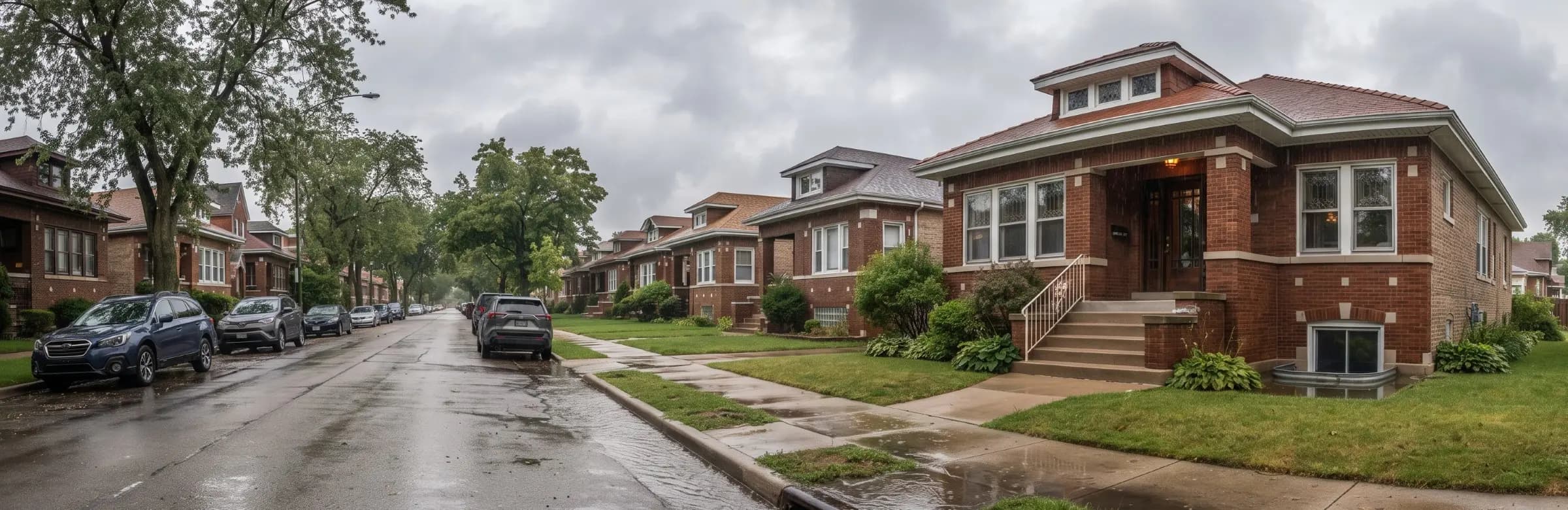

Most of Chicago drains through combined sewers that carry rain and household waste in the same pipe, so a hard storm can push that mix back up through a basement floor drain. According to WBEZ, more than 12,000 basement flooding reports reached 311 in the 17 days after the July 2, 2023 storm, so water damage restoration in this city often starts as a sewage cleanup instead of a pipe repair. Brick two flats, plaster walls, and flat roofs hold moisture for days, and wet drywall or wood framing can start growing mold within 24–48 hours.
Water damage restoration is the extraction of standing water, structural drying, and cleaning or rebuilding of affected materials to the ANSI/IICRC S500 standard, and in Illinois no state authority licenses that work, so the rules come from the Home Repair and Remodeling Act, which the Illinois Attorney General enforces, and from permits issued by the Chicago Department of Buildings. The standard sorts water into three categories by contamination and into four classes by how much moisture the structure holds, and both labels decide how long a Chicago job runs and which materials a crew can save.
Key insights
- Cost: Most Chicago water damage jobs cost $2,000–$9,100, with an average near $4,900, and sewage or multiroom flood losses reach $13,000–$32,500 or more.
- Sewer backups: Chicago's combined sewers carry rain and waste together, so water that rises through a floor drain is Category 3 under ANSI/IICRC S500 and porous materials usually come out.
- Flood history: WBEZ counted more than 12,000 basement flooding reports to 311 between July 2 and July 18, 2023, which is more than 2021 and 2022 combined.
- Licensing: Illinois licenses no water mitigation firms, so check IICRC certification, insurance, and a written contract under the Home Repair and Remodeling Act before work starts.
- Coverage: Standard homeowners policies usually exclude sewer backup unless an endorsement was added, and a federal flood policy takes 30 days to take effect.
- Permits: Chicago exempts drywall or plaster repair up to 1,000 square feet, but replacing drain, water, soil, waste, or vent pipes needs a permit and a licensed contractor.
Water damage costs by source and room
Most Chicago water damage jobs cost $2,000–$9,100, and the average is about $4,900. Small spot mitigation starts near $500, while a sewer backup or a flood across several rooms that reaches structural repair can climb to $32,500 or more. The spread comes mostly from the water category, the square footage that got wet, and whether drywall, flooring, or plaster must be rebuilt.
 Water that rises through a floor drain is Category 3 under ANSI/IICRC S500, so porous materials it touches are removed instead of dried, which is why sewer backups sit at the top of the cost range.
The Bureau of Labor Statistics reported that construction and extraction pay in the Chicago area stood at about 130 percent of the U.S. average in May 2025. A Chicago water damage restoration cost also reflects access, since hoses, pumps, and bagged debris have to travel through narrow gangways between brick two flats, up stairs to upper units, and out of basements where material soaked with sewage is hauled away.
Scenarios from a leak to a sewer backup
Costs rise sharply once water carries contamination, because Category 3 losses add removal, disposal, and sanitizing on top of the drying bill. A clean supply line leak caught within a day stays near the low end, while the same volume from a floor drain lands near the top.
Mitigation work is priced in tiers. Minor spot mitigation runs $500–$2,000, standard mitigation $2,000–$5,200, mitigation plus basic repairs $5,200–$9,100, and extensive loss with structural repair $13,000–$32,500 or more. After hours and weekend calls usually add 25–50 percent, and a citywide storm delays start dates because crews and dehumidifiers are shared.
| Scenario | Estimates | Chicago context |
|---|---|---|
| Supply line burst | $1,300–$3,900 | Braided hose or copper fitting failing in a bungalow bath or kitchen |
| Washer or dishwasher overflow | $2,600–$6,500 | Second floor laundry closets in two flats that drip into the unit below |
| Roof leak during a storm | $3,300–$9,100 | Flat membrane roofs on greystones and two flats that pond at parapet seams |
| Sewer backup | $9,100–$18,000+ | Floor drain overflow in a combined sewer area, with carpet, pad, and lower drywall removed |
| Storm flooding across rooms | $13,000–$32,500+ | Basement and first floor loss after rain that overwhelms street catch basins |
Cost by room in a Chicago home
The room matters because Chicago basements, plaster ceilings, and hardwood floors each dry on a different schedule. Rooms with finished lower walls, built in cabinets, or plaster ceilings below an upstairs bath cost more because more material has to be opened and replaced, even when the volume of water is small.
The floor that takes the water also matters. A second floor leak in a two flat usually wets the unit below, so the bill can cover two units. A basement slab has to dry for days under dehumidifiers before flooring goes back, and that adds time and cost.
| Space | Estimates | Chicago reason |
|---|---|---|
| Basement | $2,000–$13,000+ | Finished lower levels in bungalows and two flats sit beside combined sewer floor drains |
| Bathroom | $700–$5,900 | Tub and supply leaks soak the plaster ceiling in the room below |
| Kitchen | $2,000–$10,500 | Sink and dishwasher lines wet old tile and hardwood over wood subfloors |
| Living or family room | $4,200–$24,000 | Oak strip floors and plaster walls add drying days and equipment |
| Laundry room | $1,300–$6,500 | Basement hookups beside floor drains, and second floor hookups above other units |
Per square foot and equipment charges
Mitigation costs about $4.00–$9.75 per square foot overall, and the rate follows the water category. Category 1 water runs $4.00–$5.25 per square foot, Category 2 runs $5.25–$8.50, and Category 3 runs $9.00–$9.75 or more, while repair and rebuild work adds $26–$48 per square foot. A 100 square foot loss costs about $400–$1,000 to dry and $3,000–$5,800 with repairs, and a 300 square foot loss costs $1,200–$2,900 to dry and $9,000–$17,500 with repairs.
Drying equipment is billed by the day, and most clean water jobs keep it running for three to five days. A quote that lists the equipment count and the number of days lets you check the total, and daily readings decide when the equipment leaves, so ask for the daily rate for each unit in writing.
| Line item | Estimates | Billing note |
|---|---|---|
| Air mover per day | $35–$50 | Counts should rise with affected wall length and the number of rooms |
| Dehumidifier per day | $100–$200 | Large refrigerant units for basements and plaster rooms cost more |
| Moisture mapping visit | $250–$650 | Often waived when the firm also performs the drying |
Two days to act after a basement flood
In the first 48 hours, cut power to wet areas, find the water source, document the damage, notify the insurer, and start extraction. Water that came up through a floor drain or toilet should be treated as sewage, so keep children, pets, and bare skin out of the room until a crew arrives with protective gear.
 Photograph the waterline with a tape measure against the wall before anything is moved, since adjusters compare dated images against the drying log and the line records how high the water rose.
Firms that run emergency water damage restoration triage by severity, so a sewage backup or a flooded electrical panel usually gets a same day visit while a slow ceiling stain waits. Tell the dispatcher what the water touched when you call, since that decides the crew size and whether contaminated material has to be bagged and hauled out.
1. Make the basement electrically safe
If water is touching outlets, a furnace, or the panel, stay out and ask ComEd to disconnect service, since standing water can carry current. Call 911 if you smell gas, and never use a shop vacuum on sewage or in standing water near electrical equipment.
2. Identify the source before you name the water
Check whether the water came from a clean supply line, rain, or a floor drain or toilet, because the source sets the category under ANSI/IICRC S500 and the safety steps that EPA lists for flood cleanup. Sewer water and rising ground water are Category 3 and call for an N95 respirator, goggles, gloves, and boots, while clean supply water is Category 1 for roughly the first 48 hours.
3. Photograph and video every wet surface
Record the waterline on each wall, the source if it is visible, and the contents that were wet before you move anything. Adjusters compare dated images against the drying log, and a 311 service request number adds a time stamp when the city's sewer may have been involved.
4. Report the loss to your insurer and to 311
Tell the insurer as soon as the damage is found and write down the claim number. If street water or a sewer main may be involved, file a 311 request so the Department of Water Management can check the city side, since the private line from the house to the main and the main itself have different owners.
5. Move people, pets, and valuables to dry ground
Lift electronics, papers, and photographs to a dry floor, pull rugs, and close off the wet rooms. Photograph mattresses and upholstered furniture that touched Category 3 water before they are bagged for disposal.
6. Pump out clean water and keep the heat on
Extract clean water with a wet vacuum and keep the indoor temperature near 70°F so drying equipment works. Do not run fans through a sewage area, because moving air carries contamination into rooms that stayed dry.
7. Book drying within 24 hours
Choose a firm that starts extraction the same day and arrives with a moisture meter, air movers, and dehumidifiers. Drying that begins inside 24 hours keeps most drywall and subfloors salvageable, while a delay beyond 48 hours pushes the job toward removal and mold treatment.
Calling 311, a plumber, or a crew
Call 311 for street water or a city sewer problem, a plumber for a pipe or private lateral, and a restoration firm once water is on floors or in walls. The insurer should hear about every loss within the first day, whichever call comes first, so the claim has a documented start date.
Responsibility in Chicago splits at the property line. The city maintains the sewer main and the street, and the owner usually maintains the lateral that runs from the house to the main, so a plumber's camera inspection shows which side failed by finding where the blockage behind a sewage backup sits. Ask the plumber for a written report and keep the video.
| Source | Call first | Then call |
|---|---|---|
| Floor drain or toilet backup | 311 and a plumber | Restoration firm for Category 3 cleanup, then the insurer |
| Burst or leaking pipe | Plumber or the main shutoff | Restoration firm, then the insurer |
| Roof or window leak | Roofer for a temporary cover | Restoration firm, then the insurer |
| Water heater or appliance leak | Shutoff valve and a plumber | Restoration firm if floors or walls are wet |
| Street water through a window well | 311 | Restoration firm, then the insurer and flood carrier |
| Upstairs neighbor's leak | Landlord or association | Restoration firm and your own insurer |
| Water in a rented unit | Landlord, in writing | Restoration firm through the landlord, then renters insurance |
How combined sewers flood basements
Chicago basements flood mainly because combined sewers fill during heavy rain and push mixed stormwater and sewage back through floor drains. Window wells, clay soil, and old foundation walls add a second route for water, and the same storms that fill the sewers also load the ground around the house.
 The floor drain is the lowest opening in the system, so an overfull combined sewer shows itself there first, and a plumber's camera inspection of the private lateral shows which side of the property line failed.
Combined sewers and the deep tunnels
The Metropolitan Water Reclamation District's Tunnel and Reservoir Plan stores combined sewage in about 110 miles of deep tunnels and three reservoirs, with 17.5 billion gallons of capacity once the last reservoir is finished. When the tunnels fill during a storm, the local pipes that feed them back up first at the lowest openings, which are basement floor drains.
Most local sewers in the Chicago area are more than a century old. A backup brings Category 3 water into the house, so sewage backup cleanup means removing carpet, pad, and wet drywall instead of drying them in place, and a plumber should camera the lateral before the finished basement is rebuilt.
Storms that broke Chicago records
The daily rain record at O'Hare is 6.86 inches, set on July 23, 2011, when about three hours of predawn rain beat the old record of 6.64 inches from September 2008, according to the National Weather Service office in Chicago. Intensity that high fills street catch basins within minutes, and the water that cannot enter the sewer rises into low windows and basement stairwells, which is how storm damage reaches a finished basement.
Chicago's O'Hare station averages 37.86 inches of precipitation a year, and the July 2, 2023 storm dropped up to 9 inches in parts of the area in about 18 hours, with the heaviest totals near Berwyn and Cicero along the city's western edge. Illinois issued a state disaster declaration on July 11, and the federal declaration followed on August 15, which opened FEMA individual assistance for affected households.
A WBEZ analysis counted more than 12,000 basement flooding reports to 311 between July 2 and July 18, and about four in ten July reports came from Austin. Austin, Portage Park, Roseland, and West Garfield Park each logged more than 1,000 reports since 2019, and the 311 totals likely undercount the homes that were flooded.
Window wells, groundwater, and old foundations
Street water that enters a window well, a garage floor, or a low entry door produces water damage from flooding that is Category 3 on arrival, so porous materials that touched it are removed. Groundwater that seeps through a wall after a long rain is treated as water damage from flooding when it has crossed soil or the ground surface.
Chicago sits on glacial clay that drains slowly, so water lingers against basement walls after storms, and the stone and brick foundations under many prewar homes leak through mortar joints. Cracks, efflorescence, and a damp line near the floor are early signs, and water that returns after every storm points to exterior drainage or lateral problems.
Burst pipes, flat roofs, and appliances
Beyond sewers, Chicago water losses come from winter pipe bursts, leaks through flat and low slope roofs, and appliance or heating equipment failures inside older multiunit buildings. Each source starts as a different water category, and the category decides how much material has to leave the house and how quickly the drying has to begin.
 Leaves packed against a roof drain strainer keep water from draining off a flat roof, and standing water is what finds a failing seam, so clear the drain before heavy rain.
January freezes and thaw bursts
In a hard January freeze, pipes in exterior walls and unheated porches of brick bungalows and two flats are the first to freeze. A burst pipe often shows up only at the thaw, when pressure returns and a split begins to release water inside a wall cavity or above a plaster ceiling.
The first sign is usually a stain, a bulge in a plaster ceiling, or the sound of running water behind a wall. Shut the main valve, open a faucet at the lowest point to drain the line, and photograph the damage, because supply water is Category 1 only until it has soaked insulation and wood for about two days.
Flat roofs and winter ice
Flat and low slope roofs on greystones, two flats, and courtyard buildings pond water at parapet walls, drains, and seams, and a membrane a few years past its life produces a roof leak that reaches the top floor ceiling. Water that runs through attic insulation or a plaster ceiling picks up dirt and microbes, so it is often Category 2 by the time it is found, and sagging ceiling material usually has to come down.
Which source is which category
Matching the source to a category shows what a crew will remove and what can stay. The category can change over time, since clean supply water that sits in warm, closed rooms for about two days can degrade into Category 2, and Category 2 water that sits can become Category 3.
ANSI/IICRC S500 defines Category 1 as water from a sanitary source, Category 2 as water with significant contamination that can cause illness, and Category 3 as grossly contaminated water such as sewage and rising water from the ground surface. Chicago losses fall across all three, depending on whether the water came from a pipe, an appliance, or the street.
| Source | Category | What it means |
|---|---|---|
| Floor drain or toilet backup | Category 3 | Carpet, pad, and wet drywall come out and the area is disinfected |
| Street water through a window well | Category 3 | Nonporous items are cleaned, and porous items are discarded |
| Washer or dishwasher drain discharge | Category 2 | Carpet may be cleaned if it is extracted fast, and pad is replaced |
| Sump pump overflow | Category 2 | Treated as contaminated, and a pump or power failure is a common cause |
| Supply line, water heater, or radiator leak | Category 1 | Can degrade to Category 2 after about 48 hours in warm, closed rooms |
| Roof leak through insulation | Category 2 | Wet insulation and sagging ceiling board are removed |
Water heaters, washers, and air handlers
A failed water heater is a common basement loss in older Chicago homes, because tanks sit on slab floors beside drains and can release 40–50 gallons. The water is Category 1 at first and spreads across the slab and into carpet, so the faster it is extracted the more flooring survives.
In two flats and three flats, a failed hose or drain in an upstairs unit sends water through the floor into the apartment below. Air handlers in attic and closet units can cause HVAC condensation leaks, since a clogged condensate line drips onto the ceiling below for days before anyone sees a stain.
Which spills you can dry yourself
A homeowner can dry a clean water spill in a small area if it is caught within 24 hours, the source is stopped, and the surface is hard flooring or a removable rug. Category 2 or 3 water, wet insulation, wet plaster, wet ceilings, and anything that stayed wet for more than 48 hours need a crew with meters and drying equipment.
Chicago's older homes add hazards that make some jobs unsafe for a homeowner. Homes built before 1978 may have lead paint, and floor tile and pipe wrap from before the 1980s can contain asbestos, so sanding wet plaster, breaking up old tile, or tearing off pipe insulation can release hazardous dust. The EPA lead renovation rule requires certified firms and lead safe work practices when contractors disturb more than 6 square feet of painted surface inside a home built before 1978.
| Situation | Who | Chicago reason |
|---|---|---|
| Clean spill under 24 hours on tile or sealed concrete | DIY | A wet vacuum, towels, and a fan are enough if the source is fixed |
| Washing machine overflow into carpet | DIY or pro | Pad holds water, so call a crew if it stays wet after a day |
| Floor drain or toilet backup | Pro | Category 3 water needs protective gear, disposal, and disinfection |
| Wet plaster ceiling below a bathroom | Pro | Plaster and lath hold water and can collapse |
| Wet drywall in a home built before 1978 | Pro | Lead paint and asbestos materials need safe handling |
| Storm water in a finished basement | Pro | Contaminated water crosses carpet, framing, and wall cavities quickly |
Signs the water is already in the walls
Hidden water in a Chicago home often shows up as a stain far from the source, especially in two flats and courtyard buildings where the leak is inside a wall or in another unit. A water bill that climbs without a change in use also points to a running supply line, a leaking toilet, or a pipe failing inside a wall.
Cupped hardwood and a floor that feels cool underfoot show moisture below the surface, and a sewage smell from the floor drain after storms points to a partial backup. Any of these is reason enough to book a moisture inspection before the next storm, because hidden moisture lets mold start in wet drywall and framing long before a stain or smell appears.
No Illinois license for drying
Illinois does not license water extraction or structural drying, so a restoration firm needs no state permit to start pumping water and setting equipment. IICRC certification is voluntary, so the checks that matter are the written contract, the insurance certificate, and the license of any trade the firm subcontracts.
 Illinois does not license extraction or drying, so the credential to check is IICRC certification, with Certified Firm status for the company and a Water Damage Restoration Technician certificate for the lead technician.
Consumer protection comes from the Home Repair and Remodeling Act, which requires a written contract for work over $1,000, a total price with materials listed, and a separate consumer rights pamphlet before the contract is signed. The Act sets no cap on deposits, so the contract should state the payment schedule, and the Attorney General or a State's Attorney can sue over a pattern of violations, which also count as violations of the Consumer Fraud and Deceptive Business Practices Act.
| Work | Credential | Verify with |
|---|---|---|
| Extraction and drying | IICRC Certified Firm and technician certificates | IICRC firm locator and the certificate numbers |
| Plumbing repairs | Licensed plumber | License number and a city permit for pipe replacement |
| Electrical repairs | Licensed electrical contractor | License number and a city permit for the work |
| Drywall, paint, and flooring | No state license | Written contract, insurance certificate, and references |
| Masonry and foundation repair | Licensed contractor | Chicago permit records and the contractor's insurance |
The credential that matters most for drying is IICRC certification. The IICRC certifies firms and individual technicians, with the Water Damage Restoration Technician certificate as the core credential, so ask for the firm's Certified Firm status and the certificate numbers of the people who will be in the house.
Questions for a Chicago firm
Start by confirming that the firm is an IICRC Certified Firm and that the lead technician holds a Water Damage Restoration Technician certificate, then ask about insurance, written scope, direct billing, equipment counts, and permits. Good answers are specific and can be verified, so get them by email before the crew starts and call another firm if they stay vague.
 Under the Home Repair and Remodeling Act, work over $1,000 needs a written contract, so settle the scope, total price, and payment schedule before any equipment comes into the house.
Is your firm IICRC certified, and who on my job holds a WRT certificate?
A good answer names the firm's Certified Firm status and a lead technician with a Water Damage Restoration Technician certificate. Look up the numbers in the IICRC locator before the crew arrives.
Can you show a certificate of insurance with pollution coverage?
Sewage and mold losses can fall under pollution exclusions in a basic liability policy, so ask for a certificate that lists general liability and pollution coverage. Confirm that the policy is active by calling the insurer on the certificate.
What will the written contract say about price and payment?
The contract should state a total price with materials listed, any estimate charge, and the schedule and method of payment, including the down payment. Under the Home Repair and Remodeling Act, work over $1,000 needs that written contract.
Will you bill my insurer directly, and what happens if the carrier pays less?
Direct billing is common, but the homeowner stays responsible for the deductible and for any amount the carrier refuses. Ask whether the firm will provide the daily log and photos an adjuster asks for without extra fees.
How large a deposit do you want, and what milestones release the rest?
Illinois sets no cap on down payments, so tie payments to milestones such as extraction finished, drying verified, and repairs complete. A firm that asks for the full price before drying starts is a warning sign.
How many air movers and dehumidifiers will you place, and when do you check them?
A good answer gives an equipment count based on the affected wall length and room volume and promises daily visits for readings. Ask how the count changes if the plaster walls or hardwood floors dry slowly.
How will you handle and dispose of contaminated material?
For Category 3 water the crew should wear protective gear, bag removed carpet and drywall before carrying it through clean rooms, and disinfect the area. Ask where the debris goes and who removes it.
Who pulls permits and brings in the licensed trades?
Plumbing and electrical repairs need licensed contractors and Chicago permits, and the firm should say whether it employs them or subcontracts. Ask for the subcontractor's license number and insurance.
Proof that the structure is dry
A drying log records temperature, humidity, and moisture readings each day until the affected materials reach the dry standard defined in ANSI/IICRC S500, and an independent check confirms the result. The log is the record an adjuster uses to approve drying days, and it is the record a later buyer asks to see.
 An even thermal image shows no cool spots where moisture could remain, but the camera reads surface temperature and not moisture content, so the dry verdict still comes from meter readings at the dry standard.
The dry standard in ANSI/IICRC S500 comes from readings on unaffected materials of the same type in the same home, so a good log lists a dry reference reading for drywall, framing, and flooring. Daily entries should show the equipment count, the readings at fixed points, photos of the placements, and the date each piece of equipment came out.
Illinois licenses no moisture inspectors, so choose a third party who does not profit from the drying work. A certified indoor environmental professional or a home inspector with a moisture meter can verify readings before walls are closed, and the check costs far less than reopening a wall after mold shows up.
Drying timelines for Chicago materials
A typical Chicago water job starts with same day extraction, runs three to five days of structural drying, and then moves to one to three weeks of repairs if drywall, flooring, or trim were removed. Sewage losses add a day or two for removal and disinfection, and thick plaster or masonry can extend the drying period.
Materials that slow drying
Chicago housing mixes materials that release water at very different speeds, and the IICRC class system rates a loss by how much moisture the structure holds. Class 1 involves little wet material, Class 2 involves wet carpet and cushion, Class 3 involves water that came from overhead, and Class 4 involves deep moisture in dense materials that need specialty drying.
Older Chicago homes often combine plaster over wood lath on interior walls with solid masonry at the exterior, so one wet room can hold three drying rates. The daily readings should track the slowest material, not the fastest, because the slowest one decides when the structure is dry.
| Material | Class | Drying note |
|---|---|---|
| Carpet and pad over a slab | Class 2 | The pad is usually discarded and the slab is dried with dehumidifiers |
| Plaster and lath ceilings | Class 3 | Water travels through lath, and the cavity may need drilled vents or removal |
| Solid brick and block walls | Class 4 | Dense masonry holds water for weeks and needs low humidity air |
| Oak or maple strip flooring | Class 4 | Boards cup if dried too quickly, so crews use mats and slow, steady drying |
| Poured concrete slab | Class 4 | Vapor from the slab can rewet flooring until readings reach the dry standard |
Day by day on a typical job
A sewage backup follows the same stages with extra removal and disinfection, and plaster, masonry, and hardwood stretch the drying stage further. Permits for plumbing or electrical repairs can add days before rebuilding begins, as can an adjuster inspection scheduled before demolition, so ask about both on the first day.
Ask for the schedule in writing at the start, including the planned dry date and who is on site each day. A finish date that keeps slipping usually means the structure is drying slowly. The daily log shows whether readings are falling toward the dry reference, and repairs should wait until that verification is done.
| Stage | Timing | What happens |
|---|---|---|
| Assessment and extraction | Day 0 | The crew maps moisture, extracts standing water, and documents the loss |
| Removal of ruined material | Day 0–1 | Wet pad, drywall, and insulation that cannot be dried are cut out and bagged |
| Structural drying | Day 1–5 or longer | Air movers and dehumidifiers run, with daily readings |
| Verification | Day 4–6 | Readings are compared to the dry reference before equipment leaves |
| Repairs | 1–3 weeks | Permits for plumbing or electrical work may be needed before rebuilding |
Sorting belongings after wet losses
After a Chicago water loss, porous items that touched Category 3 water are discarded, while hard nonporous items such as glass, metal, and glazed ceramic can be cleaned and disinfected. Items that touched only clean supply water, such as from a washing machine leak caught within a day, are often salvageable if they dry fast.
Photographs and papers can be frozen in sealed bags within 48 hours and dried later. Write an inventory with the age, price, and photo of each discarded item before it goes to the curb, since adjusters ask for it and the list is hard to rebuild from memory.
Coverage gaps for backups and floods
Standard homeowners policies in Illinois usually exclude sewer backup and groundwater seepage unless a water backup endorsement was added, and they exclude surface flooding entirely, which needs a separate flood policy. Read the declarations page before a storm, since a limit that looks generous may apply only to the endorsement.
 Adjusters sort a loss by where the water entered, so photographs of the entry point decide whether the base policy, a water backup endorsement, or a flood policy responds.
The National Flood Insurance Program offers flood coverage for buildings and contents, and a policy generally takes effect 30 days after purchase. That waiting period means a policy bought after the forecast cannot cover the storm, which makes the decision a spring task for a basement that has flooded before.
Water that enters when a sump pump stops or overflows usually falls under the water backup endorsement, and limits on that coverage vary by insurer. A sump pump failure during a power outage is the loss many Chicago homeowners find excluded, so ask whether the endorsement lists sump pump discharge by name.
Wind driven rain through a damaged roof or window is storm damage that the base policy usually covers, while rain that rises from the ground or backs up from a sewer is excluded. Adjusters sort the loss by where the water entered, so photographs of the entry point and the waterline decide which part of the policy responds.
Water from a city main break or a failed city sewer main raises a separate question of who is responsible. Residents report main problems through 311, and claims against the city carry separate and short notice requirements, so an attorney should confirm the deadline before it passes. Keep the 311 request number, the plumber's report on where the blockage sat, and dated photographs, because those records decide whether the city side or the private lateral failed.
Carriers commonly dispute the number of drying days, the equipment count, and whether a slow leak counts as repeated seepage over weeks or months, which most policies exclude. A dated log, moisture readings, and photographs answer those objections before the adjuster raises them, and they also give an attorney or public adjuster something concrete to work from if the claim is disputed.
How Illinois insurers must respond
Report a Chicago water loss to the insurer as soon as you find it, and expect a response to your communications within 15 working days under Illinois claims rules. The same rules require an insurer to pay an undisputed amount within 30 days after it affirms liability, so a payment that has not arrived a month after the carrier agrees to pay is worth a written follow up.
 Illinois claims rules give an insurer 15 working days to respond to your communications and 30 days to pay an undisputed amount, so a dated log of every call and email is what proves a missed deadline.
The insurer's duties come from 50 Ill. Adm. Code 919.50, which also requires a carrier to explain a denial or a lower offer in writing. Section 155 of the Illinois Insurance Code lets a court award attorney fees, costs, and a penalty when an insurer's delay or refusal is vexatious and unreasonable.
When your policy will pay for the repair contract, 815 ILCS 513/18 lets you cancel until midnight on the earlier of the fifth business day after the insurer says some or all of the claim is not covered or the thirtieth business day after it receives your proof of loss. If you agreed in writing that emergency services were needed to prevent more damage, the contractor can keep the reasonable value of that work.
A carrier decides the claim from the cause of loss, the drying log, and the deductible, so how you file a water damage insurance claim matters more than the repair estimate. When the repair bill is close to the deductible, filing can cost more in future premiums than it returns.
Policy deadlines and payout limits
Illinois homeowners policies set their own deadlines for notice, proof of loss, and suing the insurer, so read the loss conditions the day the damage is found. Notice should go out promptly, the sworn proof of loss is usually due within 60 days of the insurer's request, and the time limit for suing is set by the policy, commonly one to two years.
Section 143.1 of the Illinois Insurance Code pauses the policy's suit deadline from the date the insured files proof of loss until the insurer denies the claim, which protects homeowners who are still negotiating. The pause covers the time to sue and does not extend the deadline to report the loss, so a late notice can still cost coverage.
Many policies pay replacement cost in two steps. The insurer first pays actual cash value, which subtracts depreciation, and releases the held back amount after the repair is finished and receipts are submitted, so keep every invoice. Ask early whether the policy matches undamaged flooring to the repaired area, since that decides who pays for a continuous floor.
When insurance falls short
Federal help for a Chicago flood loss opens only after a disaster declaration, and it covers losses that insurance does not. After the June 29 to July 2, 2023 storms, the Small Business Administration offered Cook County homeowners disaster loans of up to $500,000 for real property and up to $100,000 for personal property, at 2.5 percent for up to 30 years.
Each declaration sets its own application deadlines, and the SBA deadline for physical property damage from the 2023 storms was October 16, 2023, so applying early matters. FEMA individual assistance helps with uninsured needs such as repairs and temporary housing, but it follows an insurance claim and does not replace one.
As of August 2025, Chicago had no program that paid homeowners for backflow valves, although Southwest Side aldermen asked for one after a storm that produced nearly 4,800 311 complaints about basement water in about two days. Check with your alderman's office for any program adopted since, and ask whether the city offers any rebate toward a sewer or flood control device.
What needs a Chicago permit
The Chicago Department of Buildings requires no permit for drywall or plaster repair up to 1,000 square feet, carpet, tile, or paint, but replacing drain, water, soil, waste, or vent pipes does need one. Drywall work over 1,000 square feet falls under an Easy Permit, which should be requested before the walls are closed again, so ask the firm who will file it.
The Chicago Department of Buildings says property owners remain responsible for obtaining the right permits, even when a contractor applies. Owner occupants of single family homes may act as their own general contractor for carpentry and some other work, but electrical work cannot be handled that way, and landmark buildings carry extra review.
Neighboring municipalities such as Evanston, Oak Park, Cicero, Berwyn, and Skokie run their own permit offices and building codes. A firm working on a house in one of those suburbs should follow that municipality's permit and sewer rules, and its building department is the place to ask before any wall is opened.
When wet drywall turns to mold
Wet drywall, wood framing, and carpet pad can start growing mold within 24–48 hours, so a Chicago basement left wet through a weekend should be treated as a mold risk. A job moves from water damage restoration to mold remediation when growth is visible, a musty odor remains after drying, or readings stay high after the planned dry date.
Water that stays in materials past the first day is the usual trigger for mold after water damage, and below grade walls stay cool and damp through the humid summer months. Finished basements with paneling, carpet over slab, and plaster behind trim hide growth for a long time, so a moisture meter reading is more reliable than appearance.
Ask the drying firm to record readings at the dry standard before the walls are rebuilt, and stop work if growth shows up behind a removed baseboard. The Illinois Department of Public Health registers mold remediation contractors, so confirm a remediation firm's registration before any mold cleanup begins.
Community areas with repeat flooding
Austin, Portage Park, Roseland, and West Garfield Park each logged more than 1,000 basement flooding reports to 311 since 2019, and the same neighborhoods keep reappearing. Older housing adds its own foundation water damage risks and plumbing failures, such as corroded galvanized supply lines, so the block's own flooding history is the first thing to check before buying, renting, or finishing a basement.
 Ponding in an alley after a storm points to catch basins that cannot keep up, so check the block's 311 flooding history before buying, renting, or finishing a basement.
Eight areas to know
Risk in Chicago's high report community areas comes from different causes. Bungalow neighborhoods depend on floor drains tied to combined sewers, vintage courtyard buildings fail at shared stacks, and the suburbs along the western edge share the storm tracks that hit the city hardest. Knowing the cause tells an owner which fix to ask about first.
Check the block as well as the neighborhood. Ask neighbors whether the street flooded in July 2023, review the 311 history for the address, and confirm which municipality issues permits for the lot, since several of these communities sit beside separate jurisdictions. Those answers decide which backup protections are worth buying and which permit office to call.
| Area | Risk factor | Homeowner note |
|---|---|---|
| Austin | About four in ten July 2023 flooding reports | Ask about a backwater valve and keep sewer records |
| Portage Park | Bungalow floor drains and more than 1,000 reports since 2019 | Finished basements should have a battery backup |
| West Garfield Park | More than 1,000 reports since 2019 | Check the lateral and the sump pump before storms |
| Roseland | More than 1,000 reports since 2019 | Review the sewer backup endorsement |
| Rogers Park | Vintage buildings with shared stacks | Document the source for the association |
| Pilsen and Bridgeport | Brick two flats with stone foundations | Look for damp mortar joints after storms |
| Loop and South Loop | Riverside garages and condo risers | Ask the association how water events are handled |
| Berwyn, Cicero, and Oak Park | Peak rainfall in July 2023 and separate permits | Use that village's building department |
Tenant rights under the RLTO
Chicago renters can give the landlord written notice under the Residential Landlord and Tenant Ordinance. The landlord generally has 14 days to fix a material problem and 24 hours to restore essential services such as running water. Owner occupied buildings with six or fewer units are generally exempt from the ordinance, which excludes many two flats.
Tenants dealing with water damage in a rental should photograph the damage, keep every notice in writing, and send it by a method that gives a date, so the 14 day clock can be proved if the landlord disputes when it arrived. Renters insurance covers the tenant's belongings and additional living costs, while the landlord's policy covers the building.
Condo and two flat leaks
In a Chicago condo or two flat, the declaration and the source of the water decide who pays. The association handles common elements such as risers and the building envelope, while the unit owner handles the contents and interior finishes, so a roof leak that drips into a top floor unit is typically the association's repair, and the unit owner's policy picks up the interior damage.
When a neighbor's washing machine leak damages your unit, photograph the source, notify both insurers, and ask the association for written maintenance and repair records. An HO-6 policy covers interior finishes and personal property, and a loss assessment endorsement can cover your share of the association's deductible when the association's policy responds to a large loss.
In an owner occupied two flat, the owner's policy covers the building and the structure of both units, while a tenant upstairs needs a separate renters policy for belongings. Ask the upstairs tenant to report a drip or a slow drain early, and record the date of the report, because a small leak that runs for weeks can fall under the seepage exclusion in the owner's policy.
Disclosure when a flooded home sells
Under the Residential Real Property Disclosure Act (765 ILCS 77), most Illinois residential sellers must complete a disclosure report that asks whether they know of flooding or recurring leakage in the basement or crawl space, so a prior sewer backup belongs on the form. The report states what the seller knows and is not an inspection, so buyers should verify it independently.
Ask for the insurance claim history, drying logs, plumber invoices, and receipts for any backwater valve or sump pump. The city's public 311 data lists basement flooding reports by location, which gives buyers a way to compare a seller's account with the block's history, and a camera inspection of the lateral shows whether it is cracked or blocked.
Valves, sumps, and frost protection
Preventing basement flooding in Chicago starts with a backwater valve or overhead sewer, a sump pump with battery backup, and downspouts that discharge away from the foundation. Pipe protection before January and a sealed attic cover the winter sources that sewer work does not, and each fix costs far less than a single Category 3 cleanup.
 A backwater valve closes against reverse flow in the main sewer line, so water can leave the house but cannot come back up through the floor drain, and the installation usually needs a permit.
Keep unheated spaces above freezing
Insulate pipes in garages, porches, and exterior walls, disconnect hoses, and know where the main shutoff is, since frozen pipes split when pressure returns at the thaw. Keep the thermostat above 55°F when you are away.
Fit a backwater valve or overhead sewer
A plumber can install a backwater valve on the main sewer line or convert the basement to an overhead sewer, and both usually need a permit. Have the lateral cleaned and scoped every few years so roots and cracks are found before the next storm, and extend downspouts several feet from the foundation so roof water does not load the wall.
Seal the attic and keep eaves clear
Air sealing and added insulation keep roof snow from melting unevenly, which reduces the chance that ice dams form at the roof edge. A roof rake and a roofer's inspection after heavy snow also help.
Add a battery backup to the sump pump
Storms that overload sewers often knock out power, so a battery or water powered backup keeps the pit from overflowing. Test the pump each spring by pouring water into the pit and checking the float switch.
Replace tanks near the end of their life
A tank near the end of its life, often around 10 years, is the usual cause of a water heater leak, so replace it on schedule and replace rubber washer hoses with reinforced lines. Add a drain pan with a leak sensor under the tank.
Frequently asked questions
How much does water damage restoration cost in Chicago?
Most Chicago jobs cost $2,000–$9,100, with an average near $4,900. Sewer backups range from $9,100 to $18,000 or more, and floods across several rooms that need structural repair can reach $32,500 or more.
Does Illinois require a license for water damage restoration?
No, Illinois does not license water extraction or drying. Plumbing, electrical, and masonry work need licensed contractors in Chicago, and the Home Repair and Remodeling Act requires a written contract for work over $1,000.
Does homeowners insurance cover sewer backup in Chicago?
Usually not unless you added a water backup endorsement. Standard policies exclude sewer backup and surface flooding, so check your declarations page for the endorsement and its limit.
How long does a Chicago insurer have to respond to a water damage claim?
Within 15 working days of your communication, under Illinois claims rules. The insurer must pay an undisputed amount within 30 days after it affirms liability and explain a denial in writing within 30 days after the investigation is done.
Do I need a permit to repair water damage in Chicago?
Not for drywall or plaster repair up to 1,000 square feet, carpet, tile, or paint. Replacing drain, water, soil, waste, or vent pipes needs a permit, and plumbing and electrical work require licensed contractors.
Is sewer backup water dangerous?
Yes, it is Category 3 water that can contain bacteria and viruses. Wear an N95 respirator, goggles, gloves, and boots, keep children and pets out, and have a crew remove porous materials that touched the water.
Who pays when a sewer backup comes from the city main?
The owner is responsible for the private lateral, and the Department of Water Management handles the city main, so file a 311 request and ask an attorney about notice deadlines for any claim against the city.
How long does water damage restoration take in a Chicago basement?
Drying usually takes three to five days, and repairs add one to three weeks. Sewage losses and plaster, brick, or hardwood materials can extend both stages.
Can I stay in my Chicago home during restoration?
Yes, for clean water losses that are confined to one area. Leave during Category 3 cleanup, mold work, or dust from tear out, and ask whether your policy pays for living costs while the home is unusable.
Should I call 311 after a basement flood?
Yes, call 311 when street water or a sewer main may be involved. The request gives the Department of Water Management a time stamped record and adds to the data that shows where flooding is repeating.
Is a public adjuster worth hiring after a large Chicago flood loss?
Sometimes, mainly for large or disputed losses. Illinois licenses public adjusters through the Department of Insurance and caps their pay at 10 percent of total claim payments on a personal residence, so compare that fee with the likely increase before signing.
How do I find my flood zone in Chicago?
Search the address on the FEMA Flood Map Service Center, which shows whether the home sits in a mapped floodplain. A home outside a mapped zone can still flood from sewer backup and heavy rain, so the map does not predict basement flooding.
- IICRC: ANSI/IICRC S500 water damage restoration standard
- EPA: Flood Cleanup to Protect Indoor Air and Your Health
- BLS: May 2025 wages, Chicago-Naperville-Elgin, IL-IN-WI
- MWRD: Tunnel and Reservoir Plan fact sheet
- SBA: Disaster assistance for Illinois storms and flooding, 2023
- WBEZ: Chicago's record rainfall leads to record flooding
- Illinois Home Repair and Remodeling Act (815 ILCS 513)
- Illinois Administrative Code: 50 Ill. Adm. Code 919.50
- City of Chicago: Guide to building permits for homeowners
- FEMA: Waiting period for activating a flood policy
Sam Hickerson is the founder of RestoreAdvisor and writes consumer guides on mold remediation, water damage restoration, inspection, testing, and home recovery. His work focuses on helping homeowners understand costs, risks, and when to call a professional. He draws on guidance from the EPA, CDC, IICRC, and other authoritative sources to make complex home issues easier to navigate.